<?xml version="1.0" encoding="utf-8"?>
<!DOCTYPE raweb PUBLIC "-//INRIA//DTD " "raweb2.dtd">
<raweb xml:lang="en" year="2010">
  <identification id="regularity" isproject="false">
    <shortname>regularity</shortname>
    <projectName>Probabilistic modelling of irregularity and
    application to uncertainties management</projectName>
    <domaine-de-recherche>Applied Mathematics, Computation and
    Simulation</domaine-de-recherche>
    <theme-de-recherche>Stochastic Methods and
    Models</theme-de-recherche>
    <UR name="Saclay"/>
    <moreinfo>
      <p>Regularity is a comon team between Inria and Ecole
      Centrale Paris. It is located in the MAS laboratory at Ecole
      Centrale Paris.</p>
    </moreinfo>
  </identification>
  <team id="uid1">
    <person key="apis-2007-idm196903338288">
      <firstname>Erick</firstname>
      <lastname>Herbin</lastname>
      <affiliation>UnivFr</affiliation>
      <categoryPro>Enseignant</categoryPro>
      <research-centre>Saclay</research-centre>
      <moreinfo>Professor, Ecole Centrale Paris</moreinfo>
    </person>
    <person key="complex-2006-idm365925405440">
      <firstname>Jacques</firstname>
      <lastname>Lévy Véhel</lastname>
      <affiliation>INRIA</affiliation>
      <categoryPro>Chercheur</categoryPro>
      <research-centre>Saclay</research-centre>
      <moreinfo>Team leader, Senior Researcher Inria</moreinfo>
      <hdr>oui</hdr>
    </person>
    <person key="asap-2009-idm340666294208">
      <firstname>Christine</firstname>
      <lastname>Biard</lastname>
      <affiliation>INRIA</affiliation>
      <categoryPro>Assistant</categoryPro>
      <research-centre>Saclay</research-centre>
      <moreinfo>shared with other teams</moreinfo>
    </person>
    <person key="apis-2007-idm196903324752">
      <firstname>Antoine</firstname>
      <lastname>Echelard</lastname>
      <affiliation>INRIA</affiliation>
      <categoryPro>PostDoc</categoryPro>
      <research-centre>Saclay</research-centre>
      <moreinfo>until August. 2010, DIGITEO grant
      Anifrac</moreinfo>
    </person>
    <person key="regularity-2010-idm215298563344">
      <firstname>Lisandro</firstname>
      <lastname>Fermin</lastname>
      <affiliation>INRIA</affiliation>
      <categoryPro>PostDoc</categoryPro>
      <research-centre>Saclay</research-centre>
      <moreinfo>DIGITEO grant Anifrac</moreinfo>
    </person>
    <person key="regularity-2010-idm215298560288">
      <firstname>Lining</firstname>
      <lastname>Liu</lastname>
      <affiliation>INRIA</affiliation>
      <categoryPro>PostDoc</categoryPro>
      <research-centre>Saclay</research-centre>
      <moreinfo>from November. 2010, CSDL grant</moreinfo>
    </person>
    <person key="regularity-2010-idm215298557248">
      <firstname>Paul</firstname>
      <lastname>Balança</lastname>
      <affiliation>AutreEtablissementPublic</affiliation>
      <categoryPro>PhD</categoryPro>
      <research-centre>Saclay</research-centre>
      <moreinfo>ECP grant</moreinfo>
    </person>
    <person key="regularity-2010-idm215298554192">
      <firstname>Joachim</firstname>
      <lastname>Lebovits</lastname>
      <affiliation>AutreEtablissementPublic</affiliation>
      <categoryPro>PhD</categoryPro>
      <research-centre>Saclay</research-centre>
      <moreinfo>ECP grant</moreinfo>
    </person>
    <person key="apis-2007-idm196903294144">
      <firstname>Ronan</firstname>
      <lastname>Le Guével</lastname>
      <affiliation>AutreEtablissementPublic</affiliation>
      <categoryPro>PhD</categoryPro>
      <research-centre>Saclay</research-centre>
      <moreinfo>University of Nantes, until Oct. 2010</moreinfo>
    </person>
    <person key="regularity-2010-idm215298548064">
      <firstname>Alexandre</firstname>
      <lastname>Richard</lastname>
      <affiliation>INRIA</affiliation>
      <categoryPro>PhD</categoryPro>
      <research-centre>Saclay</research-centre>
    </person>
    <person key="apis-2008-idm209309066784">
      <firstname>Christian</firstname>
      <lastname>Choque-Cortez</lastname>
      <affiliation>INRIA</affiliation>
      <categoryPro>Technique</categoryPro>
      <research-centre>Saclay</research-centre>
      <moreinfo>INRIA engineer</moreinfo>
    </person>
  </team>
  <presentation id="uid2">
    <bodyTitle>Overall Objectives</bodyTitle>
    <subsection id="uid3" level="1">
      <bodyTitle>Overall Objectives</bodyTitle>
      <p>Many phenomena of interest are analyzed and controlled
      through graphs or n-dimensional images. Often, these graphs
      have an 
      <i>irregular aspect</i>, whether the studied phenomenon is of
      natural or artificial origin. In the first class, one may
      cite natural landscapes, most biological signals and images
      (EEG, ECG, MR images, ...), and temperature records. In the
      second class, prominent examples include financial logs and
      TCP traces.</p>
      <p>Such irregular phenomena are usually not adequately
      described by purely deterministic models, and a probabilistic
      ingredient is often added. Stochastic processes allow to take
      into account, with a firm theoretical basis, the numerous
      microscopic fluctuations that shape the phenomenon.</p>
      <p spacebefore="12.0pt">In general, it is a wrong view to
      believe that irregularity appears as an epiphenomenon, that
      is conveniently dealt with by introducing randomness. In many
      situations, and in particular in some of the examples
      mentioned above, irregularity is a core ingredient that
      cannot be removed without destroying the phenomenon itself.
      In some cases, irregularity is even a necessary condition for
      proper functioning. A striking example is that of ECG: an ECG
      is inherently irregular, and, moreover, in a mathematically
      precise sense, an 
      <i>increase</i>in its regularity is strongly correlated with
      a 
      <i>degradation</i>of its condition.</p>
      <p>In fact, in various situations, irregularity is a crucial
      feature that can be used to assess the behaviour of a given
      system. For instance, irregularity may the result of two or
      more sub-systems that act in a concurrent way to achieve some
      kind of equilibrium. Examples of this abound in nature ( 
      <i>e.g.</i>the sympathetic and parasympathetic systems in the
      regulation of the heart). For artifacts, such as financial
      logs and TCP traffic, irregularity is in a sense an unwanted
      feature, since it typically makes regulations more complex.
      It is again, however, a necessary one. For instance,
      efficiency in financial markets requires a constant flow of
      information among agents, which manifests itself through
      permanent fluctuations of the prices: irregularity just
      reflects the evolution of this information.</p>
      <p spacebefore="12.0pt">The aim of 
      <i>Regularity</i>is a to develop a coherent set of methods
      allowing to model such “essentially irregular” phenomena in
      view of managing the uncertainties entailed by their
      irregularity.</p>
      <p>Indeed, essential irregularity makes it more to difficult
      to study phenomena in terms of their description, modeling,
      prediction and control. It introduces 
      <i>uncertainties</i>both in the measurements and the
      dynamics. It is, for instance, obviously easier to predict
      the short time behaviour of a smooth ( 
      <i>e.g.</i>
      <span class="math"><hi rend="it">C</hi><sup>1</sup></span>) process than of a nowhere differentiable one.
      Likewise, sampling rough functions yields less precise
      information than regular ones. As a consequence, when dealing
      with essentially irregular phenomena, uncertainties are
      fundamental in the sense that one cannot hope to remove them
      by a more careful analysis or a more adequate modeling. The
      study of such phenomena then requires to develop specific
      approaches allowing to manage in an efficient way these
      inherent uncertainties.</p>
    </subsection>
    <subsection id="uid4" level="1">
      <bodyTitle>Highlights</bodyTitle>
      <p>The paper 
      <i>The Estimation of Hölderian Regularity using Genetic
      Programming</i>by Leonardo Trujillo, Pierrick Legrand and
      Jacques Levy Vehel won the Best Paper Award for the GP track
      in the conference Gecco 2010.</p>
    </subsection>
  </presentation>
  <fondements id="uid5">
    <bodyTitle>Scientific Foundations</bodyTitle>
    <subsection id="uid6" level="1">
      <bodyTitle>Theoretical aspects: probabilistic modeling of
      irregularity</bodyTitle>
      <p>The modeling of essentially irregular phenomena is an
      important challenge, with an emphasis on understanding the
      sources and functions of this irregularity. Probabilistic
      tools are well-adapted to this task, provided one can design
      stochastic models for which the regularity can be measured
      and controlled precisely. Two points deserve special
      attention:</p>
      <simplelist>
        <li id="uid7">
          <p noindent="true">first, the study of regularity has to
          be 
          <i>local</i>. Indeed, in most applications, one will want
          to act on a system based on local temporal or spatial
          information. For instance, detection of arrhythmias in
          ECG or of krachs in financial markets should be performed
          in “real time”, or, even better, ahead of time. In this
          sense, regularity is a 
          <i>local</i>indicator of the 
          <i>local</i>health of a system.</p>
        </li>
        <li id="uid8">
          <p noindent="true">Second, although we have used the term
          “irregularity” in a generic and somewhat vague sense, it
          seems obvious that, in real-world phenomena, regularity
          comes in many colors, and a rigorous analysis should
          distinguish between them. As an example, at least two
          kinds of irregularities are present in financial logs:
          the local “roughness” of the records, and the local
          density and height of jumps. These correspond to two
          different concepts of regularity (in technical terms,
          Hölder exponents and local index of stability), and they
          both contribute a different manner to financial risk.</p>
        </li>
      </simplelist>
      <p spacebefore="6.0pt">In view of the above, the 
      <i>Regularity</i>team focuses on the design of methods
      that:</p>
      <orderedlist>
        <li id="uid9">
          <p noindent="true">define and study precisely various
          relevant measures of local regularity,</p>
        </li>
        <li id="uid10">
          <p noindent="true">allow to build stochastic models
          versatile enough to mimic the rapid variations of the
          different kinds of regularities observed in real
          phenomena,</p>
        </li>
        <li id="uid11">
          <p noindent="true">allow to estimate as precisely and
          rapidly as possible these regularities, so as to alert
          systems in charge of control.</p>
        </li>
      </orderedlist>
      <p>Our aim is to address the three items above through the
      design of mathematical tools in the field of probability
      (and, to a lesser extent, statistics), and to apply these
      tools to uncertainty management as described in the following
      section. We note here that we do not intend to address the
      problem of controlling the phenomena based on regularity,
      that would naturally constitute an item 4 in the list above.
      Indeed, while we strongly believe that generic tools may be
      designed to measure and model regularity, and that these
      tools may be used to analyze real-world applications, in
      particular in the field of uncertainty management, it is
      clear that, when it comes to control, application-specific
      tools are required, that we do not wish to address.</p>
      <p>The research topics of the 
      <i>Regularity</i>team can be roughly divided into two
      strongly interacting axes, corresponding to two complementary
      ways of studying regularity:</p>
      <orderedlist>
        <li id="uid12">
          <p noindent="true">developments of tools allowing to
          characterize, measure and estimate various notions of
          local regularity, with a particular emphasis on the
          stochastic frame,</p>
        </li>
        <li id="uid13">
          <p noindent="true">definition and fine analysis of
          stochastic models for which some aspects of local
          regularity may be prescribed.</p>
        </li>
      </orderedlist>
      <p>These two aspects are detailed in sections 
      <ref xmlns:xlink="http://www.w3.org/1999/xlink" xlink:href="#uid14" location="intern" xlink:type="simple" xlink:show="replace" xlink:actuate="onRequest"/>and 
      <ref xmlns:xlink="http://www.w3.org/1999/xlink" xlink:href="#uid18" location="intern" xlink:type="simple" xlink:show="replace" xlink:actuate="onRequest"/>below.</p>
    </subsection>
    <subsection id="uid14" level="1">
      <bodyTitle>Tools for characterizing and measuring
      regularity</bodyTitle>
      <p>
        <b>Fractional Dimensions</b>
      </p>
      <p>Although the main focus of our team is on characterizing 
      <i>local</i>regularity, on occasions, it is interesting to
      use a 
      <i>global</i>index of regularity. Fractional dimensions
      provide such an index. In particular, the 
      <i>regularization dimension</i>, that was defined in 
      <ref xmlns:xlink="http://www.w3.org/1999/xlink" xlink:href="#regularity-2010-bid0" location="biblio" xlink:type="simple" xlink:show="replace" xlink:actuate="onRequest"/>, is well adapted to the study
      stochastic processes, as its definition allows to build
      robust estimators in an easy way. Since its introduction,
      regularization dimension has been used by various teams
      worldwide in many different applications including the
      characterization of certain stochastic processes, statistical
      estimation, the study of mammographies or galactograms for
      breast carcinomas detection, ECG analysis for the study of
      ventricular arrhythmia, encephalitis diagnosis from EEG,
      human skin analysis, discrimination between the nature of
      radioactive contaminations, analysis of porous media
      textures, well-logs data analysis, agro-alimentary image
      analysis, road profile analysis, remote sensing, mechanical
      systems assessment, analysis of video games, ...(see 
      <ref xmlns:xlink="http://www.w3.org/1999/xlink" xlink:href="http://regularity.saclay.inria.fr/theory/localregularity/biblioregdim" location="extern" xlink:type="simple" xlink:show="replace" xlink:actuate="onRequest">http:// 
      <allowbreak/>regularity. 
      <allowbreak/>saclay. 
      <allowbreak/>inria. 
      <allowbreak/>fr/ 
      <allowbreak/>theory/ 
      <allowbreak/>localregularity/ 
      <allowbreak/>biblioregdim</ref>for a list of works using the
      regularization dimension).</p>
      <p>
        <b>Hölder exponents</b>
      </p>
      <p>The simplest and most popular measures of local regularity
      are the pointwise and local Hölder exponents. For a
      stochastic process 
      <span class="math"><img align="middle" width="61" height="16" src="math_image_1.png" xylemeAttach="12" border="0" alt="Im1 ${{X{(t)}}}_{t\#8712 \#8477 }$"/></span>whose trajectories are continuous and nowhere
      differentiable, these are defined, at a point 

      <span class="math"><hi rend="it">t</hi><sub>0</sub></span>, as the random variables:</p>
      <p>
        <formula type="display" id="uid15">
          <img align="middle" width="327" height="42" src="math_image_2.png" xylemeAttach="13" border="0" alt="Im2 ${\#945 _X{(t_0,\#969 )}=sup\mfenced o={ c=} \#945 :\munder lim sup{\#961 \#8594 0}\munder sup{t,u\#8712 B(t_0,\#961 )}\mfrac {{|}X_t-X_u{|}}\#961 ^\#945 \lt \#8734 ,}$"/>
        </formula>
      </p>
      <p noindent="true">and</p>
      <p>
        <formula type="display" id="uid16">
          <img align="middle" width="327" height="42" src="math_image_3.png" xylemeAttach="14" border="0" alt="Im3 ${\mover \#945 \#732 _X{(t_0,\#969 )}=sup\mfenced o={ c=} \#945 :\munder lim sup{\#961 \#8594 0}\munder sup{t,u\#8712 B(t_0,\#961 )}\mfrac {{|}X_t-X_u{|}}{\#8741 t-u\#8741 }^\#945 \lt \#8734 .}$"/>
        </formula>
      </p>
      <p noindent="true">Although these quantities are in general
      random, we will omit as is customary the dependency in 
      <span class="math"><img width="12" height="12" align="bottom" border="0" src="../../images/img_omega.png" alt="$ \omega$"/></span>and 
      <span class="math"><hi rend="it">X</hi></span>and write 
      <span class="math"><img width="12" height="12" align="bottom" border="0" src="../../images/img_alpha.png" alt="$ \alpha$"/>( 
      <hi rend="it">t</hi><sub>0</sub>)</span>and 
      <span class="math"><img align="middle" width="30" height="13" src="math_image_4.png" xylemeAttach="15" border="0" alt="Im4 ${\mover \#945 \#732 {(t_0)}}$"/></span>instead of 
      <span class="math"><img width="12" height="12" align="bottom" border="0" src="../../images/img_alpha.png" alt="$ \alpha$"/><sub><hi rend="it">X</hi></sub>( 
      <hi rend="it">t</hi><sub>0</sub>, 
      <img width="12" height="12" align="bottom" border="0" src="../../images/img_omega.png" alt="$ \omega$"/>)</span>and 
      <span class="math"><img align="middle" width="55" height="13" src="math_image_5.png" xylemeAttach="16" border="0" alt="Im5 ${\mover \#945 \#732 _X{(t_0,\#969 )}}$"/></span>.</p>
      <p>The random functions 
      <span class="math"><img align="middle" width="82" height="13" src="math_image_6.png" xylemeAttach="17" border="0" alt="Im6 ${t\#8614 \#945 _X{(t_0,\#969 )}}$"/></span>and 
      <span class="math"><img align="middle" width="82" height="13" src="math_image_7.png" xylemeAttach="18" border="0" alt="Im7 ${t\#8614 \mover \#945 \#732 _X{(t_0,\#969 )}}$"/></span>are called respectively the pointwise and local Hölder
      functions of the process 
      <span class="math"><hi rend="it">X</hi></span>.</p>
      <p>The pointwise Hölder exponent is a very versatile tool, in
      the sense that the set of pointwise Hölder functions of
      continuous functions is quite large (it coincides with the
      set of lower limits of sequences of continuous functions 
      <ref xmlns:xlink="http://www.w3.org/1999/xlink" xlink:href="#regularity-2010-bid1" location="biblio" xlink:type="simple" xlink:show="replace" xlink:actuate="onRequest"/>). In this sense, the pointwise
      exponent is often a more precise tool ( 
      <i>i.e.</i>it varies in a more rapid way) than the local one,
      since local Hölder functions are always lower
      semi-continuous. This is why, in particular, it is the
      exponent that is used as a basis ingredient in multifractal
      analysis (see section 
      <ref xmlns:xlink="http://www.w3.org/1999/xlink" xlink:href="#uid14" location="intern" xlink:type="simple" xlink:show="replace" xlink:actuate="onRequest"/>). For certain classes of
      stochastic processes, and most notably Gaussian processes, it
      has the remarkable property that, at each point, it assumes
      an almost sure value 
      <ref xmlns:xlink="http://www.w3.org/1999/xlink" xlink:href="#regularity-2010-bid2" location="biblio" xlink:type="simple" xlink:show="replace" xlink:actuate="onRequest"/>. SRP, mBm, and processes of this
      kind (see sections 
      <ref xmlns:xlink="http://www.w3.org/1999/xlink" xlink:href="#uid18" location="intern" xlink:type="simple" xlink:show="replace" xlink:actuate="onRequest"/>and 
      <ref xmlns:xlink="http://www.w3.org/1999/xlink" xlink:href="#uid18" location="intern" xlink:type="simple" xlink:show="replace" xlink:actuate="onRequest"/>) rely on the sole use of the
      pointwise Hölder exponent for prescribing the regularity.</p>
      <p>However, 
      <span class="math"><img width="12" height="12" align="bottom" border="0" src="../../images/img_alpha.png" alt="$ \alpha$"/><sub><hi rend="it">X</hi></sub></span>obviously does not give a complete description of
      local regularity, even for continuous processes. It is for
      instance insensitive to “oscillations”, contrarily to the
      local exponent. A simple example in the deterministic frame
      is provided by the function 
      <span class="math"><img align="middle" width="70" height="15" src="math_image_8.png" xylemeAttach="19" border="0" alt="Im8 ${x^\#947 sin{(x^{-\#946 })}}$"/></span>, where 
      <span class="math"><img width="11" height="24" align="middle" border="0" src="../../images/img_gamma.png" alt="$ \gamma$"/>, 
      <img width="12" height="26" align="middle" border="0" src="../../images/img_beta.png" alt="$ \beta$"/></span>are
      positive real numbers. This so-called “chirp function”
      exhibits two kinds of irregularities: the first one, due to
      the term 
      <span class="math"><img align="bottom" width="14" height="9" src="math_image_9.png" xylemeAttach="20" border="0" alt="Im9 $x^\#947 $"/></span>is measured by the pointwise Hölder exponent. Indeed, 
      <span class="math"><img width="12" height="12" align="bottom" border="0" src="../../images/img_alpha.png" alt="$ \alpha$"/>(0) = 
      <img width="11" height="24" align="middle" border="0" src="../../images/img_gamma.png" alt="$ \gamma$"/></span>.
      The second one is due to the wild oscillations around 0, to
      which 
      <span class="math"><img width="12" height="12" align="bottom" border="0" src="../../images/img_alpha.png" alt="$ \alpha$"/></span>is blind. In contrast, the local Hölder exponent at 0
      is equal to 
      <span class="math"><img align="middle" width="21" height="17" src="math_image_10.png" xylemeAttach="21" border="0" alt="Im10 $\mfrac \#947 {1+\#946 }$"/></span>, and is thus influenced by the oscillatory
      behaviour.</p>
      <p>Another, related, drawback of the pointwise exponent is
      that it is not stable under integro-differentiation, which
      sometimes makes its use complicated in applications. Again,
      the local exponent provides here a useful complement to 
      <span class="math"><img width="12" height="12" align="bottom" border="0" src="../../images/img_alpha.png" alt="$ \alpha$"/></span>, since 
      <span class="math"><img align="bottom" width="9" height="10" src="math_image_11.png" xylemeAttach="22" border="0" alt="Im11 $\mover \#945 \#732 $"/></span>is stable under integro-differentiation.</p>
      <p>Both exponents have proved useful in various applications,
      ranging from image denoising and segmentation to TCP traffic
      characterization. Applications require precise estimation of
      these exponents 
      <ref xmlns:xlink="http://www.w3.org/1999/xlink" xlink:href="#regularity-2010-bid3" location="biblio" xlink:type="simple" xlink:show="replace" xlink:actuate="onRequest"/>.</p>
      <p>
        <b>Stochastic 2-microlocal analysis</b>
      </p>
      <p>Neither the pointwise nor the local exponents give a
      complete characterization of the local regularity, and,
      although their joint use somewhat improves the situation, it
      is far from yielding the complete picture.</p>
      <p>A fuller description of local regularity is provided by
      the so-called 
      <i>2-microlocal analysis</i>, introduced by J.M. Bony 
      <ref xmlns:xlink="http://www.w3.org/1999/xlink" xlink:href="#regularity-2010-bid4" location="biblio" xlink:type="simple" xlink:show="replace" xlink:actuate="onRequest"/>. In this frame, regularity at
      each point is now specified by two indices, which makes the
      analysis and estimation tasks more difficult. More precisely,
      a function 
      <span class="math"><hi rend="it">f</hi></span>is said to belong to the 
      <i>2-microlocal space</i>
      <span class="math"><hi rend="it">C</hi><sub><hi rend="it">x</hi><sub>0</sub></sub><sup><hi rend="it">s</hi>, 
        <hi rend="it">s</hi><sup>'</sup></sup></span>, where 
      <span class="math"><hi rend="it">s</hi>+ 
      <hi rend="it">s</hi><sup>'</sup>&gt;0, 
      <hi rend="it">s</hi><sup>'</sup>&lt;0</span>, if and only if its 
      <span class="math"><hi rend="it">m</hi>= [ 
      <hi rend="it">s</hi>+ 
      <hi rend="it">s</hi><sup>'</sup>]-</span>th order derivative exists around 
      <span class="math"><hi rend="it">x</hi><sub>0</sub></span>, and if there exists 
      <span class="math"><img width="10" height="13" align="bottom" border="0" src="../../images/img_delta.png" alt="$ \delta$"/>&gt;0</span>, a polynomial 
      <span class="math"><hi rend="it">P</hi></span>with degree lower than 
      <span class="math">[ 
      <hi rend="it">s</hi>]- 
      <hi rend="it">m</hi></span>, and a constant 
      <span class="math"><hi rend="it">C</hi></span>, such that</p>
      <p>
        <formula type="display">
          <img align="middle" width="448" height="27" src="math_image_12.png" xylemeAttach="23" border="0" alt="Im12 ${\mfenced o=| c=| \mfrac {\#8706 ^mf{(x)}-P{(x)}}{{|x-}x_0{|}^{[s]-m}}-\mfrac {\#8706 ^mf{(y)}-P{(y)}}{{|y-}x_0{|}^{[s]-m}}\#8804 {C|x-y|}^{s+s^'-m}{(|x-y|+|x-}x_0{|)}^{-s^'-{[s]}+m}}$"/>
        </formula>
      </p>
      <p noindent="true">for all 
      <span class="math"><hi rend="it">x</hi>, 
      <hi rend="it">y</hi></span>such that 
      <span class="math">0&lt;| 
      <hi rend="it">x</hi>- 
      <hi rend="it">x</hi>
      <sub>0</sub>|&lt; 
      <img width="10" height="13" align="bottom" border="0" src="../../images/img_delta.png" alt="$ \delta$"/></span>, 
      <span class="math">0&lt;| 
      <hi rend="it">y</hi>- 
      <hi rend="it">x</hi>
      <sub>0</sub>|&lt; 
      <img width="10" height="13" align="bottom" border="0" src="../../images/img_delta.png" alt="$ \delta$"/></span>.
      This characterization was obtained in 
      <ref xmlns:xlink="http://www.w3.org/1999/xlink" xlink:href="#regularity-2010-bid5" location="biblio" xlink:type="simple" xlink:show="replace" xlink:actuate="onRequest"/>, 
      <ref xmlns:xlink="http://www.w3.org/1999/xlink" xlink:href="#regularity-2010-bid6" location="biblio" xlink:type="simple" xlink:show="replace" xlink:actuate="onRequest"/>. See 
      <ref xmlns:xlink="http://www.w3.org/1999/xlink" xlink:href="#regularity-2010-bid7" location="biblio" xlink:type="simple" xlink:show="replace" xlink:actuate="onRequest"/>, 
      <ref xmlns:xlink="http://www.w3.org/1999/xlink" xlink:href="#regularity-2010-bid8" location="biblio" xlink:type="simple" xlink:show="replace" xlink:actuate="onRequest"/>for other characterizations and
      results. These spaces are stable through
      integro-differentiation, i.e. 
      <span class="math"><hi rend="it">f</hi><img width="13" height="24" align="middle" border="0" src="../../images/img_other_in.png" alt="$ \in$"/><hi rend="it">C</hi><sub><hi rend="it">x</hi></sub><sup><hi rend="it">s</hi>, 
        <hi rend="it">s</hi><sup>'</sup></sup></span>if and only if 
      <span class="math"><hi rend="it">f</hi><sup>'</sup><img width="13" height="24" align="middle" border="0" src="../../images/img_other_in.png" alt="$ \in$"/><hi rend="it">C</hi><sub><hi rend="it">x</hi></sub><sup><hi rend="it">s</hi>-1, 
        <hi rend="it">s</hi><sup>'</sup></sup></span>. Knowing to which space 
      <span class="math"><hi rend="it">f</hi></span>belongs thus allows to predict the evolution of its
      regularity after derivation, a useful feature if one uses
      models based on some kind differential equations. A lot of
      work remains to be done in this area, in order to obtain more
      general characterizations, to develop robust estimation
      methods, and to extend the “2-microlocal formalism” : this is
      a tool allowing to detect which space a function belongs to,
      from the computation of the Legendre transform of an
      auxiliary function known as its 
      <i>2-microlocal spectrum</i>. This spectrum provide a wealth
      of information on the local regularity.</p>
      <p>In 
      <ref xmlns:xlink="http://www.w3.org/1999/xlink" xlink:href="#regularity-2010-bid2" location="biblio" xlink:type="simple" xlink:show="replace" xlink:actuate="onRequest"/>, we have laid some foundations
      for a stochastic version of 2-microlocal analysis. We believe
      this will provide a fine analysis of the local regularity of
      random processes in a direction different from the one
      detailed for instance in 
      <ref xmlns:xlink="http://www.w3.org/1999/xlink" xlink:href="#regularity-2010-bid9" location="biblio" xlink:type="simple" xlink:show="replace" xlink:actuate="onRequest"/>.We have defined random versions
      of the 2-microlocal spaces, and given almost sure conditions
      for continuous processes to belong to such spaces. More
      precise results have also been obtained for Gaussian
      processes. A preliminary investigation of the 2-microlocal
      behaviour of Wiener integrals has been performed.</p>
      <p>
        <b>Multifractal analysis of stochastic processes</b>
      </p>
      <p>A direct use of the local regularity is often fruitful in
      applications. This is for instance the case in RR analysis or
      terrain modeling. However, in some situations, it is
      interesting to supplement or replace it by a more global
      approach known as 
      <i>multifractal analysis</i>(MA). The idea behind MA is to
      group together all points with same regularity (as measured
      by the pointwise Hölder exponent) and to measure the “size”
      of the sets thus obtained 
      <ref xmlns:xlink="http://www.w3.org/1999/xlink" xlink:href="#regularity-2010-bid10" location="biblio" xlink:type="simple" xlink:show="replace" xlink:actuate="onRequest"/>, 
      <ref xmlns:xlink="http://www.w3.org/1999/xlink" xlink:href="#regularity-2010-bid11" location="biblio" xlink:type="simple" xlink:show="replace" xlink:actuate="onRequest"/>, 
      <ref xmlns:xlink="http://www.w3.org/1999/xlink" xlink:href="#regularity-2010-bid12" location="biblio" xlink:type="simple" xlink:show="replace" xlink:actuate="onRequest"/>. There are mainly two ways to do
      so, a geometrical and a statistical one.</p>
      <p>In the geometrical approach, one defines the 
      <i>Hausdorff multifractal spectrum</i>of a process or
      function 
      <span class="math"><hi rend="it">X</hi></span>as the function: 
      <span class="math"><img align="middle" width="202" height="15" src="math_image_13.png" xylemeAttach="24" border="0" alt="Im13 ${\#945 \#8614 f_h{(\#945 )}=dim{{t:\#945 _X{(t)}=\#945 }}}$"/></span>, where 
      <span class="math">dim 
      <hi rend="it">E</hi></span>denotes the Hausdorff dimension of
      the set 
      <span class="math"><hi rend="it">E</hi></span>. This gives a fine measure-theoretic information, but
      is often difficult to compute theoretically, and almost
      impossible to estimate on numerical data.</p>
      <p>The statistical path to MA is based on the so-called 
      <i>large deviation multifractal spectrum</i>:</p>
      <p>
        <formula type="display">
          <img align="middle" width="169" height="23" src="math_image_14.png" xylemeAttach="25" border="0" alt="Im14 ${f_g{(\#945 )}=\munder lim{\#949 \#8594 0}\munder lim inf{n\#8594 \#8734 }\mfrac {log~N_n^\#949 {(\#945 )}}{log~n},}$"/>
        </formula>
      </p>
      <p noindent="true">where:</p>
      <p>
        <formula type="display">
          <img align="middle" width="224" height="16" src="math_image_15.png" xylemeAttach="26" border="0" alt="Im15 ${N_n^\#949 {(\#945 )}=#{{k:\#945 -\#949 \#8804 \#945 _n^k\#8804 \#945 +\#949 }},}$"/>
        </formula>
      </p>
      <p noindent="true">and 
      <span class="math"><img width="12" height="12" align="bottom" border="0" src="../../images/img_alpha.png" alt="$ \alpha$"/><sub><hi rend="it">n</hi></sub><sup><hi rend="it">k</hi></sup></span>is the “coarse grained exponent” corresponding to the
      interval 
      <span class="math"><img align="middle" width="81" height="17" src="math_image_16.png" xylemeAttach="27" border="0" alt="Im16 ${I_n^k=\mfenced o=[ c=] \mfrac kn,\mfrac {k+1}n}$"/></span>, 
      <i>i.e.</i>:</p>
      <p>
        <formula type="display">
          <img align="middle" width="80" height="23" src="math_image_17.png" xylemeAttach="28" border="0" alt="Im17 ${\#945 _n^k=\mfrac {{log|}Y_n^k{|}}{-log~n}.}$"/>
        </formula>
      </p>
      <p noindent="true">Here, 
      <span class="math"><hi rend="it">Y</hi><sub><hi rend="it">n</hi></sub><sup><hi rend="it">k</hi></sup></span>is some quantity that measures the variation of 
      <span class="math"><hi rend="it">X</hi></span>in the interval 
      <span class="math"><hi rend="it">I</hi><sub><hi rend="it">n</hi></sub><sup><hi rend="it">k</hi></sup></span>, such as the increment, the oscillation or a wavelet
      coefficient.</p>
      <p>The large deviation spectrum is typically easier to
      compute and to estimate than the Hausdorff one. In addition,
      it often gives more relevant information in applications.</p>
      <p>Under very mild conditions ( 
      <i>e.g.</i>for instance, if the support of 
      <span class="math"><hi rend="it">f</hi><sub><hi rend="it">g</hi></sub></span>is bounded, 
      <ref xmlns:xlink="http://www.w3.org/1999/xlink" xlink:href="#regularity-2010-bid13" location="biblio" xlink:type="simple" xlink:show="replace" xlink:actuate="onRequest"/>) the concave envelope of 
      <span class="math"><hi rend="it">f</hi><sub><hi rend="it">g</hi></sub></span>can be computed easily from an auxiliary function,
      called the 
      <i>Legendre multifractal spectrum</i>. To do so, one
      basically interprets the spectrum 
      <span class="math"><hi rend="it">f</hi><sub><hi rend="it">g</hi></sub></span>as a rate function in a large deviation principle
      (LDP): define, for 
      <span class="math"><img align="middle" width="34" height="13" src="math_image_18.png" xylemeAttach="29" border="0" alt="Im18 ${q\#8712 \#8477 }$"/></span>,</p>
      <p>
        <formula type="display" id="uid17">
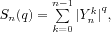
          <img align="middle" width="111" height="32" src="math_image_19.png" xylemeAttach="30" border="0" alt="Im19 ${S_n{(q)}=\munderover \#8721 {k=0}{n-1}{|Y_n^k|}^q,}$"/>
        </formula>
      </p>
      <p noindent="true">with the convention 
      <span class="math">0 
      <sup><hi rend="it">q</hi></sup>: = 0</span>for all 
      <span class="math"><img align="middle" width="34" height="13" src="math_image_18.png" xylemeAttach="29" border="0" alt="Im18 ${q\#8712 \#8477 }$"/></span>. Let:</p>
      <p>
        <formula type="display">
          <img align="middle" width="131" height="22" src="math_image_20.png" xylemeAttach="31" border="0" alt="Im20 ${\#964 {(q)}=\munder lim inf{n\#8594 \#8734 }\mfrac {logS_n{(q)}}{-log(n)}.}$"/>
        </formula>
      </p>
      <p noindent="true">The Legendre multifractal spectrum of 
      <span class="math"><hi rend="it">X</hi></span>is defined as the Legendre transform 
      <span class="math"><img width="11" height="12" align="bottom" border="0" src="../../images/img_tau.png" alt="$ \tau$"/><sup>*</sup></span>of 
      <span class="math"><img width="11" height="12" align="bottom" border="0" src="../../images/img_tau.png" alt="$ \tau$"/></span>:</p>
      <p>
        <formula type="display">
          <img align="middle" width="202" height="21" src="math_image_21.png" xylemeAttach="32" border="0" alt="Im21 ${f_l{(\#945 )}:={\#964 }^*{(\#945 )}:=\munder inf{q\#8712 \#8477 }{(q\#945 -\#964 {(q)})}.}$"/>
        </formula>
      </p>
      <p>To see the relation between 
      <span class="math"><hi rend="it">f</hi><sub><hi rend="it">g</hi></sub></span>and 
      <span class="math"><hi rend="it">f</hi><sub><hi rend="it">l</hi></sub></span>, define the sequence of random variables 
      <span class="math"><hi rend="it">Z</hi><sub><hi rend="it">n</hi></sub>: = log| 
      <hi rend="it">Y</hi><sub><hi rend="it">n</hi></sub><sup><hi rend="it">k</hi></sup>|</span>where the randomness is through a choice of 
      <span class="math"><hi rend="it">k</hi></span>uniformly in 
      <span class="math">{0, ..., 
      <hi rend="it">n</hi>-1}</span>. Consider the corresponding
      moment generating functions:</p>
      <p>
        <formula type="display">
          <img align="middle" width="152" height="21" src="math_image_22.png" xylemeAttach="33" border="0" alt="Im22 ${c_n{(q)}:=-\mfrac {logE_n{[exp{(qZ_n)}]}}{log(n)}}$"/>
        </formula>
      </p>
      <p>where 
      <span class="math"><hi rend="it">E</hi><sub><hi rend="it">n</hi></sub></span>denotes expectation with respect to 
      <span class="math"><hi rend="it">P</hi><sub><hi rend="it">n</hi></sub></span>, the uniform distribution on 
      <span class="math">{0, ..., 
      <hi rend="it">n</hi>-1}</span>. A version of Gärtner-Ellis
      theorem ensures that if 
      <span class="math">lim 
      <hi rend="it">c</hi>
      <sub><hi rend="it">n</hi></sub>( 
      <hi rend="it">q</hi>)</span>exists (in which case it equals 
      <span class="math">1 + 
      <img width="11" height="12" align="bottom" border="0" src="../../images/img_tau.png" alt="$ \tau$"/>( 
      <hi rend="it">q</hi>)</span>), and is differentiable, then 
      <span class="math"><hi rend="it">c</hi><sup>*</sup>= 
      <hi rend="it">f</hi><sub><hi rend="it">g</hi></sub>-1</span>. In this case, one says that the 
      <i>weak multifractal formalism</i>holds, 
      <i>i.e.</i>
      <span class="math"><hi rend="it">f</hi><sub><hi rend="it">g</hi></sub>= 
      <hi rend="it">f</hi><sub><hi rend="it">l</hi></sub></span>. In favorable cases, this also coincides with 
      <span class="math"><hi rend="it">f</hi><sub><hi rend="it">h</hi></sub></span>, a situation referred to as the 
      <i>strong multifractal formalism</i>.</p>
      <p>Multifractal spectra subsume a lot of information about
      the distribution of the regularity, that has proved useful in
      various situations. A most notable example is the strong
      correlation reported recently in several works between the
      narrowing of the multifractal spectrum of ECG and certain
      pathologies of the heart 
      <ref xmlns:xlink="http://www.w3.org/1999/xlink" xlink:href="#regularity-2010-bid14" location="biblio" xlink:type="simple" xlink:show="replace" xlink:actuate="onRequest"/>, 
      <ref xmlns:xlink="http://www.w3.org/1999/xlink" xlink:href="#regularity-2010-bid15" location="biblio" xlink:type="simple" xlink:show="replace" xlink:actuate="onRequest"/>. Let us also mention the
      multifractality of TCP traffic, that has been both observed
      experimentally and proved on simplified models of TCP 
      <ref xmlns:xlink="http://www.w3.org/1999/xlink" xlink:href="#regularity-2010-bid16" location="biblio" xlink:type="simple" xlink:show="replace" xlink:actuate="onRequest"/>, 
      <ref xmlns:xlink="http://www.w3.org/1999/xlink" xlink:href="#regularity-2010-bid17" location="biblio" xlink:type="simple" xlink:show="replace" xlink:actuate="onRequest"/>.</p>
      <p>
        <b>Another colour in local regularity: jumps</b>
      </p>
      <p>As noted above, apart from Hölder exponents and their
      generalizations, at least another type of irregularity may
      sometimes be observed on certain real phenomena:
      discontinuities, which occur for instance on financial logs
      and certain biomedical signals. In this frame, it is of
      interest to supplement Hölder exponents and their extensions
      with (at least) an additional index that measures the local
      intensity and size of jumps. This is a topic we intend to
      pursue in full generality in the near future. So far, we have
      developed an approach in the particular frame of 
      <i>multistable processes</i>. We refer to section 
      <ref xmlns:xlink="http://www.w3.org/1999/xlink" xlink:href="#uid18" location="intern" xlink:type="simple" xlink:show="replace" xlink:actuate="onRequest"/>for more details.</p>
    </subsection>
    <subsection id="uid18" level="1">
      <bodyTitle>Stochastic models</bodyTitle>
      <p>The second axis in the theoretical developments of the 
      <i>Regularity</i>team aims at defining and studying
      stochastic processes for which various aspects of the local
      regularity may be prescribed.</p>
      <p>
        <b>Multifractional Brownian motion</b>
      </p>
      <p>One of the simplest stochastic process for which some kind
      of control over the Hölder exponents is possible is probably
      fractional Brownian motion (fBm). This process was defined by
      Kolmogorov and further studied by Mandelbrot and Van Ness,
      followed by many authors. The so-called “moving average”
      definition of fBm reads as follows:</p>
      <p>
        <formula type="display">
          <img align="middle" width="412" height="26" src="math_image_23.png" xylemeAttach="34" border="0" alt="Im23 ${Y_t=\#8747 _{-\#8734 }^0\mfenced o=[ c=] {(t-u)}^{H-\mfrac 12}-{(-u)}^{H-\mfrac 12}.\#120142 {(du)}+\#8747 _0^t{(t-u)}^{H-\mfrac 12}.\#120142 {(du)},}$"/>
        </formula>
      </p>
      <p noindent="true">where 
      <span class="math"><img align="bottom" width="14" height="10" src="math_image_24.png" xylemeAttach="35" border="0" alt="Im24 $\#120142 $"/></span>denotes the real white noise. The parameter 
      <span class="math"><hi rend="it">H</hi></span>ranges in 
      <span class="math">(0, 1)</span>, and it governs the
      pointwise regularity: indeed, almost surely, at each point,
      both the local and pointwise Hölder exponents are equal to 
      <span class="math"><hi rend="it">H</hi></span>.</p>
      <p>Although varying 
      <span class="math"><hi rend="it">H</hi></span>yields processes with different regularity, the fact
      that the exponents are constant along any single path is
      often a major drawback for the modeling of real world
      phenomena. For instance, fBm has often been used for the
      synthesis natural terrains. This is not satisfactory since it
      yields images lacking crucial features of real mountains,
      where some parts are smoother than others, due, for instance,
      to erosion.</p>
      <p>It is possible to generalize fBm to obtain a Gaussian
      process for which the pointwise Hölder exponent may be tuned
      at each point: the 
      <i>multifractional Brownian motion (mBm)</i>is such an
      extension, obtained by substituting the constant parameter 
      <span class="math"><hi rend="it">H</hi><img width="13" height="24" align="middle" border="0" src="../../images/img_other_in.png" alt="$ \in$"/>(0,
      1)</span>with a 
      <i>regularity function</i>
      <span class="math"><img align="middle" width="95" height="13" src="math_image_25.png" xylemeAttach="36" border="0" alt="Im25 ${H:\#8477 _+\#8594 {(0,1)}}$"/></span>.</p>
      <p>mBm was introduced independently by two groups of authors:
      on the one hand, Peltier and Levy-Vehel 
      <ref xmlns:xlink="http://www.w3.org/1999/xlink" xlink:href="#regularity-2010-bid18" location="biblio" xlink:type="simple" xlink:show="replace" xlink:actuate="onRequest"/>defined the mBm 
      <span class="math"><img align="middle" width="81" height="15" src="math_image_26.png" xylemeAttach="37" border="0" alt="Im26 ${{X_t;~t\#8712 \#8477 _+}}$"/></span>from the moving average definition of the fractional
      Brownian motion, and set:</p>
      <p>
        <formula type="display">
          <img align="middle" width="455" height="26" src="math_image_27.png" xylemeAttach="38" border="0" alt="Im27 ${X_t=\#8747 _{-\#8734 }^0\mfenced o=[ c=] {(t-u)}^{H{(t)}-\mfrac 12}-{(-u)}^{H{(t)}-\mfrac 12}.\#120142 {(du)}+\#8747 _0^t{(t-u)}^{H{(t)}-\mfrac 12}.\#120142 {(du)},}$"/>
        </formula>
      </p>
      <p noindent="true">On the other hand, Benassi, Jaffard and
      Roux 
      <ref xmlns:xlink="http://www.w3.org/1999/xlink" xlink:href="#regularity-2010-bid19" location="biblio" xlink:type="simple" xlink:show="replace" xlink:actuate="onRequest"/>defined the mBm from the
      harmonizable representation of the fBm, 
      <i>i.e.</i>:</p>
      <p>
        <formula type="display">
          <img align="middle" width="149" height="26" src="math_image_28.png" xylemeAttach="39" border="0" alt="Im28 ${X_t=\#8747 _\#8477 \mfrac {e^{it\#958 }-1}\mfenced o=| c=| \#958 ^{H{(t)}+\mfrac 12}.\mover \#120142 ^{(d\#958 )},}$"/>
        </formula>
      </p>
      <p noindent="true">where 
      <span class="math"><img align="bottom" width="14" height="14" src="math_image_29.png" xylemeAttach="40" border="0" alt="Im29 $\mover \#120142 ^$"/></span>denotes the complex white noise.</p>
      <p>The Hölder exponents of the mBm are prescribed almost
      surely: the pointwise Hölder exponent is 
      <span class="math"><img width="12" height="12" align="bottom" border="0" src="../../images/img_alpha.png" alt="$ \alpha$"/><sub><hi rend="it">X</hi></sub>( 
      <hi rend="it">t</hi>) = 
      <hi rend="it">H</hi>( 
      <hi rend="it">t</hi>) 
      <img width="13" height="12" align="bottom" border="0" src="../../images/img_other_wedge.png" alt="$ \wedge$"/><img width="12" height="12" align="bottom" border="0" src="../../images/img_alpha.png" alt="$ \alpha$"/><sub><hi rend="it">H</hi></sub>( 
      <hi rend="it">t</hi>)</span>a.s., and the local Hölder
      exponent is 
      <span class="math"><img align="middle" width="132" height="13" src="math_image_30.png" xylemeAttach="41" border="0" alt="Im30 ${\mover \#945 \#732 _X{(t)}=H{(t)}\#8743 \mover \#945 \#732 _H{(t)}}$"/></span>a.s. Consequently, the regularity of the sample paths
      of the mBm are determined by the function 

      <span class="math"><hi rend="it">H</hi></span>or by its regularity. The multifractional Brownian
      motion is our prime example of a stochastic process with
      prescribed local regularity.</p>
      <p>The fact that the local regularity of mBm may be tuned 
      <i>via</i>a functional parameter has made it a useful model
      in various areas such as finance, biomedicine, geophysics,
      image analysis, .... A large number of studies have been
      devoted worldwide to its mathematical properties, including
      in particular its local time. In addition, there is now a
      rather strong body of work dealing the estimation of its
      functional parameter, 
      <i>i.e.</i>its local regularity. See 
      <ref xmlns:xlink="http://www.w3.org/1999/xlink" xlink:href="http://regularity.saclay.inria.fr/theory/stochasticmodels/bibliombm" location="extern" xlink:type="simple" xlink:show="replace" xlink:actuate="onRequest">http:// 
      <allowbreak/>regularity. 
      <allowbreak/>saclay. 
      <allowbreak/>inria. 
      <allowbreak/>fr/ 
      <allowbreak/>theory/ 
      <allowbreak/>stochasticmodels/ 
      <allowbreak/>bibliombm</ref>for a partial list of works,
      applied or theoretical, that deal with mBm.</p>
      <p>
        <b>Self-regulating processes</b>
      </p>
      <p>We have recently introduced another class of stochastic
      models, inspired by mBm, but where the local regularity,
      instead of being tuned “exogenously”, is a function of the
      amplitude. In other words, at each point 
      <span class="math"><hi rend="it">t</hi></span>, the Hölder exponent of the process 
      <span class="math"><hi rend="it">X</hi></span>verifies almost surely 
      <span class="math"><img width="12" height="12" align="bottom" border="0" src="../../images/img_alpha.png" alt="$ \alpha$"/><sub><hi rend="it">X</hi></sub>( 
      <hi rend="it">t</hi>) = 
      <hi rend="it">g</hi>( 
      <hi rend="it">X</hi>( 
      <hi rend="it">t</hi>))</span>, where 
      <span class="math"><hi rend="it">g</hi></span>is a fixed deterministic function verifying certain
      conditions. A process satisfying such an equation is
      generically termed a 
      <i>self-regulating process</i>(SRP). The particular process
      obtained by adapting adequately mBm is called the
      self-regulating multifractional process 
      <ref xmlns:xlink="http://www.w3.org/1999/xlink" xlink:href="#regularity-2010-bid20" location="biblio" xlink:type="simple" xlink:show="replace" xlink:actuate="onRequest"/>. Another instance is given by
      modifying the Lévy construction of Brownian motion 
      <ref xmlns:xlink="http://www.w3.org/1999/xlink" xlink:href="#regularity-2010-bid21" location="biblio" xlink:type="simple" xlink:show="replace" xlink:actuate="onRequest"/>. The motivation for introducing
      self-regulating processes is based on the following general
      fact: in nature, the local regularity of a phenomenon is
      often related to its amplitude. An intuitive example is
      provided by natural terrains: in young mountains, regions at
      higher altitudes are typically more irregular than regions at
      lower altitudes. We have verified this fact experimentally on
      several digital elevation models 
      <ref xmlns:xlink="http://www.w3.org/1999/xlink" xlink:href="#regularity-2010-bid22" location="biblio" xlink:type="simple" xlink:show="replace" xlink:actuate="onRequest"/>(see section 
      <ref xmlns:xlink="http://www.w3.org/1999/xlink" xlink:href="#uid36" location="intern" xlink:type="simple" xlink:show="replace" xlink:actuate="onRequest"/>). Other natural phenomena
      displaying a relation between amplitude and exponent include
      temperatures records and RR intervals extracted from ECG 
      <ref xmlns:xlink="http://www.w3.org/1999/xlink" xlink:href="#regularity-2010-bid21" location="biblio" xlink:type="simple" xlink:show="replace" xlink:actuate="onRequest"/>.</p>
      <p>To build the SRMP, one starts from a field of fractional
      Brownian motions 
      <span class="math"><hi rend="it">B</hi>( 
      <hi rend="it">t</hi>, 
      <hi rend="it">H</hi>)</span>, where 
      <span class="math">( 
      <hi rend="it">t</hi>, 
      <hi rend="it">H</hi>)</span>span 
      <span class="math">[0, 1]×[ 
      <hi rend="it">a</hi>, 
      <hi rend="it">b</hi>]</span>and 
      <span class="math">0&lt; 
      <hi rend="it">a</hi>&lt; 
      <hi rend="it">b</hi>&lt;1</span>. For each fixed 
      <span class="math"><hi rend="it">H</hi></span>, 
      <span class="math"><hi rend="it">B</hi>( 
      <hi rend="it">t</hi>, 
      <hi rend="it">H</hi>)</span>is a fractional Brownian motion
      with exponent 
      <span class="math"><hi rend="it">H</hi></span>. Denote:</p>
      <p>
        <formula type="display">
          <img align="middle" width="254" height="24" src="math_image_31.png" xylemeAttach="42" border="0" alt="Im31 $\mtable{...}$"/>
        </formula>
      </p>
      <p>the affine rescaling between 
      <span class="math"><img width="12" height="12" align="bottom" border="0" src="../../images/img_alpha.png" alt="$ \alpha$"/><sup>'</sup></span>and 
      <span class="math"><img width="12" height="26" align="middle" border="0" src="../../images/img_beta.png" alt="$ \beta$"/><sup>'</sup></span>of an arbitrary continuous random field over a compact
      set 
      <span class="math"><hi rend="it">K</hi></span>. One considers the following (stochastic) operator,
      defined almost surely:</p>
      <p>
        <formula type="display">
          <img align="middle" width="271" height="45" src="math_image_32.png" xylemeAttach="43" border="0" alt="Im32 $\mtable{...}$"/>
        </formula>
      </p>
      <p>where 
      <span class="math"><img width="12" height="12" align="bottom" border="0" src="../../images/img_alpha.png" alt="$ \alpha$"/><img width="14" height="24" align="middle" border="0" src="../../images/img_other_le.png" alt="$ \le$"/><img width="12" height="12" align="bottom" border="0" src="../../images/img_alpha.png" alt="$ \alpha$"/><sup>'</sup>&lt; 
      <img width="12" height="26" align="middle" border="0" src="../../images/img_beta.png" alt="$ \beta$"/>
      <sup>'</sup>
      <img width="14" height="24" align="middle" border="0" src="../../images/img_other_le.png" alt="$ \le$"/>
      <img width="12" height="26" align="middle" border="0" src="../../images/img_beta.png" alt="$ \beta$"/></span>, 
      <span class="math"><img width="12" height="12" align="bottom" border="0" src="../../images/img_alpha.png" alt="$ \alpha$"/></span>and 
      <span class="math"><img width="12" height="26" align="middle" border="0" src="../../images/img_beta.png" alt="$ \beta$"/></span>are two real numbers, and 
      <span class="math"><img width="12" height="12" align="bottom" border="0" src="../../images/img_alpha.png" alt="$ \alpha$"/><sup>'</sup>, 
      <img width="12" height="26" align="middle" border="0" src="../../images/img_beta.png" alt="$ \beta$"/><sup>'</sup></span>are random variables adequately chosen.
      One may show that this operator is contractive with respect
      to the sup-norm. Its unique fixed point is the SRMP.
      Additional arguments allow to prove that, indeed, the Hölder
      exponent at each point is almost surely 
      <span class="math"><hi rend="it">g</hi>( 
      <hi rend="it">t</hi>)</span>.</p>
      <p spacebefore="6.0pt">An example of a two dimensional SRMP
      with function 
      <span class="math"><hi rend="it">g</hi>( 
      <hi rend="it">x</hi>) = 1- 
      <hi rend="it">x</hi><sup>2</sup></span>is displayed on figure 
      <ref xmlns:xlink="http://www.w3.org/1999/xlink" xlink:href="#uid19" location="intern" xlink:type="simple" xlink:show="replace" xlink:actuate="onRequest"/>.</p>
      <object id="uid19">
        <table>
          <tr>
            <td>
              <ressource xmlns:xlink="http://www.w3.org/1999/xlink" aux="IMG/Z2D_geo_5.png" xylemeAttach="1" xlink:href="IMG/Z2D_geo_5" type="float" width="298.8987pt" xlink:type="simple" xlink:show="replace" xlink:actuate="onRequest" media="WEB"/>
            </td>
          </tr>
        </table>
        <caption>Self-regulating miltifractional process with 
        <span class="math"><hi rend="it">g</hi>( 
        <hi rend="it">x</hi>) = 1- 
        <hi rend="it">x</hi><sup>2</sup></span></caption>
      </object>
      <p>We believe that SRP open a whole new and very promising
      area of research.</p>
      <p>
        <b>Multistable processes</b>
      </p>
      <p>Non-continuous phenomena are commonly encountered in
      real-world applications, 
      <i>e.g.</i>financial records or EEG traces. For such
      processes, the information brought by the Hölder exponent
      must be supplemented by some measure of the density and size
      of jumps. Stochastic processes with jumps, and in particular
      Lévy processes, are currently an active area of research.</p>
      <p>The simplest class of non-continuous Lévy processes is
      maybe the one of stable processes 
      <ref xmlns:xlink="http://www.w3.org/1999/xlink" xlink:href="#regularity-2010-bid23" location="biblio" xlink:type="simple" xlink:show="replace" xlink:actuate="onRequest"/>. These are mainly characterized
      by a parameter 
      <span class="math"><img width="12" height="12" align="bottom" border="0" src="../../images/img_alpha.png" alt="$ \alpha$"/><img width="13" height="24" align="middle" border="0" src="../../images/img_other_in.png" alt="$ \in$"/>(0,
      2]</span>, the 
      <i>stability index</i>( 
      <span class="math"><img width="12" height="12" align="bottom" border="0" src="../../images/img_alpha.png" alt="$ \alpha$"/>=
      2</span>corresponds to the Gaussian case, that we do not
      consider here). This index measures in some precise sense the
      intensity of jumps. Paths of stable processes with 
      <span class="math"><img width="12" height="12" align="bottom" border="0" src="../../images/img_alpha.png" alt="$ \alpha$"/></span>close to 2 tend to display “small jumps”, while, when 
      <span class="math"><img width="12" height="12" align="bottom" border="0" src="../../images/img_alpha.png" alt="$ \alpha$"/></span>is near 0, their aspect is governed by large ones.</p>
      <p>In line with our quest for the characterization and
      modeling of various notions of local regularity, we have
      defined 
      <i>multistable processes</i>. These are processes which are
      “locally” stable, but where the stability index 
      <span class="math"><img width="12" height="12" align="bottom" border="0" src="../../images/img_alpha.png" alt="$ \alpha$"/></span>is now a function of time. This allows to model
      phenomena which, at times, are “almost continuous”, and at
      others display large discontinuities. Such a behaviour is for
      instance obvious on almost any sufficiently long financial
      record.</p>
      <p>More formally, a multistable process is a process which
      is, at each time 
      <span class="math"><hi rend="it">u</hi></span>, tangent to a stable process 
      <ref xmlns:xlink="http://www.w3.org/1999/xlink" xlink:href="#regularity-2010-bid24" location="biblio" xlink:type="simple" xlink:show="replace" xlink:actuate="onRequest"/>. Recall that a process 
      <span class="math"><hi rend="it">Y</hi></span>is said to be tangent at 
      <span class="math"><hi rend="it">u</hi></span>to the process 
      <span class="math"><hi rend="it">Y</hi><sub><hi rend="it">u</hi></sub><sup>'</sup></span>if:</p>
      <p>
        <formula type="display" id="uid20">
          <img align="middle" width="154" height="22" src="math_image_33.png" xylemeAttach="44" border="0" alt="Im33 ${\munder lim{r\#8594 0}\mfrac {Y(u+rt)-Y(u)}r^h=Y_{u}^'{(t)},}$"/>
        </formula>
      </p>
      <p noindent="true">where the limit is understood either in
      finite dimensional distributions or in the stronger sense of
      distributions. Note 
      <span class="math"><hi rend="it">Y</hi><sub><hi rend="it">u</hi></sub><sup>'</sup></span>may and in general will vary with 
      <span class="math"><hi rend="it">u</hi></span>.</p>
      <p>One approach to defining multistable processes is similar
      to the one developed for constructing mBm 
      <ref xmlns:xlink="http://www.w3.org/1999/xlink" xlink:href="#regularity-2010-bid18" location="biblio" xlink:type="simple" xlink:show="replace" xlink:actuate="onRequest"/>: we consider fields of
      stochastic processes 
      <span class="math"><hi rend="it">X</hi>( 
      <hi rend="it">t</hi>, 
      <hi rend="it">u</hi>)</span>, where 
      <span class="math"><hi rend="it">t</hi></span>is time and 
      <span class="math"><hi rend="it">u</hi></span>is an independent parameter that controls the
      variation of 
      <span class="math"><img width="12" height="12" align="bottom" border="0" src="../../images/img_alpha.png" alt="$ \alpha$"/></span>. We then consider a “diagonal” process 
      <span class="math"><hi rend="it">Y</hi>( 
      <hi rend="it">t</hi>) = 
      <hi rend="it">X</hi>( 
      <hi rend="it">t</hi>, 
      <hi rend="it">t</hi>)</span>, which will be, under certain
      conditions, “tangent” at each point 
      <span class="math"><hi rend="it">t</hi></span>to a process 
      <span class="math"><img align="middle" width="68" height="13" src="math_image_34.png" xylemeAttach="45" border="0" alt="Im34 ${t\#8614 X(t,u)}$"/></span>.</p>
      <p>A particular class of multistable processes, termed
      “linear multistable multifractional motions” (lmmm) takes the
      following form 
      <ref xmlns:xlink="http://www.w3.org/1999/xlink" xlink:href="#regularity-2010-bid25" location="biblio" xlink:type="simple" xlink:show="replace" xlink:actuate="onRequest"/>, 
      <ref xmlns:xlink="http://www.w3.org/1999/xlink" xlink:href="#regularity-2010-bid26" location="biblio" xlink:type="simple" xlink:show="replace" xlink:actuate="onRequest"/>. Let 
      <span class="math"><img align="middle" width="52" height="13" src="math_image_35.png" xylemeAttach="46" border="0" alt="Im35 ${(E,\#8496 ,m)}$"/></span>be a 
      <span class="math"><img width="12" height="12" align="bottom" border="0" src="../../images/img_sigma.png" alt="$ \sigma$"/></span>-finite measure space, and 
      <span class="math"><img width="14" height="13" align="bottom" border="0" src="../../images/img_upper_pi.png" alt="$ \upper_pi$"/></span>be a Poisson process on 
      <span class="math"><img align="middle" width="38" height="10" src="math_image_36.png" xylemeAttach="47" border="0" alt="Im36 ${E×\#8477 }$"/></span>with mean measure 
      <span class="math"><img align="middle" width="38" height="10" src="math_image_37.png" xylemeAttach="48" border="0" alt="Im37 ${m×\#8466 }$"/></span>( 
      <span class="math"><img align="bottom" width="9" height="10" src="math_image_38.png" xylemeAttach="49" border="0" alt="Im38 $\#8466 $"/></span>denotes the Lebesgue measure). An lmmm is defined
      as:</p>

      <p>
        <formula type="display" id="uid21">
          <img align="middle" width="454" height="32" src="math_image_39.png" xylemeAttach="50" border="0" alt="Im39 ${Y{(t)}=a{(t)}\munder \#8721 {(\#120247 ,\#120248 )\#8712 \#928 }{\#120248 }^{\lt -1/\#945 (t)\gt }\mfenced o=( c=) {|t-\#120247 |}^{h(t)-1/\#945 (t)}-{|\#120247 |}^{h(t)-1/\#945 (t)}~{(t\#8712 \#8477 )}.}$"/>
        </formula>
      </p>
      <p noindent="true">where 
      <span class="math"><img align="middle" width="118" height="15" src="math_image_40.png" xylemeAttach="51" border="0" alt="Im40 ${x^{\lt y\gt }:=\mtext sign{(x)}{|x|}^y}$"/></span>, 
      <span class="math"><img align="bottom" width="69" height="11" src="math_image_41.png" xylemeAttach="52" border="0" alt="Im41 ${a:\#8477 \#8594 \#8477 ^+}$"/></span>is a 
      <span class="math"><hi rend="it">C</hi><sup>1</sup></span>function and 
      <span class="math"><img align="middle" width="82" height="13" src="math_image_42.png" xylemeAttach="53" border="0" alt="Im42 ${\#945 :\#8477 \#8594 (0,2)}$"/></span>and 
      <span class="math"><img align="middle" width="81" height="13" src="math_image_43.png" xylemeAttach="54" border="0" alt="Im43 ${h:\#8477 \#8594 (0,1)}$"/></span>are 
      <span class="math"><hi rend="it">C</hi><sup>2</sup></span>functions.</p>
      <p>In fact, lmmm are somewhat more general than said above:
      indeed, the couple 
      <span class="math">( 
      <hi rend="it">h</hi>, 
      <img width="12" height="12" align="bottom" border="0" src="../../images/img_alpha.png" alt="$ \alpha$"/>)</span>allows to prescribe at each point,
      under certain conditions, both the pointwise Hölder exponent
      and the local intensity of jumps. In this sense, they
      generalize both the mBm and the linear multifractional stable
      motion 
      <ref xmlns:xlink="http://www.w3.org/1999/xlink" xlink:href="#regularity-2010-bid27" location="biblio" xlink:type="simple" xlink:show="replace" xlink:actuate="onRequest"/>. From a broader perspective,
      such multistable multifractional processes are expected to
      provide relevant models for TCP traces, financial logs, EEG
      and other phenomena displaying time-varying regularity both
      in terms of Hölder exponents and discontinuity structure.</p>
      <p>Figure 
      <ref xmlns:xlink="http://www.w3.org/1999/xlink" xlink:href="#uid22" location="intern" xlink:type="simple" xlink:show="replace" xlink:actuate="onRequest"/>displays a graph of an lmmm with
      linearly increasing 
      <span class="math"><img width="12" height="12" align="bottom" border="0" src="../../images/img_alpha.png" alt="$ \alpha$"/></span>and linearly decreasing 
      <span class="math"><hi rend="it">H</hi></span>. One sees that the path has large jumps at the
      beginning, and almost no jumps at the end. Conversely, it is
      smooth (between jumps) at the beginning, but becomes jaggier
      and jaggier as time evolves.</p>
      <object id="uid22">
        <table>
          <tr>
            <td>
              <ressource xmlns:xlink="http://www.w3.org/1999/xlink" aux="IMG/lmmm.png" xylemeAttach="2" xlink:href="IMG/lmmm" type="float" width="298.8987pt" xlink:type="simple" xlink:show="replace" xlink:actuate="onRequest" media="WEB"/>
            </td>
          </tr>
        </table>
        <caption>Linear multistable multifractional motion with
        linearly increasing 
        <span class="math"><img width="12" height="12" align="bottom" border="0" src="../../images/img_alpha.png" alt="$ \alpha$"/></span>and linearly decreasing 
        <span class="math"><hi rend="it">H</hi></span></caption>
      </object>
      <p>
        <b>Multiparameter processes</b>
      </p>
      <p>In order to use stochastic processes to represent the
      variability of multidimensional phenomena, it is necessary to
      define extensions for indices in 
      <span class="math"><img align="bottom" width="19" height="12" src="math_image_44.png" xylemeAttach="55" border="0" alt="Im44 $\#8477 ^N$"/></span>( 
      <span class="math"><hi rend="it">N</hi><img width="14" height="24" align="middle" border="0" src="../../images/img_other_ge.png" alt="$ \ge$"/>2</span>)
      (see 
      <ref xmlns:xlink="http://www.w3.org/1999/xlink" xlink:href="#regularity-2010-bid28" location="biblio" xlink:type="simple" xlink:show="replace" xlink:actuate="onRequest"/>for an introduction to the theory
      of multiparameter processes). Two different kinds of
      extensions of multifractional Brownian motion have already
      been considered: an isotropic extension using the Euclidean
      norm of 
      <span class="math"><img align="bottom" width="19" height="12" src="math_image_44.png" xylemeAttach="55" border="0" alt="Im44 $\#8477 ^N$"/></span>and a tensor product of one-dimensional processes on
      each axis. We refer to 
      <ref xmlns:xlink="http://www.w3.org/1999/xlink" xlink:href="#regularity-2010-bid29" location="biblio" xlink:type="simple" xlink:show="replace" xlink:actuate="onRequest"/>for a comprehensive survey.</p>
      <p>These works have highlighted the difficulty of giving
      satisfactory definitions for increment stationarity, Hölder
      continuity and covariance structure which are not closely
      dependent on the structure of 
      <span class="math"><img align="bottom" width="19" height="12" src="math_image_44.png" xylemeAttach="55" border="0" alt="Im44 $\#8477 ^N$"/></span>. For example, the Euclidean structure can be
      unadapted to represent natural phenomena.</p>
      <p>A promising improvement in the definition of
      multiparameter extensions is the concept of 
      <i>set-indexed processes</i>. A set-indexed process is a
      process whose indices are no longer “times” or “locations”
      but may be some compact connected subsets of a metric measure
      space. In the simplest case, this framework is a
      generalization of the classical multiparameter processes 
      <ref xmlns:xlink="http://www.w3.org/1999/xlink" xlink:href="#regularity-2010-bid30" location="biblio" xlink:type="simple" xlink:show="replace" xlink:actuate="onRequest"/>: usual multiparameter processes
      are set-indexed processes where the indexing subsets are
      simply the rectangles 
      <span class="math">[0, 
      <hi rend="it">t</hi>]</span>, with 
      <span class="math"><img align="middle" width="41" height="17" src="math_image_45.png" xylemeAttach="56" border="0" alt="Im45 ${t\#8712 \#8477 _+^N}$"/></span>.</p>
      <p>Set-indexed processes allow for greater flexibility, and
      should in particular be useful for the modeling of censored
      data. This situation occurs frequently in biology and
      medicine, since, for instance, data may not be constantly
      monitored. Censored data also appear in natural terrain
      modeling when data are acquired from sensors in presence of
      hidden areas. In these contexts, set-indexed models should
      constitute a relevant frame.</p>
      <p spacebefore="10.0pt">A set-indexed extension of fBm is the
      first step toward the modeling of irregular phenomena within
      this more general frame. In 
      <ref xmlns:xlink="http://www.w3.org/1999/xlink" xlink:href="#regularity-2010-bid31" location="biblio" xlink:type="simple" xlink:show="replace" xlink:actuate="onRequest"/>, the so-called 
      <i>set-indexed fractional Brownian motion (sifBm)</i>was
      defined as the mean-zero Gaussian process 
      <span class="math"><img align="middle" width="84" height="16" src="math_image_46.png" xylemeAttach="57" border="0" alt="Im46 ${{\#119809 _U^H;~U\#8712 \#119964 }}$"/></span>such that</p>
      <p>
        <formula type="display">
          <img align="middle" width="404" height="26" src="math_image_47.png" xylemeAttach="58" border="0" alt="Im47 ${\#8704 U,V\#8712 \#119964 ;~E{[\#119809 _U^H~\#119809 _V^H]}=\mfrac 12\mfenced o=[ c=] m{(U)}^{2H}+m{(V)}^{2H}-m{(U\#9651 V)}^{2H}}$"/>
        </formula>
      </p>
      <p noindent="true">where 
      <span class="math"><img align="bottom" width="10" height="11" src="math_image_48.png" xylemeAttach="59" border="0" alt="Im48 $\#119964 $"/></span>is a collection of connected compact subsets of a
      measure metric space and 
      <span class="math"><img align="middle" width="64" height="16" src="math_image_49.png" xylemeAttach="60" border="0" alt="Im49 ${0\lt H\#8804 \mfrac 12}$"/></span>.</p>
      <p>This process appears to be the only set-indexed process
      whose projection on increasing paths is a one-parameter
      fractional Brownian motion 
      <ref xmlns:xlink="http://www.w3.org/1999/xlink" xlink:href="#regularity-2010-bid32" location="biblio" xlink:type="simple" xlink:show="replace" xlink:actuate="onRequest"/>. The construction also provides
      a way to define fBm's extensions on non-euclidean spaces, 
      <i>e.g.</i>indices can belong to the unit hyper-sphere of 
      <span class="math"><img align="bottom" width="19" height="12" src="math_image_44.png" xylemeAttach="55" border="0" alt="Im44 $\#8477 ^N$"/></span>. The study of fractal properties needs specific
      definitions for increment stationarity and self-similarity of
      set-indexed processes 
      <ref xmlns:xlink="http://www.w3.org/1999/xlink" xlink:href="#regularity-2010-bid33" location="biblio" xlink:type="simple" xlink:show="replace" xlink:actuate="onRequest"/>. We have proved that the sifBm
      is the only Gaussian set-indexed process satisfying these two
      (extended) properties.</p>
      <p>In the specific case of the indexing collection 
      <span class="math"><img align="middle" width="158" height="17" src="math_image_50.png" xylemeAttach="61" border="0" alt="Im50 ${\#119964 ={{[0,t]},t\#8712 \#8477 _+^N}\#8746 {{\#8709 }}}$"/></span>, the sifBm can be seen as a multiparameter extension
      of fBm which is called 
      <i>multiparameter fractional Brownian motion (MpfBm)</i>.
      This process differs from the Lévy fractional Brownian motion
      and the fractional Brownian sheet, which are also
      multiparameter extension of fBm (but do not derive from
      set-indexed processes). The local behaviour of the sample
      paths of the MpfBm has been studied in 
      <ref xmlns:xlink="http://www.w3.org/1999/xlink" xlink:href="#regularity-2010-bid34" location="biblio" xlink:type="simple" xlink:show="replace" xlink:actuate="onRequest"/>. The self-similarity index 
      <span class="math"><hi rend="it">H</hi></span>is proved to be the almost sure value of the local
      Hölder exponent at any point, and the Hausdorff dimension of
      the graph is determined in function of 
      <span class="math"><hi rend="it">H</hi></span>.</p>
      <p spacebefore="10.0pt">The increment stationarity property
      for set-indexed processes, previously defined in the study of
      the sifBm, allows to consider set-indexed processes whose
      increments are independent and stationary. This generalizes
      the definition of Bass-Pyke and Adler-Feigin for Lévy
      processes indexed by subsets of 
      <span class="math"><img align="bottom" width="19" height="12" src="math_image_44.png" xylemeAttach="55" border="0" alt="Im44 $\#8477 ^N$"/></span>, to a more general indexing collection. We have
      obtained a Lévy-Khintchine representation for these
      set-indexed Lévy processes and we also characterized this
      class of Markov processes.</p>
    </subsection>
  </fondements>
  <domaine id="uid23">
    <bodyTitle>Application Domains</bodyTitle>
    <subsection id="uid24" level="1">
      <bodyTitle>Application: uncertainties management</bodyTitle>
      <p>Our theoretical works are motivated by and find natural
      applications to real-world problems in a general frame
      generally referred to as uncertainty management, that we
      describe now.</p>
      <p>Since a few decades, modeling has gained an increasing
      part in complex systems design in various fields of industry
      such as automobile, aeronautics, energy, etc. Industrial
      design involves several levels of modeling: from behavioural
      models in preliminary design to finite-elements models aiming
      at representing sharply physical phenomena. Nowadays, the
      fundamental challenge of numerical simulation is in designing
      physical systems while saving the experimentation steps.</p>
      <p>As an example, at the early stage of conception in
      aeronautics, numerical simulation aims at exploring the
      design parameters space and setting the global variables such
      that target performances are satisfied. This iterative
      procedure needs fast multiphysical models. These simplified
      models are usually calibrated using high-fidelity models or
      experiments. At each of these levels, modeling requires
      control of uncertainties due to simplifications of models,
      numerical errors, data imprecisions, variability of
      surrounding conditions, etc.</p>
      <p>One dilemma in the design by numerical simulation is that
      many crucial choices are made very early, and thus when
      uncertainties are maximum, and that these choices have a
      fundamental impact on the final performances.</p>
      <p>Classically, coping with this variability is achieved
      through 
      <i>model registration</i>by experimenting and adding fixed 
      <i>margins</i>to the model response. In view of technical and
      economical performance, it appears judicious to replace these
      fixed margins by a rigorous analysis and control of risk.
      This may be achieved through a probabilistic approach to
      uncertainties, that provides decision criteria adapted to the
      management of unpredictability inherent to design issues.</p>
      <p>From the particular case of aircraft design emerge several
      general aspects of management of uncertainties in simulation.
      Probabilistic decision criteria, that translate decision
      making into mathematical/probabilistic terms, require the
      following three steps to be considered 
      <ref xmlns:xlink="http://www.w3.org/1999/xlink" xlink:href="#regularity-2010-bid35" location="biblio" xlink:type="simple" xlink:show="replace" xlink:actuate="onRequest"/>:</p>
      <orderedlist>
        <li id="uid25">
          <p noindent="true">build a probabilistic description of
          the fluctuations of the model's parameters ( 
          <i>Quantification</i>of uncertainty sources),</p>
        </li>
        <li id="uid26">
          <p noindent="true">deduce the implication of these
          distribution laws on the model's response ( 
          <i>Propagation</i>of uncertainties),</p>
        </li>
        <li id="uid27">
          <p noindent="true">and determine the specific influence
          of each uncertainty source on the model's response
          variability ( 
          <i>Sensitivity Analysis</i>).</p>
        </li>
      </orderedlist>
      <p spacebefore="10.0pt">The previous analysis now constitutes
      the framework of a general study of uncertainties. It is used
      in industrial contexts where uncertainties can be represented
      by 
      <i>random variables</i>(unknown temperature of an external
      surface, physical quantities of a given material, ... at a
      given 
      <i>fixed time</i>). However, in order for the numerical
      models to describe with high fidelity a phenomenon, the
      relevant uncertainties must generally depend on time or space
      variables. Consequently, one has to tackle the following
      issues:</p>
      <simplelist>
        <li id="uid28">
          <p noindent="true"><i>How to capture the distribution law of time (or space)
          dependent parameters, without directly accessible
          data?</i>The distribution of probability of the
          continuous time (or space) uncertainty sources must
          describe the links between variations at neighbor times
          (or points). The local and global regularity are
          important parameters of these laws, since it describes
          how the fluctuations at some time (or point) induce
          fluctuations at close times (or points). The continuous
          equations representing the studied phenomena should help 
          <i>to propose models for the law of the random
          fields</i>. Let us notice that interactions between
          various levels of modeling might also be used to derive
          distributions of probability at the lowest one.</p>
        </li>
        <li id="uid29">
          <p noindent="true">The navigation between the various
          natures of models needs a kind of 
          <i>metric</i>which could 
          <i>mathematically describe the notion of granularity or
          fineness</i>of the models. Of course, the local
          regularity will not be totally absent of this
          mathematical definition.</p>
        </li>
        <li id="uid30">
          <p noindent="true">All the various levels of conception,
          preliminary design or high-fidelity modelling, require 
          <i>registrations by experimentation</i>to reduce model
          errors. This 
          <i>calibration</i>issue has been present in this frame
          since a long time, especially in a deterministic
          optimization context. The random modeling of uncertainty
          requires the definition of a systematic approach. The
          difficulty in this specific context is: statistical
          estimation with few data and estimation of a function
          with continuous variables using only discrete setting of
          values.</p>
        </li>
      </simplelist>
      <p spacebefore="10.0pt">Moreover, a multi-physical context
      must be added to these questions. The complex system design
      is most often located at the interface between several
      disciplines. In that case, modeling relies on a coupling
      between several models for the various phenomena and design
      becomes a 
      <i>multidisciplinary optimization</i>problem. In this
      uncertainty context, the real challenge turns robust
      optimization to manage technical and economical risks (risk
      for non-satisfaction of technical specifications, cost
      control).</p>
      <p>We participate in the uncertainties community through
      several collaborative research projects (ANR and Pôle
      SYSTEM@TIC), and also through our involvement in the
      MASCOT-NUM research group (GDR of CNRS). In addition, we are
      considering probabilistic models as phenomenological models
      to cope with uncertainties in the DIGITEO ANIFRAC project. As
      explained above, we focus on essentially irregular phenomena,
      for which irregularity is a relevant quantity to capture the
      variability (e.g. certain biomedical signals, terrain
      modeling, financial data, etc.). These will be modeled
      through stochastic processes with prescribed regularity.</p>
    </subsection>
    <subsection id="uid31" level="1">
      <bodyTitle>Design of complex systems</bodyTitle>
      <object id="uid32">
        <table>
          <tr>
            <td>
              <ressource xmlns:xlink="http://www.w3.org/1999/xlink" aux="IMG/CouplageMulti.png" xylemeAttach="3" xlink:href="IMG/CouplageMulti" type="float" width="341.6013pt" xlink:type="simple" xlink:show="replace" xlink:actuate="onRequest" media="WEB"/>
            </td>
          </tr>
        </table>
        <caption>Coupling uncertainty between heterogeneous
        models</caption>
      </object>
      <p>The design of a complex (mechanical) system such as
      aircraft, automobile or nuclear plant involves numerical
      simulation of several interacting physical phenomena: CFD and
      structural dynamics, thermal evolution of a fluid
      circulation, ... For instance, they can represent the
      resolution of coupled partial differential equations using
      finite element method. In the framework of uncertainty
      treatment, the studied “phenomenological model" is a chaining
      of different models representing the various involved
      physical phenomena. As an example, the pressure field on an
      aircraft wing is the result of both aerodynamic and
      structural mechanical phenomena. Let us consider the
      particular case of two models of partial differential
      equations coupled by limit conditions. The direct propagation
      of uncertainties is impossible since it requires an
      exploration and then, many calls to costly models. As a
      solution, engineers use to build reduced-order models: the
      complex high-fidelity model is substituted with a CPU less
      costly model. The uncertainty propagation is then realized
      through the simplified model, taking into account the
      approximation error (see 
      <ref xmlns:xlink="http://www.w3.org/1999/xlink" xlink:href="#regularity-2010-bid36" location="biblio" xlink:type="simple" xlink:show="replace" xlink:actuate="onRequest"/>).</p>
      <p>Interactions between the various models are usually
      explicited at the finest level (cf. Fig. 
      <ref xmlns:xlink="http://www.w3.org/1999/xlink" xlink:href="#uid32" location="intern" xlink:type="simple" xlink:show="replace" xlink:actuate="onRequest"/>). How may this coupling be
      formulated when the fine structures of exchange have
      disappeared during model reduction? How can be expressed the
      interactions between models at different levels (in a
      multi-level modeling)? The ultimate question would be: how to
      choose the right level of modeling with respect to
      performance requirements?</p>
      <p>In the multi-physical numerical simulation, two kinds of
      uncertainties then coexist: the uncertainty due to
      substitution of high-fidelity models with approximated
      reduced-order models, and the uncertainty due to the new
      coupling structure between reduced-order models.</p>
      <p spacebefore="10.0pt">According to the previous discussion,
      the uncertainty treatment in a multi-physical and multi-level
      modeling implies a large range of issues, for instance
      numerical resolutions of PDE (which do not enter into the
      research topics of 
      <i>Regularity</i>). Our goal is to contribute to the
      theoretical arsenal that allows to fly among the different
      levels of modelling (and then, among the existing numerical
      simulations). We will focus on the following three axes:</p>
      <simplelist>
        <li id="uid33">
          <p noindent="true">In the case of a phenomenon
          represented by two coupled partial differential equations
          whose resolution is represented by reduced-order models,
          how to define a probabilistic model of the coupling
          errors? In connection with our theoretical development,
          we plan to characterize the regularity of this error in
          order to quantify its distribution. This research axis is
          supported by an ANR grant (OPUS project).</p>
        </li>
        <li id="uid34">
          <p noindent="true">The multi-level modeling assumes the
          ability to choose the right level of details for the
          models in adequacy to the goals of the study. In order to
          do that, a rigorous mathematical definition of the notion
          of 
          <i>model fineness/granularity</i>would be very helpful.
          Again, a precise analysis of the fine regularity of
          stochastic models is expected to give elements toward a
          precise definition of granularity. This research axis is
          supported by a a Pôle SYSTEM@TIC grant (EHPOC project),
          and also by a collaboration with EADS.</p>
        </li>
        <li id="uid35">
          <p noindent="true">Some fine characteristics of the
          phenomenological model may be used to define the
          probabilistic behaviour of its variability. The action of
          modelling a phenomena can be seen as an interpolation
          issue between given observations. This interpolation can
          be driven by physical evolution equations or fine
          analytical description of the physical quantities. We are
          convinced that Hölder regularity is an essential
          parameter in that context, since it captures how
          variations at a given point induce variations at its
          neighbours. Stochastic processes with prescribed
          regularity (see section 
          <ref xmlns:xlink="http://www.w3.org/1999/xlink" xlink:href="#uid18" location="intern" xlink:type="simple" xlink:show="replace" xlink:actuate="onRequest"/>) have already been used to
          represent various fluctuating phenomena: Internet
          traffic, financial data, ocean floor. We believe that
          these models should be relevant to describe solutions of
          PDE perturbed by uncertain (random) coefficients or limit
          conditions. This research axis is supported by a Pôle
          SYSTEM@TIC grant (CSDL project).</p>
        </li>
      </simplelist>
    </subsection>
    <subsection id="uid36" level="1">
      <bodyTitle>Natural Terrain Modeling</bodyTitle>
      <p>The problem, posed by Dassault Aviation, is that of
      digital terrains assessment. Typically, several sets of
      digital data are available for a single region. They
      originate from different modalities ( 
      <i>e.g.</i>radar images, geographical data, ...), have
      different resolutions, and may be locally incomplete. The
      challenge is to merge these data so as to obtain both a more
      reliable description 
      <i>and</i>a “note” for each point, 
      <i>i.e.</i>a number assessing the confidence one has in this
      particular value.</p>
      <p>Our strategy is to model terrains with well-chosen
      stochastic processes, to estimate the parameters of the
      models, and then to use standard tools from statistics to
      qualify each point.</p>
      <p>A first idea is to use mBm (which was precisely invented
      with this application in mind). More recently, we have used
      the SRMP as an alternative and sometimes more adapted model.
      Results using this approach are illustrated on figures 
      <ref xmlns:xlink="http://www.w3.org/1999/xlink" xlink:href="#uid39" location="intern" xlink:type="simple" xlink:show="replace" xlink:actuate="onRequest"/>and 
      <ref xmlns:xlink="http://www.w3.org/1999/xlink" xlink:href="#uid40" location="intern" xlink:type="simple" xlink:show="replace" xlink:actuate="onRequest"/>. They mainly show two facts:</p>
      <orderedlist>
        <li id="uid37">
          <p noindent="true">On small enough zones, natural
          terrains do indeed exhibit a measurable relation between
          altitude and regularity, so that a modeling with a
          self-regulating process makes sense.</p>
        </li>
        <li id="uid38">
          <p noindent="true">Estimation of the 
          <span class="math"><hi rend="it">g</hi></span>function of the SRMP indicates that young
          mountains (such as Himalaya and the Rocky Mountains)
          behave differently from older ones (such as Tibesti and
          Massif Central): for young mountains, points at higher
          altitudes are more irregular. The reverse seems to be
          true for old mountains, possibly due to erosion
          phenomena.</p>
        </li>
      </orderedlist>
      <p>Our current work focuses on the search for better
      estimation methods of the parameters of the mBm modeling the
      terrains, a more thorough exploration of the relevance of SRP
      for terrain modeling, along with robust estimation methods,
      and finally on the development of an interpolation method
      based on local regularity, allowing to assess the quality of
      the available data.</p>
      <object id="uid39">
        <table rend="inline">
          <tr style="">
            <td style="text-align:center;" halign="center">
              <ressource xmlns:xlink="http://www.w3.org/1999/xlink" aux="IMG/SousMassifCentral_coul.png" xylemeAttach="4" xlink:href="IMG/SousMassifCentral_coul" type="inline" width="106.75pt" xlink:type="simple" xlink:show="replace" xlink:actuate="onRequest" media="WEB"/>
            </td>
            <td style="">
              <ressource xmlns:xlink="http://www.w3.org/1999/xlink" aux="IMG/SousRocheuses_coul.png" xylemeAttach="5" xlink:href="IMG/SousRocheuses_coul" type="inline" width="106.75pt" xlink:type="simple" xlink:show="replace" xlink:actuate="onRequest" media="WEB"/>
            </td>
            <td style="">
              <ressource xmlns:xlink="http://www.w3.org/1999/xlink" aux="IMG/SousAfrique_coul.png" xylemeAttach="6" xlink:href="IMG/SousAfrique_coul" type="inline" width="106.75pt" xlink:type="simple" xlink:show="replace" xlink:actuate="onRequest" media="WEB"/>
            </td>
            <td style="">
              <ressource xmlns:xlink="http://www.w3.org/1999/xlink" aux="IMG/SousHimalaya_coul.png" xylemeAttach="7" xlink:href="IMG/SousHimalaya_coul" type="inline" width="106.75pt" xlink:type="simple" xlink:show="replace" xlink:actuate="onRequest" media="WEB"/>
            </td>
          </tr>
          <tr style="">
            <td style="text-align:center;" halign="center">Massif
            central</td>
            <td style="">Rocky mountains</td>
            <td style="">Tibesti</td>
            <td style="">Himalaya</td>
          </tr>
          <caption/>
        </table>
        <caption>In each cell, the upper-right figure is the
        original image of size 
        <span class="math">512 
        <sup>2</sup></span>pixels, the upper-left figure displays
        the exponent at each point of the image and the lower
        figure shows the density of the scatter plot in the
        “altitude-exponent” plane.</caption>
      </object>
      <object id="uid40">
        <table rend="inline">
          <tr style="">
            <td style="text-align:center;" halign="center">
              <ressource xmlns:xlink="http://www.w3.org/1999/xlink" aux="IMG/GraphCorrMassifCentral256.png" xylemeAttach="8" xlink:href="IMG/GraphCorrMassifCentral256" type="inline" width="93.94052pt" xlink:type="simple" xlink:show="replace" xlink:actuate="onRequest" media="WEB"/>
            </td>
            <td style="text-align:center;" halign="center">
              <ressource xmlns:xlink="http://www.w3.org/1999/xlink" aux="IMG/GraphCorrRocheuses256.png" xylemeAttach="9" xlink:href="IMG/GraphCorrRocheuses256" type="inline" width="93.94052pt" xlink:type="simple" xlink:show="replace" xlink:actuate="onRequest" media="WEB"/>
            </td>
            <td style="text-align:center;" halign="center">
              <ressource xmlns:xlink="http://www.w3.org/1999/xlink" aux="IMG/GraphCorrAfrique256.png" xylemeAttach="10" xlink:href="IMG/GraphCorrAfrique256" type="inline" width="93.94052pt" xlink:type="simple" xlink:show="replace" xlink:actuate="onRequest" media="WEB"/>
            </td>
            <td style="text-align:center;" halign="center">
              <ressource xmlns:xlink="http://www.w3.org/1999/xlink" aux="IMG/GraphCorrHimalaya256.png" xylemeAttach="11" xlink:href="IMG/GraphCorrHimalaya256" type="inline" width="93.94052pt" xlink:type="simple" xlink:show="replace" xlink:actuate="onRequest" media="WEB"/>
            </td>
          </tr>
          <tr style="">
            <td style="text-align:center;" halign="center">Massif
            central</td>
            <td style="text-align:center;" halign="center">Rocky
            Mountains</td>
            <td style="text-align:center;" halign="center">
            Tibesti</td>
            <td style="text-align:center;" halign="center">
            Himalaya</td>
          </tr>
          <caption/>
        </table>
        <caption>For a given abscissa 
        <span class="math"><hi rend="it">x</hi></span>, in red, the number of windows with a correlation
        higher than 
        <span class="math"><hi rend="it">x</hi></span>and in blue, the number of windows with a
        correlation smaller than 
        <span class="math">- 
        <hi rend="it">x</hi></span>. For instance, the blue circle
        on the Tibesti figure means: “2600 windows have a
        correlation smaller than 
        <span class="math">-0.1</span>”.</caption>
      </object>
    </subsection>
    <subsection id="uid41" level="1">
      <bodyTitle>Biomedical Applications</bodyTitle>
      <p>
        <b>ECG analysis and modeling</b>
      </p>
      <p>ECG and signals derived from them are an important source
      of information in the detection of various pathologies,
      including 
      <i>e.g.</i>congestive heart failure, arrhythmia and sleep
      apnea. The fact that the irregularity of ECG bears some
      information on the condition of the heart is well documented
      (see 
      <i>e.g.</i>the web resource 
      <ref xmlns:xlink="http://www.w3.org/1999/xlink" xlink:href="http://www.physionet.org" location="extern" xlink:type="simple" xlink:show="replace" xlink:actuate="onRequest">http:// 
      <allowbreak/>www. 
      <allowbreak/>physionet. 
      <allowbreak/>org</ref>). The regularity parameters that have
      been studied so far are mainly the box and regularization
      dimensions, the local Hölder exponent and the multifractal
      spectrum 
      <ref xmlns:xlink="http://www.w3.org/1999/xlink" xlink:href="#regularity-2010-bid14" location="biblio" xlink:type="simple" xlink:show="replace" xlink:actuate="onRequest"/>, 
      <ref xmlns:xlink="http://www.w3.org/1999/xlink" xlink:href="#regularity-2010-bid15" location="biblio" xlink:type="simple" xlink:show="replace" xlink:actuate="onRequest"/>. These have been found to
      correlate well with certain pathologies in some situations.
      From a general point of view, we participate in this research
      area in two ways.</p>
      <simplelist>
        <li id="uid42">
          <p noindent="true">First, we use refined regularity
          characterizations, such as the regularization dimension,
          2-microlocal analysis and advanced multifractal spectra
          for a more precise analysis of ECG data. This requires in
          particular to test current estimation procedures and to
          develop new ones.</p>
        </li>
        <li id="uid43">
          <p noindent="true">Second, we build stochastic processes
          that mimic in a faithful way some features of the
          dynamics of ECG. For instance, the local regularity of RR
          intervals, estimated in a parametric way based on a
          modeling by an mBm, displays correlations with the
          amplitude of the signal, a feature that seems to have
          remained unobserved so far 
          <ref xmlns:xlink="http://www.w3.org/1999/xlink" xlink:href="#regularity-2010-bid20" location="biblio" xlink:type="simple" xlink:show="replace" xlink:actuate="onRequest"/>. In
          other words, RR intervals behave as SRP. We believe that
          modeling in a simplified way some aspects of the
          interplay between the sympathetic and parasympathetic
          systems might lead to an SRP, and to explain both this
          self-regulating property and the reasons behind the
          observed multifractality of records. This will open the
          way to understanding how these properties evolve under
          abnormal behaviour.</p>
        </li>
      </simplelist>
      <p>
        <b>Pharmacodynamics and patient drug compliance</b>
      </p>
      <p>Poor adherence to treatment is a worldwide problem that
      threatens efficacy of therapy, particularly in the case of
      chronic diseases. Compliance to pharmacotherapy can range
      from 
      <span class="math">5%</span>to 
      <span class="math">90%</span>. This fact renders clinical
      tested therapies less effective in ambulatory settings.
      Increasing the effectiveness of adherence interventions has
      been placed by the World Health Organization at the top list
      of the most urgent needs for the health system. A large
      number of studies have appeared on this new topic in recent
      years 
      <ref xmlns:xlink="http://www.w3.org/1999/xlink" xlink:href="#regularity-2010-bid37" location="biblio" xlink:type="simple" xlink:show="replace" xlink:actuate="onRequest"/>, 
      <ref xmlns:xlink="http://www.w3.org/1999/xlink" xlink:href="#regularity-2010-bid38" location="biblio" xlink:type="simple" xlink:show="replace" xlink:actuate="onRequest"/>. In collaboration with the
      pharmacy faculty of Montréal university, we consider the
      problem of compliance within the context of multiple dosing.
      Analysis of multiple dosing drug concentrations, with common
      deterministic models, is usually based on patient full
      compliance assumption, 
      <i>i.e.</i>, drugs are administered at a fixed dosage.
      However, the drug concentration-time curve is often
      influenced by the random drug input generated by patient poor
      adherence behaviour, inducing erratic therapeutic outcomes.
      Following work already started in Montréal 
      <ref xmlns:xlink="http://www.w3.org/1999/xlink" xlink:href="#regularity-2010-bid39" location="biblio" xlink:type="simple" xlink:show="replace" xlink:actuate="onRequest"/>, 
      <ref xmlns:xlink="http://www.w3.org/1999/xlink" xlink:href="#regularity-2010-bid40" location="biblio" xlink:type="simple" xlink:show="replace" xlink:actuate="onRequest"/>, we consider stochastic
      processes induced by taking into account the random drug
      intake induced by various compliance patterns. Such studies
      have been made possible by technological progress, such as
      the “medication event monitoring system”, which allows to
      obtain data describing the behaviour of patients.</p>
      <p>We use different approaches to study this problem:
      statistical methods where enough data are available,
      model-based ones in presence of qualitative description of
      the patient behaviour. In this latter case, piecewise
      deterministic Markov processes (PDP) seem a promising path.
      PDP are non-diffusion processes whose evolution follows a
      deterministic trajectory governed by a flow between random
      time instants, where it undergoes a jump according to some
      probability measure 
      <ref xmlns:xlink="http://www.w3.org/1999/xlink" xlink:href="#regularity-2010-bid41" location="biblio" xlink:type="simple" xlink:show="replace" xlink:actuate="onRequest"/>. There is a well-developed
      theory for PDP, which studies stochastic properties such as
      extended generator, Dynkin formula, long time behaviour. It
      is easy to cast a simplified model of non-compliance in terms
      of PDP. This has allowed us already to obtain certain
      properties of interest of the random concentration of drug 
      <ref xmlns:xlink="http://www.w3.org/1999/xlink" xlink:href="#regularity-2010-bid42" location="biblio" xlink:type="simple" xlink:show="replace" xlink:actuate="onRequest"/>, 
      <ref xmlns:xlink="http://www.w3.org/1999/xlink" xlink:href="#regularity-2010-bid43" location="biblio" xlink:type="simple" xlink:show="replace" xlink:actuate="onRequest"/>. In the simplest case of a
      Poisson distribution, we have obtained rather precise results
      that also point to a surprising connection with infinite
      Bernouilli convolutions 
      <ref xmlns:xlink="http://www.w3.org/1999/xlink" xlink:href="#regularity-2010-bid44" location="biblio" xlink:type="simple" xlink:show="replace" xlink:actuate="onRequest"/>, 
      <ref xmlns:xlink="http://www.w3.org/1999/xlink" xlink:href="#regularity-2010-bid45" location="biblio" xlink:type="simple" xlink:show="replace" xlink:actuate="onRequest"/>. Statistical aspects remain to
      be investigated in the general case.</p>
    </subsection>
  </domaine>
  <logiciels id="uid44">
    <bodyTitle>Software</bodyTitle>
    <subsection id="uid45" level="1">
      <bodyTitle>FracLab</bodyTitle>
      <participants>
        <person key="apis-2008-idm209309066784">
          <firstname>Christian</firstname>
          <lastname>Choque-Cortez</lastname>
        </person>
        <person key="complex-2006-idm365925405440">
          <firstname>Jacques</firstname>
          <lastname>Lévy Véhel</lastname>
          <moreinfo>correspondant</moreinfo>
        </person>
      </participants>
      <p>FracLab was developed for two main purposes:</p>
      <orderedlist>
        <li id="uid46">
          <p noindent="true">propose a general platform allowing
          research teams to avoid the need to re-code basic and
          advanced techniques in the processing of signals based on
          (local) regularity.</p>
        </li>
        <li id="uid47">
          <p noindent="true">provide state of the art algorithms
          allowing both to disseminate new methods in this area and
          to compare results on a common basis.</p>
        </li>
      </orderedlist>
      <p>FracLab is a general purpose signal and image processing
      toolbox based on fractal, multifractal and local regularity
      methods. FracLab can be approached from two different
      perspectives:</p>
      <simplelist>
        <li id="uid48">
          <p noindent="true">(multi-) fractal and local regularity
          analysis: A large number of procedures allow to compute
          various quantities associated with 1D or 2D signals, such
          as dimensions, Hölder and 2-microlocal exponents or
          multifractal spectra.</p>
        </li>
        <li id="uid49">
          <p noindent="true">Signal/Image processing:
          Alternatively, one can use FracLab directly to perform
          many basic tasks in signal processing, including
          estimation, detection, denoising, modeling, segmentation,
          classification, and synthesis.</p>
        </li>
      </simplelist>
      <p>A graphical interface makes FracLab easy to use and
      intuitive. In addition, various wavelet-related tools are
      available in FracLab.</p>
      <p>FracLab is a free software. It mainly consists of routines
      developed in MatLab or C-code interfaced with MatLab. It runs
      under Linux, MacOS and Windows environments. In addition, a
      “stand-alone” version ( 
      <i>i.e.</i>which does not require MatLab to run) is
      available.</p>
      <p>Fraclab has been downloaded several thousands of times in
      the last years by users all around the world. A few dozens
      laboratories seem to use it regularly, with more than fifty
      registered users. Our ambition is to make it the standard in
      fractal softwares for signal and image processing
      applications. We have signs that this is beginning to become
      the case. To date, its use has been acknowledged in more than
      120 research papers in various areas such as astrophysics,
      chemical engineering, financial modeling, fluid dynamics,
      internet and road traffic analysis, image and signal
      processing, geophysics, biomedical applications, computer
      science, as well as in mathematical studies in analysis and
      statistics (see 
      <ref xmlns:xlink="http://www.w3.org/1999/xlink" xlink:href="http://fraclab.saclay.inria.fr/" location="extern" xlink:type="simple" xlink:show="replace" xlink:actuate="onRequest">http:// 
      <allowbreak/>fraclab. 
      <allowbreak/>saclay. 
      <allowbreak/>inria. 
      <allowbreak/>fr/ 
      <allowbreak/></ref>for a partial list with papers). In
      addition, we have recently opened the development of FracLab
      so that other teams worldwide may contribute. Recent
      additions have been made by groups in Australia, England, the
      USA, and Serbia.</p>
    </subsection>
  </logiciels>
  <resultats id="uid50">
    <bodyTitle>New Results</bodyTitle>
    <subsection id="uid51" level="1">
      <bodyTitle>Stochastic Integration with respect to
      multifractional Brownian motion</bodyTitle>
      <participants>
        <person key="regularity-2010-idm215298554192">
          <firstname>Joachim</firstname>
          <lastname>Lebovits</lastname>
        </person>
        <person key="complex-2006-idm365925405440">
          <firstname>Jacques</firstname>
          <lastname>Lévy Véhel</lastname>
        </person>
      </participants>
      <p>Our purpose is to build a stochastic calculus with respect
      to mBm. We have first defined a stochastic integral with
      respect to mBm in the frame of White Noise Theory developped
      first by Hida. More precisely, we start from the normalized
      mBm with functional parameter 
      <span class="math"><hi rend="it">h</hi></span>on 
      <span class="math"><img align="bottom" width="10" height="10" src="math_image_51.png" xylemeAttach="62" border="0" alt="Im51 $\#8477 $"/></span>:</p>
      <p>
        <formula type="display" id="uid52">
          <img align="middle" width="233" height="37" src="math_image_52.png" xylemeAttach="63" border="0" alt="Im52 $\mstyle {B^{(h)}{(t)}=\mfrac 1{c(h(t))}{\#8747 _\#8477 \mfrac {e^{itu}-1}{|u|}^{h(t)+1/2}\mover W\#732 {(du)}},}$"/>
        </formula>
      </p>
      <p>where 
      <span class="math"><img align="bottom" width="15" height="14" src="math_image_53.png" xylemeAttach="64" border="0" alt="Im53 $\mover W\#732 $"/></span>denotes a complex-valued Gaussian measure and where 
      <span class="math"><img align="middle" width="148" height="31" src="math_image_54.png" xylemeAttach="65" border="0" alt="Im54 ${c_x:={\mfenced o=( c=) \mfrac {2cos(\#960 x)\#915 (2-2x)}{x(1-2x)}}^\mfrac 12}$"/></span>for all 
      <span class="math"><hi rend="it">x</hi></span>in 
      <span class="math">(0, 1)</span>.</p>
      <p>One approach to integration with respect to mBm is to use
      stochastic spaces in which one may actually differentiate
      stochastic processes such as Brownian motion. Considering the
      probability space 
      <span class="math"><img align="middle" width="115" height="13" src="math_image_55.png" xylemeAttach="66" border="0" alt="Im55 ${(\#120138 ^'{(\#8477 )},\#120121 {(\#120138 ^'{(\#8477 )})},\#956 )}$"/></span>where 
      <span class="math"><img width="12" height="24" align="middle" border="0" src="../../images/img_mu.png" alt="$ \mu$"/></span>is given by Böchner Minlos theorem, White Noise Theory
      build two spaces, noted 
      <span class="math"><img align="middle" width="16" height="13" src="math_image_56.png" xylemeAttach="67" border="0" alt="Im56 ${(\#119982 )}$"/></span>and 
      <span class="math"><img align="middle" width="22" height="13" src="math_image_57.png" xylemeAttach="68" border="0" alt="Im57 ${({\#119982 }^*)}$"/></span>which will play an analogous role to the space 
      <span class="math"><img align="middle" width="27" height="13" src="math_image_58.png" xylemeAttach="69" border="0" alt="Im58 ${\#120138 (\#8477 )}$"/></span>(the Schwartz space of rapidly decreasing functions
      which are infinitely differentiable) and 
      <span class="math"><img align="middle" width="31" height="13" src="math_image_59.png" xylemeAttach="70" border="0" alt="Im59 ${\#120138 ^'{(\#8477 )}}$"/></span>(the space of tempered distributions).</p>
      <p>We have shown that mBm 
      <span class="math"><hi rend="it">B</hi><sup>( 
        <hi rend="it">h</hi>)</sup></span>has the following Wiener-Itô chaos decomposition in 
      <span class="math">( 
      <hi rend="it">L</hi>
      <sup>2</sup>)</span>, the space of random variables defined
      on the probability space 
      <span class="math"><img align="middle" width="115" height="13" src="math_image_55.png" xylemeAttach="66" border="0" alt="Im55 ${(\#120138 ^'{(\#8477 )},\#120121 {(\#120138 ^'{(\#8477 )})},\#956 )}$"/></span>which admit a second order moment:</p>
      <p>
        <formula type="display" id="uid53">
          <img align="middle" width="559" height="48" src="math_image_60.png" xylemeAttach="71" border="0" alt="Im60 $\mstyle {B^{(h)}{(t)}={\munderover \#8721 {k=0}{+\#8734 }{\lt 1_{[0;t]},M_{h(t)}{(e_k)}\gt }_{L^2{(\ ... {\munderover \#8721 {k=0}{+\#8734 }\mfenced o=( c=) \#8747 _0^tM_{h(t)}{(e_k)}{(s)}ds\lt .,e_k\gt }}$"/>
        </formula>
      </p>
      <p>where 
      <span class="math"><img align="middle" width="44" height="15" src="math_image_61.png" xylemeAttach="72" border="0" alt="Im61 ${(e_k)}_{k\#8712 \#8469 }$"/></span>denotes the family of Hermite functions, defined for
      every integer 
      <span class="math"><hi rend="it">k</hi></span>in 
      <span class="math"><img align="bottom" width="10" height="10" src="math_image_62.png" xylemeAttach="73" border="0" alt="Im62 $\#8469 $"/></span>, by 
      <span class="math"><hi rend="it">e</hi><sub><hi rend="it">k</hi></sub>( 
      <hi rend="it">x</hi>): = 
      <img width="12" height="12" align="bottom" border="0" src="../../images/img_pi.png" alt="$ \pi$"/><sup>-1/4</sup>(2 
      <sup><hi rend="it">k</hi></sup><hi rend="it">k</hi>!) 
      <sup>-1/2</sup><hi rend="it">e</hi><sup>- 
      <hi rend="it">x</hi>
      <sup>2</sup>/2</sup><hi rend="it">h</hi><sub><hi rend="it">k</hi></sub>( 
      <hi rend="it">x</hi>)</span>and where 
      <span class="math"><img align="middle" width="45" height="15" src="math_image_63.png" xylemeAttach="74" border="0" alt="Im63 ${(h_k)}_{k\#8712 \#8469 }$"/></span>is the family of Hermite polynomial, defined for every
      integer 
      <span class="math"><hi rend="it">k</hi></span>in 
      <span class="math"><img align="bottom" width="10" height="10" src="math_image_62.png" xylemeAttach="73" border="0" alt="Im62 $\#8469 $"/></span>, by 
      <span class="math"><img align="middle" width="169" height="20" src="math_image_64.png" xylemeAttach="75" border="0" alt="Im64 ${h_k{(x)}:={(-1)}^ke^x^2\mfrac d^k{dx^k}{(e^{-x^2})}}$"/></span>. Note moreover that 
      <span class="math"><hi rend="it">M</hi><sub><hi rend="it">H</hi></sub></span>is an operator from 
      <span class="math"><img align="middle" width="27" height="13" src="math_image_58.png" xylemeAttach="69" border="0" alt="Im58 ${\#120138 (\#8477 )}$"/></span>to 
      <span class="math"><img align="middle" width="35" height="14" src="math_image_65.png" xylemeAttach="76" border="0" alt="Im65 ${L^2{(\#8477 )}}$"/></span>for every real 
      <span class="math"><hi rend="it">H</hi></span>in 
      <span class="math">(0, 1)</span>and 
      <span class="math">&lt;., 
      <hi rend="it">e</hi>
      <sub><hi rend="it">k</hi></sub>&gt;</span>is a centred random gaussian with second
      moment order equal to 1 for all 
      <span class="math"><hi rend="it">k</hi></span>in 
      <span class="math"><img align="bottom" width="10" height="10" src="math_image_62.png" xylemeAttach="73" border="0" alt="Im62 $\#8469 $"/></span>. We may then prove that the derivative of 
      <span class="math"><hi rend="it">B</hi><sup>( 
        <hi rend="it">h</hi>)</sup></span>in the sense of 
      <span class="math"><img align="middle" width="22" height="13" src="math_image_57.png" xylemeAttach="68" border="0" alt="Im57 ${({\#119982 }^*)}$"/></span>exists and is equal to:</p>
      <p>
        <formula type="display" id="uid54">
          <img align="middle" width="318" height="40" src="math_image_66.png" xylemeAttach="77" border="0" alt="Im66 $\mstyle {W^{(h)}{(t)}={\munderover \#8721 {k=0}{+\#8734 }[\mfrac d{dt}}\mfenced o=( c=) \#8747 _0^t~M_{h(t)}{(e_k)}{(s)}~ds]~\lt .,e_k\gt .}$"/>
        </formula>
      </p>
      <p>This leads to defining the integral with respect to mBm of
      any process 
      <span class="math"><img align="middle" width="77" height="13" src="math_image_67.png" xylemeAttach="78" border="0" alt="Im67 ${\#934 :\#8477 \#8594 ({\#119982 }^*)}$"/></span>as being the element of 
      <span class="math"><img align="middle" width="22" height="13" src="math_image_57.png" xylemeAttach="68" border="0" alt="Im57 ${({\#119982 }^*)}$"/></span>given by:</p>
      <p>
        <formula type="display" id="uid55">
          <img align="middle" width="277" height="17" src="math_image_68.png" xylemeAttach="79" border="0" alt="Im68 ${\#8747 _\#8477 \#934 {(s,\#969 )}dB^{(h)}{(s)}=\#8747 _\#8477 \#934 {(s)}\#8900 W^{(h)}{(s)}ds~{(\#969 )},}$"/>
        </formula>
      </p>
      <p>where 
      <span class="math"><img width="10" height="12" align="bottom" border="0" src="../../images/img_other_diamond.png" alt="$ \diamond$"/></span>denotes the Wick product on 
      <span class="math"><img align="middle" width="22" height="13" src="math_image_57.png" xylemeAttach="68" border="0" alt="Im57 ${({\#119982 }^*)}$"/></span>. It is then possible to obtain Itô formulas for
      functions with sub exponential growth and to solve stochastic
      differential equation driven by a mBm such as</p>
      <p spacebefore="-14.22636pt"/>
      <p>
        <formula type="display" id="uid56">
          <img align="middle" width="267" height="42" src="math_image_69.png" xylemeAttach="80" border="0" alt="Im69 $\mfenced o={ \mtable{...}$"/>
        </formula>
      </p>
      <p spacebefore="-7.11317pt" noindent="true"/>
    </subsection>
    <subsection id="uid57" level="1">
      <bodyTitle>Multistable Proceses</bodyTitle>
      <participants>
        <person key="apis-2007-idm196903294144">
          <firstname>Ronan</firstname>
          <lastname>Le Guével</lastname>
        </person>
        <person key="complex-2006-idm365925405440">
          <firstname>Jacques</firstname>
          <lastname>Lévy Véhel</lastname>
        </person>
      </participants>
      <p>
        <i>In collaboration with Prof. Kenneth Falconer (St Andrews
        University, Scotland).</i>
      </p>
      <p>We have pursued our studies of multistable processes,
      introduced in 
      <ref xmlns:xlink="http://www.w3.org/1999/xlink" xlink:href="#regularity-2010-bid25" location="biblio" xlink:type="simple" xlink:show="replace" xlink:actuate="onRequest"/>, 
      <ref xmlns:xlink="http://www.w3.org/1999/xlink" xlink:href="#regularity-2010-bid26" location="biblio" xlink:type="simple" xlink:show="replace" xlink:actuate="onRequest"/>, 
      <ref xmlns:xlink="http://www.w3.org/1999/xlink" xlink:href="#regularity-2010-bid46" location="biblio" xlink:type="simple" xlink:show="replace" xlink:actuate="onRequest"/>. We have obtained bounds on the
      Hölder exponents of such processes, with an exact value in
      the case of the Lévy multistalbe motion 
      <ref xmlns:xlink="http://www.w3.org/1999/xlink" xlink:href="#regularity-2010-bid47" location="biblio" xlink:type="simple" xlink:show="replace" xlink:actuate="onRequest"/>. In this last situation the
      exponent, is, at each 
      <span class="math"><hi rend="it">t</hi></span>, almost surely, equal to the value of the
      localisability exponent, as expected. Obtaining uniform
      results, 
      <i>e.g.</i>almost sure results for a path, leads to
      performing a multifractal analysis, a task that we are
      currently undertaking.</p>
      <p>Another line of study is that of the estimation of the
      functional parameters of multistable processes. We have
      designed such estimators for the localisability and
      regularity functions in the case of the Lévy multistable
      motion and the the linear multifractional multistable motion 
      <ref xmlns:xlink="http://www.w3.org/1999/xlink" xlink:href="#regularity-2010-bid48" location="biblio" xlink:type="simple" xlink:show="replace" xlink:actuate="onRequest"/>. Convergence in 
      <span class="math"><hi rend="it">L</hi><sup><hi rend="it">p</hi></sup>, 
      <hi rend="it">p</hi>&gt;0</span>and almost sure convergence
      have been proven.</p>
    </subsection>
    <subsection id="uid58" level="1">
      <bodyTitle>Definition and study of the Set-indexed Lévy
      Process</bodyTitle>
      <participants>
        <person key="apis-2007-idm196903338288">
          <firstname>Erick</firstname>
          <lastname>Herbin</lastname>
        </person>
      </participants>
      <p>
        <i>In collaboration with Prof. Ely Merzbach (Bar Ilan
        University, Israel).</i>
      </p>
      <p>In 
      <ref xmlns:xlink="http://www.w3.org/1999/xlink" xlink:href="#regularity-2010-bid33" location="biblio" xlink:type="simple" xlink:show="replace" xlink:actuate="onRequest"/>, a stationarity property was
      proved for the set-indexed fractional Brownian motion 
      <span class="math"><img align="middle" width="84" height="16" src="math_image_46.png" xylemeAttach="57" border="0" alt="Im46 ${{\#119809 _U^H;~U\#8712 \#119964 }}$"/></span>, where 
      <span class="math"><img align="bottom" width="10" height="11" src="math_image_48.png" xylemeAttach="59" border="0" alt="Im48 $\#119964 $"/></span>is a class of subsets of the measure metric space 
      <span class="math"><img align="middle" width="49" height="13" src="math_image_70.png" xylemeAttach="81" border="0" alt="Im70 ${(\#119983 ,d,m)}$"/></span>satisfying some assumptions. From the indexing
      collection 
      <span class="math"><img align="bottom" width="10" height="11" src="math_image_48.png" xylemeAttach="59" border="0" alt="Im48 $\#119964 $"/></span>, we consider the class 
      <span class="math"><img align="middle" width="12" height="12" src="math_image_71.png" xylemeAttach="82" border="0" alt="Im71 $\#119966 _0$"/></span>of elements 
      <span class="math"><img align="middle" width="38" height="10" src="math_image_72.png" xylemeAttach="83" border="0" alt="Im72 ${U\#8726 V}$"/></span>( 
      <span class="math"><img align="middle" width="53" height="13" src="math_image_73.png" xylemeAttach="84" border="0" alt="Im73 ${U,V\#8712 \#119964 }$"/></span>), and the class 
      <span class="math"><img align="bottom" width="7" height="10" src="math_image_74.png" xylemeAttach="85" border="0" alt="Im74 $\#119966 $"/></span>of elements 
      <span class="math"><img align="middle" width="99" height="16" src="math_image_75.png" xylemeAttach="86" border="0" alt="Im75 ${U\#8726 (\#8899 _{1\#8804 i\#8804 n}U_i)}$"/></span>( 
      <span class="math"><img align="middle" width="106" height="13" src="math_image_76.png" xylemeAttach="87" border="0" alt="Im76 ${U,U_1,\#8943 ,U_n\#8712 \#119964 }$"/></span>).</p>
      <p>For any integer 
      <span class="math"><hi rend="it">n</hi></span>, for all 
      <span class="math"><img align="middle" width="39" height="11" src="math_image_77.png" xylemeAttach="88" border="0" alt="Im77 ${V\#8712 \#119964 }$"/></span>and for all increasing sequences 
      <span class="math"><img align="middle" width="58" height="16" src="math_image_78.png" xylemeAttach="89" border="0" alt="Im78 ${(U_i)}_{1\#8804 i\#8804 n}$"/></span>and 
      <span class="math"><img align="middle" width="58" height="16" src="math_image_79.png" xylemeAttach="90" border="0" alt="Im79 ${(A_i)}_{1\#8804 i\#8804 n}$"/></span>in 
      <span class="math"><img align="bottom" width="10" height="11" src="math_image_48.png" xylemeAttach="59" border="0" alt="Im48 $\#119964 $"/></span>,</p>
      <p>
        <formula type="display">
          <img align="middle" width="497" height="21" src="math_image_80.png" xylemeAttach="91" border="0" alt="Im80 ${\#8704 i,~m{(U_i\#8726 V)}=m{(A_i)}~\#8658 ~\mfenced o=( c=) \#916 \#119809 _{U_1\#8726 V}^H,\#8943 ... _{U_n\#8726 V}^H\mover ={(d)}\mfenced o=( c=) \#916 \#119809 _A_1^H,\#8943 ,\#916 \#119809 _A_n^H.}$"/>
        </formula>
      </p>
      <p noindent="true">This so-called 
      <span class="math"><img align="middle" width="12" height="12" src="math_image_71.png" xylemeAttach="82" border="0" alt="Im71 $\#119966 _0$"/></span>-increments 
      <span class="math"><hi rend="it">m</hi></span>-stationarity property is considered as the good
      generalization of the increment stationarity property for
      one-parameter processes since the projection of a stationary
      process on any flow is one-parameter process with stationary
      increments.</p>
      <p>In 
      <ref xmlns:xlink="http://www.w3.org/1999/xlink" xlink:href="#regularity-2010-bid49" location="biblio" xlink:type="simple" xlink:show="replace" xlink:actuate="onRequest"/>, we use this new property
      statement to define the class of set-indexed Lévy processes.
      A set-indexed process 
      <span class="math"><img align="middle" width="114" height="15" src="math_image_81.png" xylemeAttach="92" border="0" alt="Im81 ${X=\mfenced o={ c=} X_U;~U\#8712 \#119964 }$"/></span>is called a 
      <i>set-indexed Lévy process</i>if the following conditions
      hold</p>
      <orderedlist>
        <li id="uid59">
          <p noindent="true"><span class="math"><img align="middle" width="50" height="12" src="math_image_82.png" xylemeAttach="93" border="0" alt="Im82 ${X_\#8709 ^'=0}$"/></span>almost surely.</p>
        </li>
        <li id="uid60">
          <p noindent="true">the increments of 
          <span class="math"><hi rend="it">X</hi></span>are independent: for all pairwise disjoint 
          <span class="math"><img align="middle" width="64" height="13" src="math_image_83.png" xylemeAttach="94" border="0" alt="Im83 ${C_1,\#8943 ,C_n}$"/></span>in 
          <span class="math"><img align="bottom" width="7" height="10" src="math_image_74.png" xylemeAttach="85" border="0" alt="Im74 $\#119966 $"/></span>, the random variables 
          <span class="math"><img align="middle" width="105" height="14" src="math_image_84.png" xylemeAttach="95" border="0" alt="Im84 ${\#916 X_C_1,\#8943 ,\#916 X_C_n}$"/></span>are independent.</p>
        </li>
        <li id="uid61">
          <p noindent="true"><span class="math"><hi rend="it">X</hi></span>has 
          <span class="math"><hi rend="it">m</hi></span>-stationary 
          <span class="math"><img align="middle" width="12" height="12" src="math_image_71.png" xylemeAttach="82" border="0" alt="Im71 $\#119966 _0$"/></span>-increments, i.e. for all integer 
          <span class="math"><hi rend="it">n</hi></span>, all 
          <span class="math"><img align="middle" width="39" height="11" src="math_image_77.png" xylemeAttach="88" border="0" alt="Im77 ${V\#8712 \#119964 }$"/></span>and for all increasing sequences 
          <span class="math">( 
          <hi rend="it">U</hi>
          <sub><hi rend="it">i</hi></sub>) 
          <sub><hi rend="it">i</hi></sub></span>and 
          <span class="math">( 
          <hi rend="it">A</hi>
          <sub><hi rend="it">i</hi></sub>) 
          <sub><hi rend="it">i</hi></sub></span>in 
          <span class="math"><img align="bottom" width="10" height="11" src="math_image_48.png" xylemeAttach="59" border="0" alt="Im48 $\#119964 $"/></span>, we have</p>
          <p>
            <formula type="display">
              <img align="middle" width="466" height="20" src="math_image_85.png" xylemeAttach="96" border="0" alt="Im85 ${\mfenced o=[ c=] \#8704 i,~m{(U_i\#8726 V)}=m{(A_i)}\#8658 {(\#916 X_{U_1\#8726 V},\#8943 ,\#916 X_{U_n\#8726 V})}\mover ={(d)}{(\#916 X_A_1,\#8943 ,\#916 X_A_n)}}$"/>
            </formula>
          </p>
        </li>
        <li id="uid62">
          <p noindent="true"><span class="math"><hi rend="it">X</hi></span>is continuous in probability.</p>
        </li>
      </orderedlist>
      <p>Contrarily to previous works of Adler and Feigin (1984) on
      one hand, and Bass and Pyke (1984) one the other hand, the
      increment stationarity property allows to characterize the
      distribution of a set-indexed Lévy process in terms of
      infinitely divisible probability measure (as in the
      real-parameter classical case).</p>
      <p>If 
      <span class="math"><img align="middle" width="108" height="15" src="math_image_86.png" xylemeAttach="97" border="0" alt="Im86 ${X={X_U~U\#8712 \#119964 }}$"/></span>is a set-indexed Lévy process and 
      <span class="math"><img align="middle" width="42" height="12" src="math_image_87.png" xylemeAttach="98" border="0" alt="Im87 ${U_0\#8712 \#119964 }$"/></span>such that 
      <span class="math"><hi rend="it">m</hi>( 
      <hi rend="it">U</hi><sub>0</sub>)&gt;0</span>, then for all 
      <span class="math"><img align="middle" width="37" height="11" src="math_image_88.png" xylemeAttach="99" border="0" alt="Im88 ${U\#8712 \#119964 }$"/></span>the distribution of 
      <span class="math"><hi rend="it">X</hi><sub><hi rend="it">U</hi></sub></span>is equal to 
      <span class="math">( 
      <hi rend="it">P</hi>
      <sub><hi rend="it">X</hi><sub><hi rend="it">U</hi><sub>0</sub></sub></sub>) 
      <sup><hi rend="it">m</hi>( 
      <hi rend="it">U</hi>)/ 
      <hi rend="it">m</hi>( 
      <hi rend="it">U</hi><sub>0</sub>)</sup></span>. Moreover the law of the Lévy
      process 
      <span class="math"><hi rend="it">X</hi></span>is completely determined by the law of 
      <span class="math"><hi rend="it">X</hi><sub><hi rend="it">U</hi><sub>0</sub></sub></span>.</p>
      <p>Conversely, for any infinitely divisible probability
      measure 
      <span class="math"><img width="11" height="12" align="bottom" border="0" src="../../images/img_nu.png" alt="$ \nu$"/></span>on 
      <span class="math"><img align="middle" width="37" height="13" src="math_image_89.png" xylemeAttach="100" border="0" alt="Im89 ${(\#119825 ,\#8492 )}$"/></span>, there exists a set-indexed Lévy process 
      <span class="math"><hi rend="it">X</hi></span>such that</p>
      <p>
        <formula type="display">
          <img align="middle" width="151" height="16" src="math_image_90.png" xylemeAttach="101" border="0" alt="Im90 ${\#8704 U\#8712 \#119964 ;~P_X_U=\#957 ^{m(U)}.}$"/>
        </formula>
      </p>
      <p>This canonical representation of the set-indexed Lévy
      processes opens the door to a deep study : Characterization
      by an homogeneous Markov transition system, and a Lévy-Ito
      type representation (see 
      <ref xmlns:xlink="http://www.w3.org/1999/xlink" xlink:href="#regularity-2010-bid49" location="biblio" xlink:type="simple" xlink:show="replace" xlink:actuate="onRequest"/>for details).</p>
    </subsection>
    <subsection id="uid63" level="1">
      <bodyTitle>Hausdorff dimension of Gaussian
      processes</bodyTitle>
      <participants>
        <person key="apis-2007-idm196903338288">
          <firstname>Erick</firstname>
          <lastname>Herbin</lastname>
        </person>
      </participants>
      <p>
        <i>In collaboration with Benjamin Arras and Geoffroy
        Barruel (students at Ecole Centrale Paris).</i>
      </p>
      <p>The two classical ways to described the regularity of
      stochastic processes, the local/pointwise Hölder exponents
      and the fractal dimensions are connected in some specific
      cases. For instance, if 
      <span class="math"><img align="middle" width="127" height="16" src="math_image_91.png" xylemeAttach="102" border="0" alt="Im91 ${B^H={{B_t^H;~t\#8712 \#8477 _+}}}$"/></span>is a real-valued fractional Brownian motion (fBm) with
      self-similarity index 
      <span class="math"><hi rend="it">H</hi><img width="13" height="24" align="middle" border="0" src="../../images/img_other_in.png" alt="$ \in$"/>(0,
      1)</span>, the pointwise Hölder exponent at any point 
      <span class="math"><img align="middle" width="40" height="13" src="math_image_92.png" xylemeAttach="103" border="0" alt="Im92 ${t\#8712 \#8477 _+}$"/></span>satisfy 
      <span class="math"><img width="12" height="12" align="bottom" border="0" src="../../images/img_alpha.png" alt="$ \alpha$"/><sub><hi rend="it">B</hi><sup><hi rend="it">H</hi></sup></sub>( 
      <hi rend="it">t</hi>) = 
      <hi rend="it">H</hi></span>almost surely. Besides, the
      Hausdorff dimension of the graph of 
      <span class="math"><hi rend="it">B</hi><sup><hi rend="it">H</hi></sup></span>is given by 
      <span class="math"><img align="middle" width="138" height="13" src="math_image_93.png" xylemeAttach="104" border="0" alt="Im93 ${dim_\#8459 {(Gr_B^H)}=2-H}$"/></span>.</p>
      <p>The connection between these two quantities can be
      interpreted as a consequence of an old paper from Adler
      (1977), who studied the local Hausdorff dimension of
      stationnary Gaussian fields.</p>
      <p>In the present work, we studied a more general result,
      suitable for some larger class of processes.</p>
      <p>Following 
      <ref xmlns:xlink="http://www.w3.org/1999/xlink" xlink:href="#regularity-2010-bid2" location="biblio" xlink:type="simple" xlink:show="replace" xlink:actuate="onRequest"/>, both the pointwise and local
      Hölder exponents of the Gaussian process 
      <span class="math"><img align="middle" width="81" height="15" src="math_image_26.png" xylemeAttach="37" border="0" alt="Im26 ${{X_t;~t\#8712 \#8477 _+}}$"/></span>at 
      <span class="math"><img align="middle" width="46" height="13" src="math_image_94.png" xylemeAttach="105" border="0" alt="Im94 ${t_0\#8712 \#8477 _+}$"/></span>can be derived from the study of 
      <span class="math"><hi rend="it">E</hi>[| 
      <hi rend="it">X</hi><sub><hi rend="it">t</hi></sub>- 
      <hi rend="it">X</hi><sub><hi rend="it">s</hi></sub>| 
      <sup>2</sup>]</span>when 
      <span class="math"><hi rend="it">s</hi></span>and 
      <span class="math"><hi rend="it">t</hi></span>are close to 
      <span class="math"><hi rend="it">t</hi><sub>0</sub></span>. In addition to the 
      <i>deterministic local Hölder exponent</i></p>
      <p>
        <formula type="display">
          <img align="middle" width="341" height="42" src="math_image_95.png" xylemeAttach="106" border="0" alt="Im95 ${\mover \#945 \#732 _X{(t_0)}=sup\mfenced o={ c=} \#945 \gt 0:\munder lim{\#961 \#8594 0}\munder sup{s,t\#8712 B(t_0,\#961 )}\mfrac {E{[X_t-X_s]}^2}{\#8741 t-s\#8741 }^{2\#945 }\lt +\#8734 ,}$"/>
        </formula>
      </p>
      <p noindent="true">which gives the almost sure value of the
      local Hölder exponent of 
      <span class="math"><hi rend="it">X</hi></span>at 
      <span class="math"><hi rend="it">t</hi><sub>0</sub></span>, we introduced a new exponent, 
      <i>deterministic local sub-exponent</i></p>
      <p>
        <formula type="display" id="uid64">
          <img align="middle" width="359" height="91" src="math_image_96.png" xylemeAttach="107" border="0" alt="Im96 $\mtable{...}$"/>
        </formula>
      </p>
      <p noindent="true">We proved the following result:</p>
      <p noindent="true">
        <b>Theorem (Pointwise almost sure result)</b>
      </p>
      <p>If 
      <span class="math"><img align="middle" width="79" height="14" src="math_image_97.png" xylemeAttach="108" border="0" alt="Im97 ${\mover \#945 \#732 _X^{(i)}{(t_0)}\gt 0}$"/></span>, then the Hausdorff dimensions of the graph and the
      range of 
      <span class="math"><hi rend="it">X</hi></span>satisfy almost surely,</p>
      <p>
        <formula type="display" id="uid65">
          <img align="middle" width="482" height="46" src="math_image_98.png" xylemeAttach="109" border="0" alt="Im98 $\mtable{...}$"/>
        </formula>
      </p>
      <p>We also proved the same kind of result for the Hausdorff
      dimension of the range of 
      <span class="math"><hi rend="it">X</hi></span>around 
      <span class="math"><hi rend="it">t</hi><sub>0</sub></span>. Several extensions of this result have been stated:
      an uniform almost sure result and a almost sure global
      result.</p>
      <p>As an application, we proved that if 
      <span class="math"><img align="middle" width="129" height="17" src="math_image_99.png" xylemeAttach="110" border="0" alt="Im99 ${\#119809 ^H={{\#119809 _t^H;~t\#8712 \#8477 _+^N}}}$"/></span>is a multiparameter fractional Brownian motion with
      index 
      <span class="math"><hi rend="it">H</hi><img width="13" height="24" align="middle" border="0" src="../../images/img_other_in.png" alt="$ \in$"/>(0,
      1/2]</span>, then with probability one, the Hausdorff
      dimensions of the graph and the range of the sample paths of 
      <span class="math"><img align="bottom" width="21" height="12" src="math_image_100.png" xylemeAttach="111" border="0" alt="Im100 $\#119809 ^H$"/></span>are</p>
      <p>
        <formula type="display" id="uid66">
          <img align="middle" width="314" height="41" src="math_image_101.png" xylemeAttach="112" border="0" alt="Im101 $\mtable{...}$"/>
        </formula>
      </p>
    </subsection>
    <subsection id="uid67" level="1">
      <bodyTitle>Definition and study of the set-indexed
      Ornstein-Uhlenbeck process</bodyTitle>
      <participants>
        <person key="regularity-2010-idm215298557248">
          <firstname>Paul</firstname>
          <lastname>Balança</lastname>
        </person>
        <person key="apis-2007-idm196903338288">
          <firstname>Erick</firstname>
          <lastname>Herbin</lastname>
        </person>
      </participants>
      <p>We have defined a set-indexed extension of the well-known
      stationary Ornstein-Uhlenbeck process. This process (ssiOU)
      is defined as the zero-mean Gaussian process 
      <span class="math"><img align="middle" width="113" height="15" src="math_image_102.png" xylemeAttach="113" border="0" alt="Im102 ${X={X_U;~U\#8712 \#119964 }}$"/></span>such that</p>
      <p>
        <formula type="display">
          <img align="middle" width="294" height="19" src="math_image_103.png" xylemeAttach="114" border="0" alt="Im103 ${\#8704 U,V\#8712 \#119964 ;~E{[X_UX_V]}=\mfrac \#963 ^2{2\#955 }exp{(-\#955 m{(U\#916 V)})},}$"/>
        </formula>
      </p>
      <p noindent="true">where 
      <span class="math"><img align="bottom" width="10" height="11" src="math_image_48.png" xylemeAttach="59" border="0" alt="Im48 $\#119964 $"/></span>is a class of subsets of a measure metric space 
      <span class="math"><img align="middle" width="49" height="13" src="math_image_70.png" xylemeAttach="81" border="0" alt="Im70 ${(\#119983 ,d,m)}$"/></span>, satisfying some topological assumptions, and 
      <span class="math"><img width="11" height="13" align="bottom" border="0" src="../../images/img_lambda.png" alt="$ \lambda$"/>, 
      <img width="12" height="12" align="bottom" border="0" src="../../images/img_sigma.png" alt="$ \sigma$"/></span>are
      positive parameters.</p>
      <p>We have defined a stationary property satisfied by this
      process and similar to the definition of stationary
      increments verified by the set-indexed fractional Brownian
      motion. For any integer 
      <span class="math"><hi rend="it">n</hi></span>, for every 
      <span class="math"><img align="middle" width="39" height="11" src="math_image_77.png" xylemeAttach="88" border="0" alt="Im77 ${V\#8712 \#119964 }$"/></span>and for all increasing sequences 
      <span class="math"><img align="middle" width="58" height="16" src="math_image_78.png" xylemeAttach="89" border="0" alt="Im78 ${(U_i)}_{1\#8804 i\#8804 n}$"/></span>and 
      <span class="math"><img align="middle" width="58" height="16" src="math_image_79.png" xylemeAttach="90" border="0" alt="Im79 ${(A_i)}_{1\#8804 i\#8804 n}$"/></span>, we have</p>
      <p>
        <formula type="display">
          <img align="middle" width="379" height="19" src="math_image_104.png" xylemeAttach="115" border="0" alt="Im104 ${\#8704 i,~m{(U_i\#8726 V)}=m{(A_i)}\#8658 {(X_U_1,\#8943 ,X_U_n)}\mover =d{(X_A_1,\#8943 ,X_A_n)}.}$"/>
        </formula>
      </p>
      <p noindent="true">This 
      <span class="math"><img align="middle" width="12" height="12" src="math_image_71.png" xylemeAttach="82" border="0" alt="Im71 $\#119966 _0$"/></span>-stationarity property extends the classic
      stationarity property for one-parameter processes.
      Furthermore, projections of 
      <span class="math"><img align="middle" width="12" height="12" src="math_image_71.png" xylemeAttach="82" border="0" alt="Im71 $\#119966 _0$"/></span>-stationary processes along elementary flows are
      one-dimensional stationary processes.</p>
      <p>We have also shown that the stationary set-indexed
      Ornstein-Uhlenbeck process verifies the following set-indexed
      Markov property, called 
      <span class="math"><img align="middle" width="12" height="12" src="math_image_71.png" xylemeAttach="82" border="0" alt="Im71 $\#119966 _0$"/></span>-Markov property:</p>
      <p>
        <formula type="display">
          <img align="middle" width="286" height="15" src="math_image_105.png" xylemeAttach="116" border="0" alt="Im105 ${\#8704 U,V\#8712 \#119964 ;~E{[f{(X_U)}|\#8497 _V]}=E{[f{(X_U)}|X_{U\#8745 V}]},}$"/>
        </formula>
      </p>
      <p noindent="true">where 
      <span class="math"><hi rend="it">f</hi></span>is a bounded measurable function and 
      <span class="math"><img align="middle" width="79" height="15" src="math_image_106.png" xylemeAttach="117" border="0" alt="Im106 ${{\#8497 _U;~U\#8712 \#119964 }}$"/></span>is the minimal filtration of 
      <span class="math"><hi rend="it">X</hi></span>.</p>
      <p>Conversely, we get a characterization theorem similar to
      the one-parameter case, i.e., the stationary set-indexed
      Ornstein-Uhlenbeck process is the only zero-mean Gaussian
      process which has the following properties:</p>
      <orderedlist>
        <li id="uid68">
          <p noindent="true"><span class="math"><hi rend="it">L</hi><sup>2</sup></span>inner- and outer-continuity;</p>
        </li>
        <li id="uid69">
          <p noindent="true"><span class="math"><img align="middle" width="12" height="12" src="math_image_71.png" xylemeAttach="82" border="0" alt="Im71 $\#119966 _0$"/></span>-stationarity;</p>
        </li>
        <li id="uid70">
          <p noindent="true"><span class="math"><img align="middle" width="12" height="12" src="math_image_71.png" xylemeAttach="82" border="0" alt="Im71 $\#119966 _0$"/></span>-Markov property.</p>
        </li>
      </orderedlist>
      <p>Finally, we have shown that our definition extends the
      existing stationary multiparameter Ornstein-Uhlenbeck process
      defined in the literature. More precisely, this
      multiparameter process corresponds to the stationary
      set-indexed Ornstein-Uhlenbeck with the collection 
      <span class="math"><img align="middle" width="120" height="17" src="math_image_107.png" xylemeAttach="118" border="0" alt="Im107 ${\#119964 ={{[0,t]};~t\#8712 \#8477 _+^N}}$"/></span>and the following measure:</p>
      <p>
        <formula type="display">
          <img align="middle" width="236" height="33" src="math_image_108.png" xylemeAttach="119" border="0" alt="Im108 ${\#8704 A\#8712 \#8492 {(\#8477 ^N)};~m_1{(A)}=\munderover \#8721 {i=1}N\#955 {(e_i\#8745 A)},}$"/>
        </formula>
      </p>
      <p noindent="true">where 
      <span class="math"><img width="11" height="13" align="bottom" border="0" src="../../images/img_lambda.png" alt="$ \lambda$"/></span>is the Lebesgue measure on 
      <span class="math"><img align="bottom" width="10" height="10" src="math_image_51.png" xylemeAttach="62" border="0" alt="Im51 $\#8477 $"/></span>and 
      <span class="math"><img align="middle" width="57" height="16" src="math_image_109.png" xylemeAttach="120" border="0" alt="Im109 ${(e_i)}_{1\#8804 i\#8804 N}$"/></span>are the natural axes in 
      <span class="math"><img align="bottom" width="19" height="12" src="math_image_44.png" xylemeAttach="55" border="0" alt="Im44 $\#8477 ^N$"/></span>.</p>
      <p>Both the characterization result and the multiparameter
      case are two important justifications of the ssiOU's
      definition, which can lead to natural extensions of the
      Ornstein-Uhlenbeck process on non-Euclidian spaces.</p>
    </subsection>
    <subsection id="uid71" level="1">
      <bodyTitle>Stochastic formalism to model computer-based
      experiments</bodyTitle>
      <participants>
        <person key="apis-2007-idm196903338288">
          <firstname>Erick</firstname>
          <lastname>Herbin</lastname>
        </person>
      </participants>
      <p>
        <i>In collaboration with Prof. Florian de Vuyst (ENS
        Cachan) and Antoine Merval (Ecole Centrale Paris).</i>
      </p>
      <p>Computing solutions 
      <span class="math"><img align="middle" width="43" height="15" src="math_image_110.png" xylemeAttach="121" border="0" alt="Im110 ${u^\#952 {(x,t)}}$"/></span>of a PDE problem parameterized by (N-dimensional)
      parameter 
      <span class="math"><img width="12" height="13" align="bottom" border="0" src="../../images/img_theta.png" alt="$ \theta$"/></span>requires the use of some Finite Elements (FE) code,
      which involves high computational times. The high cost in
      term of CPU time raises difficulties:</p>
      <simplelist>
        <li id="uid72">
          <p noindent="true">to perform robust analysis with
          respect to parameter 
          <span class="math"><img width="12" height="13" align="bottom" border="0" src="../../images/img_theta.png" alt="$ \theta$"/></span>,</p>
        </li>
        <li id="uid73">
          <p noindent="true">or, to optimize 
          <span class="math"><img width="12" height="13" align="bottom" border="0" src="../../images/img_theta.png" alt="$ \theta$"/></span>with respect to some criterion 
          <span class="math"><img align="middle" width="33" height="15" src="math_image_111.png" xylemeAttach="122" border="0" alt="Im111 ${J(u^\#952 )}$"/></span>.</p>
        </li>
      </simplelist>
      <p>An usual way to deal with the CPU cost is to build
      reduced-order representations of 
      <span class="math"><img align="bottom" width="13" height="12" src="math_image_112.png" xylemeAttach="123" border="0" alt="Im112 $u^\#952 $"/></span>. In non-stationary cases, a snapshot of 
      <span class="math"><img align="middle" width="43" height="15" src="math_image_110.png" xylemeAttach="121" border="0" alt="Im110 ${u^\#952 {(x,t)}}$"/></span>at some fixed time 
      <span class="math"><hi rend="it">t</hi></span>may not be as interesting as the study of some
      integrated values such as mean during some time interval or
      proportion of time spent over or below some threshold. The
      formalism of probability is particularly adapted to such a
      description: considering time variable as the alea leads to
      view integrated quantities in time as moments of a random
      variable or quantiles.</p>
      <p>More precisely, in order to describe the evolution of 
      <span class="math"><img align="middle" width="43" height="15" src="math_image_110.png" xylemeAttach="121" border="0" alt="Im110 ${u^\#952 {(x,t)}}$"/></span>along the time interval 
      <span class="math">[0, 1]</span>, our idea is to consider the
      uniform probability measure on 
      <span class="math">[0, 1]</span>and to identify 
      <span class="math"><img align="middle" width="99" height="15" src="math_image_113.png" xylemeAttach="124" border="0" alt="Im113 ${u^\#952 {(x,t)}=U^\#952 {(\#969 )}}$"/></span>for 
      <span class="math"><img width="12" height="12" align="bottom" border="0" src="../../images/img_omega.png" alt="$ \omega$"/>= 
      <hi rend="it">t</hi><img width="13" height="24" align="middle" border="0" src="../../images/img_other_in.png" alt="$ \in$"/><img width="13" height="13" align="bottom" border="0" src="../../images/img_upper_omega.png" alt="$ \upper_omega$"/>= [0, 1]</span>. Then the integrated
      quantities can be interpreted as the expectation 
      <span class="math"><img align="middle" width="34" height="16" src="math_image_114.png" xylemeAttach="125" border="0" alt="Im114 ${E[U^\#952 ]}$"/></span>, the variance 
      <span class="math"><img align="middle" width="48" height="15" src="math_image_115.png" xylemeAttach="126" border="0" alt="Im115 ${Var(U^\#952 )}$"/></span>, or the probabilities 
      <span class="math"><img align="middle" width="64" height="15" src="math_image_116.png" xylemeAttach="127" border="0" alt="Im116 ${P(U^\#952 \gt a)}$"/></span>, and the exploration of the parameter space or the
      interpolation between some given values of 
      <span class="math"><img align="bottom" width="15" height="12" src="math_image_117.png" xylemeAttach="128" border="0" alt="Im117 $U^\#952 $"/></span>is realized by the analysis of the multiparameter
      stochastic process 
      <span class="math"><img align="middle" width="131" height="18" src="math_image_118.png" xylemeAttach="129" border="0" alt="Im118 ${U={U^\#952 ,\#952 \#8712 {[0,T]}^N}}$"/></span>. In this work, we restrict to Gaussian processes
      whose covariance structure, i.e. the functions 
      <span class="math"><img align="middle" width="63" height="16" src="math_image_119.png" xylemeAttach="130" border="0" alt="Im119 ${\#952 \#8614 E[U^\#952 ]}$"/></span>and 
      <span class="math"><img align="middle" width="111" height="17" src="math_image_120.png" xylemeAttach="131" border="0" alt="Im120 ${{(\#952 ,\#952 ^')}\#8614 E{[U^\#952 U^\#952 ^']}}$"/></span>, is parametrized by the local regularity of the
      quantity 
      <span class="math"><img align="bottom" width="15" height="12" src="math_image_117.png" xylemeAttach="128" border="0" alt="Im117 $U^\#952 $"/></span>with respect to 
      <span class="math"><img width="12" height="13" align="bottom" border="0" src="../../images/img_theta.png" alt="$ \theta$"/></span>. We think that the multifractional processes, which
      have been studied by Regularity members for several years,
      can provide a model of probabilistic interpolation between
      fixed values of 
      <span class="math"><img width="12" height="13" align="bottom" border="0" src="../../images/img_theta.png" alt="$ \theta$"/></span>.</p>
      <p>This approach is illustrated on a database made of
      time-series representing temperature evolution in an aircraft
      cabin, computed by a FE model ruled by Navier-Stokes
      equations. These works have been submitted to publication 
      <ref xmlns:xlink="http://www.w3.org/1999/xlink" xlink:href="#regularity-2010-bid50" location="biblio" xlink:type="simple" xlink:show="replace" xlink:actuate="onRequest"/>.</p>
    </subsection>
    <subsection id="uid74" level="1">
      <bodyTitle>General models for drug concentration in
      multi-dosing administration</bodyTitle>
      <participants>
        <person key="apis-2007-idm196903324752">
          <firstname>Antoine</firstname>
          <lastname>Echelard</lastname>
        </person>
        <person key="complex-2006-idm365925405440">
          <firstname>Jacques</firstname>
          <lastname>Lévy Véhel</lastname>
        </person>
      </participants>
      <p>In the frame of ANIFRAC, we have tried to use SRP to
      detect arrhythmia from RR intervals, and to assess the
      efficiency of certain drugs. The basic idea is as follows: if
      ECG are well modeled with self-regulating processes, it seems
      plausible that arrhythmias will modify the dynamics of the
      relation between the amplitude of the signal and its local
      regularity. Such changes should be noticeable on estimations
      of the 
      <span class="math"><hi rend="it">g</hi></span>function of the self-regulating process, providing
      detection of such events. Our results so far indicate that it
      is indeed possible to detect with high accuracy patients
      suffering from arrhythmia by analyzing their 
      <span class="math"><hi rend="it">g</hi></span>function. This allows in turn to quantify the effect
      of certain drugs 
      <ref xmlns:xlink="http://www.w3.org/1999/xlink" xlink:href="#regularity-2010-bid21" location="biblio" xlink:type="simple" xlink:show="replace" xlink:actuate="onRequest"/>.</p>
    </subsection>
    <subsection id="uid75" level="1">
      <bodyTitle>General models for drug concentration in
      multi-dosing administration</bodyTitle>
      <participants>
        <person key="regularity-2010-idm215298563344">
          <firstname>Lisandro</firstname>
          <lastname>Fermin</lastname>
        </person>
        <person key="complex-2006-idm365925405440">
          <firstname>Jacques</firstname>
          <lastname>Lévy Véhel</lastname>
        </person>
      </participants>
      <p>
        <i>In collaboration with P.E. Lévy Véhel (University of
        Nice-Sophia-Antipolis and Banque Postale)</i>
      </p>
      <p>The purpose of a multiple-dosing regimen is to achieve and
      maintain a consistent pharmacological response for a period
      longer than the duration of a single dose administration.
      Practically, a loading dose is given to quickly achieve a
      quasi-steady-state concentration level, followed by
      maintenance doses to keep the concentration within this
      level. We consider the classical multiple intravenous
      (multi-IV) and multiple oral (multi-oral) models with the
      simple one-compartment pharmacokinetic model and the
      first-order kinetics.</p>
      <p>
        <b>Concentration response in the multi-IV case</b>
      </p>
      <p>The concentration in the multi-IV case can be written in
      the following way. Assume that a patient takes doses 
      <span class="math"><hi rend="it">D</hi><sub><hi rend="it">i</hi></sub></span>at times 
      <span class="math"><hi rend="it">T</hi><sub><hi rend="it">i</hi></sub></span>. These doses translate into immediate ( 
      <i>i.e.</i>at each time 
      <span class="math"><hi rend="it">T</hi><sub><hi rend="it">i</hi></sub></span>) increases of the concentration by the value 
      <span class="math"><img align="middle" width="14" height="20" src="math_image_121.png" xylemeAttach="132" border="0" alt="Im121 $\mfrac D_iV_d$"/></span>, where 
      <span class="math"><hi rend="it">V</hi><sub><hi rend="it">d</hi></sub></span>is the volume of distribution. After that, the effect
      of the dose taken at 
      <span class="math"><hi rend="it">T</hi><sub><hi rend="it">i</hi></sub></span>on the overall concentration decreases exponentially
      fast, with exponential speed 
      <span class="math"><hi rend="it">k</hi><sub><hi rend="it">e</hi></sub></span>. Formally, the concentration is given by</p>
      <p>
        <formula type="display" id="uid76">
          <img align="middle" width="260" height="31" src="math_image_122.png" xylemeAttach="133" border="0" alt="Im122 ${C{(t)}=\mfrac 1V_d\munderover \#8721 {i=0}\#8734 D_iexp{(-k{(t-T_i)})}1~l{(t\#8805 T_i)}.}$"/>
        </formula>
      </p>
      <p>
        <b>Concentration response in the multi-oral case</b>
      </p>
      <p>The multiple oral doses model considers two important
      processes, the first is the oral absorption process defined
      by the amount of drug at the absorption site remaining to be
      absorbed, which is characterized by the absorption
      coefficient rate 
      <span class="math"><hi rend="it">k</hi><sub><hi rend="it">a</hi></sub></span>. The other is the elimination process defined by the
      irreversible loss of drug from the site of measurement, which
      is eliminated with a rate constant 
      <span class="math"><hi rend="it">k</hi><sub><hi rend="it">e</hi></sub></span>. Thus, we have the following expression to the drug
      concentration process,</p>
      <p>
        <formula type="display" id="uid77">
          <img align="middle" width="328" height="25" src="math_image_123.png" xylemeAttach="134" border="0" alt="Im123 ${C{(t)}=\mfrac FV_d\mfrac k_a{k_a-k_e}\munder \#8721 iD_i\mfenced o=( c=) e^{-k_e{(t-T_i)}}-e^{-k_a{(t-T_i)}}1~l_{(t\#8805 T_i)},}$"/>
        </formula>
      </p>
      <p noindent="true">where 
      <span class="math"><hi rend="it">F</hi></span>is the absolute bioavailability and 
      <span class="math"><hi rend="it">V</hi><sub><hi rend="it">d</hi></sub></span>is the apparent volume of distribution.</p>
      <p>
        <b>Variability and singularity arising from poor compliance
        in a PD/Pk model</b>
      </p>
      <p>In the seminal works 
      <ref xmlns:xlink="http://www.w3.org/1999/xlink" xlink:href="#regularity-2010-bid39" location="biblio" xlink:type="simple" xlink:show="replace" xlink:actuate="onRequest"/>, 
      <ref xmlns:xlink="http://www.w3.org/1999/xlink" xlink:href="#regularity-2010-bid40" location="biblio" xlink:type="simple" xlink:show="replace" xlink:actuate="onRequest"/>, the authors attacked this using
      a probabilistic frame. Our work is similar in spirit. In our
      first article 
      <ref xmlns:xlink="http://www.w3.org/1999/xlink" xlink:href="#regularity-2010-bid44" location="biblio" xlink:type="simple" xlink:show="replace" xlink:actuate="onRequest"/>, in a series of three, we
      consider models of increasing generality and complexity. We
      investigate the probability distribution of drug
      concentration in the context of multiple-IV dosing and poor
      compliance. In a second article 
      <ref xmlns:xlink="http://www.w3.org/1999/xlink" xlink:href="#regularity-2010-bid45" location="biblio" xlink:type="simple" xlink:show="replace" xlink:actuate="onRequest"/>, we consider the more realistic
      multi-oral model and poor compliance. We suppose that the
      moments of drug intake to follow a Poisson process. This
      assumption allows to obtain precise results describing
      various aspects of the distribution of the concentration that
      are important for assessing the efficacy of the regimen.</p>
      <p>In the multiple oral dosing case, the characteristic
      function is given by</p>
      <p>
        <formula type="display" id="uid78">
          <img align="middle" width="409" height="34" src="math_image_124.png" xylemeAttach="135" border="0" alt="Im124 ${\#981 _t{(\#952 )}=exp\mfenced o={ c=} \#955 \#8747 _{e^{-t}}^1\mfrac {exp\mfenced o={ c=} i\#952 \#945 \mfenced o=( c=) u^k_e-u^k_a-1}udu+i\#952 \#945 \mfenced o=( c=) e^{-k_et}-e^{-k_at}.}$"/>
        </formula>
      </p>
      <p noindent="true">We focus on aspects of practical
      relevance: the 
      <i>variability</i>of the concentration, the 
      <i>regularity</i>of its probability distribution and of its
      limit probability distribution. It is intuitively obvious
      that poor compliance will increase the variability of the
      concentration around its mean as compared to the full
      compliance case. Our results quantify this in a precise way,
      showing the exact role played by each parameter of the
      process.</p>
      <p>An even more radical situation occurs if, instead of
      considering a continuous time model, one investigates another
      approach to the modeling of drug concentration by analyzing a
      time-discretized version: in this setting, the problem at
      hand reveals unexpected links with possibly multifractal
      measures. Again, depending on some parameters, the
      discretized concentration may exhibit an extremely irregular
      behavior. This is obviously an undesirable feature which may
      have strongly negative consequences.</p>
      <p>
        <b>Modeling patient poor compliance in the multi-IV
        administration case with Piecewise Deterministic Markov
        Models</b>
      </p>
      <p>We use a particular piecewise deterministic Markov process
      (PDMP) to model the drug concentration in the multi-IV case 
      <ref xmlns:xlink="http://www.w3.org/1999/xlink" xlink:href="#regularity-2010-bid43" location="biblio" xlink:type="simple" xlink:show="replace" xlink:actuate="onRequest"/>. The model allows to take into
      account the irregular drug intake times. We study the
      stochastic properties of the PDMP through its infinitesimal
      generator 
      <span class="math"><img align="bottom" width="10" height="10" src="math_image_125.png" xylemeAttach="136" border="0" alt="Im125 $\#119984 $"/></span>given by</p>
      <p>
        <formula type="display" id="uid79">
          <img align="middle" width="350" height="17" src="math_image_126.png" xylemeAttach="137" border="0" alt="Im126 ${\#119984 f{(x)}=-k_ex\mfrac d{dx}f{(x)}+\#955 {(x)}\#8747 _Af\mfenced o=( c=) x+\mfrac D{Vd}u-f{(x)}\#957 {(du)}.}$"/>
        </formula>
      </p>
    </subsection>
    <subsection id="uid80" level="1">
      <bodyTitle>Uncertainties management</bodyTitle>
      <participants>
        <person key="apis-2007-idm196903338288">
          <firstname>Erick</firstname>
          <lastname>Herbin</lastname>
        </person>
      </participants>
      <p>
        <i>In collaboration with Dassault Aviation, EDF, EADS.</i>
      </p>
      <p>A general methodology has been defined to manage
      uncertainties in the numerical simulation context. An
      intensive collaboration with R&amp;D entities of industrial
      compagnies led to a common view of the problem.</p>
      <p>At the early stage of aircraft design, the models involved
      are very simplified and the geometric and environmental
      variables are not completely determined. Then, the prescribed
      performances of the designed aircraft are uncertain and
      considered as random variables. In 
      <ref xmlns:xlink="http://www.w3.org/1999/xlink" xlink:href="#regularity-2010-bid51" location="biblio" xlink:type="simple" xlink:show="replace" xlink:actuate="onRequest"/>, 
      <ref xmlns:xlink="http://www.w3.org/1999/xlink" xlink:href="#regularity-2010-bid52" location="biblio" xlink:type="simple" xlink:show="replace" xlink:actuate="onRequest"/>, 
      <ref xmlns:xlink="http://www.w3.org/1999/xlink" xlink:href="#regularity-2010-bid53" location="biblio" xlink:type="simple" xlink:show="replace" xlink:actuate="onRequest"/>, 
      <ref xmlns:xlink="http://www.w3.org/1999/xlink" xlink:href="#regularity-2010-bid54" location="biblio" xlink:type="simple" xlink:show="replace" xlink:actuate="onRequest"/>, the general issue of robust
      aircraft design has been stated in terms of probability
      framework and multi-disciplinary optimization of uncertain
      variables.</p>
      <p>The preliminary design of complex systems is common to
      several areas, such as aeronautics, automobile and energy
      industries. It can be described as an exploration process of
      a so-called design space, generated by the global parameters.
      An interactive exploration, with a decisional visualization
      goal, needs reduced-order models of the involved physical
      phenomena. We are convinced that the local regularity of
      phenomena is a relevant quantity to drive these approximated
      models. Roughly speaking, in order to be representative, a
      model needs more informations where the fluctuations are the
      more important (and consequently, where irregularity is the
      more important).</p>
      <p>In collaboration with Dassault Aviation, EDF and EADS, we
      study how the local regularity can provide a good
      quantification of the concept of 
      <i>granularity</i>of a model, in order to select the good
      level of fidelity adapted to the requiered precision.</p>
      <p>A particular aspect of our works in that field is the
      study of the evolution of the local regularity inside partial
      differential equations (PDE), such as models coming from
      fluid dynamics. The fluctuating phenomena is represented by
      stochastic processes with prescribed regularity, and the
      knowledge of the fine behaviour of the solution of the PDE
      will provide important informations in the view of numerical
      simulations.</p>
    </subsection>
  </resultats>
  <contrats id="uid81">
    <bodyTitle>Contracts and Grants with Industry</bodyTitle>
    <subsection id="uid82" level="1">
      <bodyTitle>Contracts with Industry</bodyTitle>
      <p>EHPOC project of the Pôle de Compétitivité SYSTEM@TIC
      PARIS-REGION (ended in 08/2010). The industrial partners
      involved were CEA, Dassault Aviation, EADS, EDF. The goal of
      the project was the development of a generic methodology to
      manage uncertainties and its demonstration through industrial
      cases.</p>
    </subsection>
    <subsection id="uid83" level="1">
      <bodyTitle>Grants with Industry</bodyTitle>
      <p>CSDL (Complex Systems Design Lab) project of the Pôle de
      Compétitivité SYSTEM@TIC PARIS-REGION (11/2009-10/2012).
      Among the involved industrial partners, we can mention
      Dassault Aviation, EADS, EDF, MBDA and Renault. The goal of
      the project is the development of a scientific plateform of
      decisional visualization for preliminary design of complex
      systems.</p>
    </subsection>
    <subsection id="uid84" level="1">
      <bodyTitle>National Initiatives</bodyTitle>
      <p>EHPOC project of the Pôle de Compétitivité SYSTEM@TIC
      PARIS-REGION. The academic partners involved in the
      uncertainty workpackage were ECP (Prof. Florian de Vuyst) and
      INRIA Select (Gilles Celeux).</p>
      <p>CSDL project of the Pôle de Compétitivité SYSTEM@TIC
      PARIS-REGION. The academic partners involved include ECP,
      Ecole des Mines de Paris, ENS Cachan, INRIA, Supelec.</p>
      <p>DIGITEO ANIFRAC project on uncertainties management in
      pharmacodynamics and ECG anlysis. The involved academic
      partners include ECP, INRIA, Supelec and Nantes
      University.</p>
    </subsection>
    <subsection id="uid85" level="1">
      <bodyTitle>European Initiatives</bodyTitle>
      <p>Jacques Lévy Véhel was an invited speaker at the “Workshop
      on Fundamental Research Problems of the Future Internet” held
      in Budapest in September.</p>
    </subsection>
    <subsection id="uid86" level="1">
      <bodyTitle>International Initiatives</bodyTitle>
      <p>The Regularity team collaborates with Bar Ilan university
      on theoretical developments around set-indexed fractional
      Brownian motion and set-indexed Lévy processes (invitations
      of Erick Herbin in Israël during four months in 2006, 2007,
      2008 and 2009 and invitation of Prof. Ely Merzbach at Ecole
      Centrale Paris in 2008, 2009 and 2010).</p>
      <p>The Regularity team collaborates with Michigan State
      University (Prof. Yimin Xiao) on the study of fine regularity
      of multiparameter fractional Brownian motion (invitation of
      Erick Herbin at East Lansing in 2010).</p>
      <p>Erick Herbin was invited to School of Mathematics Seminar
      (Georgia Tech, Atlanta, USA) in May, 2010.</p>
      <p>The Regularity team collaborates with Saint Andrews
      University (Prof. Kenneth Falconer) on the study of
      multistable processes.</p>
      <p>The Regularity team collaborates with Acadia University
      (Canada, Prof. Franklin Mendivil) on the study of
      multifractal strings.</p>
    </subsection>
  </contrats>
  <diffusion id="uid87">
    <bodyTitle>Dissemination</bodyTitle>
    <subsection id="uid88" level="1">
      <bodyTitle>Animation of the scientific community</bodyTitle>
      <p>Erick Herbin is involved in the organization of the
      continuing education program "Engager et élaborer une
      démarche incertitudes", under the labels IMdR (Institut de
      Maitrise des Risques), SMAI (Société de Mathématiques
      Appliquées et Industrielles), SFdS (Société Française de
      Statistiques) and TERATEC.</p>
      <p>Erick Herbin is member of the IMdR Work Group "Uncertainty
      and industry".</p>
      <p>Erick Herbin is member of the CNRS Research Group GDR
      Mascot Num, devoted to stochastic analysis methods for codes
      and numerical treatment.</p>
      <p>Erick Herbin is reviewer for Mathematical Reviews
      (AMS).</p>
      <p>Jacques Lévy Véhel is associate editor for the journal 
      <i>Fractals</i>.</p>
      <p>Jacques Lévy Véhel was a reviewer for the Ph.D. thesis of
      Hédi Kortas and a reviewer for the Habilitation à Diriger des
      Recherches of C. Gentil.</p>
    </subsection>
    <subsection id="uid89" level="1">
      <bodyTitle>Teaching</bodyTitle>
      <simplelist>
        <li id="uid90">
          <p noindent="true">Erick Herbin is in charge of the
          Probability Course at Ecole Centrale Paris (20h).</p>
        </li>
        <li id="uid91">
          <p noindent="true">Erick Herbin is in charge of the
          Random Modeling Course at Ecole Centrale Paris (30h).</p>
        </li>
        <li id="uid92">
          <p noindent="true">Erick Herbin and Jacques Lévy Véhel
          are in charge of the Brownian Motion and Stochastic
          Calculus Course at Ecole Centrale Paris (30h).</p>
        </li>
        <li id="uid93">
          <p noindent="true">Erick Herbin gives travaux dirigés on
          Real and Complex Analysis at Ecole Centrale Paris
          (10h).</p>
        </li>
        <li id="uid94">
          <p noindent="true">Erick Herbin is in charge of the
          Numerical Simulation Program in the Applied Mathematics
          option of Ecole Centrale Paris.</p>
        </li>
        <li id="uid95">
          <p noindent="true">Erick Herbin is supervisor of several
          student's research projects in the field of Mathematics
          at Ecole Centrale Paris.</p>
        </li>
        <li id="uid96">
          <p noindent="true">Paul Balança gives travaux dirigés on
          Probability, Real and Complex Analysis at Ecole Centrale
          Paris (20h).</p>
        </li>
        <li id="uid97">
          <p noindent="true">Paul Balança gives travaux dirigés on
          Random Modeling at Ecole Centrale Paris (17h).</p>
        </li>
        <li id="uid98">
          <p noindent="true">Jaochim Lebovits gives travaux dirigés
          on analysis and probability at Ecole Centrale Paris
          (12h).</p>
        </li>
        <li id="uid99">
          <p noindent="true">Jaochim Lebovits gives travaux dirigés
          on financial mathematics at Ecole Centrale Paris
          (6h).</p>
        </li>
        <li id="uid100">
          <p noindent="true">Jaochim Lebovits supervises students
          research projects on financial mathematics at Ecole
          Centrale Paris.</p>
        </li>
        <li id="uid101">
          <p noindent="true">Jaochim Lebovits gives travaux dirigés
          on stochastic calculus at Ecole Centrale Paris (15h).</p>
        </li>
        <li id="uid102">
          <p noindent="true">Lisandro Fermin gives travaux dirigés
          on stochastic modeling mathematics at Ecole Centrale
          Paris (9h).</p>
        </li>
        <li id="uid103">
          <p noindent="true">Lisandro Fermin gives travaux dirigés
          on probability at Ecole Centrale Paris (9h).</p>
        </li>
        <li id="uid104">
          <p noindent="true">Lisandro Fermin gives travaux dirigés
          on statistics at University Paris X- Nanterre (18h).</p>
        </li>
      </simplelist>
    </subsection>
  </diffusion>
  <biblio id="bibliography" html="bibliography" numero="10" titre="Bibliography">
    <biblStruct id="regularity-2010-bid16" type="article" rend="refer" n="refercite:JLVBarral2004">
      <analytic>
        <title level="a">Multifractal Analysis of a Class of
        Additive Processes with Correlated Non-Stationary
        Increments</title>
        <author>
          <persName key="sosso2-2006-idm492987647152">
            <foreName>Julien</foreName>
            <surname>Barral</surname>
            <initial>J.</initial>
          </persName>
          <persName key="complex-2006-idm365925405440">
            <foreName>Jacques</foreName>
            <surname>Lévy Véhel</surname>
            <initial>J.</initial>
          </persName>
        </author>
      </analytic>
      <monogr x-editorial-board="yes" x-international-audience="yes">
        <title level="j">Electronic Journal of Probability</title>
        <imprint>
          <biblScope type="volume">9</biblScope>
          <dateStruct>
            <year>2004</year>
          </dateStruct>
          <biblScope type="pages">508–543</biblScope>
        </imprint>
      </monogr>
    </biblStruct>
    <biblStruct id="regularity-2010-bid20" type="article" rend="refer" n="refercite:OBJLV">
      <analytic>
        <title level="a">Application of the Self Regulating
        Multifractional Process to cardiac interbeats
        intervals</title>
        <author>
          <persName key="apis-2007-idm196903300928">
            <foreName>Olivier</foreName>
            <surname>Barrière</surname>
            <initial>O.</initial>
          </persName>
          <persName key="complex-2006-idm365925405440">
            <foreName>Jacques</foreName>
            <surname>Lévy Véhel</surname>
            <initial>J.</initial>
          </persName>
        </author>
      </analytic>
      <monogr x-editorial-board="yes" x-international-audience="yes">
        <title level="j">J. Soc. Fr. Stat.</title>
        <imprint>
          <biblScope type="volume">150</biblScope>
          <biblScope type="number">1</biblScope>
          <dateStruct>
            <year>2009</year>
          </dateStruct>
          <biblScope type="pages">54–72</biblScope>
        </imprint>
      </monogr>
    </biblStruct>
    <biblStruct id="regularity-2010-bid57" type="inproceedings" rend="refer" n="refercite:AIAA">
      <analytic>
        <title level="a">Estimation of the impact of geometrical
        uncertainties on aerodynamic coefficients using CFD</title>
        <author>
          <persName>
            <foreName>F.</foreName>
            <surname>Chalot</surname>
            <initial>F.</initial>
          </persName>
          <persName>
            <foreName>Q. V.</foreName>
            <surname>Dinh</surname>
            <initial>Q. V.</initial>
          </persName>
          <persName key="apis-2007-idm196903338288">
            <foreName>Erick</foreName>
            <surname>Herbin</surname>
            <initial>E.</initial>
          </persName>
          <persName>
            <foreName>L.</foreName>
            <surname>Martin</surname>
            <initial>L.</initial>
          </persName>
          <persName>
            <foreName>M.</foreName>
            <surname>Ravachol</surname>
            <initial>M.</initial>
          </persName>
          <persName>
            <foreName>G.</foreName>
            <surname>Rogé</surname>
            <initial>G.</initial>
          </persName>
        </author>
      </analytic>
      <monogr x-international-audience="yes" x-proceedings="yes">
        <title level="m">10th AIAA Non-Deterministic
        Approaches</title>
        <loc>Schaumburg, USA</loc>
        <imprint>
          <dateStruct>
            <month>April</month>
            <year>2008</year>
          </dateStruct>
        </imprint>
      </monogr>
    </biblStruct>
    <biblStruct id="regularity-2010-bid51" type="inproceedings" rend="refer" n="refercite:eh-AIAA">
      <analytic>
        <title level="a">Estimation of the impact of geometrical
        uncertainties on aerodynamic coefficients using CFD</title>
        <author>
          <persName>
            <foreName>F.</foreName>
            <surname>Chalot</surname>
            <initial>F.</initial>
          </persName>
          <persName>
            <foreName>Q. V.</foreName>
            <surname>Dinh</surname>
            <initial>Q. V.</initial>
          </persName>
          <persName key="apis-2007-idm196903338288">
            <foreName>Erick</foreName>
            <surname>Herbin</surname>
            <initial>E.</initial>
          </persName>
          <persName>
            <foreName>L.</foreName>
            <surname>Martin</surname>
            <initial>L.</initial>
          </persName>
          <persName>
            <foreName>M.</foreName>
            <surname>Ravachol</surname>
            <initial>M.</initial>
          </persName>
          <persName>
            <foreName>G.</foreName>
            <surname>Rogé</surname>
            <initial>G.</initial>
          </persName>
        </author>
      </analytic>
      <monogr x-international-audience="yes" x-proceedings="yes">
        <title level="m">10th AIAA Non-Deterministic Approaches
        Conference</title>
        <imprint>
          <dateStruct>
            <year>2008</year>
          </dateStruct>
        </imprint>
      </monogr>
      <note type="bnote">Schaumburg</note>
    </biblStruct>
    <biblStruct id="regularity-2010-bid1" type="article" rend="refer" n="refercite:DLVM">
      <analytic>
        <title level="a">Construction of continuous functions with
        prescribed local regularity</title>
        <author>
          <persName key="geostat-2009-idm201365093792">
            <foreName>Khalid</foreName>
            <surname>Daoudi</surname>
            <initial>K.</initial>
          </persName>
          <persName key="complex-2006-idm365925405440">
            <foreName>Jacques</foreName>
            <surname>Lévy Véhel</surname>
            <initial>J.</initial>
          </persName>
          <persName>
            <foreName>Yves</foreName>
            <surname>Meyer</surname>
            <initial>Y.</initial>
          </persName>
        </author>
      </analytic>
      <monogr x-editorial-board="yes" x-international-audience="yes">
        <title level="j">Journal of Constructive
        Approximation</title>
        <imprint>
          <biblScope type="volume">014</biblScope>
          <biblScope type="number">03</biblScope>
          <dateStruct>
            <year>1998</year>
          </dateStruct>
          <biblScope type="pages">349–385</biblScope>
        </imprint>
      </monogr>
    </biblStruct>
    <biblStruct id="regularity-2010-bid52" type="inproceedings" rend="refer" n="refercite:eh-AIAA-MAO">
      <analytic>
        <title level="a">Environmental MDO and uncertainty hybrid
        approach applied to a supersonic business jet</title>
        <author>
          <persName>
            <foreName>Y.</foreName>
            <surname>Deremaux</surname>
            <initial>Y.</initial>
          </persName>
          <persName>
            <foreName>J.</foreName>
            <surname>Négrier</surname>
            <initial>J.</initial>
          </persName>
          <persName>
            <foreName>N.</foreName>
            <surname>Piétremont</surname>
            <initial>N.</initial>
          </persName>
          <persName key="apis-2007-idm196903338288">
            <foreName>Erick</foreName>
            <surname>Herbin</surname>
            <initial>E.</initial>
          </persName>
          <persName>
            <foreName>M.</foreName>
            <surname>Ravachol</surname>
            <initial>M.</initial>
          </persName>
        </author>
      </analytic>
      <monogr x-international-audience="yes" x-proceedings="yes">
        <title level="m">12th AIAA/ISSMO Multidisciplinary Analysis
        and Optimization conference</title>
        <imprint>
          <dateStruct>
            <year>2008</year>
          </dateStruct>
        </imprint>
      </monogr>
      <note type="bnote">Victoria</note>
    </biblStruct>
    <biblStruct id="regularity-2010-bid26" type="article" rend="refer" n="refercite:FLGLV">
      <analytic>
        <title level="a">Localisable moving average stable and
        multistable processes</title>
        <author>
          <persName>
            <foreName>Kenneth</foreName>
            <surname>Falconer</surname>
            <initial>K.</initial>
          </persName>
          <persName key="apis-2007-idm196903294144">
            <foreName>Ronan</foreName>
            <surname>Le Guèvel</surname>
            <initial>R.</initial>
          </persName>
          <persName key="complex-2006-idm365925405440">
            <foreName>Jacques</foreName>
            <surname>Lévy Véhel</surname>
            <initial>J.</initial>
          </persName>
        </author>
      </analytic>
      <monogr x-editorial-board="yes" x-international-audience="yes">
        <title level="j">Stoch. Models</title>
        <imprint>
          <biblScope type="volume">25</biblScope>
          <dateStruct>
            <year>2009</year>
          </dateStruct>
          <biblScope type="pages">648–672</biblScope>
        </imprint>
      </monogr>
      <affiliation>
        <country>UK</country>
      </affiliation>
    </biblStruct>
    <biblStruct id="regularity-2010-bid25" type="article" rend="refer" n="refercite:FLV">
      <analytic>
        <title level="a">Multifractional, multistable, and other
        processes with prescribed local form</title>
        <author>
          <persName>
            <foreName>Kenneth</foreName>
            <surname>Falconer</surname>
            <initial>K.</initial>
          </persName>
          <persName key="complex-2006-idm365925405440">
            <foreName>Jacques</foreName>
            <surname>Lévy Véhel</surname>
            <initial>J.</initial>
          </persName>
        </author>
      </analytic>
      <monogr x-editorial-board="yes" x-international-audience="yes">
        <title level="j">J. Theoret. Probab.</title>
        <imprint>
          <biblScope type="volume">119</biblScope>
          <dateStruct>
            <year>2008</year>
          </dateStruct>
          <biblScope type="pages">2277–2311</biblScope>
        </imprint>
      </monogr>
      <note type="bnote">DOI 10.1007/s10959-008-0147-9</note>
      <affiliation>
        <country>UK</country>
      </affiliation>
    </biblStruct>
    <biblStruct id="regularity-2010-bid29" type="article" rend="refer" n="refercite:EH">
      <analytic>
        <title level="a">From n parameter fractional brownian
        motions to n parameter multifractional brownian
        motions</title>
        <author>
          <persName key="apis-2007-idm196903338288">
            <foreName>Erick</foreName>
            <surname>Herbin</surname>
            <initial>E.</initial>
          </persName>
        </author>
      </analytic>
      <monogr x-editorial-board="yes" x-international-audience="yes">
        <title level="j">Rocky Mountain Journal of
        Mathematics</title>
        <imprint>
          <biblScope type="volume">36</biblScope>
          <biblScope type="number">4</biblScope>
          <dateStruct>
            <year>2006</year>
          </dateStruct>
          <biblScope type="pages">1249–1284</biblScope>
        </imprint>
      </monogr>
    </biblStruct>
    <biblStruct id="regularity-2010-bid53" type="inproceedings" rend="refer" n="refercite:AVT-147">
      <analytic>
        <title level="a">Management of uncertainties at the level
        of global design</title>
        <author>
          <persName key="apis-2007-idm196903338288">
            <foreName>Erick</foreName>
            <surname>Herbin</surname>
            <initial>E.</initial>
          </persName>
          <persName>
            <foreName>J.</foreName>
            <surname>Jakubowski</surname>
            <initial>J.</initial>
          </persName>
          <persName>
            <foreName>M.</foreName>
            <surname>Ravachol</surname>
            <initial>M.</initial>
          </persName>
          <persName>
            <foreName>Q. V.</foreName>
            <surname>Dinh</surname>
            <initial>Q. V.</initial>
          </persName>
        </author>
      </analytic>
      <monogr x-international-audience="yes" x-proceedings="yes">
        <title level="m">Symposium "Computational Uncertainties",
        RTO AVT-147</title>
        <imprint>
          <dateStruct>
            <year>2007</year>
          </dateStruct>
        </imprint>
      </monogr>
      <note type="bnote">Athens</note>
    </biblStruct>
    <biblStruct id="regularity-2010-bid2" type="article" rend="refer" n="refercite:EHJLV">
      <analytic>
        <title level="a">Stochastic 2-microlocal analysis</title>
        <author>
          <persName key="apis-2007-idm196903338288">
            <foreName>Erick</foreName>
            <surname>Herbin</surname>
            <initial>E.</initial>
          </persName>
          <persName key="complex-2006-idm365925405440">
            <foreName>Jacques</foreName>
            <surname>Lévy Véhel</surname>
            <initial>J.</initial>
          </persName>
        </author>
      </analytic>
      <monogr x-editorial-board="yes" x-international-audience="yes">
        <title level="j">Stochastic Proc. Appl.</title>
        <imprint>
          <biblScope type="volume">119</biblScope>
          <biblScope type="number">7</biblScope>
          <dateStruct>
            <year>2009</year>
          </dateStruct>
          <biblScope type="pages">2277–2311</biblScope>
          <ref xmlns:xlink="http://www.w3.org/1999/xlink" xlink:href="http://arxiv.org/abs/math.PR/0504551" location="extern" xlink:type="simple" xlink:show="replace" xlink:actuate="onRequest">http:// 
          <allowbreak/>arxiv. 
          <allowbreak/>org/ 
          <allowbreak/>abs/ 
          <allowbreak/>math. 
          <allowbreak/>PR/ 
          <allowbreak/>0504551</ref>
        </imprint>
      </monogr>
    </biblStruct>
    <biblStruct id="regularity-2010-bid32" type="article" rend="refer" n="refercite:ehem-CRAS">
      <analytic>
        <title level="a">A characterization of the set-indexed
        fractional Brownian motion</title>
        <author>
          <persName key="apis-2007-idm196903338288">
            <foreName>Erick</foreName>
            <surname>Herbin</surname>
            <initial>E.</initial>
          </persName>
          <persName>
            <foreName>Ely</foreName>
            <surname>Merzbach</surname>
            <initial>E.</initial>
          </persName>
        </author>
      </analytic>
      <monogr x-editorial-board="yes" x-international-audience="yes">
        <title level="j">C. R. Acad. Sci. Paris</title>
        <imprint>
          <biblScope type="volume">Ser. I 343</biblScope>
          <dateStruct>
            <year>2006</year>
          </dateStruct>
          <biblScope type="pages">767–772</biblScope>
        </imprint>
      </monogr>
      <affiliation>
        <country>IL</country>
      </affiliation>
    </biblStruct>
    <biblStruct id="regularity-2010-bid31" type="article" rend="refer" n="refercite:ehem-JTP">
      <analytic>
        <title level="a">A set-indexed fractional brownian
        motion</title>
        <author>
          <persName key="apis-2007-idm196903338288">
            <foreName>Erick</foreName>
            <surname>Herbin</surname>
            <initial>E.</initial>
          </persName>
          <persName>
            <foreName>Ely</foreName>
            <surname>Merzbach</surname>
            <initial>E.</initial>
          </persName>
        </author>
      </analytic>
      <monogr x-editorial-board="yes" x-international-audience="yes">
        <title level="j">J. of theor. probab.</title>
        <imprint>
          <biblScope type="volume">19</biblScope>
          <biblScope type="number">2</biblScope>
          <dateStruct>
            <year>2006</year>
          </dateStruct>
          <biblScope type="pages">337–364</biblScope>
        </imprint>
      </monogr>
      <affiliation>
        <country>IL</country>
      </affiliation>
    </biblStruct>
    <biblStruct id="regularity-2010-bid33" type="article" rend="refer" n="refercite:ehem-flows">
      <analytic>
        <title level="a">Stationarity and self-similarity
        characterization of the set-indexed fractional Brownian
        motion</title>
        <author>
          <persName key="apis-2007-idm196903338288">
            <foreName>Erick</foreName>
            <surname>Herbin</surname>
            <initial>E.</initial>
          </persName>
          <persName>
            <foreName>Ely</foreName>
            <surname>Merzbach</surname>
            <initial>E.</initial>
          </persName>
        </author>
      </analytic>
      <monogr x-editorial-board="yes" x-international-audience="yes">
        <title level="j">J. of theor. probab.</title>
        <imprint>
          <biblScope type="volume">22</biblScope>
          <biblScope type="number">4</biblScope>
          <dateStruct>
            <year>2009</year>
          </dateStruct>
          <biblScope type="pages">1010–1029</biblScope>
        </imprint>
      </monogr>
      <affiliation>
        <country>IL</country>
      </affiliation>
    </biblStruct>
    <biblStruct id="regularity-2010-bid5" type="article" rend="refer" n="refercite:KLV">
      <analytic>
        <title level="a">A time domain characterization of the fine
        local regularity of functions</title>
        <author>
          <persName>
            <foreName>Kiran</foreName>
            <surname>Kolwankar</surname>
            <initial>K.</initial>
          </persName>
          <persName key="complex-2006-idm365925405440">
            <foreName>Jacques</foreName>
            <surname>Lévy Véhel</surname>
            <initial>J.</initial>
          </persName>
        </author>
      </analytic>
      <monogr x-editorial-board="yes" x-international-audience="yes">
        <title level="j">J. Fourier Anal. Appl.</title>
        <imprint>
          <biblScope type="volume">8</biblScope>
          <biblScope type="number">4</biblScope>
          <dateStruct>
            <year>2002</year>
          </dateStruct>
          <biblScope type="pages">319–334</biblScope>
        </imprint>
      </monogr>
      <affiliation>
        <country>IN</country>
      </affiliation>
    </biblStruct>
    <biblStruct id="regularity-2010-bid46" type="misc" rend="refer" n="refercite:LGLV">
      <monogr x-editorial-board="yes" x-international-audience="yes">
        <title level="m">A series representation of multistable and
        other processes</title>
        <author>
          <persName key="apis-2007-idm196903294144">
            <foreName>Ronan</foreName>
            <surname>Le Guèvel</surname>
            <initial>R.</initial>
          </persName>
          <persName key="complex-2006-idm365925405440">
            <foreName>Jacques</foreName>
            <surname>Lévy Véhel</surname>
            <initial>J.</initial>
          </persName>
        </author>
        <imprint>
          <dateStruct>
            <year>2008</year>
          </dateStruct>
        </imprint>
      </monogr>
      <note type="bnote">Submitted to an international
      journal</note>
    </biblStruct>
    <biblStruct id="regularity-2010-bid56" type="inbook" rend="refer" n="refercite:CL04">
      <analytic>
        <author>
          <persName key="complex-2006-idm365925405440">
            <foreName>Jacques</foreName>
            <surname>Lévy Véhel</surname>
            <initial>J.</initial>
          </persName>
          <persName>
            <foreName>Claude</foreName>
            <surname>Tricot</surname>
            <initial>C.</initial>
          </persName>
        </author>
        <title level="a">On various multifractal spectra</title>
      </analytic>
      <monogr>
        <title level="m">Fractal Geometry and Stochastics III,
        Progress in Probability</title>
        <imprint>
          <biblScope type="volume">57</biblScope>
          <publisher>
            <orgName>Birkhäuser, ISBN 376437070X,
            9783764370701</orgName>
          </publisher>
          <dateStruct>
            <year>2004</year>
          </dateStruct>
          <biblScope type="pages">23-42</biblScope>
        </imprint>
      </monogr>
      <note type="bnote">C. Bandt, U. Mosco and M. Zähle (Eds),
      Birkhäuser Verlag</note>
    </biblStruct>
    <biblStruct id="regularity-2010-bid10" type="article" rend="refer" n="refercite:eng-levy-vojak">
      <analytic>
        <title level="a">Multifractal Analysis of Choquet
        Capacities: Preliminary Results</title>
        <author>
          <persName key="complex-2006-idm365925405440">
            <foreName>Jacques</foreName>
            <surname>Lévy Véhel</surname>
            <initial>J.</initial>
          </persName>
          <persName>
            <foreName>Robert</foreName>
            <surname>Vojak</surname>
            <initial>R.</initial>
          </persName>
        </author>
      </analytic>
      <monogr x-editorial-board="yes" x-international-audience="yes">
        <title level="j">Advances in Applied Mathematics</title>
        <imprint>
          <biblScope type="volume">20</biblScope>
          <dateStruct>
            <month>January</month>
            <year>1998</year>
          </dateStruct>
          <biblScope type="pages">1–43</biblScope>
        </imprint>
      </monogr>
    </biblStruct>
    <biblStruct id="regularity-2010-bid18" type="techreport" rend="refer" n="refercite:RPJLV95b">
      <identifiant type="hal" value="inria-00074045"/>
      <monogr>
        <title level="m">Multifractional Brownian Motion</title>
        <author>
          <persName>
            <foreName>Romain</foreName>
            <surname>Peltier</surname>
            <initial>R.</initial>
          </persName>
          <persName key="complex-2006-idm365925405440">
            <foreName>Jacques</foreName>
            <surname>Lévy Véhel</surname>
            <initial>J.</initial>
          </persName>
        </author>
        <imprint>
          <biblScope type="number">2645</biblScope>
          <publisher>
            <orgName type="institution">INRIA</orgName>
          </publisher>
          <dateStruct>
            <year>1995</year>
          </dateStruct>
          <ref xmlns:xlink="http://www.w3.org/1999/xlink" xlink:href="http://hal.inria.fr/inria-00074045" location="extern" xlink:type="simple" xlink:show="replace" xlink:actuate="onRequest">http:// 
          <allowbreak/>hal. 
          <allowbreak/>inria. 
          <allowbreak/>fr/ 
          <allowbreak/>inria-00074045</ref>
        </imprint>
      </monogr>
      <note type="typdoc">Technical report</note>
    </biblStruct>
    <biblStruct id="regularity-2010-bid54" type="inproceedings" rend="refer" n="refercite:eh-ICAS">
      <analytic>
        <title level="a">Uncertainties at the conceptual stage:
        Multilevel multidisciplinary design and optimization
        approach</title>
        <author>
          <persName>
            <foreName>M.</foreName>
            <surname>Ravachol</surname>
            <initial>M.</initial>
          </persName>
          <persName>
            <foreName>Y.</foreName>
            <surname>Deremaux</surname>
            <initial>Y.</initial>
          </persName>
          <persName>
            <foreName>Q. V.</foreName>
            <surname>Dinh</surname>
            <initial>Q. V.</initial>
          </persName>
          <persName key="apis-2007-idm196903338288">
            <foreName>Erick</foreName>
            <surname>Herbin</surname>
            <initial>E.</initial>
          </persName>
        </author>
      </analytic>
      <monogr x-international-audience="yes" x-proceedings="yes">
        <title level="m">26th International Congress of the
        Aeronautical Sciences</title>
        <imprint>
          <dateStruct>
            <year>2008</year>
          </dateStruct>
        </imprint>
      </monogr>
      <note type="bnote">Anchorage</note>
    </biblStruct>
    <biblStruct id="regularity-2010-bid0" type="inproceedings" rend="refer" n="refercite:FRJLV">
      <analytic>
        <title level="a">A Regularization Approach to Fractional
        Dimension Estimation</title>
        <author>
          <persName>
            <foreName>Francois</foreName>
            <surname>Roueff</surname>
            <initial>F.</initial>
          </persName>
          <persName key="complex-2006-idm365925405440">
            <foreName>Jacques</foreName>
            <surname>Lévy Véhel</surname>
            <initial>J.</initial>
          </persName>
        </author>
      </analytic>
      <monogr x-international-audience="yes" x-proceedings="yes">
        <title level="m">Fractals'98</title>
        <imprint>
          <dateStruct>
            <year>1998</year>
          </dateStruct>
        </imprint>
      </monogr>
      <note type="bnote">Malta</note>
    </biblStruct>
    <biblStruct id="regularity-2010-bid6" type="article" rend="refer" n="refercite:SLV">
      <analytic>
        <title level="a">A time domain characterization of of
        2-microlocal Spaces</title>
        <author>
          <persName key="sisyphe-2008-idm438503595280">
            <foreName>Stéphane</foreName>
            <surname>Seuret</surname>
            <initial>S.</initial>
          </persName>
          <persName key="complex-2006-idm365925405440">
            <foreName>Jacques</foreName>
            <surname>Lévy Véhel</surname>
            <initial>J.</initial>
          </persName>
        </author>
      </analytic>
      <monogr x-editorial-board="yes" x-international-audience="yes">
        <title level="j">J. Fourier Anal. Appl.</title>
        <imprint>
          <biblScope type="volume">9</biblScope>
          <biblScope type="number">5</biblScope>
          <dateStruct>
            <year>2003</year>
          </dateStruct>
          <biblScope type="pages">472–495</biblScope>
        </imprint>
      </monogr>
    </biblStruct>
    <biblStruct dedoublkey="1097" subtype="nonparu" id="regularity-2010-bid55" type="article" rend="year" n="cite:levyvehel:2010:inria-00538956:1">
      <identifiant type="hal" value="inria-00538956"/>
      <analytic>
        <title level="a">Multifractal and higher dimensional zeta
        functions</title>
        <author>
          <persName key="complex-2006-idm365925405440">
            <foreName>Jacques</foreName>
            <surname>Lévy Véhel</surname>
            <initial>J.</initial>
          </persName>
          <persName key="complex-2006-idm365925375184">
            <foreName>Franklin</foreName>
            <surname>Mendivil</surname>
            <initial>F.</initial>
          </persName>
        </author>
      </analytic>
      <monogr id="rid01601" x-editorial-board="yes" x-international-audience="yes">
        <idno type="issn">0951-7715</idno>
        <title level="j">Nonlinearity</title>
        <imprint>
          <dateStruct>
            <year>2010</year>
          </dateStruct>
          <ref xmlns:xlink="http://www.w3.org/1999/xlink" xlink:href="http://hal.inria.fr/inria-00538956/en" type="hal" location="extern" xlink:type="simple" xlink:show="replace" xlink:actuate="onRequest">http:// 
          <allowbreak/>hal. 
          <allowbreak/>inria. 
          <allowbreak/>fr/ 
          <allowbreak/>inria-00538956/ 
          <allowbreak/>en</ref>
        </imprint>
      </monogr>
      <note type="bnote">To appear</note>
      <affiliation>
        <country>CA</country>
      </affiliation>
    </biblStruct>
    <biblStruct dedoublkey="4960" id="regularity-2010-bid22" type="inproceedings" rend="year" n="cite:echelard:2010:inria-00538907:1">
      <identifiant type="hal" value="inria-00538907"/>
      <analytic>
        <title level="a">Terrain modelling with multifractional
        Brownian motion and self-regulating processes</title>
        <author>
          <persName key="apis-2007-idm196903324752">
            <foreName>Antoine</foreName>
            <surname>Echelard</surname>
            <initial>A.</initial>
          </persName>
          <persName key="apis-2007-idm196903300928">
            <foreName>Olivier</foreName>
            <surname>Barrière</surname>
            <initial>O.</initial>
          </persName>
          <persName key="complex-2006-idm365925405440">
            <foreName>Jacques</foreName>
            <surname>Lévy Véhel</surname>
            <initial>J.</initial>
          </persName>
        </author>
      </analytic>
      <monogr x-international-audience="yes" x-proceedings="yes" x-invited-conference="no">
        <editor role="editor">
          <persName>
            <foreName>R.</foreName>
            <surname>Bolc</surname>
            <initial>R.</initial>
          </persName>
          <persName>
            <foreName>X.J.</foreName>
            <surname>Chmielewski</surname>
            <initial>X.</initial>
          </persName>
          <persName>
            <foreName>K.W.</foreName>
            <surname>Wojciechowski</surname>
            <initial>K.</initial>
          </persName>
        </editor>
        <title level="m">ICCVG 2010</title>
        <loc>Pologne Warsaw</loc>
        <title level="s">Lecture Notes in Computer Science</title>
        <imprint>
          <biblScope type="volume">6374</biblScope>
          <publisher>
            <orgName>Springer</orgName>
          </publisher>
          <dateStruct>
            <year>2010</year>
          </dateStruct>
          <biblScope type="pages">342-351</biblScope>
          <ref xmlns:xlink="http://www.w3.org/1999/xlink" xlink:href="http://hal.inria.fr/inria-00538907/en" type="hal" location="extern" xlink:type="simple" xlink:show="replace" xlink:actuate="onRequest">http:// 
          <allowbreak/>hal. 
          <allowbreak/>inria. 
          <allowbreak/>fr/ 
          <allowbreak/>inria-00538907/ 
          <allowbreak/>en</ref>
        </imprint>
        <meeting id="cid398431">
          <title>International Conference on Computer Vision and Graphics ICCVG</title>
          <num>2010</num>
          <abbr type="sigle">ICCVG</abbr>
        </meeting>
      </monogr>
    </biblStruct>
    <biblStruct dedoublkey="4988" id="regularity-2010-bid3" type="inproceedings" rend="year" n="cite:TLLV">
      <analytic>
        <title level="a">The estimation of Holderian regularity
        using genetic programming</title>
        <author>
          <persName key="complex-2006-idm365925364464">
            <foreName>Leonardo</foreName>
            <surname>Trujillo</surname>
            <initial>L.</initial>
          </persName>
          <persName key="complex-2006-idm365925358496">
            <foreName>Pierrick</foreName>
            <surname>Legrand</surname>
            <initial>P.</initial>
          </persName>
          <persName key="complex-2006-idm365925405440">
            <foreName>Jacques</foreName>
            <surname>Lévy Véhel</surname>
            <initial>J.</initial>
          </persName>
        </author>
      </analytic>
      <monogr x-international-audience="yes" x-proceedings="yes" x-invited-conference="no">
        <title level="m">GECCO '10: Proceedings of the 12th annual
        conference on Genetic and evolutionary computation</title>
        <loc>Portland, Oregon, USA</loc>
        <imprint>
          <publisher>
            <orgName>ACM</orgName>
          </publisher>
          <dateStruct>
            <year>2010</year>
          </dateStruct>
          <biblScope type="pages">861-868</biblScope>
        </imprint>
        <meeting id="cid74001">
          <title>Genetic and Evolutionary Computation Conference</title>
          <num>2010</num>
          <abbr type="sigle">GECCO</abbr>
        </meeting>
      </monogr>
    </biblStruct>
    <biblStruct dedoublkey="6260" id="regularity-2010-bid21" type="techreport" rend="year" n="cite:ECGANIFRAC">
      <monogr>
        <title level="m">Processus auto-régulés et application à la
        classification d'enregistrements RR</title>
        <author>
          <persName key="apis-2007-idm196903324752">
            <foreName>Antoine</foreName>
            <surname>Echelard</surname>
            <initial>A.</initial>
          </persName>
          <persName key="complex-2006-idm365925405440">
            <foreName>Jacques</foreName>
            <surname>Lévy Véhel</surname>
            <initial>J.</initial>
          </persName>
        </author>
        <imprint>
          <publisher>
            <orgName type="institution">Rapport DIGITEO ANIFRAC
            INRIA</orgName>
          </publisher>
          <dateStruct>
            <year>2010</year>
          </dateStruct>
        </imprint>
      </monogr>
      <note type="typdoc">Technical report</note>
    </biblStruct>
    <biblStruct dedoublkey="6252" id="regularity-2010-bid42" type="techreport" rend="year" n="cite:PharmacoANIFRAC">
      <monogr>
        <title level="m">Pharmacodynamics and Patient Drug
        Compliance Stochastic Models</title>
        <author>
          <persName key="regularity-2010-idm215298563344">
            <foreName>Lisandro</foreName>
            <surname>Fermin</surname>
            <initial>L.</initial>
          </persName>
          <persName key="complex-2006-idm365925405440">
            <foreName>Jacques</foreName>
            <surname>Lévy Véhel</surname>
            <initial>J.</initial>
          </persName>
        </author>
        <imprint>
          <publisher>
            <orgName type="institution">Rapport DIGITEO ANIFRAC
            INRIA</orgName>
          </publisher>
          <dateStruct>
            <year>2010</year>
          </dateStruct>
        </imprint>
      </monogr>
      <note type="typdoc">Technical report</note>
    </biblStruct>
    <biblStruct dedoublkey="6639" id="regularity-2010-bid50" type="unpublished" rend="year" n="cite:FdV-EH-AM">
      <monogr>
        <title level="m">Stochastic formalism to model
        computer-based experiments</title>
        <author>
          <persName>
            <foreName>Florian</foreName>
            <surname>de Vuyst</surname>
            <initial>F.</initial>
          </persName>
          <persName key="apis-2007-idm196903338288">
            <foreName>Erick</foreName>
            <surname>Herbin</surname>
            <initial>E.</initial>
          </persName>
          <persName>
            <foreName>Antoine</foreName>
            <surname>Merval</surname>
            <initial>A.</initial>
          </persName>
        </author>
        <imprint>
          <dateStruct>
            <year>2010</year>
          </dateStruct>
        </imprint>
      </monogr>
      <note type="bnote">preprint</note>
    </biblStruct>
    <biblStruct dedoublkey="6414" id="regularity-2010-bid13" type="unpublished" rend="year" n="cite:ELVT">
      <monogr>
        <title level="m">2-microlocal and multifractal
        formalisms</title>
        <author>
          <persName key="apis-2007-idm196903324752">
            <foreName>Antoine</foreName>
            <surname>Echelard</surname>
            <initial>A.</initial>
          </persName>
          <persName key="complex-2006-idm365925405440">
            <foreName>Jacques</foreName>
            <surname>Lévy Véhel</surname>
            <initial>J.</initial>
          </persName>
          <persName>
            <foreName>Claude</foreName>
            <surname>Tricot</surname>
            <initial>C.</initial>
          </persName>
        </author>
        <imprint>
          <dateStruct>
            <year>2010</year>
          </dateStruct>
        </imprint>
      </monogr>
      <note type="bnote">preprint</note>
    </biblStruct>
    <biblStruct dedoublkey="6660" id="regularity-2010-bid45" type="unpublished" rend="year" n="cite:FLV">
      <monogr>
        <title level="m">Variability and singularity arising from
        poor compliance in a pharmacodynamical model II: the
        multi-oral case</title>
        <author>
          <persName key="regularity-2010-idm215298563344">
            <foreName>Lisandro</foreName>
            <surname>Fermin</surname>
            <initial>L.</initial>
          </persName>
          <persName key="complex-2006-idm365925405440">
            <foreName>Jacques</foreName>
            <surname>Lévy Véhel</surname>
            <initial>J.</initial>
          </persName>
        </author>
        <imprint>
          <dateStruct>
            <year>2010</year>
          </dateStruct>
        </imprint>
      </monogr>
      <note type="bnote">preprint</note>
    </biblStruct>
    <biblStruct dedoublkey="6558" id="regularity-2010-bid43" type="unpublished" rend="year" n="cite:FLVLV">
      <monogr>
        <title level="m">Modeling patient poor compliance in in the
        multi-IV administration case with Piecewise Deterministic
        Markov Models</title>
        <author>
          <persName key="regularity-2010-idm215298563344">
            <foreName>Lisandro</foreName>
            <surname>Fermin</surname>
            <initial>L.</initial>
          </persName>
          <persName>
            <foreName>Pierre-Emmanuel</foreName>
            <surname>Lévy Véhel</surname>
            <initial>P.-E.</initial>
          </persName>
          <persName key="complex-2006-idm365925405440">
            <foreName>Jacques</foreName>
            <surname>Lévy Véhel</surname>
            <initial>J.</initial>
          </persName>
        </author>
        <imprint>
          <dateStruct>
            <year>2010</year>
          </dateStruct>
        </imprint>
      </monogr>
      <note type="bnote">preprint</note>
    </biblStruct>
    <biblStruct dedoublkey="6511" id="regularity-2010-bid34" type="unpublished" rend="year" n="cite:Hausdorff">
      <monogr>
        <title level="m">From almost sure local regularity to
        almost sure Hausdorff dimension for Gaussian fields</title>
        <author>
          <persName key="apis-2007-idm196903338288">
            <foreName>Erick</foreName>
            <surname>Herbin</surname>
            <initial>E.</initial>
          </persName>
          <persName>
            <foreName>Benjamin</foreName>
            <surname>Arras</surname>
            <initial>B.</initial>
          </persName>
          <persName>
            <foreName>Geoffroy</foreName>
            <surname>Barruel</surname>
            <initial>G.</initial>
          </persName>
        </author>
        <imprint>
          <dateStruct>
            <year>2010</year>
          </dateStruct>
        </imprint>
      </monogr>
      <note type="bnote">preprint</note>
    </biblStruct>
    <biblStruct dedoublkey="6652" id="regularity-2010-bid49" type="unpublished" rend="year" n="cite:ehem-Levy">
      <monogr>
        <title level="m">The set-indexed Lévy process:
        Stationarity, Markov and martingale properties</title>
        <author>
          <persName key="apis-2007-idm196903338288">
            <foreName>Erick</foreName>
            <surname>Herbin</surname>
            <initial>E.</initial>
          </persName>
          <persName>
            <foreName>Ely</foreName>
            <surname>Merzbach</surname>
            <initial>E.</initial>
          </persName>
        </author>
        <imprint>
          <dateStruct>
            <year>2010</year>
          </dateStruct>
        </imprint>
      </monogr>
      <note type="bnote">preprint</note>
    </biblStruct>
    <biblStruct dedoublkey="6434" id="regularity-2010-bid48" type="unpublished" rend="year" n="cite:RLG">
      <monogr>
        <title level="m">An estimation of the stability and the
        localisability functions of multistable processes</title>
        <author>
          <persName key="apis-2007-idm196903294144">
            <foreName>Ronan</foreName>
            <surname>Le Guèvel</surname>
            <initial>R.</initial>
          </persName>
        </author>
        <imprint>
          <dateStruct>
            <year>2010</year>
          </dateStruct>
        </imprint>
      </monogr>
      <note type="bnote">preprint</note>
    </biblStruct>
    <biblStruct dedoublkey="6540" id="regularity-2010-bid47" type="unpublished" rend="year" n="cite:RLGJLVExponents">
      <monogr>
        <title level="m">Incremental moments and Holder exponents
        of multifractional multistable processes</title>
        <author>
          <persName key="apis-2007-idm196903294144">
            <foreName>Ronan</foreName>
            <surname>Le Guèvel</surname>
            <initial>R.</initial>
          </persName>
          <persName key="complex-2006-idm365925405440">
            <foreName>Jacques</foreName>
            <surname>Lévy Véhel</surname>
            <initial>J.</initial>
          </persName>
        </author>
        <imprint>
          <dateStruct>
            <year>2010</year>
          </dateStruct>
        </imprint>
      </monogr>
      <note type="bnote">preprint</note>
    </biblStruct>
    <biblStruct dedoublkey="6661" id="regularity-2010-bid44" type="unpublished" rend="year" n="cite:LevyLevy">
      <monogr>
        <title level="m">Variability and singularity arising from
        poor compliance in a pharmacodynamical model I: the
        multi-IV case</title>
        <author>
          <persName>
            <foreName>Pierre-Emmanuel</foreName>
            <surname>Lévy Véhel</surname>
            <initial>P.-E.</initial>
          </persName>
          <persName key="complex-2006-idm365925405440">
            <foreName>Jacques</foreName>
            <surname>Lévy Véhel</surname>
            <initial>J.</initial>
          </persName>
        </author>
        <imprint>
          <dateStruct>
            <year>2010</year>
          </dateStruct>
        </imprint>
      </monogr>
      <note type="bnote">preprint</note>
    </biblStruct>
    <biblStruct id="regularity-2010-bid17" type="inproceedings" rend="foot" n="footcite:Bac">
      <analytic>
        <title level="a">AIMD, Fairness and Fractal Scaling of TCP
        Traffic</title>
        <author>
          <persName key="trec-2006-idm535139423088">
            <foreName>F.</foreName>
            <surname>Baccelli</surname>
            <initial>F.</initial>
          </persName>
          <persName>
            <foreName>D.</foreName>
            <surname>Hong</surname>
            <initial>D.</initial>
          </persName>
        </author>
      </analytic>
      <monogr>
        <title level="m">INFOCOM'02</title>
        <imprint>
          <dateStruct>
            <month>June</month>
            <year>2002</year>
          </dateStruct>
        </imprint>
      </monogr>
    </biblStruct>
    <biblStruct id="regularity-2010-bid19" type="article" rend="foot" n="footcite:BJR">
      <analytic>
        <title level="a">Elliptic Gaussian random processes</title>
        <author>
          <persName>
            <foreName>A.</foreName>
            <surname>Benassi</surname>
            <initial>A.</initial>
          </persName>
          <persName>
            <foreName>S.</foreName>
            <surname>Jaffard</surname>
            <initial>S.</initial>
          </persName>
          <persName>
            <foreName>D.</foreName>
            <surname>Roux</surname>
            <initial>D.</initial>
          </persName>
        </author>
      </analytic>
      <monogr>
        <title level="j">Rev. Mathemàtica Iberoamericana</title>
        <imprint>
          <biblScope type="volume">13</biblScope>
          <biblScope type="number">1</biblScope>
          <dateStruct>
            <year>1997</year>
          </dateStruct>
          <biblScope type="pages">19–90</biblScope>
        </imprint>
      </monogr>
    </biblStruct>
    <biblStruct id="regularity-2010-bid4" type="inproceedings" rend="foot" n="footcite:JMB">
      <analytic>
        <title level="a">Second microlocalization and propagation
        of singularities for semilinear hyperbolic
        equations</title>
        <author>
          <persName>
            <foreName>J.M.</foreName>
            <surname>Bony</surname>
            <initial>J.</initial>
          </persName>
        </author>
      </analytic>
      <monogr>
        <title level="m">Conf. on Hyperbolic Equations and Related
        Topics</title>
        <imprint>
          <dateStruct>
            <year>1984</year>
          </dateStruct>
          <biblScope type="pages">11–49</biblScope>
        </imprint>
      </monogr>
      <note type="bnote">Kata/Kyoto,Academic Press, Boston</note>
    </biblStruct>
    <biblStruct id="regularity-2010-bid11" type="article" rend="foot" n="footcite:BMP">
      <analytic>
        <title level="a">On the multifractal analysis of
        measures</title>
        <author>
          <persName>
            <foreName>G.</foreName>
            <surname>Brown</surname>
            <initial>G.</initial>
          </persName>
          <persName>
            <foreName>G.</foreName>
            <surname>Michon</surname>
            <initial>G.</initial>
          </persName>
          <persName>
            <foreName>J.</foreName>
            <surname>Peyrière</surname>
            <initial>J.</initial>
          </persName>
        </author>
      </analytic>
      <monogr>
        <title level="j">J. Statist. Phys.</title>
        <imprint>
          <biblScope type="volume">66</biblScope>
          <biblScope type="number">3</biblScope>
          <dateStruct>
            <year>1992</year>
          </dateStruct>
          <biblScope type="pages">775–790</biblScope>
        </imprint>
      </monogr>
    </biblStruct>
    <biblStruct id="regularity-2010-bid36" type="book" rend="foot" n="footcite:Cacucci">
      <monogr>
        <title level="m">Sensitivity and Uncertainty Analysis,
        Volume 1: Theory.</title>
        <author>
          <persName>
            <foreName>D.</foreName>
            <surname>Cacuci</surname>
            <initial>D.</initial>
          </persName>
        </author>
        <imprint>
          <publisher>
            <orgName>Chapman &amp; Hall/CRC</orgName>
          </publisher>
          <dateStruct>
            <year>2003</year>
          </dateStruct>
        </imprint>
      </monogr>
    </biblStruct>
    <biblStruct id="regularity-2010-bid41" type="book" rend="foot" n="footcite:Davis">
      <monogr>
        <title level="m">Markov Models and Optimization</title>
        <author>
          <persName>
            <foreName>M.H.A.</foreName>
            <surname>Davis</surname>
            <initial>M.</initial>
          </persName>
        </author>
        <imprint>
          <publisher>
            <orgName>Chapman &amp; Hall, London</orgName>
          </publisher>
          <dateStruct>
            <year>1993</year>
          </dateStruct>
        </imprint>
      </monogr>
    </biblStruct>
    <biblStruct id="regularity-2010-bid35" type="book" rend="foot" n="footcite:esreda">
      <monogr>
        <title level="m">Uncertainty in Industrial Practice, a
        Guide to Quantitative Uncertainty Management</title>
        <author>
          <persName>
            <foreName/>
            <surname>ESReDA</surname>
            <initial/>
          </persName>
        </author>
        <imprint>
          <publisher>
            <orgName>Wiley</orgName>
          </publisher>
          <dateStruct>
            <year>2009</year>
          </dateStruct>
        </imprint>
      </monogr>
    </biblStruct>
    <biblStruct id="regularity-2010-bid24" type="article" rend="foot" n="footcite:Falc2">
      <analytic>
        <title level="a">The local structure of random
        processes</title>
        <author>
          <persName>
            <foreName>K.J.</foreName>
            <surname>Falconer</surname>
            <initial>K.</initial>
          </persName>
        </author>
      </analytic>
      <monogr>
        <title level="j">J. London Math. Soc.</title>
        <imprint>
          <biblScope type="volume">2</biblScope>
          <biblScope type="number">67</biblScope>
          <dateStruct>
            <year>2003</year>
          </dateStruct>
          <biblScope type="pages">657–672</biblScope>
        </imprint>
      </monogr>
    </biblStruct>
    <biblStruct id="regularity-2010-bid12" type="article" rend="foot" n="footcite:FMF">
      <analytic>
        <title level="a">The multifractal spectrum of statistically
        self-similar measures</title>
        <author>
          <persName>
            <foreName>K.J.</foreName>
            <surname>Falconer</surname>
            <initial>K.</initial>
          </persName>
        </author>
      </analytic>
      <monogr>
        <title level="j">J. Theor. Prob.</title>
        <imprint>
          <biblScope type="volume">7</biblScope>
          <dateStruct>
            <year>1994</year>
          </dateStruct>
          <biblScope type="pages">681–702</biblScope>
        </imprint>
      </monogr>
    </biblStruct>
    <biblStruct id="regularity-2010-bid14" type="article" rend="foot" n="footcite:PNAS">
      <analytic>
        <title level="a">Fractal dynamics in physiology:
        Alterations with disease and aging</title>
        <author>
          <persName>
            <foreName>A.L.</foreName>
            <surname>Goldberger</surname>
            <initial>A.</initial>
          </persName>
          <persName>
            <foreName>L. A. N.</foreName>
            <surname>Amaral</surname>
            <initial>L. A. N.</initial>
          </persName>
          <persName>
            <foreName>J.M.</foreName>
            <surname>Hausdorff</surname>
            <initial>J.</initial>
          </persName>
          <persName>
            <foreName>P.C.</foreName>
            <surname>Ivanov</surname>
            <initial>P.</initial>
          </persName>
          <persName>
            <foreName>C.K.</foreName>
            <surname>Peng</surname>
            <initial>C.</initial>
          </persName>
          <persName>
            <foreName>H.E.</foreName>
            <surname>Stanley</surname>
            <initial>H.</initial>
          </persName>
        </author>
      </analytic>
      <monogr>
        <title level="j">PNAS</title>
        <imprint>
          <biblScope type="volume">99</biblScope>
          <dateStruct>
            <year>2002</year>
          </dateStruct>
          <biblScope type="pages">2466–2472</biblScope>
        </imprint>
      </monogr>
    </biblStruct>
    <biblStruct id="regularity-2010-bid30" type="book" rend="foot" n="footcite:Ivanoff">
      <monogr>
        <title level="m">Set-Indexed Martingales</title>
        <author>
          <persName>
            <foreName>G.</foreName>
            <surname>Ivanoff</surname>
            <initial>G.</initial>
          </persName>
          <persName>
            <foreName>E.</foreName>
            <surname>Merzbach</surname>
            <initial>E.</initial>
          </persName>
        </author>
        <imprint>
          <publisher>
            <orgName>Chapman &amp; Hall/CRC</orgName>
          </publisher>
          <dateStruct>
            <year>2000</year>
          </dateStruct>
        </imprint>
      </monogr>
    </biblStruct>
    <biblStruct id="regularity-2010-bid15" type="article" rend="foot" n="footcite:Nature">
      <analytic>
        <title level="a">Multifractality in human heartbeat
        dynamics</title>
        <author>
          <persName>
            <foreName>P.C.</foreName>
            <surname>Ivanov</surname>
            <initial>P.</initial>
          </persName>
          <persName>
            <foreName>L. A. N.</foreName>
            <surname>Amaral</surname>
            <initial>L. A. N.</initial>
          </persName>
          <persName>
            <foreName>A.L.</foreName>
            <surname>Goldberger</surname>
            <initial>A.</initial>
          </persName>
          <persName>
            <foreName>S.</foreName>
            <surname>Havlin</surname>
            <initial>S.</initial>
          </persName>
          <persName>
            <foreName>M.G.</foreName>
            <surname>Rosenblum</surname>
            <initial>M.</initial>
          </persName>
          <persName>
            <foreName>Z.R.</foreName>
            <surname>Struzik</surname>
            <initial>Z.</initial>
          </persName>
          <persName>
            <foreName>H.E.</foreName>
            <surname>Stanley</surname>
            <initial>H.</initial>
          </persName>
        </author>
      </analytic>
      <monogr>
        <title level="j">Nature</title>
        <imprint>
          <biblScope type="volume">399</biblScope>
          <dateStruct>
            <month>June</month>
            <year>1999</year>
          </dateStruct>
        </imprint>
      </monogr>
    </biblStruct>
    <biblStruct id="regularity-2010-bid7" type="article" rend="foot" n="footcite:J2ML">
      <analytic>
        <title level="a">Pointwise smoothness,
        two-microlocalization and wavelet coefficients</title>
        <author>
          <persName>
            <foreName>S.</foreName>
            <surname>Jaffard</surname>
            <initial>S.</initial>
          </persName>
        </author>
      </analytic>
      <monogr>
        <title level="j">Publ. Mat.</title>
        <imprint>
          <biblScope type="volume">35</biblScope>
          <biblScope type="number">1</biblScope>
          <dateStruct>
            <year>1991</year>
          </dateStruct>
          <biblScope type="pages">155–168</biblScope>
        </imprint>
      </monogr>
    </biblStruct>
    <biblStruct id="regularity-2010-bid8" type="article" rend="foot" n="footcite:HK">
      <analytic>
        <title level="a">2-Microlocal Besov and Triebel-Lizorkin
        Spaces of Variable Integrability</title>
        <author>
          <persName>
            <foreName>H.</foreName>
            <surname>Kempka</surname>
            <initial>H.</initial>
          </persName>
        </author>
      </analytic>
      <monogr>
        <title level="j">Rev. Mat. Complut.</title>
        <imprint>
          <biblScope type="volume">22</biblScope>
          <biblScope type="number">1</biblScope>
          <dateStruct>
            <year>2009</year>
          </dateStruct>
          <biblScope type="pages">227–251</biblScope>
        </imprint>
      </monogr>
    </biblStruct>
    <biblStruct id="regularity-2010-bid28" type="book" rend="foot" n="footcite:davar">
      <monogr>
        <title level="m">Multiparameter Processes: an introduction
        to random fields</title>
        <author>
          <persName>
            <foreName>D.</foreName>
            <surname>Khoshnevisan</surname>
            <initial>D.</initial>
          </persName>
        </author>
        <imprint>
          <publisher>
            <orgName>Springer</orgName>
          </publisher>
          <dateStruct>
            <year>2002</year>
          </dateStruct>
        </imprint>
      </monogr>
    </biblStruct>
    <biblStruct id="regularity-2010-bid39" type="article" rend="foot" n="footcite:Fahima1">
      <analytic>
        <title level="a">A Pharmacokinetic Formalism Explicitly
        Integrating the Patient Drug Compliance</title>
        <author>
          <persName key="macsi-2006-idm18854152336">
            <foreName>J.</foreName>
            <surname>Li</surname>
            <initial>J.</initial>
          </persName>
          <persName>
            <foreName>F.</foreName>
            <surname>Nekka</surname>
            <initial>F.</initial>
          </persName>
        </author>
      </analytic>
      <monogr>
        <title level="j">J. Pharmacokinet. Pharmacodyn.</title>
        <imprint>
          <biblScope type="volume">34</biblScope>
          <biblScope type="number">1</biblScope>
          <dateStruct>
            <year>2007</year>
          </dateStruct>
          <biblScope type="pages">115–139</biblScope>
        </imprint>
      </monogr>
    </biblStruct>
    <biblStruct id="regularity-2010-bid40" type="article" rend="foot" n="footcite:Fahima2">
      <analytic>
        <title level="a">A probabilistic approach for the
        evaluation of pharmacological effect induced by patient
        irregular drug intake</title>
        <author>
          <persName key="macsi-2006-idm18854152336">
            <foreName>J.</foreName>
            <surname>Li</surname>
            <initial>J.</initial>
          </persName>
          <persName>
            <foreName>F.</foreName>
            <surname>Nekka</surname>
            <initial>F.</initial>
          </persName>
        </author>
      </analytic>
      <monogr>
        <title level="j">J. Pharmacokinet. Pharmacodyn.</title>
        <imprint>
          <biblScope type="volume">36</biblScope>
          <biblScope type="number">3</biblScope>
          <dateStruct>
            <year>2009</year>
          </dateStruct>
          <biblScope type="pages">221–238</biblScope>
        </imprint>
      </monogr>
    </biblStruct>
    <biblStruct id="regularity-2010-bid9" type="book" rend="foot" n="footcite:marcusrosen">
      <monogr>
        <title level="m">Markov Processes, Gaussian Processes and
        Local Times</title>
        <author>
          <persName>
            <foreName>M. B.</foreName>
            <surname>Marcus</surname>
            <initial>M. B.</initial>
          </persName>
          <persName>
            <foreName>J.</foreName>
            <surname>Rosen</surname>
            <initial>J.</initial>
          </persName>
        </author>
        <imprint>
          <publisher>
            <orgName>Cambridge University Press</orgName>
          </publisher>
          <dateStruct>
            <year>2006</year>
          </dateStruct>
        </imprint>
      </monogr>
    </biblStruct>
    <biblStruct id="regularity-2010-bid23" type="book" rend="foot" n="footcite:ST">
      <monogr>
        <title level="m">Stable Non-Gaussian Random
        Processes</title>
        <author>
          <persName>
            <foreName>G.</foreName>
            <surname>Samorodnitsky</surname>
            <initial>G.</initial>
          </persName>
          <persName>
            <foreName>M.S.</foreName>
            <surname>Taqqu</surname>
            <initial>M.</initial>
          </persName>
        </author>
        <imprint>
          <publisher>
            <orgName>Chapman and Hall</orgName>
          </publisher>
          <dateStruct>
            <year>1994</year>
          </dateStruct>
        </imprint>
      </monogr>
    </biblStruct>
    <biblStruct id="regularity-2010-bid27" type="article" rend="foot" n="footcite:ST1">
      <analytic>
        <title level="a">Stochastic properties of the linear
        multifractional stable motion</title>
        <author>
          <persName>
            <foreName>S.</foreName>
            <surname>Stoev</surname>
            <initial>S.</initial>
          </persName>
          <persName>
            <foreName>M.S.</foreName>
            <surname>Taqqu</surname>
            <initial>M.</initial>
          </persName>
        </author>
      </analytic>
      <monogr>
        <title level="j">Adv. Appl. Probab.</title>
        <imprint>
          <biblScope type="volume">36</biblScope>
          <dateStruct>
            <year>2004</year>
          </dateStruct>
          <biblScope type="pages">1085–1115</biblScope>
        </imprint>
      </monogr>
    </biblStruct>
    <biblStruct id="regularity-2010-bid38" type="article" rend="foot" n="footcite:Comp4">
      <analytic>
        <title level="a">New findings about patient adherence to
        prescribed drug dosing regimens: an introduction to
        pharmionics</title>
        <author>
          <persName>
            <foreName>B.</foreName>
            <surname>Vrijens</surname>
            <initial>B.</initial>
          </persName>
          <persName>
            <foreName>J.</foreName>
            <surname>Urquhart</surname>
            <initial>J.</initial>
          </persName>
        </author>
      </analytic>
      <monogr>
        <title level="j">Eur. J. Hosp. Pharm. Sci.</title>
        <imprint>
          <biblScope type="volume">11</biblScope>
          <biblScope type="number">5</biblScope>
          <dateStruct>
            <year>2005</year>
          </dateStruct>
          <biblScope type="pages">103–106</biblScope>
        </imprint>
      </monogr>
    </biblStruct>
    <biblStruct id="regularity-2010-bid37" type="article" rend="foot" n="footcite:Comp3">
      <analytic>
        <title level="a">Patient adherence to prescribed
        antimicrobial drug dosing regimens</title>
        <author>
          <persName>
            <foreName>B.</foreName>
            <surname>Vrijens</surname>
            <initial>B.</initial>
          </persName>
          <persName>
            <foreName>J.</foreName>
            <surname>Urquhart</surname>
            <initial>J.</initial>
          </persName>
        </author>
      </analytic>
      <monogr>
        <title level="j">J. Antimicrob. Chemother.</title>
        <imprint>
          <biblScope type="volume">55</biblScope>
          <dateStruct>
            <year>2005</year>
          </dateStruct>
          <biblScope type="pages">616–627</biblScope>
        </imprint>
      </monogr>
    </biblStruct>
  </biblio>
</raweb>