<?xml version="1.0" encoding="utf-8"?>
<!DOCTYPE html PUBLIC "-//W3C//DTD XHTML 1.1 plus MathML 2.0 plus SVG 1.1//EN" "http://www.w3.org/2002/04/xhtml-math-svg/xhtml-math-svg.dtd">
<html xmlns="http://www.w3.org/1999/xhtml">
  <head>
    <meta http-equiv="Content-Type" content="application/xhtml+xml; charset=utf-8"/>
    <title>Project-Team:AMIB</title>
    <link rel="stylesheet" href="../static/css/raweb.css" type="text/css"/>
    <meta name="description" content="Research Program - RNA"/>
    <meta name="dc.title" content="Research Program - RNA"/>
    <meta name="dc.creator" content="Yann Ponty"/>
    <meta name="dc.creator" content="Antoine Soulé"/>
    <meta name="dc.creator" content="Alice Heliou"/>
    <meta name="dc.creator" content="Vincent Le Gallic"/>
    <meta name="dc.creator" content="Yann Ponty"/>
    <meta name="dc.creator" content="Yann Ponty"/>
    <meta name="dc.creator" content="Afaf Saaidi"/>
    <meta name="dc.creator" content="Mireille Regnier"/>
    <meta name="dc.subject" content=""/>
    <meta name="dc.publisher" content="INRIA"/>
    <meta name="dc.date" content="(SCHEME=ISO8601) 2015-01"/>
    <meta name="dc.type" content="Report"/>
    <meta name="dc.language" content="(SCHEME=ISO639-1) en"/>
    <meta name="projet" content="AMIB"/>
    <!-- Piwik -->
    <script type="text/javascript" src="/rapportsactivite/piwik.js"></script>
    <noscript><p><img src="//piwik.inria.fr/piwik.php?idsite=49" style="border:0;" alt="" /></p></noscript>
    <!-- End Piwik Code -->
  </head>
  <body>
    <div class="tdmdiv">
      <div class="logo">
        <a href="http://www.inria.fr">
          <img style="align:bottom; border:none" src="../static/img/icons/logo_INRIA-coul.jpg" alt="Inria"/>
        </a>
      </div>
      <div class="TdmEntry">
        <div class="tdmentete">
          <a href="uid0.html">Project-Team Amib</a>
        </div>
        <span>
          <a href="uid1.html">Members</a>
        </span>
      </div>
      <div class="TdmEntry">
        <a href="./uid3.html">Overall Objectives</a>
      </div>
      <div class="TdmEntry">Research Program<ul><li class="tdmActPage"><a href="uid5.html&#10;&#9;&#9;  ">RNA</a></li><li><a href="uid10.html&#10;&#9;&#9;  ">Sequences</a></li><li><a href="uid13.html&#10;&#9;&#9;  ">3D interaction and structure prediction</a></li></ul></div>
      <div class="TdmEntry">
        <a href="./uid17.html">Highlights of the Year</a>
      </div>
      <div class="TdmEntry">New Software and Platforms<ul><li><a href="uid21.html&#10;&#9;&#9;  ">VARNA</a></li><li><a href="uid25.html&#10;&#9;&#9;  ">KGS</a></li><li><a href="uid29.html&#10;&#9;&#9;  ">SV-BAY</a></li><li><a href="uid33.html&#10;&#9;&#9;  ">DeClone</a></li></ul></div>
      <div class="TdmEntry">New Results<ul><li><a href="uid38.html&#10;&#9;&#9;  ">RNA Design</a></li><li><a href="uid40.html&#10;&#9;&#9;  ">Combinatorics of motifs and algorithms</a></li><li><a href="uid41.html&#10;&#9;&#9;  ">Structural variants</a></li></ul></div>
      <div class="TdmEntry">Partnerships and Cooperations<ul><li><a href="uid44.html&#10;&#9;&#9;  ">National Initiatives</a></li><li><a href="uid51.html&#10;&#9;&#9;  ">European Initiatives</a></li><li><a href="uid59.html&#10;&#9;&#9;  ">International Initiatives</a></li><li><a href="uid90.html&#10;&#9;&#9;  ">International Research Visitors</a></li></ul></div>
      <div class="TdmEntry">Dissemination<ul><li><a href="uid129.html&#10;&#9;&#9;  ">Promoting Scientific Activities</a></li><li><a href="uid169.html&#10;&#9;&#9;  ">Teaching - Supervision - Juries</a></li><li><a href="uid194.html&#10;&#9;&#9;  ">Popularization</a></li></ul></div>
      <div class="TdmEntry">
        <div>Bibliography</div>
      </div>
      <div class="TdmEntry">
        <ul>
          <li>
            <a id="tdmbibentmajor" href="bibliography.html">Major publications</a>
          </li>
          <li>
            <a id="tdmbibentyear" href="bibliography.html#year">Publications of the year</a>
          </li>
          <li>
            <a id="tdmbibentfoot" href="bibliography.html#References">References in notes</a>
          </li>
        </ul>
      </div>
    </div>
    <div id="main">
      <div class="mainentete">
        <div id="head_agauche">
          <small><a href="http://www.inria.fr">
	    
	    Inria
	  </a> | <a href="../index.html">
	    
	    Raweb 
	    2015</a> | <a href="http://www.inria.fr/en/teams/amib">Presentation of the Project-Team AMIB</a> | <a href="http://team.inria.fr/amib/">AMIB Web Site
	  </a></small>
        </div>
        <div id="head_adroite">
          <table class="qrcode">
            <tr>
              <td>
                <a href="amib.xml">
                  <img style="align:bottom; border:none" alt="XML" src="../static/img/icons/xml_motif.png"/>
                </a>
              </td>
              <td>
                <a href="amib.pdf">
                  <img style="align:bottom; border:none" alt="PDF" src="IMG/qrcode-amib-pdf.png"/>
                </a>
              </td>
              <td>
                <a href="../amib/amib.epub">
                  <img style="align:bottom; border:none" alt="e-pub" src="IMG/qrcode-amib-epub.png"/>
                </a>
              </td>
            </tr>
            <tr>
              <td/>
              <td>PDF
</td>
              <td>e-Pub
</td>
            </tr>
          </table>
        </div>
      </div>
      <!--FIN du corps du module-->
      <br/>
      <div class="bottomNavigation">
        <div class="tail_aucentre">
          <a href="./uid3.html" accesskey="P"><img style="align:bottom; border:none" alt="previous" src="../static/img/icons/previous_motif.jpg"/> Previous | </a>
          <a href="./uid0.html" accesskey="U"><img style="align:bottom; border:none" alt="up" src="../static/img/icons/up_motif.jpg"/>  Home</a>
          <a href="./uid10.html" accesskey="N"> | Next <img style="align:bottom; border:none" alt="next" src="../static/img/icons/next_motif.jpg"/></a>
        </div>
        <br/>
      </div>
      <div id="textepage">
        <!--DEBUT2 du corps du module-->
        <h2>Section: 
      Research Program</h2>
        <h3 class="titre3">RNA</h3>
        <p>At the secondary structure level, we contributed novel generic techniques
applicable to dynamic programming and statistical sampling, and
applied them to design novel efficient algorithms for probing the
conformational space.
Another originality of our approach is that we cover a wide range of
scales for RNA structure representation. For each scale (atomic,
sequence, secondary and tertiary structure...) cutting-edge
algorithmic strategies and accurate and efficient tools have been
developed or are under development. This offers a new view on the
complexity of RNA structure and function that will certainly provide
valuable insights for biological studies.</p>
        <a name="uid6"/>
        <h4 class="titre4">Dynamic programming and complexity</h4>
        <p class="participants"><span class="part">Participants</span> :
	Yann Ponty, Antoine Soulé.</p>
        <p class="bold">
          <p>Common activity with J. Waldispühl (McGill) and A. Denise (<span class="smallcap">Lri </span>).</p>
        </p>
        <p>Ever since the seminal work of Zuker and Stiegler, the field of RNA bioinformatics has been characterized by a strong emphasis on the secondary structure. This discrete abstraction of the
3D conformation of RNA has paved the way for a development of
quantitative approaches in RNA computational biology, revealing
unexpected connections between combinatorics and molecular
biology. Using our strong background in enumerative combinatorics, we
propose generic and efficient algorithms, both for sampling and
counting structures using dynamic programming.
These general techniques have been applied to study the sequence-structure relationship  <a href="./bibliography.html#amib-2015-bid0">[56]</a> , the correction of pyrosequencing errors  <a href="./bibliography.html#amib-2015-bid1">[48]</a> , and the efficient detection of multi-stable RNAs (riboswitches)  <a href="./bibliography.html#amib-2015-bid2">[50]</a> , <a href="./bibliography.html#amib-2015-bid3">[51]</a> .</p>
        <div align="center" style="margin-top:10px">
          <a name="uid7">
            <!--...-->
          </a>
          <table title="" class="objectContainer">
            <caption align="bottom"><strong>Figure
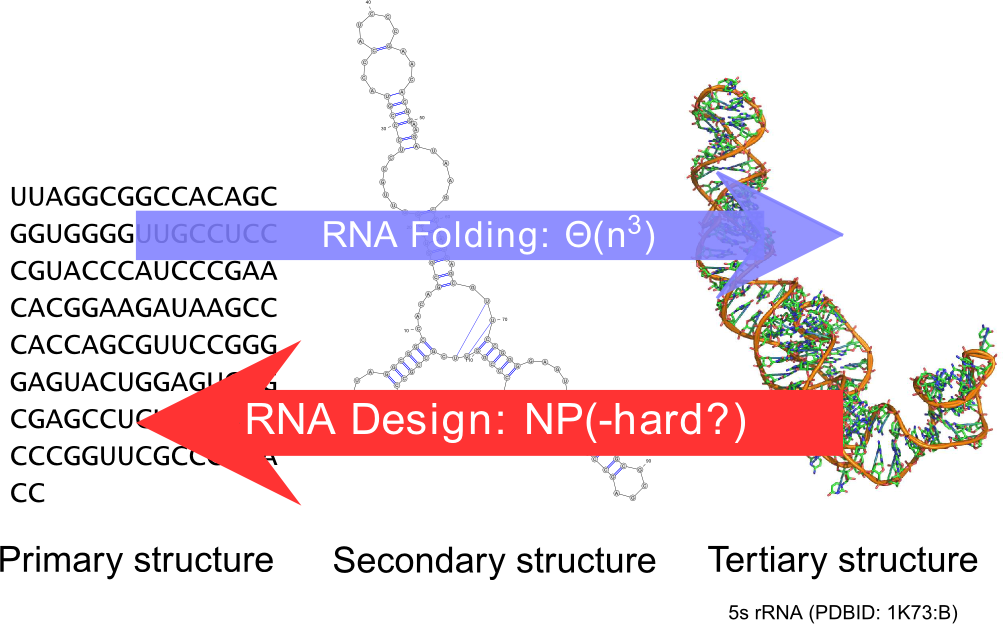
	1. </strong>The goal of RNA design, aka RNA inverse folding, is to find a sequence that folds back into a given (secondary) structure.</caption>
            <tr align="center">
              <td>
                <table>
                  <tr>
                    <td xmlns="" style="height:3px;" align="center">
                      <img xmlns="http://www.w3.org/1999/xhtml" style="width:256.2026pt" alt="IMG/design.png" src="IMG/design.png"/>
                    </td>
                  </tr>
                </table>
              </td>
            </tr>
          </table>
        </div>
        <a name="uid8"/>
        <h4 class="titre4">RNA design.</h4>
        <p class="participants"><span class="part">Participants</span> :
	Alice Heliou, Vincent Le Gallic, Yann Ponty.</p>
        <p class="bold">
          <p>Joint project with A. Denise (sc Lri), S. Vialette (Marne-la-Vallée), J. Waldispühl (McGill) and Y. Zhang (Wuhan).</p>
        </p>
        <p>It is a natural pursue to build on our understanding of the secondary structure to construct artificial RNAs performing predetermined functions, ultimately targeting therapeutic and synthetic biology applications. Towards this goal, a key element is the design of RNA sequences that fold into a predetermined secondary structure, according to established energy models (inverse-folding problem). Quite surprisingly, and despite two decades of studies of the problem, the computational complexity of the inverse-folding problem is currently unknown.</p>
        <p>Within our group, we offer a new methodology, based on weighted
random generation  <a href="./bibliography.html#amib-2015-bid4">[33]</a>  and multidimensional
Boltzmann sampling, for this
problem. Initially lifting the constraint of folding back into the
target structure, we explored the random generation of sequences that
are compatible with the target, using a probability distribution which
favors exponentially sequences of high affinity towards the target. A
simple posterior rejection step selects sequences that effectively
fold back into the latter, resulting in a <i>global sampling</i>
pipeline that showed comparable performances to its competitors based
on local search  <a href="./bibliography.html#amib-2015-bid5">[39]</a> .</p>
        <a name="uid9"/>
        <h4 class="titre4">Towards 3D modeling of large molecules</h4>
        <p class="participants"><span class="part">Participants</span> :
	Yann Ponty, Afaf Saaidi, Mireille Regnier.</p>
        <p class="bold">
          <p>Joint projects with A. Denise (sc Lri), D. Barth (Versailles),
J. Cohen (Paris-Sud), B. Sargueil (Paris V) and
Jérome Waldispühl (McGill).</p>
        </p>
        <p>The modeling of large RNA 3D structures, that is predicting the
three-dimensional structure of a given RNA sequence, relies on two
complementary approaches. The approach by homology is used when the
structure of a sequence homologous to the sequence of interest has
already been resolved experimentally. The main problem then is to
calculate an alignment between the known structure and the
sequence. The ab initio approach is required when no homologous
structure is known for the sequence of interest (or for some parts of
it). We contribute methods inspired by both of these settings directions.</p>
        <p>Modeling tasks can also be greatly helped by the availability of experimental data.
However, high-resolution techniques such as crystallography or RMN, are notoriously costly in term of time and ressources, leading to the current gap between the amount of available sequences and structural data.
As part of a colloboration with B. Sargueil's lab (Faculté de
pharmacie, Paris V) funded by the Fondation pour la Recherche medical,
we strive to propose a new paradigm for the analysis data produced
using a new experimental technique, called <span class="smallcap">Shape </span> analysis (Selective
2'-Hydroxyl Acylation analyzed by Primer Extension). This experimental
setup produces an accessibility profile associated with the different
positions of an RNA, the <i>shadow</i> of an RNA. As part of
A. Saaidi's PhD, we currently design new algorithmic strategies to
infer the secondary structure of RNA from multiple <span class="smallcap">Shape </span> experiments performed by experimentalists at Paris V. Those are obtained on mutants, and will be coupled with a fragment-based 3D modeling strategy developed by our partners at McGill.</p>
      </div>
      <!--FIN du corps du module-->
      <br/>
      <div class="bottomNavigation">
        <div class="tail_aucentre">
          <a href="./uid3.html" accesskey="P"><img style="align:bottom; border:none" alt="previous" src="../static/img/icons/previous_motif.jpg"/> Previous | </a>
          <a href="./uid0.html" accesskey="U"><img style="align:bottom; border:none" alt="up" src="../static/img/icons/up_motif.jpg"/>  Home</a>
          <a href="./uid10.html" accesskey="N"> | Next <img style="align:bottom; border:none" alt="next" src="../static/img/icons/next_motif.jpg"/></a>
        </div>
        <br/>
      </div>
    </div>
  </body>
</html>