<?xml version="1.0" encoding="utf-8"?>
<!DOCTYPE html PUBLIC "-//W3C//DTD XHTML 1.1 plus MathML 2.0 plus SVG 1.1//EN" "http://www.w3.org/2002/04/xhtml-math-svg/xhtml-math-svg.dtd">
<html xmlns="http://www.w3.org/1999/xhtml">
  <head>
    <meta http-equiv="Content-Type" content="application/xhtml+xml; charset=utf-8"/>
    <title>Project-Team:QUANTIC</title>
    <link rel="stylesheet" href="../static/css/raweb.css" type="text/css"/>
    <meta name="description" content="Research Program - Towards microwave quantum networks"/>
    <meta name="dc.title" content="Research Program - Towards microwave quantum networks"/>
    <meta name="dc.subject" content=""/>
    <meta name="dc.publisher" content="INRIA"/>
    <meta name="dc.date" content="(SCHEME=ISO8601) 2015-01"/>
    <meta name="dc.type" content="Report"/>
    <meta name="dc.language" content="(SCHEME=ISO639-1) en"/>
    <meta name="projet" content="QUANTIC"/>
    <!-- Piwik -->
    <script type="text/javascript" src="/rapportsactivite/piwik.js"></script>
    <noscript><p><img src="//piwik.inria.fr/piwik.php?idsite=49" style="border:0;" alt="" /></p></noscript>
    <!-- End Piwik Code -->
  </head>
  <body>
    <div class="tdmdiv">
      <div class="logo">
        <a href="http://www.inria.fr">
          <img style="align:bottom; border:none" src="../static/img/icons/logo_INRIA-coul.jpg" alt="Inria"/>
        </a>
      </div>
      <div class="TdmEntry">
        <div class="tdmentete">
          <a href="uid0.html">Project-Team Quantic</a>
        </div>
        <span>
          <a href="uid1.html">Members</a>
        </span>
      </div>
      <div class="TdmEntry">Overall Objectives<ul><li><a href="./uid3.html">Overall objectives</a></li></ul></div>
      <div class="TdmEntry">Research Program<ul><li class="tdmActPage"><a href="uid5.html&#10;&#9;&#9;  ">Towards microwave quantum networks</a></li><li><a href="uid7.html&#10;&#9;&#9;  ">Hardware-efficient quantum information processing</a></li><li><a href="uid9.html&#10;&#9;&#9;  ">Reservoir (dissipation) engineering and autonomous stabilization of quantum systems</a></li><li><a href="uid10.html&#10;&#9;&#9;  ">System theory for quantum information processing</a></li></ul></div>
      <div class="TdmEntry">Application Domains<ul><li><a href="uid16.html&#10;&#9;&#9;  ">Quantum engineering</a></li></ul></div>
      <div class="TdmEntry">
        <a href="./uid19.html">Highlights of the Year</a>
      </div>
      <div class="TdmEntry">New Results<ul><li><a href="uid24.html&#10;&#9;&#9;  ">Entanglement between stationary and propagating modes</a></li><li><a href="uid27.html&#10;&#9;&#9;  ">Wideband Josephson mixer</a></li><li><a href="uid30.html&#10;&#9;&#9;  ">Quantum Zeno dynamics</a></li><li><a href="uid32.html&#10;&#9;&#9;  ">Efficient quantum filtering for quantum feedback control</a></li><li><a href="uid33.html&#10;&#9;&#9;  ">Adaptive low-rank approximation and denoised Monte-Carlo approach for high-dimensional Lindblad equations</a></li><li><a href="uid34.html&#10;&#9;&#9;  ">Stabilization of photon-number states via single-photon corrections: a first convergence analysis under an ideal set-up</a></li><li><a href="uid35.html&#10;&#9;&#9;  ">Convergence and adiabatic elimination for a driven dissipative quantum harmonic oscillator</a></li><li><a href="uid36.html&#10;&#9;&#9;  ">Parameter estimation from measurements along quantum trajectories</a></li><li><a href="uid37.html&#10;&#9;&#9;  ">Adding a single state memory optimally accelerates symmetric linear maps</a></li><li><a href="uid38.html&#10;&#9;&#9;  ">A common symmetrization framework for iterative (linear) maps</a></li><li><a href="uid39.html&#10;&#9;&#9;  ">Deterministic hidden coordinate for a qubit under fluorescence measurement</a></li><li><a href="uid40.html&#10;&#9;&#9;  ">Relations between quantum walks, open quantum walks, and lifted walks: the cycle graph</a></li><li><a href="uid41.html&#10;&#9;&#9;  ">Confining the state of light to a quantum manifold by engineered two-photon loss</a></li><li><a href="uid42.html&#10;&#9;&#9;  ">Single-Photon-Resolved Cross-Kerr Interaction for Autonomous Stabilization of Photon-Number States</a></li><li><a href="uid43.html&#10;&#9;&#9;  ">Characterizing entanglement of an artificial atom and a cavity cat state with Bell's inequality</a></li></ul></div>
      <div class="TdmEntry">Partnerships and Cooperations<ul><li><a href="uid45.html&#10;&#9;&#9;  ">Regional Initiatives</a></li><li><a href="uid48.html&#10;&#9;&#9;  ">National Initiatives</a></li><li><a href="uid52.html&#10;&#9;&#9;  ">European Initiatives</a></li><li><a href="uid60.html&#10;&#9;&#9;  ">International Initiatives</a></li><li><a href="uid68.html&#10;&#9;&#9;  ">International Research Visitors</a></li></ul></div>
      <div class="TdmEntry">Dissemination<ul><li><a href="uid72.html&#10;&#9;&#9;  ">Promoting Scientific Activities</a></li><li><a href="uid107.html&#10;&#9;&#9;  ">Teaching - Supervision - Juries</a></li><li><a href="uid132.html&#10;&#9;&#9;  ">Popularization</a></li></ul></div>
      <div class="TdmEntry">
        <div>Bibliography</div>
      </div>
      <div class="TdmEntry">
        <ul>
          <li>
            <a id="tdmbibentmajor" href="bibliography.html">Major publications</a>
          </li>
          <li>
            <a id="tdmbibentyear" href="bibliography.html#year">Publications of the year</a>
          </li>
          <li>
            <a id="tdmbibentfoot" href="bibliography.html#References">References in notes</a>
          </li>
        </ul>
      </div>
    </div>
    <div id="main">
      <div class="mainentete">
        <div id="head_agauche">
          <small><a href="http://www.inria.fr">
	    
	    Inria
	  </a> | <a href="../index.html">
	    
	    Raweb 
	    2015</a> | <a href="http://www.inria.fr/en/teams/quantic">Presentation of the Project-Team QUANTIC</a> | <a href="https://team.inria.fr/quantic/">QUANTIC Web Site
	  </a></small>
        </div>
        <div id="head_adroite">
          <table class="qrcode">
            <tr>
              <td>
                <a href="quantic.xml">
                  <img style="align:bottom; border:none" alt="XML" src="../static/img/icons/xml_motif.png"/>
                </a>
              </td>
              <td>
                <a href="quantic.pdf">
                  <img style="align:bottom; border:none" alt="PDF" src="IMG/qrcode-quantic-pdf.png"/>
                </a>
              </td>
              <td>
                <a href="../quantic/quantic.epub">
                  <img style="align:bottom; border:none" alt="e-pub" src="IMG/qrcode-quantic-epub.png"/>
                </a>
              </td>
            </tr>
            <tr>
              <td/>
              <td>PDF
</td>
              <td>e-Pub
</td>
            </tr>
          </table>
        </div>
      </div>
      <!--FIN du corps du module-->
      <br/>
      <div class="bottomNavigation">
        <div class="tail_aucentre">
          <a href="./uid3.html" accesskey="P"><img style="align:bottom; border:none" alt="previous" src="../static/img/icons/previous_motif.jpg"/> Previous | </a>
          <a href="./uid0.html" accesskey="U"><img style="align:bottom; border:none" alt="up" src="../static/img/icons/up_motif.jpg"/>  Home</a>
          <a href="./uid7.html" accesskey="N"> | Next <img style="align:bottom; border:none" alt="next" src="../static/img/icons/next_motif.jpg"/></a>
        </div>
        <br/>
      </div>
      <div id="textepage">
        <!--DEBUT2 du corps du module-->
        <h2>Section: 
      Research Program</h2>
        <h3 class="titre3">Towards microwave quantum networks</h3>
        <p>The classical states of microwave radiation, are the so-called coherent states. They can be prepared by a commercial microwave generator (frequency <span class="math"><math xmlns="http://www.w3.org/1998/Math/MathML"><mrow><mn>1</mn><mtext>GHz</mtext><mo>&lt;</mo><mi>f</mi><mo>&lt;</mo><mn>20</mn><mtext>GHz</mtext></mrow></math></span>) followed by thermalization to <span class="math"><math xmlns="http://www.w3.org/1998/Math/MathML"><mrow><msub><mi>k</mi><mi>B</mi></msub><mi>T</mi><mo>≪</mo><mi>h</mi><mi>f</mi></mrow></math></span> using a chain of attenuators anchored at various stages of a dilution refrigerator.</p>
        <p>Owing to the strength of its coupling to superconducting circuits  <a href="./bibliography.html#quantic-2015-bid0">[55]</a>  or Rydberg atoms  <a href="./bibliography.html#quantic-2015-bid1">[73]</a> , microwave radiation can also be prepared in many possible non-classical states. Using a sequence of quanta exchanges between superconducting qubits and a microwave cavity, the direct preparation of an arbitrary superposition of Fock states has been demonstrated in 2009  <a href="./bibliography.html#quantic-2015-bid2">[75]</a>  with about <span class="math"><math xmlns="http://www.w3.org/1998/Math/MathML"><mrow><mn>90</mn><mo>%</mo></mrow></math></span> fidelity up to 5 photons. Recently, the physicists at Yale university in collaboration with the theorists of QUANTIC team, demonstrated a superposition of classical states, or Schrödinger cat, with 100 photons on average, using the dispersive coupling to a transmon qubit  <a href="./bibliography.html#quantic-2015-bid3">[122]</a> .</p>
        <p>An important class of states for quantum information processing with continuous variables is that of the Gaussian squeezed states  <a href="./bibliography.html#quantic-2015-bid4">[123]</a> . These states can be seen as a coherent state for which the fluctuations on a quadrature are less than the zero point fluctuations. Of course, owing to Heisenberg uncertainty principle, this comes at the expense of larger fluctuations on the conjugated quadrature. In the optical domain, Gaussian light has been demonstrated and used with single and multimodes decades ago  <a href="./bibliography.html#quantic-2015-bid4">[123]</a> . In the microwave domain, single mode squeezing of thermal noise had been demonstrated already in 1988  <a href="./bibliography.html#quantic-2015-bid5">[128]</a>  but vacuum noise squeezing was only demonstrated in 2008  <a href="./bibliography.html#quantic-2015-bid6">[53]</a> . Since then, several groups have been able to generate single- and two-mode squeezing of microwave radiation, including us <a href="./bibliography.html#quantic-2015-bid7">[59]</a> , <a href="./bibliography.html#quantic-2015-bid8">[125]</a> , <a href="./bibliography.html#quantic-2015-bid9">[91]</a> , <a href="./bibliography.html#quantic-2015-bid10">[95]</a> , <a href="./bibliography.html#quantic-2015-bid11">[61]</a> . The two-mode squeezed states are of particular interest for quantum information processing, because they are maximally entangled for a given average number of quanta. In particular, the circuit developed by QUANTIC's experimentalists is able to directly generate two-mode squeezed states on separate transmission lines, at arbitrarily different frequencies <a href="./bibliography.html#quantic-2015-bid11">[61]</a> .</p>
        <p>In the perspective of a quantum network using microwave radiation, one needs a way to store and preserve microwave fields in nodes. Arguably, creating a memory for quantum systems able to preserve indefinitely a quantum state is the next big challenge on the road towards quantum computing  <a href="./bibliography.html#quantic-2015-bid12">[56]</a> , yet unrealized in any system. In a first step, we focus on a quantum node able to preserve a quantum state for a finite time.</p>
        <p>In the optical domain, current implementations of quantum memories  <a href="./bibliography.html#quantic-2015-bid13">[114]</a>  rely mainly on two physical effects: the light deceleration due to electromagnetically induced transparency and the transfer of photonic quantum states onto collective atomic coherences (optical or spin). In the microwave domain, several quantum memories have emerged in the last years using spin ensembles <a href="./bibliography.html#quantic-2015-bid14">[126]</a> , <a href="./bibliography.html#quantic-2015-bid15">[80]</a> , <a href="./bibliography.html#quantic-2015-bid16">[109]</a> , mechanical resonators  <a href="./bibliography.html#quantic-2015-bid17">[98]</a> , <a href="./bibliography.html#quantic-2015-bid18">[99]</a>  or superconducting circuits  <a href="./bibliography.html#quantic-2015-bid19">[127]</a> , <a href="./bibliography.html#quantic-2015-bid20">[124]</a> , such as our device described in  <a href="./bibliography.html#quantic-2015-bid21">[62]</a> .</p>
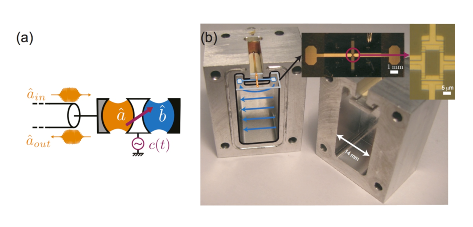
        <p>All these microwave implementations have pros and cons. However, only two of them, the mechanical oscillator of the Lehnert group  <a href="./bibliography.html#quantic-2015-bid18">[99]</a>  and our device <a href="./bibliography.html#quantic-2015-bid21">[62]</a>  have demonstrated entanglement between the memory and a propagating microwave mode. Specifically, our device consists in a 3D storage microwave cavity whose coupling to a transmission line is performed using an active superconducting circuit: the Josephson ring modulator. In the frequency conversion regime, it acts as a tunable coupler whose rate is solely controlled by the amplitude of a pump signal. In the parametric down-conversion regime, it acts as an entanglement generator, similarly to the mechanical version of the Boulder group. However, the inherently small coupling rate between the transmission line and the mechanical resonator in  <a href="./bibliography.html#quantic-2015-bid18">[99]</a>  makes our device  <a href="./bibliography.html#quantic-2015-bid21">[62]</a>  a much stronger candidate for a quantum node. Apart from this crucial possibility to generate entanglement, our device is similar to the implementation of Santa Barbara  <a href="./bibliography.html#quantic-2015-bid19">[127]</a> . Both have demonstrated fast tuning (up to 30 MHz for Santa Barbara) with high catching efficiency and storage time of 4 <span class="math"><math xmlns="http://www.w3.org/1998/Math/MathML"><mi>μ</mi></math></span>s. However we believe that two specificities make our route more promising. In their case it is a flux knob which allows tuning of the transparency of a 2D microwave cavity. The core of the device we propose is a 3D storage microwave, an architecture where there is plenty of room to improve the storage time and exceed this figure by orders of magnitude, even without quantum error correction  <a href="./bibliography.html#quantic-2015-bid22">[104]</a> . Moreover the cavity transparency is controlled solely by the amplitude of a microwave tone, free of the complications of hysteresis inherent to fast flux tuning in a superconducting environment.</p>
        <p>The quantum information protocols one can envision using the quantum node developed by QUANTIC's experimentalists gets a useful inspiration from what has been realized in the optical domain in the last 20 years. One of the most interesting protocols we would like to implement is the teleportation of a quantum state from the memory into a transmission line or another memory. In optics, this was performed already in 1998 for a coherent state  <a href="./bibliography.html#quantic-2015-bid23">[63]</a> , and more recently for a Schrödinger-cat-like state  <a href="./bibliography.html#quantic-2015-bid24">[82]</a> . We could readily reproduce these experiments in the microwave regime. The deterministic teleportation of a superconducting quantum bit was realized only in 2013  <a href="./bibliography.html#quantic-2015-bid25">[118]</a>  but no experiments have shown teleportation of a continuous variable state in the microwave domain up to now. Furthermore, none of the protocols needed for quantum information processing (entanglement distillation and dilution for instance) have ever been realized in the microwave domain with Gaussian states  <a href="./bibliography.html#quantic-2015-bid4">[123]</a> . It is thus of great interest to investigate where the tools specific to superconducting circuits will allow us to go beyond what can be done in the optical domain. In particular, the microwave quantum limited amplifiers  <a href="./bibliography.html#quantic-2015-bid26">[107]</a>  developed by QUANTIC's experimentalists lead to unmatched heterodyne measurement efficiencies. Finally using a qubit as a Fock number resolved photocounter unleashes many scenarios in the preparation and manipulation by measurement of an entangled state.</p>
        <div align="center" style="margin-top:10px">
          <a name="uid6">
            <!--...-->
          </a>
          <table title="" class="objectContainer">
            <caption align="bottom"><strong>Figure
	1. </strong>(a) Scheme of the quantum memory. A three-wave mixer is used as a controllable switch between a read/write cavity a and a long storage time cavity <span class="math"><math xmlns="http://www.w3.org/1998/Math/MathML"><mi>𝐛</mi></math></span> via the application of a control field <span class="math"><math xmlns="http://www.w3.org/1998/Math/MathML"><mi>c</mi></math></span>. (b) Picture of the first device. A 2D microstrip resonator on a Sapphire chip is dynamically coupled to a 3D aluminum cavity mode through antennas attached to a ring of 4 Josephson junctions.</caption>
            <tr align="center">
              <td>
                <table>
                  <tr>
                    <td xmlns="" style="height:3px;" align="center">
                      <img xmlns="http://www.w3.org/1999/xhtml" style="width:384.2974pt" alt="IMG/Node.png" src="IMG/Node.png"/>
                    </td>
                  </tr>
                </table>
              </td>
            </tr>
          </table>
        </div>
      </div>
      <!--FIN du corps du module-->
      <br/>
      <div class="bottomNavigation">
        <div class="tail_aucentre">
          <a href="./uid3.html" accesskey="P"><img style="align:bottom; border:none" alt="previous" src="../static/img/icons/previous_motif.jpg"/> Previous | </a>
          <a href="./uid0.html" accesskey="U"><img style="align:bottom; border:none" alt="up" src="../static/img/icons/up_motif.jpg"/>  Home</a>
          <a href="./uid7.html" accesskey="N"> | Next <img style="align:bottom; border:none" alt="next" src="../static/img/icons/next_motif.jpg"/></a>
        </div>
        <br/>
      </div>
    </div>
  </body>
</html>