<?xml version="1.0" encoding="utf-8"?>
<!DOCTYPE html PUBLIC "-//W3C//DTD XHTML 1.1 plus MathML 2.0 plus SVG 1.1//EN" "http://www.w3.org/2002/04/xhtml-math-svg/xhtml-math-svg.dtd">
<html xmlns="http://www.w3.org/1999/xhtml">
  <head>
    <meta http-equiv="Content-Type" content="application/xhtml+xml; charset=utf-8"/>
    <title>Project-Team:GAMBLE</title>
    <link rel="stylesheet" href="../static/css/raweb.css" type="text/css"/>
    <meta name="description" content="Research Program - Non-linear computational geometry"/>
    <meta name="dc.title" content="Research Program - Non-linear computational geometry"/>
    <meta name="dc.subject" content=""/>
    <meta name="dc.publisher" content="INRIA"/>
    <meta name="dc.date" content="(SCHEME=ISO8601) 2017-01"/>
    <meta name="dc.type" content="Report"/>
    <meta name="dc.language" content="(SCHEME=ISO639-1) en"/>
    <meta name="projet" content="GAMBLE"/>
    <script type="text/javascript" src="https://cdn.mathjax.org/mathjax/latest/MathJax.js?config=TeX-MML-AM_CHTML">
      <!--MathJax-->
    </script>
  </head>
  <body>
    <div class="tdmdiv">
      <div class="logo">
        <a href="http://www.inria.fr">
          <img style="align:bottom; border:none" src="../static/img/icons/logo_INRIA-coul.jpg" alt="Inria"/>
        </a>
      </div>
      <div class="TdmEntry">
        <div class="tdmentete">
          <a href="uid0.html">Project-Team Gamble</a>
        </div>
        <span>
          <a href="uid1.html">Personnel</a>
        </span>
      </div>
      <div class="TdmEntry">
        <a href="./uid3.html">Overall Objectives</a>
      </div>
      <div class="TdmEntry">Research Program<ul><li class="tdmActPage"><a href="uid11.html&#10;&#9;&#9;  ">Non-linear computational geometry</a></li><li><a href="uid14.html&#10;&#9;&#9;  ">Non-Euclidean computational geometry</a></li><li><a href="uid20.html&#10;&#9;&#9;  ">Probability in computational geometry</a></li></ul></div>
      <div class="TdmEntry">Application Domains<ul><li><a href="uid22.html&#10;&#9;&#9;  ">Applications of computational geometry</a></li></ul></div>
      <div class="TdmEntry">
        <a href="./uid25.html">Highlights of the Year</a>
      </div>
      <div class="TdmEntry">New Software and Platforms<ul><li><a href="uid27.html&#10;&#9;&#9;  ">ISOTOP</a></li><li><a href="uid31.html&#10;&#9;&#9;  ">CGAL Package : 3D periodic regular triangulations</a></li><li><a href="uid35.html&#10;&#9;&#9;  ">CGAL Package : 2D hyperbolic triangulations</a></li><li><a href="uid40.html&#10;&#9;&#9;  ">CGAL Package : 2D periodic hyperbolic triangulations</a></li></ul></div>
      <div class="TdmEntry">New Results<ul><li><a href="uid46.html&#10;&#9;&#9;  ">Non-Linear Computational Geometry</a></li><li><a href="uid49.html&#10;&#9;&#9;  ">Non-Euclidean Computational Geometry</a></li><li><a href="uid52.html&#10;&#9;&#9;  ">Probabilistic Analysis of Geometric
Data Structures and Algorithms</a></li><li><a href="uid55.html&#10;&#9;&#9;  ">Classical Computational Geometry and Graph Drawing</a></li></ul></div>
      <div class="TdmEntry">Bilateral Contracts and Grants with Industry<ul><li><a href="uid60.html&#10;&#9;&#9;  ">Bilateral Contracts with Industry</a></li></ul></div>
      <div class="TdmEntry">Partnerships and Cooperations<ul><li><a href="uid62.html&#10;&#9;&#9;  ">Regional Initiatives</a></li><li><a href="uid63.html&#10;&#9;&#9;  ">National Initiatives</a></li><li><a href="uid65.html&#10;&#9;&#9;  ">International Initiatives</a></li><li><a href="uid76.html&#10;&#9;&#9;  ">International Research Visitors</a></li></ul></div>
      <div class="TdmEntry">Dissemination<ul><li><a href="uid82.html&#10;&#9;&#9;  ">Promoting Scientific Activities</a></li><li><a href="uid126.html&#10;&#9;&#9;  ">Teaching - Supervision - Juries</a></li><li><a href="uid156.html&#10;&#9;&#9;  ">Popularization</a></li></ul></div>
      <div class="TdmEntry">
        <div>Bibliography</div>
      </div>
      <div class="TdmEntry">
        <ul>
          <li>
            <a id="tdmbibentyear" href="bibliography.html">Publications of the year</a>
          </li>
          <li>
            <a id="tdmbibentfoot" href="bibliography.html#References">References in notes</a>
          </li>
        </ul>
      </div>
    </div>
    <div id="main">
      <div class="mainentete">
        <div id="head_agauche">
          <small><a href="http://www.inria.fr">
	    
	    Inria
	  </a> | <a href="../index.html">
	    
	    Raweb 
	    2017</a> | <a href="http://www.inria.fr/en/teams/gamble">Presentation of the Project-Team GAMBLE</a> | <a href="http://gamble.loria.fr/">GAMBLE Web Site
	  </a></small>
        </div>
        <div id="head_adroite">
          <table class="qrcode">
            <tr>
              <td>
                <a href="gamble.xml">
                  <img style="align:bottom; border:none" alt="XML" src="../static/img/icons/xml_motif.png"/>
                </a>
              </td>
              <td>
                <a href="gamble.pdf">
                  <img style="align:bottom; border:none" alt="PDF" src="IMG/qrcode-gamble-pdf.png"/>
                </a>
              </td>
              <td>
                <a href="../gamble/gamble.epub">
                  <img style="align:bottom; border:none" alt="e-pub" src="IMG/qrcode-gamble-epub.png"/>
                </a>
              </td>
            </tr>
            <tr>
              <td/>
              <td>PDF
</td>
              <td>e-Pub
</td>
            </tr>
          </table>
        </div>
      </div>
      <!--FIN du corps du module-->
      <br/>
      <div class="bottomNavigation">
        <div class="tail_aucentre">
          <a href="./uid3.html" accesskey="P"><img style="align:bottom; border:none" alt="previous" src="../static/img/icons/previous_motif.jpg"/> Previous | </a>
          <a href="./uid0.html" accesskey="U"><img style="align:bottom; border:none" alt="up" src="../static/img/icons/up_motif.jpg"/>  Home</a>
          <a href="./uid14.html" accesskey="N"> | Next <img style="align:bottom; border:none" alt="next" src="../static/img/icons/next_motif.jpg"/></a>
        </div>
        <br/>
      </div>
      <div id="textepage">
        <!--DEBUT2 du corps du module-->
        <h2>Section: 
      Research Program</h2>
        <h3 class="titre3">Non-linear computational geometry</h3>
        <div align="center" style="margin-top:10px">
          <a name="uid12">
            <!--...-->
          </a>
          <table title="" class="objectContainer">
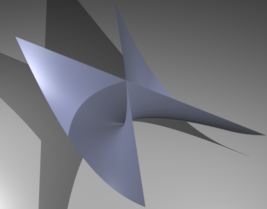
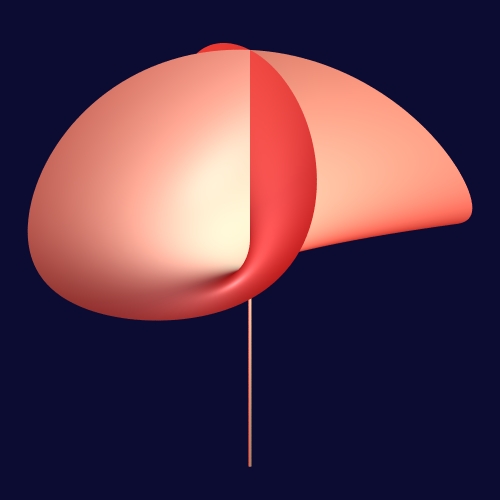
            <caption align="bottom"><strong>Figure
	1. </strong>Two views of the Whitney umbrella (on the left, the “stick” of the
umbrella, i.e., the negative <span class="math"><math xmlns="http://www.w3.org/1998/Math/MathML"><mi>z</mi></math></span>-axis, is missing). Right picture from
<a href="https://en.wikipedia.org/wiki/Whitney_umbrella">[Wikipedia]</a>, left
picture from
<a href="http://www.lama.univ-savoie.fr/~lachaud/Research/Digital-surfaces-and-singular-surfaces/body.html">[Lachaud
et al.]</a>.</caption>
            <tr align="center">
              <td>
                <table>
                  <tr>
                    <td style="height:3px;" align="center">
                      <img style="height:113.81102pt" alt="IMG/Whitney_unbrella.png" src="IMG/Whitney_unbrella.png"/>
                    </td>
                    <td style="height:3px;" align="center">
                      <img style="height:113.81102pt" alt="IMG/whitney-rc.jpg" src="IMG/whitney-rc.jpg"/>
                    </td>
                  </tr>
                </table>
              </td>
            </tr>
          </table>
        </div>
        <p>As mentioned above, curved objects are ubiquitous in real world problems modelings and in computer science and, despite this
fact, there are very few problems on curved objects that admit robust and efficient algorithmic
solutions without first discretizing the curved objects into meshes.
Meshing curved objects induces
some loss of accuracy which is sometimes not an issue but which can also be most problematic
depending on the application. In addition, discretizing induces a combinatorial explosion which could
cause a loss in efficiency compared to a direct solution on the curved objects (as our work on
quadrics has demonstrated with flying colors
<a href="./bibliography.html#gamble-2017-bid1">[32]</a>, <a href="./bibliography.html#gamble-2017-bid2">[33]</a>, <a href="./bibliography.html#gamble-2017-bid3">[34]</a>, <a href="./bibliography.html#gamble-2017-bid4">[36]</a>, <a href="./bibliography.html#gamble-2017-bid5">[40]</a>).
But it is also crucial to know that even the
process of computing meshes that approximate curved objects is far from being resolved. As a matter
of fact there is no algorithm capable of computing in practice meshes with certified topology of
even rather simple singular 3D surfaces, due to the high constants in the
theoretical complexity and the difficulty of handling degenerate cases. Even in 2D, meshing an algebraic curve with the correct
topology, that is in other words producing a correct drawing of the curve (without knowing where
the domain of interest is), is a very difficult
problem on which we have recently made important contributions <a href="./bibliography.html#gamble-2017-bid6">[19]</a>, <a href="./bibliography.html#gamble-2017-bid7">[20]</a>, <a href="./bibliography.html#gamble-2017-bid8">[41]</a>.</p>
        <p>It is thus to be understood that producing practical robust and efficient algorithmic solutions to
geometric problems on curved objects is a challenge on all and even the most basic problems. The
basicness and fundamentality of two problems we mentioned above on the intersection of 3D quadrics
and on the drawing in a topologically certified way of plane algebraic curves show rather well that
the domain is still at its infancy. And it should be stressed that these two sets of results were
not anecdotical but flagship results produced during the lifetime of <span class="smallcap">Vegas </span> team.</p>
        <p>There are many
problems in this theme that are expected to have high long-term
impacts. Intersecting NURBS (Non-uniform rational basis spline) in a certified way is an important problem in computer-aided design and
manufacturing. As hinted above, meshing objects in a certified way is important
when topology matters.
The 2D case, that is essentially drawing plane curves with the correct topology,
is a fundamental
problem with far-reaching applications in research or R&amp;D.
Notice that on such elementary problems it is often difficult to predict the
reach of the applications; as an example, we were astonished by the scope of the applications of our
software on 3D quadric intersection (QI: <a href="http://vegas.loria.fr/qi/">http://vegas.loria.fr/qi/</a>.) which was used by researchers
in, for instance, photochemistry, computer vision, statistics and
mathematics.</p>
      </div>
      <!--FIN du corps du module-->
      <br/>
      <div class="bottomNavigation">
        <div class="tail_aucentre">
          <a href="./uid3.html" accesskey="P"><img style="align:bottom; border:none" alt="previous" src="../static/img/icons/previous_motif.jpg"/> Previous | </a>
          <a href="./uid0.html" accesskey="U"><img style="align:bottom; border:none" alt="up" src="../static/img/icons/up_motif.jpg"/>  Home</a>
          <a href="./uid14.html" accesskey="N"> | Next <img style="align:bottom; border:none" alt="next" src="../static/img/icons/next_motif.jpg"/></a>
        </div>
        <br/>
      </div>
    </div>
  </body>
</html>