<?xml version="1.0" encoding="utf-8"?>
<!DOCTYPE html PUBLIC "-//W3C//DTD XHTML 1.1 plus MathML 2.0 plus SVG 1.1//EN" "http://www.w3.org/2002/04/xhtml-math-svg/xhtml-math-svg.dtd">
<html xmlns="http://www.w3.org/1999/xhtml">
  <head>
    <meta http-equiv="Content-Type" content="application/xhtml+xml; charset=utf-8"/>
    <title>Project-Team:ACES</title>
    <link rel="stylesheet" href="../static/css/raweb.css" type="text/css"/>
    <meta name="description" content="Research Program - Spatial Information Systems"/>
    <meta name="dc.title" content="Research Program - Spatial Information Systems"/>
    <meta name="dc.subject" content=""/>
    <meta name="dc.publisher" content="INRIA"/>
    <meta name="dc.date" content="(SCHEME=ISO8601) 2013-01"/>
    <meta name="dc.type" content="Report"/>
    <meta name="dc.language" content="(SCHEME=ISO639-1) en"/>
    <meta name="projet" content="ACES"/>
  </head>
  <body>
    <div class="tdmdiv">
      <div class="logo">
        <a href="http://www.inria.fr">
          <img style="align:bottom; border:none" src="../static/img/icons/logo_INRIA-coul.jpg" alt="Inria"/>
        </a>
      </div>
      <div class="TdmEntry">
        <div class="tdmentete">
          <a href="uid0.html">Project-Team Aces</a>
        </div>
        <span>
          <a href="uid1.html">Members</a>
        </span>
      </div>
      <div class="TdmEntry">
        <a href="./uid3.html">Overall Objectives</a>
      </div>
      <div class="TdmEntry">Research Program<ul><li><a href="uid7.html&#10;&#9;&#9;  ">Programming Context</a></li><li class="tdmActPage"><a href="uid11.html&#10;&#9;&#9;  ">Spatial Information Systems</a></li><li><a href="uid15.html&#10;&#9;&#9;  ">Coupled objects</a></li></ul></div>
      <div class="TdmEntry">Software and Platforms<ul><li><a href="uid17.html&#10;&#9;&#9;  ">Software and Platforms</a></li></ul></div>
      <div class="TdmEntry">New Results<ul><li><a href="uid20.html&#10;&#9;&#9;  ">Self-describing objects</a></li><li><a href="uid23.html&#10;&#9;&#9;  ">Pervasive support for Smart Homes</a></li></ul></div>
      <div class="TdmEntry">Bilateral Contracts and Grants with Industry<ul><li><a href="uid34.html&#10;&#9;&#9;  ">Bilateral Contracts with Industry</a></li></ul></div>
      <div class="TdmEntry">Partnerships and Cooperations<ul><li><a href="uid39.html&#10;&#9;&#9;  ">National Initiatives</a></li></ul></div>
      <div class="TdmEntry">Dissemination<ul><li><a href="uid53.html&#10;&#9;&#9;  ">Scientific Animation</a></li><li><a href="uid58.html&#10;&#9;&#9;  ">Teaching - Supervision - Juries</a></li></ul></div>
      <div class="TdmEntry">
        <div>Bibliography</div>
      </div>
      <div class="TdmEntry">
        <ul>
          <li>
            <a id="tdmbibentyear" href="bibliography.html">Publications of the year</a>
          </li>
          <li>
            <a id="tdmbibentfoot" href="bibliography.html#References">References in notes</a>
          </li>
        </ul>
      </div>
    </div>
    <div id="main">
      <div class="mainentete">
        <div id="head_agauche">
          <small><a href="http://www.inria.fr">
	    
	    Inria
	  </a> | <a href="../index.html">
	    
	    Raweb 
	    2013</a> | <a href="http://www.inria.fr/en/teams/aces">Presentation of the Project-Team ACES</a> | <a href="http://www.irisa.fr/aces/">ACES Web Site
	  </a></small>
        </div>
        <div id="head_adroite">
          <table class="qrcode">
            <tr>
              <td>
                <a href="aces.xml">
                  <img style="align:bottom; border:none" alt="XML" src="../static/img/icons/xml_motif.png"/>
                </a>
              </td>
              <td>
                <a href="aces.pdf">
                  <img style="align:bottom; border:none" alt="PDF" src="IMG/qrcode-aces-pdf.png"/>
                </a>
              </td>
              <td>
                <a href="../aces/aces.epub">
                  <img style="align:bottom; border:none" alt="e-pub" src="IMG/qrcode-aces-epub.png"/>
                </a>
              </td>
            </tr>
            <tr>
              <td/>
              <td>PDF
</td>
              <td>e-Pub
</td>
            </tr>
          </table>
        </div>
      </div>
      <!--FIN du corps du module-->
      <br/>
      <div class="bottomNavigation">
        <div class="tail_aucentre">
          <a href="./uid7.html" accesskey="P"><img style="align:bottom; border:none" alt="previous" src="../static/img/icons/previous_motif.jpg"/> Previous | </a>
          <a href="./uid0.html" accesskey="U"><img style="align:bottom; border:none" alt="up" src="../static/img/icons/up_motif.jpg"/>  Home</a>
          <a href="./uid15.html" accesskey="N"> | Next <img style="align:bottom; border:none" alt="next" src="../static/img/icons/next_motif.jpg"/></a>
        </div>
        <br/>
      </div>
      <div id="textepage">
        <!--DEBUT2 du corps du module-->
        <h2>Section: 
      Research Program</h2>
        <h3 class="titre3">Spatial Information Systems</h3>
        <p>One of the major research efforts in <span class="smallcap">Aces </span> over the last few years has
been the definition of the Spread programming model to cater for spacial
context. The model is derived from the
Linda <a href="./bibliography.html#aces-2013-bid3">[10]</a>  tuple-space model. Each
information item is a <i>tuple</i>, which is a sequence of typed data items.
For example, <tt>&lt;10, 'Peter', -3.14&gt;</tt>  is a tuple where the first element is
the integer 10, the second is the string `"Peter" and the third is the real
value -3.14. Information is addressed using patterns that match one or a set
of tuples present in the tuple-space. An example pattern that matches the
previous tuple is <tt>&lt;int, 'Peter', float&gt;</tt> . The tuple-space model has the
advantage of allowing devices that meet for the first time to exchange data
since there is no notion of names or addresses.</p>
        <p>Data items are not only addressed by their type, but also by the physical
space in which they reside. The size of the space is determined by the
strength of the radio signal of the device. The important difference between
Spread and other tuple-space systems (e.g., Sun's
JavaSpaces <a href="./bibliography.html#aces-2013-bid4">[9]</a> , IBM's T-Space <a href="./bibliography.html#aces-2013-bid5">[13]</a> ) is that when
a program issues a matching request, only the tuples filling the <i>physical
space</i> of the requesting program are tested for matching. Thus, though SIS (Spatial Information Systems)
applications are highly distributed by nature, they only rely on localised
communications; they do not require access to a global communication
infrastructure. Figure <a title="Spatial Information Systems" href="./uid11.html#uid12">1</a>  shows an example of a physical
tuple space, made of tuples arranged in the space and occupying different
spaces.</p>
        <div align="center" style="margin-top:10px">
          <a name="uid12">
            <!--...-->
          </a>
          <table title="" class="objectContainer">
            <caption align="bottom"><strong>Figure
	1. </strong>Physical Tuple Space</caption>
            <tr align="center">
              <td>
                <table>
                  <tr>
                    <td style="height:3px;" align="center">
                      <img style="width:284.52756pt" alt="./IMG/phy-tspace.png" src="./IMG/phy-tspace.png"/>
                    </td>
                  </tr>
                </table>
              </td>
            </tr>
          </table>
        </div>
        <p>As an example of the power of this model, consider two of the applications
that we have developed using it.</p>
        <ul>
          <li>
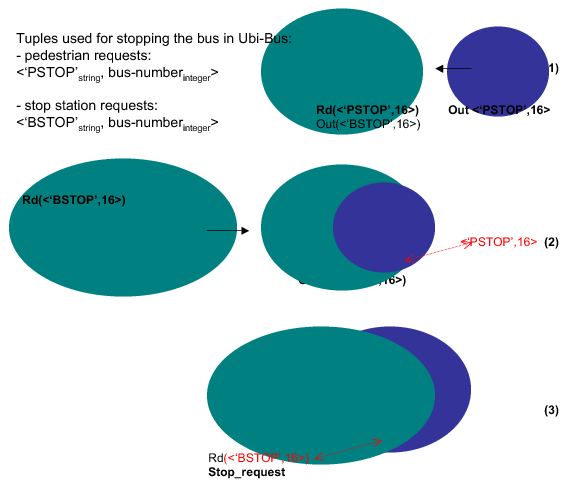
            <p class="notaparagraph"><a name="uid13"> </a><i>Ubi-bus</i> is a spatial
information application whose role is to help blind and partially blind people
use public transport. When taking a bus, a blind person uses his PDA to signal
his intention to a device embedded in the bus stop; this device then contacts
the bus on the person's behalf. This application illustrates how data is
distributed over the objects of the physical world, and generally, how devices
complement human means of communication.</p>
          </li>
          <li>
            <p class="notaparagraph"><a name="uid14"> </a><i>Ubi-board</i> is a spatial information application designed for
public electronic billboards. Travel hotspots like airports and major train
stations have an international customer base, so bill-board announcements need
to be made in several languages. In Ubi-bus, a billboard has an embedded
device. When a person comes within communication range of the billboard, his
device sends a request to the billboard asking it to print the message in the
language of the person. In the case where several travellers are in proximity
of the billboard, the board sends a translation of its information message to
each person. The Ubi-board application illustrates personal context in use,
i.e., the choice of natural language, and also how actions can be provoked in
the physical world without explicit intervention by the person.</p>
          </li>
        </ul>
      </div>
      <!--FIN du corps du module-->
      <br/>
      <div class="bottomNavigation">
        <div class="tail_aucentre">
          <a href="./uid7.html" accesskey="P"><img style="align:bottom; border:none" alt="previous" src="../static/img/icons/previous_motif.jpg"/> Previous | </a>
          <a href="./uid0.html" accesskey="U"><img style="align:bottom; border:none" alt="up" src="../static/img/icons/up_motif.jpg"/>  Home</a>
          <a href="./uid15.html" accesskey="N"> | Next <img style="align:bottom; border:none" alt="next" src="../static/img/icons/next_motif.jpg"/></a>
        </div>
        <br/>
      </div>
    </div>
  </body>
</html>