<?xml version="1.0" encoding="utf-8"?>
<!DOCTYPE html PUBLIC "-//W3C//DTD XHTML 1.1 plus MathML 2.0 plus SVG 1.1//EN" "http://www.w3.org/2002/04/xhtml-math-svg/xhtml-math-svg.dtd">
<html xmlns="http://www.w3.org/1999/xhtml">
  <head>
    <meta http-equiv="Content-Type" content="application/xhtml+xml; charset=utf-8"/>
    <title>Project-Team:CAIRN</title>
    <link rel="stylesheet" href="../static/css/raweb.css" type="text/css"/>
    <meta name="description" content="Software and Platforms - PowWow: Power Optimized Hardware and Software FrameWork for Wireless Motes (AP-L-10-01)"/>
    <meta name="dc.title" content="Software and Platforms - PowWow: Power Optimized Hardware and Software FrameWork for Wireless Motes (AP-L-10-01)"/>
    <meta name="dc.creator" content="Olivier Sentieys"/>
    <meta name="dc.creator" content="Olivier Berder"/>
    <meta name="dc.creator" content="Arnaud Carer"/>
    <meta name="dc.creator" content="Steven Derrien"/>
    <meta name="dc.subject" content=""/>
    <meta name="dc.publisher" content="INRIA"/>
    <meta name="dc.date" content="(SCHEME=ISO8601) 2013-01"/>
    <meta name="dc.type" content="Report"/>
    <meta name="dc.language" content="(SCHEME=ISO639-1) en"/>
    <meta name="projet" content="CAIRN"/>
  </head>
  <body>
    <div class="tdmdiv">
      <div class="logo">
        <a href="http://www.inria.fr">
          <img style="align:bottom; border:none" src="../static/img/icons/logo_INRIA-coul.jpg" alt="Inria"/>
        </a>
      </div>
      <div class="TdmEntry">
        <div class="tdmentete">
          <a href="uid0.html">Project-Team Cairn</a>
        </div>
        <span>
          <a href="uid1.html">Members</a>
        </span>
      </div>
      <div class="TdmEntry">Overall Objectives<ul><li><a href="./uid3.html">Overall Objectives</a></li><li><a href="./uid4.html">Highlights of the Year</a></li></ul></div>
      <div class="TdmEntry">Research Program<ul><li><a href="uid6.html&#10;&#9;&#9;  ">Panorama</a></li><li><a href="uid9.html&#10;&#9;&#9;  ">Reconfigurable Architecture Design</a></li><li><a href="uid14.html&#10;&#9;&#9;  ">Compilation and Synthesis for Reconfigurable Platforms</a></li><li><a href="uid15.html&#10;&#9;&#9;  ">Interaction between Algorithms and Architectures</a></li></ul></div>
      <div class="TdmEntry">Application Domains<ul><li><a href="uid17.html&#10;&#9;&#9;  ">Panorama</a></li><li><a href="uid18.html&#10;&#9;&#9;  ">4G Wireless Communication Systems</a></li><li><a href="uid19.html&#10;&#9;&#9;  ">Wireless Sensor Networks</a></li><li><a href="uid20.html&#10;&#9;&#9;  ">Multimedia processing</a></li></ul></div>
      <div class="TdmEntry">Software and Platforms<ul><li><a href="uid22.html&#10;&#9;&#9;  ">Panorama</a></li><li><a href="uid28.html&#10;&#9;&#9;  ">Gecos</a></li><li><a href="uid29.html&#10;&#9;&#9;  ">ID.Fix: Infrastructure for the Design of Fixed-point Systems</a></li><li><a href="uid30.html&#10;&#9;&#9;  ">UPaK: Abstract Unified Pattern-Based Synthesis Kernel for Hardware and Software Systems</a></li><li><a href="uid31.html&#10;&#9;&#9;  ">DURASE: Automatic Synthesis of Application-Specific Processor Extensions</a></li><li class="tdmActPage"><a href="uid35.html&#10;&#9;&#9;  ">PowWow: Power Optimized Hardware and Software FrameWork for Wireless Motes (AP-L-10-01)</a></li><li><a href="uid41.html&#10;&#9;&#9;  ">Ziggie: a Platform for Wireless Body Sensor Networks</a></li><li><a href="uid50.html&#10;&#9;&#9;  ">SoCLib: Open Platform for Virtual Prototyping of Multi-Processors System on Chip</a></li></ul></div>
      <div class="TdmEntry">New Results<ul><li><a href="uid52.html&#10;&#9;&#9;  ">Reconfigurable Architecture Design</a></li><li><a href="uid59.html&#10;&#9;&#9;  ">Compilation and Synthesis for Reconfigurable Platform</a></li><li><a href="uid64.html&#10;&#9;&#9;  ">Interaction between Algorithms and Architectures</a></li></ul></div>
      <div class="TdmEntry">Partnerships and Cooperations<ul><li><a href="uid73.html&#10;&#9;&#9;  ">National Initiatives</a></li><li><a href="uid86.html&#10;&#9;&#9;  ">European Initiatives</a></li><li><a href="uid108.html&#10;&#9;&#9;  ">International Initiatives</a></li><li><a href="uid122.html&#10;&#9;&#9;  ">International Research Visitors</a></li></ul></div>
      <div class="TdmEntry">Dissemination<ul><li><a href="uid138.html&#10;&#9;&#9;  ">Scientific Animation</a></li><li><a href="uid139.html&#10;&#9;&#9;  ">Seminars and Invitations</a></li><li><a href="uid140.html&#10;&#9;&#9;  ">Teaching - Supervision - Juries</a></li><li><a href="uid229.html&#10;&#9;&#9;  ">Popularization</a></li></ul></div>
      <div class="TdmEntry">
        <div>Bibliography</div>
      </div>
      <div class="TdmEntry">
        <ul>
          <li>
            <a id="tdmbibentmajor" href="bibliography.html">Major publications</a>
          </li>
          <li>
            <a id="tdmbibentyear" href="bibliography.html#year">Publications of the year</a>
          </li>
          <li>
            <a id="tdmbibentfoot" href="bibliography.html#References">References in notes</a>
          </li>
        </ul>
      </div>
    </div>
    <div id="main">
      <div class="mainentete">
        <div id="head_agauche">
          <small><a href="http://www.inria.fr">
	    
	    Inria
	  </a> | <a href="../index.html">
	    
	    Raweb 
	    2013</a> | <a href="http://www.inria.fr/en/teams/cairn">Presentation of the Project-Team CAIRN</a> | <a href="http://www.irisa.fr/cairn">CAIRN Web Site
	  </a></small>
        </div>
        <div id="head_adroite">
          <table class="qrcode">
            <tr>
              <td>
                <a href="cairn.xml">
                  <img style="align:bottom; border:none" alt="XML" src="../static/img/icons/xml_motif.png"/>
                </a>
              </td>
              <td>
                <a href="cairn.pdf">
                  <img style="align:bottom; border:none" alt="PDF" src="IMG/qrcode-cairn-pdf.png"/>
                </a>
              </td>
              <td>
                <a href="../cairn/cairn.epub">
                  <img style="align:bottom; border:none" alt="e-pub" src="IMG/qrcode-cairn-epub.png"/>
                </a>
              </td>
            </tr>
            <tr>
              <td/>
              <td>PDF
</td>
              <td>e-Pub
</td>
            </tr>
          </table>
        </div>
      </div>
      <!--FIN du corps du module-->
      <br/>
      <div class="bottomNavigation">
        <div class="tail_aucentre">
          <a href="./uid31.html" accesskey="P"><img style="align:bottom; border:none" alt="previous" src="../static/img/icons/previous_motif.jpg"/> Previous | </a>
          <a href="./uid0.html" accesskey="U"><img style="align:bottom; border:none" alt="up" src="../static/img/icons/up_motif.jpg"/>  Home</a>
          <a href="./uid41.html" accesskey="N"> | Next <img style="align:bottom; border:none" alt="next" src="../static/img/icons/next_motif.jpg"/></a>
        </div>
        <br/>
      </div>
      <div id="textepage">
        <!--DEBUT2 du corps du module-->
        <h2>Section: 
      Software and Platforms</h2>
        <h3 class="titre3">PowWow: Power Optimized Hardware and Software FrameWork for Wireless Motes (AP-L-10-01)</h3>
        <p class="participants"><span class="part">Participants</span> :
	Olivier Sentieys [corresponding author] , Olivier Berder, Arnaud Carer, Steven Derrien.</p>
        <p>Keywords: Wireless Sensor Networks, Low Power, Preamble Sampling MAC Protocol, Hardware and Software Platform</p>
        <p>PowWow is an open-source hardware and software platform designed to handle wireless sensor network (WSN) protocols and related applications. Based on an optimized preamble sampling medium access (MAC) protocol, geographical routing and <tt>protothread</tt>  library, PowWow requires a lighter hardware system than Zigbee <a href="./bibliography.html#cairn-2013-bid47">[85]</a>  to be processed (memory usage including application is less than 10kb). Therefore, network lifetime is increased and price per node is significantly decreased.</p>
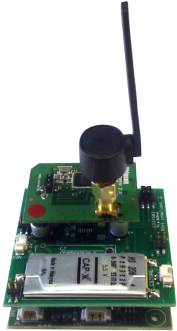
        <p><span class="smallcap">Cairn </span>'s hardware platform (see Figure <a title="PowWow: Power Optimized Hardware and Software FrameWork for Wireless Motes (AP-L-10-01)" href="./uid35.html#uid40">3</a> ) is composed of:</p>
        <ul>
          <li>
            <p class="notaparagraph"><a name="uid36"> </a>The motherboard, designed to reduce power consumption of sensor nodes, embeds an MSP430 microcontroller and all needed components to process PowWow protocol except radio chip. JTAG, RS232, and I2C interfaces are available on this board.</p>
          </li>
          <li>
            <p class="notaparagraph"><a name="uid37"> </a>The radio chip daughter board is currently based on a TI CC2420.</p>
          </li>
          <li>
            <p class="notaparagraph"><a name="uid38"> </a>The coprocessing daughter board includes a low-power FPGA which allows for hardware acceleration for some PowWow features and also includes dynamic voltage scaling features to increase power efficiency. The current version of PowWow integrates an Actel IGLOO AGL250 FPGA and a programmable DC-DC converter. We have shown that gains in energy of up to 700 can be obtained by using FPGA acceleration on functions like CRC-32 or error detection with regards to a software implementation on the MSP430.</p>
          </li>
          <li>
            <p class="notaparagraph"><a name="uid39"> </a>Finally, a last daughter board is dedicated to energy harvesting techniques. Based on the energy management component LTC3108 from Linear Technologies, the board can be configured with several types of stored energy (batteries, micro-batteries, super-capacitors) and several types of energy sources (a small solar panel to recover photovoltaic energy, a piezoelectric sensor for mechanical energy and a Peltier thermal energy sensor).</p>
          </li>
        </ul>
        <div align="center" style="margin-top:10px">
          <a name="uid40">
            <!--...-->
          </a>
          <table title="" class="objectContainer">
            <caption align="bottom"><strong>Figure
	3. </strong><span class="smallcap">Cairn </span>'s PowWow motherboard with radio and energy-harvesting boards connected</caption>
            <tr align="center">
              <td>
                <table>
                  <tr>
                    <td style="height:3px;" align="center">
                      <img style="width:85.35826pt" alt="IMG/PowWowRcup.png" src="IMG/PowWowRcup.png"/>
                    </td>
                  </tr>
                </table>
              </td>
            </tr>
          </table>
        </div>
        <p>PowWow distribution also includes a generic software architecture using event-driven programming and organized into protocol layers (PHY, MAC, LINK, NET and APP).
The software is based on Contiki <a href="./bibliography.html#cairn-2013-bid48">[101]</a> , and more precisely on the <tt>Protothread</tt>  library which provides a sequential control flow without complex state machines or full multi-threading.</p>
        <p>To optimize the network regarding a particular application and to define a global strategy to reduce energy, PowWow offers the following extra tools: over-the-air reprogramming (and soon reconfiguration), analytical power estimation based on software profiling and power measurements, a dedicated network analyzer to probe and fix transmissions errors in the network.
More information can be found at <a href="http://powwow.gforge.inria.fr">http://powwow.gforge.inria.fr</a> .
</p>
      </div>
      <!--FIN du corps du module-->
      <br/>
      <div class="bottomNavigation">
        <div class="tail_aucentre">
          <a href="./uid31.html" accesskey="P"><img style="align:bottom; border:none" alt="previous" src="../static/img/icons/previous_motif.jpg"/> Previous | </a>
          <a href="./uid0.html" accesskey="U"><img style="align:bottom; border:none" alt="up" src="../static/img/icons/up_motif.jpg"/>  Home</a>
          <a href="./uid41.html" accesskey="N"> | Next <img style="align:bottom; border:none" alt="next" src="../static/img/icons/next_motif.jpg"/></a>
        </div>
        <br/>
      </div>
    </div>
  </body>
</html>