<?xml version="1.0" encoding="utf-8"?>
<!DOCTYPE html PUBLIC "-//W3C//DTD XHTML 1.1 plus MathML 2.0 plus SVG 1.1//EN" "http://www.w3.org/2002/04/xhtml-math-svg/xhtml-math-svg.dtd">
<html xmlns="http://www.w3.org/1999/xhtml">
  <head>
    <meta http-equiv="Content-Type" content="application/xhtml+xml; charset=utf-8"/>
    <title>Project-Team:AMIB</title>
    <link rel="stylesheet" href="../static/css/raweb.css" type="text/css"/>
    <meta name="description" content="Research Program - RNA"/>
    <meta name="dc.title" content="Research Program - RNA"/>
    <meta name="dc.creator" content="Alain Denise"/>
    <meta name="dc.creator" content="Yann Ponty"/>
    <meta name="dc.creator" content="Antoine Soulé"/>
    <meta name="dc.creator" content="Alain Denise"/>
    <meta name="dc.creator" content="Vincent Le Gallic"/>
    <meta name="dc.creator" content="Yann Ponty"/>
    <meta name="dc.creator" content="Alain Denise"/>
    <meta name="dc.creator" content="Mélanie Boudard"/>
    <meta name="dc.creator" content="Julie Bernauer"/>
    <meta name="dc.creator" content="Rasmus Fonseca"/>
    <meta name="dc.subject" content=""/>
    <meta name="dc.publisher" content="INRIA"/>
    <meta name="dc.date" content="(SCHEME=ISO8601) 2014-01"/>
    <meta name="dc.type" content="Report"/>
    <meta name="dc.language" content="(SCHEME=ISO639-1) en"/>
    <meta name="projet" content="AMIB"/>
    <!-- Piwik -->
    <script type="text/javascript" src="/rapportsactivite/piwik.js"></script>
    <noscript><p><img src="//piwik.inria.fr/piwik.php?idsite=49" style="border:0;" alt="" /></p></noscript>
    <!-- End Piwik Code -->
  </head>
  <body>
    <div class="tdmdiv">
      <div class="logo">
        <a href="http://www.inria.fr">
          <img style="align:bottom; border:none" src="../static/img/icons/logo_INRIA-coul.jpg" alt="Inria"/>
        </a>
      </div>
      <div class="TdmEntry">
        <div class="tdmentete">
          <a href="uid0.html">Project-Team Amib</a>
        </div>
        <span>
          <a href="uid1.html">Members</a>
        </span>
      </div>
      <div class="TdmEntry">
        <a href="./uid3.html">Overall Objectives</a>
      </div>
      <div class="TdmEntry">Research Program<ul><li class="tdmActPage"><a href="uid5.html&#10;&#9;&#9;  ">RNA</a></li><li><a href="uid11.html&#10;&#9;&#9;  ">Sequences</a></li><li><a href="uid14.html&#10;&#9;&#9;  ">Geometry and machine learning for 3D interaction prediction</a></li><li><a href="uid18.html&#10;&#9;&#9;  ">Data Integration</a></li><li><a href="uid21.html&#10;&#9;&#9;  ">Systems Biology</a></li></ul></div>
      <div class="TdmEntry">New Software and Platforms<ul><li><a href="uid29.html&#10;&#9;&#9;  ">Cartaj</a></li><li><a href="uid30.html&#10;&#9;&#9;  ">DiMoVo</a></li><li><a href="uid31.html&#10;&#9;&#9;  ">VorScore</a></li><li><a href="uid32.html&#10;&#9;&#9;  ">ConQuR-Bio</a></li><li><a href="uid33.html&#10;&#9;&#9;  ">VARNA (Visualization Application for RNA)</a></li><li><a href="uid34.html&#10;&#9;&#9;  ">GenRGenS (GENeration of Random GENomic Sequences)</a></li><li><a href="uid35.html&#10;&#9;&#9;  ">GeneValorization</a></li><li><a href="uid36.html&#10;&#9;&#9;  ">HSIM</a></li><li><a href="uid37.html&#10;&#9;&#9;  ">Pint</a></li></ul></div>
      <div class="TdmEntry">New Results<ul><li><a href="uid39.html&#10;&#9;&#9;  ">RNA</a></li><li><a href="uid44.html&#10;&#9;&#9;  ">Sequences</a></li><li><a href="uid48.html&#10;&#9;&#9;  ">3D Modelling and Interactions</a></li><li><a href="uid51.html&#10;&#9;&#9;  ">Data Integration</a></li><li><a href="uid52.html&#10;&#9;&#9;  ">Systems Biology</a></li></ul></div>
      <div class="TdmEntry">Partnerships and Cooperations<ul><li><a href="uid56.html&#10;&#9;&#9;  ">National Initiatives</a></li><li><a href="uid65.html&#10;&#9;&#9;  ">European Initiatives</a></li><li><a href="uid73.html&#10;&#9;&#9;  ">International Initiatives</a></li><li><a href="uid104.html&#10;&#9;&#9;  ">International Research Visitors</a></li></ul></div>
      <div class="TdmEntry">Dissemination<ul><li><a href="uid170.html&#10;&#9;&#9;  ">Promoting Scientific Activities</a></li><li><a href="uid220.html&#10;&#9;&#9;  ">Teaching - Supervision - Juries</a></li><li><a href="uid264.html&#10;&#9;&#9;  ">Popularization</a></li></ul></div>
      <div class="TdmEntry">
        <div>Bibliography</div>
      </div>
      <div class="TdmEntry">
        <ul>
          <li>
            <a id="tdmbibentmajor" href="bibliography.html">Major publications</a>
          </li>
          <li>
            <a id="tdmbibentyear" href="bibliography.html#year">Publications of the year</a>
          </li>
          <li>
            <a id="tdmbibentfoot" href="bibliography.html#References">References in notes</a>
          </li>
        </ul>
      </div>
    </div>
    <div id="main">
      <div class="mainentete">
        <div id="head_agauche">
          <small><a href="http://www.inria.fr">
	    
	    Inria
	  </a> | <a href="../index.html">
	    
	    Raweb 
	    2014</a> | <a href="http://www.inria.fr/en/teams/amib">Presentation of the Project-Team AMIB</a> | <a href="http://team.inria.fr/amib/">AMIB Web Site
	  </a></small>
        </div>
        <div id="head_adroite">
          <table class="qrcode">
            <tr>
              <td>
                <a href="amib.xml">
                  <img style="align:bottom; border:none" alt="XML" src="../static/img/icons/xml_motif.png"/>
                </a>
              </td>
              <td>
                <a href="amib.pdf">
                  <img style="align:bottom; border:none" alt="PDF" src="IMG/qrcode-amib-pdf.png"/>
                </a>
              </td>
              <td>
                <a href="../amib/amib.epub">
                  <img style="align:bottom; border:none" alt="e-pub" src="IMG/qrcode-amib-epub.png"/>
                </a>
              </td>
            </tr>
            <tr>
              <td/>
              <td>PDF
</td>
              <td>e-Pub
</td>
            </tr>
          </table>
        </div>
      </div>
      <!--FIN du corps du module-->
      <br/>
      <div class="bottomNavigation">
        <div class="tail_aucentre">
          <a href="./uid3.html" accesskey="P"><img style="align:bottom; border:none" alt="previous" src="../static/img/icons/previous_motif.jpg"/> Previous | </a>
          <a href="./uid0.html" accesskey="U"><img style="align:bottom; border:none" alt="up" src="../static/img/icons/up_motif.jpg"/>  Home</a>
          <a href="./uid11.html" accesskey="N"> | Next <img style="align:bottom; border:none" alt="next" src="../static/img/icons/next_motif.jpg"/></a>
        </div>
        <br/>
      </div>
      <div id="textepage">
        <!--DEBUT2 du corps du module-->
        <h2>Section: 
      Research Program</h2>
        <h3 class="titre3">RNA</h3>
        <p>At the secondary structure level, we contributed novel generic techniques
applicable to dynamic programming and statistical sampling, and
applied them to design novel efficient algorithms for probing the
conformational space.
Another originality of our approach is that we cover a wide range of
scales for RNA structure representation. For each scale (atomic,
sequence, secondary and tertiary structure...) cutting-edge
algorithmic strategies and accurate and efficient tools have been
developed or are under development. This offers a new view on the
complexity of RNA structure and function that will certainly provide
valuable insights for biological studies.</p>
        <p>3D modeling was supported by the Digiteo project <span class="smallcap">Japarin-3D </span>.
Statistical potentials were supported by <span class="smallcap">Carnage </span> and <span class="smallcap">Itsnap </span>.</p>
        <a name="uid6"/>
        <h4 class="titre4">Dynamic programming and complexity</h4>
        <p class="participants"><span class="part">Participants</span> :
	Alain Denise, Yann Ponty, Antoine Soulé.</p>
        <p class="bold">
          <p>Common activity with J. Waldispühl (McGill).</p>
        </p>
        <p>Ever since the seminal work of Zuker and Stiegler, the field of RNA bioinformatics has been characterized by a strong emphasis on the secondary structure. This discrete abstraction of the
3D conformation of RNA has paved the way for a development of
quantitative approaches in RNA computational biology, revealing
unexpected connections between combinatorics and molecular
biology. Using our strong background in enumerative combinatorics, we
propose generic and efficient algorithms, both for sampling and
counting structures using dynamic programming.
These general techniques have been applied to study the sequence-structure relationship  <a href="./bibliography.html#amib-2014-bid0">[77]</a> , the correction of pyrosequencing errors  <a href="./bibliography.html#amib-2014-bid1">[71]</a> , and the efficient detection of multi-stable RNAs (riboswitches)  <a href="./bibliography.html#amib-2014-bid2">[72]</a> , <a href="./bibliography.html#amib-2014-bid3">[73]</a> .</p>
        <div align="center" style="margin-top:10px">
          <a name="uid7">
            <!--...-->
          </a>
          <table title="" class="objectContainer">
            <caption align="bottom"><strong>Figure
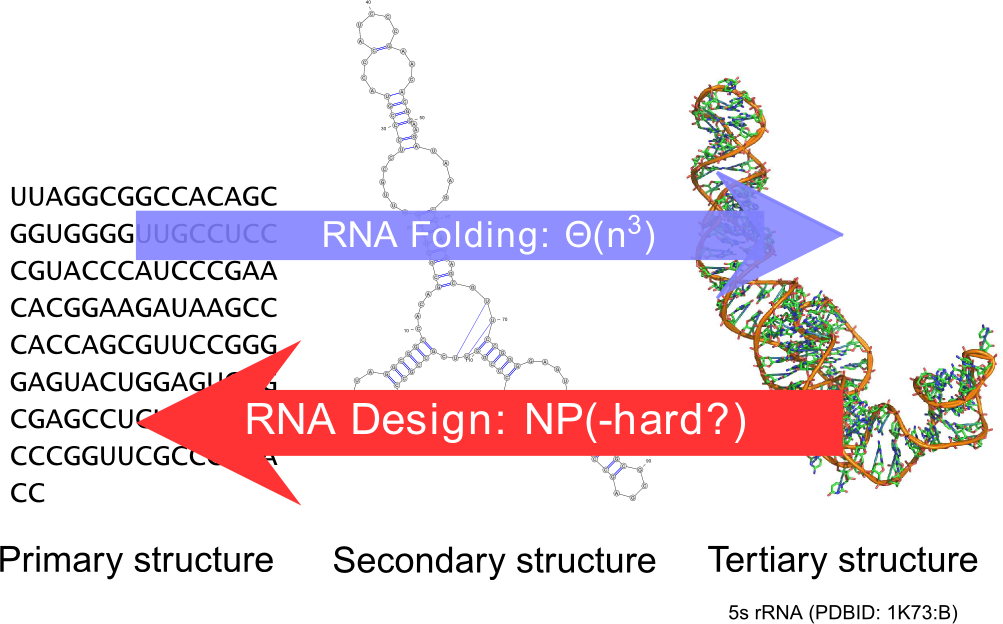
	1. </strong>The goal of RNA design, aka RNA inverse folding, is to find a sequence that folds back into a given (secondary) structure.</caption>
            <tr align="center">
              <td>
                <table>
                  <tr>
                    <td xmlns="" style="height:3px;" align="center">
                      <img xmlns="http://www.w3.org/1999/xhtml" style="width:256.2026pt" alt="IMG/design.png" src="IMG/design.png"/>
                    </td>
                  </tr>
                </table>
              </td>
            </tr>
          </table>
        </div>
        <a name="uid8"/>
        <h4 class="titre4">RNA design.</h4>
        <p class="participants"><span class="part">Participants</span> :
	Alain Denise, Vincent Le Gallic, Yann Ponty.</p>
        <p class="bold">
          <p>Joint project with S. Vialette (Marne-la-Vallée), J. Waldispühl (McGill) and Y. Zhang (Wuhan).</p>
        </p>
        <p>It is a natural pursue to build on our understanding of the secondary structure to construct artificial RNAs performing predetermined functions, ultimately targeting therapeutic and synthetic biology applications. Towards this goal, a key element is the design of RNA sequences that fold into a predetermined secondary structure, according to established energy models (inverse-folding problem). Quite surprisingly, and despite two decades of studies of the problem, the computational complexity of the inverse-folding problem is currently unknown.</p>
        <p>Within our group, we offer a new methodology, based on weighted
random generation  <a href="./bibliography.html#amib-2014-bid4">[54]</a>  and multidimensional
Boltzmann sampling, for this
problem. Initially lifting the constraint of folding back into the
target structure, we explored the random generation of sequences that
are compatible with the target, using a probability distribution which
favors exponentially sequences of high affinity towards the target. A
simple posterior rejection step selects sequences that effectively
fold back into the latter, resulting in a <i>global sampling</i>
pipeline that showed comparable performances to its competitors based
on local search  <a href="./bibliography.html#amib-2014-bid5">[60]</a> .</p>
        <a name="uid9"/>
        <h4 class="titre4">Towards 3D modeling of large molecules</h4>
        <p class="participants"><span class="part">Participants</span> :
	Alain Denise, Mélanie Boudard.</p>
        <p class="bold">
          <p>Joint project with D. Barth (Versailles) and J. Cohen (Paris-Sud).</p>
        </p>
        <p>The modeling of large RNA 3D structures, that is predicting the
three-dimensional structure of a given RNA sequence, relies on two
complementary approaches. The approach by homology is used when the
structure of a sequence homologous to the sequence of interest has
already been resolved experimentally. The main problem then is to
calculate an alignment between the known structure and the
sequence. The ab initio approach is required when no homologous
structure is known for the sequence of interest (or for some parts of
it).
We work in both directions.</p>
        <a name="uid10"/>
        <h4 class="titre4">Statistical and robotics-inspired models for structure and dynamics</h4>
        <p class="participants"><span class="part">Participants</span> :
	Julie Bernauer, Rasmus Fonseca.</p>
        <p>Despite being able to correctly model small globular proteins, the computational structural biology community still craves for efficient force fields and scoring functions for prediction but also good sampling and dynamics strategies.</p>
        <p>Our current and future efforts towards knowledge-based scoring function and ion location prediction have been described in <a title="RNA" href="./uid5.html#uid10">
	3.1.4</a> .</p>
        <p>Over the last two decades a strong connection between robotics and computational structural biology has
emerged, in which internal coordinates of proteins are interpreted as a kinematic linkage with rotatable bonds as
joints and corresponding groups of atoms as links <a href="./bibliography.html#amib-2014-bid6">[76]</a> , <a href="./bibliography.html#amib-2014-bid7">[51]</a> , <a href="./bibliography.html#amib-2014-bid8">[64]</a> , <a href="./bibliography.html#amib-2014-bid9">[63]</a> . Initially, fragments in proteins limited to tens of residues
were modeled as a kinematic linkage, but this approach has been extended to encompass (multi-domain) proteins <a href="./bibliography.html#amib-2014-bid10">[62]</a> . For RNA, progress in this direction has been realized as well. A kinematics-based conformational sampling
algorithm, KGS, for loops was recently developed <a href="./bibliography.html#amib-2014-bid11">[58]</a> , but it does not fully utilize the potential of a kinematic model. It
breaks and recloses loops using six torsional degrees of freedom, which results in a finite number of solutions. The
discrete nature of the solution set in the conformational space makes
difficult an optimization of a target function with a gradient
descent method. Our methods overcome this limitation by performing a conformational sampling
and optimization in a co-dimension 6 subspace. Fragments remain
closed, but these methods are limited to proteins.
Our objective is to extend the approach proposed in <a href="./bibliography.html#amib-2014-bid11">[58]</a> , <a href="./bibliography.html#amib-2014-bid6">[76]</a>  to nucleic acids and protein/nucleic acid complexes
with a view towards improving structure determination of nucleic acids and their complexes and in silico docking
experiments of protein/RNA complexes.
For that purpose, we have developed a generic strategy for differentiable statistical potentials <a href="./bibliography.html#amib-2014-bid12">[2]</a> , <a href="./bibliography.html#amib-2014-bid13">[74]</a>  that can be directly integrated in the procedure.</p>
        <p>Results from in silico docking experiments will also directly benefit
structure determination of complexes which, in turn, will provide structural insights in nucleic acid and
protein/nucleic acid complexes.
From the small proof-of-concept single chain protein implementation of the KGS strategy, we have developed a robust preliminary implementation that can handle RNA and will be further developed to account for multi-chain molecules. Rasmus Fonseca, post-doctoral scholar in the project is currently performing an extensive computational and biological validation.</p>
      </div>
      <!--FIN du corps du module-->
      <br/>
      <div class="bottomNavigation">
        <div class="tail_aucentre">
          <a href="./uid3.html" accesskey="P"><img style="align:bottom; border:none" alt="previous" src="../static/img/icons/previous_motif.jpg"/> Previous | </a>
          <a href="./uid0.html" accesskey="U"><img style="align:bottom; border:none" alt="up" src="../static/img/icons/up_motif.jpg"/>  Home</a>
          <a href="./uid11.html" accesskey="N"> | Next <img style="align:bottom; border:none" alt="next" src="../static/img/icons/next_motif.jpg"/></a>
        </div>
        <br/>
      </div>
    </div>
  </body>
</html>