<?xml version="1.0" encoding="utf-8"?>
<!DOCTYPE html PUBLIC "-//W3C//DTD XHTML 1.1 plus MathML 2.0 plus SVG 1.1//EN" "http://www.w3.org/2002/04/xhtml-math-svg/xhtml-math-svg.dtd">
<html xmlns="http://www.w3.org/1999/xhtml">
  <head>
    <meta http-equiv="Content-Type" content="application/xhtml+xml; charset=utf-8"/>
    <title>Project-Team:ABS</title>
    <link rel="stylesheet" href="../static/css/raweb.css" type="text/css"/>
    <meta name="description" content="Overall Objectives - Overall Objectives"/>
    <meta name="dc.title" content="Overall Objectives - Overall Objectives"/>
    <meta name="dc.subject" content=""/>
    <meta name="dc.publisher" content="INRIA"/>
    <meta name="dc.date" content="(SCHEME=ISO8601) 2015-01"/>
    <meta name="dc.type" content="Report"/>
    <meta name="dc.language" content="(SCHEME=ISO639-1) en"/>
    <meta name="projet" content="ABS"/>
    <!-- Piwik -->
    <script type="text/javascript" src="/rapportsactivite/piwik.js"></script>
    <noscript><p><img src="//piwik.inria.fr/piwik.php?idsite=49" style="border:0;" alt="" /></p></noscript>
    <!-- End Piwik Code -->
  </head>
  <body>
    <div class="tdmdiv">
      <div class="logo">
        <a href="http://www.inria.fr">
          <img style="align:bottom; border:none" src="../static/img/icons/logo_INRIA-coul.jpg" alt="Inria"/>
        </a>
      </div>
      <div class="TdmEntry">
        <div class="tdmentete">
          <a href="uid0.html">Project-Team Abs</a>
        </div>
        <span>
          <a href="uid1.html">Members</a>
        </span>
      </div>
      <div class="tdmActPage">
        <a href="./uid3.html">Overall Objectives</a>
      </div>
      <div class="TdmEntry">Research Program<ul><li><a href="uid6.html&#10;&#9;&#9;  ">Introduction</a></li><li><a href="uid7.html&#10;&#9;&#9;  ">Modeling Interfaces and Contacts</a></li><li><a href="uid10.html&#10;&#9;&#9;  ">Modeling Macro-molecular Assemblies</a></li><li><a href="uid13.html&#10;&#9;&#9;  ">Modeling the Flexibility of Macro-molecules</a></li><li><a href="uid15.html&#10;&#9;&#9;  ">Algorithmic Foundations</a></li></ul></div>
      <div class="TdmEntry">
        <a href="./uid20.html">Highlights of the Year</a>
      </div>
      <div class="TdmEntry">New Software and Platforms<ul><li><a href="uid25.html&#10;&#9;&#9;  ">The Structural Bioinformatics Library</a></li></ul></div>
      <div class="TdmEntry">New Results<ul><li><a href="uid58.html&#10;&#9;&#9;  ">Modeling Interfaces and Contacts</a></li><li><a href="uid61.html&#10;&#9;&#9;  ">Modeling Macro-molecular Assemblies</a></li><li><a href="uid63.html&#10;&#9;&#9;  ">Modeling the Flexibility of
Macro-molecules</a></li><li><a href="uid65.html&#10;&#9;&#9;  ">Algorithmic Foundations</a></li></ul></div>
      <div class="TdmEntry">Partnerships and Cooperations<ul><li><a href="uid69.html&#10;&#9;&#9;  ">National Initiatives</a></li><li><a href="uid77.html&#10;&#9;&#9;  ">International Research Visitors</a></li></ul></div>
      <div class="TdmEntry">Dissemination<ul><li><a href="uid83.html&#10;&#9;&#9;  ">Promoting Scientific Activities</a></li><li><a href="uid97.html&#10;&#9;&#9;  ">Teaching - Supervision - Juries</a></li><li><a href="uid112.html&#10;&#9;&#9;  ">Popularization</a></li></ul></div>
      <div class="TdmEntry">
        <div>Bibliography</div>
      </div>
      <div class="TdmEntry">
        <ul>
          <li>
            <a id="tdmbibentmajor" href="bibliography.html">Major publications</a>
          </li>
          <li>
            <a id="tdmbibentyear" href="bibliography.html#year">Publications of the year</a>
          </li>
          <li>
            <a id="tdmbibentfoot" href="bibliography.html#References">References in notes</a>
          </li>
        </ul>
      </div>
    </div>
    <div id="main">
      <div class="mainentete">
        <div id="head_agauche">
          <small><a href="http://www.inria.fr">
	    
	    Inria
	  </a> | <a href="../index.html">
	    
	    Raweb 
	    2015</a> | <a href="http://www.inria.fr/en/teams/abs">Presentation of the Project-Team ABS</a> | <a href="http://team.inria.fr/abs/">ABS Web Site
	  </a></small>
        </div>
        <div id="head_adroite">
          <table class="qrcode">
            <tr>
              <td>
                <a href="abs.xml">
                  <img style="align:bottom; border:none" alt="XML" src="../static/img/icons/xml_motif.png"/>
                </a>
              </td>
              <td>
                <a href="abs.pdf">
                  <img style="align:bottom; border:none" alt="PDF" src="IMG/qrcode-abs-pdf.png"/>
                </a>
              </td>
              <td>
                <a href="../abs/abs.epub">
                  <img style="align:bottom; border:none" alt="e-pub" src="IMG/qrcode-abs-epub.png"/>
                </a>
              </td>
            </tr>
            <tr>
              <td/>
              <td>PDF
</td>
              <td>e-Pub
</td>
            </tr>
          </table>
        </div>
      </div>
      <!--FIN du corps du module-->
      <br/>
      <div class="bottomNavigation">
        <div class="tail_aucentre">
          <a href="./uid1.html" accesskey="P"><img style="align:bottom; border:none" alt="previous" src="../static/img/icons/previous_motif.jpg"/> Previous | </a>
          <a href="./uid0.html" accesskey="U"><img style="align:bottom; border:none" alt="up" src="../static/img/icons/up_motif.jpg"/>  Home</a>
          <a href="./uid6.html" accesskey="N"> | Next <img style="align:bottom; border:none" alt="next" src="../static/img/icons/next_motif.jpg"/></a>
        </div>
        <br/>
      </div>
      <div id="textepage">
        <!--DEBUT2 du corps du module-->
        <h2>Section: 
      Overall Objectives</h2>
        <h3 class="titre3">Overall Objectives</h3>
        <p class="notaparagraph"><b>Computational Biology and Computational Structural Biology.</b>
Understanding the lineage between species and the genetic drift of
genes and genomes, apprehending the control and feed-back loops
governing the behavior of a cell, a tissue, an organ or a body, and
inferring the relationship between the structure of biological
(macro)-molecules and their functions are amongst the major challenges
of modern biology. The investigation of these challenges is
supported by three types of data: genomic data, transcription and
expression data, and structural data.</p>
        <p>Genetic data feature sequences of nucleotides on DNA and RNA
molecules, and are symbolic data whose processing falls in the realm
of Theoretical Computer Science: dynamic programming, algorithms on
texts and strings, graph theory dedicated to phylogenetic problems.
Transcription and expression data feature evolving concentrations of
molecules (RNAs, proteins, metabolites) over time, and fit in the formalism of
discrete and continuous dynamical systems, and of graph theory. The
exploration and the modeling of these data are covered by a rapidly
expanding research field termed <i>systems biology</i>.
Structural data encode informations about the 3D structures of
molecules (nucleic acids (DNA, RNA), proteins, small molecules) and their
interactions, and come from three main sources: X ray
crystallography, NMR spectroscopy, cryo Electron Microscopy.
Ultimately, structural data should expand our understanding of how the
structure accounts for the function of macro-molecules – one of the
central questions in structural biology. This goal actually subsumes
two equally difficult challenges, which are <i>folding</i> – the
process through which a protein adopts its 3D structure, and <i>docking</i> – the process through which two or several molecules
assemble. Folding and docking are driven by non covalent interactions,
and for complex systems, are actually inter-twined
<a href="./bibliography.html#abs-2015-bid0">[45]</a> .
Apart from the bio-physical interests raised by these processes, two
different application domains are concerned: in fundamental biology,
one is primarily interested in understanding the machinery of the
cell; in medicine, applications to drug design are developed.</p>
        <p class="notaparagraph"><b>Modeling in Computational Structural Biology.</b>
Acquiring structural data is not always possible: NMR is restricted to
relatively small molecules; membrane proteins do not crystallize, etc.
As a matter of fact, the order of magnitude of the number of
genomes sequenced is of the order of one thousand, which results in
circa one million of genes recorded in the manually curated
Swiss-Prot database.
On the other hand, the Protein Data Bank contains circa 90,000
structures. Thus, the paucity of structures with respect to the known
number of genes calls for modeling in structural biology, so as to
foster our understanding of the structure-to-function relationship.</p>
        <p>Ideally, bio-physical models of macro-molecules should resort to
quantum mechanics. While this is possible for small systems, say up to
50 atoms, large systems are investigated within the framework of the
Born-Oppenheimer approximation which stipulates the nuclei and the
electron cloud can be decoupled.
Example force fields developed in this realm are AMBER, CHARMM, OPLS.
Of particular importance are Van der Waals models, where each atom is
modeled by a sphere whose radius depends on the atom chemical type.
From an historical perspective, Richards
<a href="./bibliography.html#abs-2015-bid1">[43]</a> , <a href="./bibliography.html#abs-2015-bid2">[32]</a>  and later Connolly
<a href="./bibliography.html#abs-2015-bid3">[28]</a> , while defining molecular surfaces and
developing algorithms to compute them, established the connexions
between molecular modeling and geometric constructions. Remarkably, a
number of difficult problems (e.g. additively weighted Voronoi
diagrams) were touched upon in these early days.</p>
        <p>The models developed in this vein are instrumental in investigating
the interactions of molecules for which no structural data is
available. But such models often fall short from providing complete
answers, which we illustrate with the folding problem. On one hand, as
the conformations of side-chains belong to discrete sets (the
so-called rotamers or rotational isomers) <a href="./bibliography.html#abs-2015-bid4">[34]</a> ,
the number of distinct conformations of a poly-peptidic chain is
exponential in the number of amino-acids. On the other hand, Nature
folds proteins within time scales ranging from milliseconds to hours,
while time-steps used in molecular dynamics simulations are of the
order of the femto-second, so that biologically relevant time-scales
are out reach for simulations. The fact that Nature avoids the
exponential trap is known as Levinthal's paradox.
The intrinsic difficulty of problems calls for models exploiting
several classes of informations. For small systems, <i>ab initio</i>
models can be built from first principles. But for more complex
systems, <i>homology</i> or template-based models integrating a variable amount of
knowledge acquired on similar systems are resorted to.</p>
        <p>The variety of approaches developed are illustrated by the two
community wide experiments CASP (<i>Critical Assessment of Techniques
for Protein Structure Prediction</i>; <a href="http://predictioncenter.org">http://predictioncenter.org</a> ) and
CAPRI (<i>Critical Assessment of Prediction of Interactions</i>;
<a href="http://capri.ebi.ac.uk">http://capri.ebi.ac.uk</a> ), which allow models and prediction algorithms
to be compared to experimentally resolved structures.</p>
        <p>As illustrated by the previous discussion, modeling macro-molecules
touches upon biology, physics and chemistry, as well as
mathematics and computer science. In the following, we present the
topics investigated within <span class="smallcap">ABS </span>.</p>
        <div align="center" style="margin-top:10px">
          <a name="uid4">
            <!--...-->
          </a>
          <table title="" class="objectContainer">
            <caption align="bottom"><strong>Figure
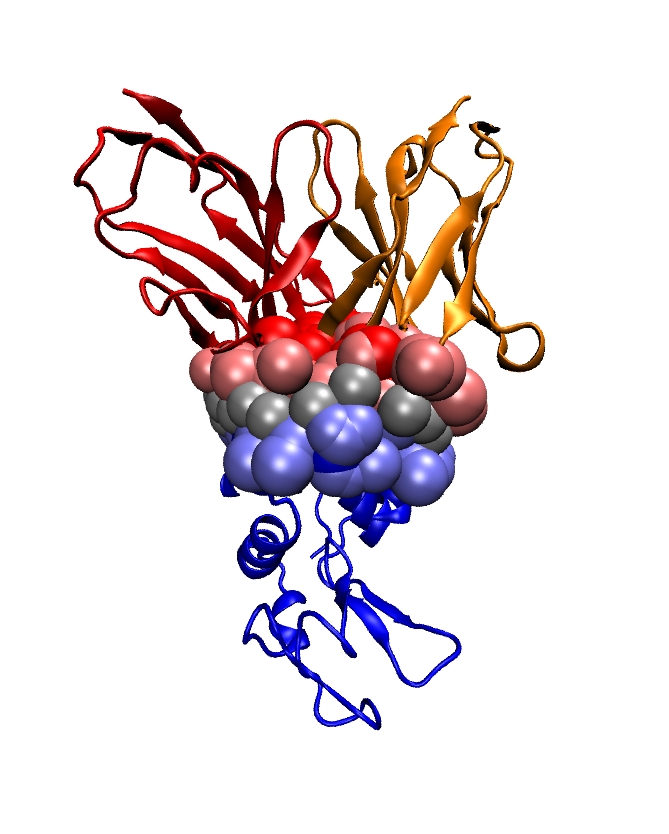
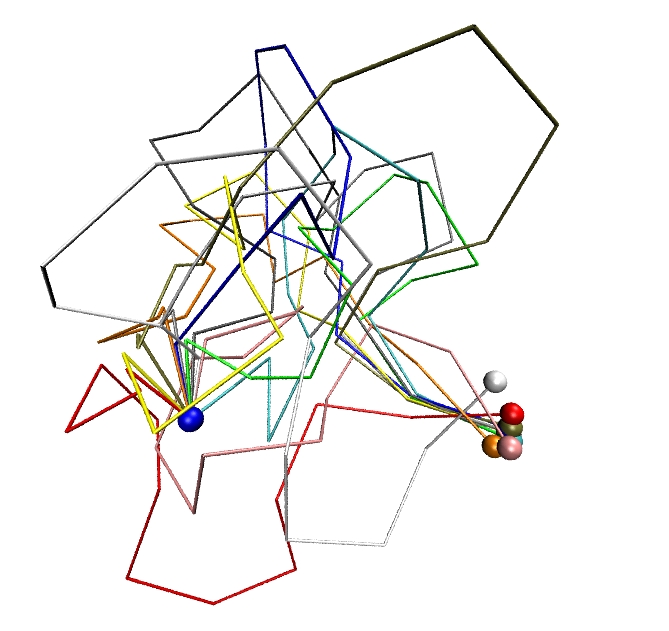
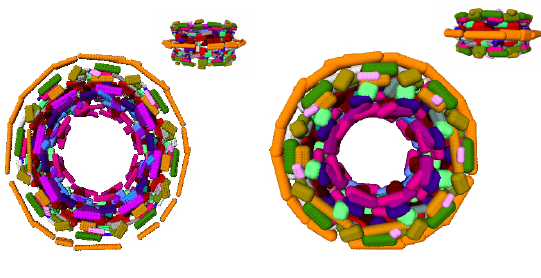
	1. </strong><b>Geometric constructions in computational structural biology.</b>
(a) An antibody-antigen complex, with interface atoms
identified by our Voronoi based interface
model <a href="./bibliography.html#abs-2015-bid5">[3]</a> . This model is
instrumental in mining correlations between structural and
biological as well as biophysical properties of protein complexes.
(b) A diverse set of conformations of a backbone loop, selected
thanks to a geometric optimization algorithm
<a href="./bibliography.html#abs-2015-bid6">[10]</a> . Such conformations are used by mean field
theory based docking algorithms.
(c) A toleranced model (TOM) of the nuclear pore complex, visualized at two
different scales <a href="./bibliography.html#abs-2015-bid7">[9]</a> . The parameterized family of
shapes coded by a TOM is instrumental to identify stable properties
of the underlying macro-molecular system.</caption>
            <tr align="center">
              <td>
                <table>
                  <caption>
                    <!--...-->
                  </caption>
                  <tr>
                    <td xmlns="" style="height:3px;text-align:center;" align="center">
                      <img xmlns="http://www.w3.org/1999/xhtml" style="height:99.58464pt" alt="IMG/1vfb_chains_iatoms.jpg" src="IMG/1vfb_chains_iatoms.jpg"/>
                    </td>
                    <td xmlns="" style="height:3px;text-align:center;" align="center">
                      <img xmlns="http://www.w3.org/1999/xhtml" style="height:99.58464pt" alt="IMG/conformers_1BTH_77-86__backbones10-20.jpg" src="IMG/conformers_1BTH_77-86__backbones10-20.jpg"/>
                    </td>
                    <td xmlns="" style="height:3px;text-align:center;" align="center">
                      <img xmlns="http://www.w3.org/1999/xhtml" style="height:99.58464pt" alt="IMG/Toleranced-model-canonical-configurations_subfig_pict.png" src="IMG/Toleranced-model-canonical-configurations_subfig_pict.png"/>
                    </td>
                  </tr>
                  <tr>
                    <td xmlns="" style="text-align:center;">(a)</td>
                    <td xmlns="" style="text-align:center;">(b)</td>
                    <td xmlns="" style="text-align:center;">(c)</td>
                  </tr>
                </table>
              </td>
            </tr>
          </table>
        </div>
      </div>
      <!--FIN du corps du module-->
      <br/>
      <div class="bottomNavigation">
        <div class="tail_aucentre">
          <a href="./uid1.html" accesskey="P"><img style="align:bottom; border:none" alt="previous" src="../static/img/icons/previous_motif.jpg"/> Previous | </a>
          <a href="./uid0.html" accesskey="U"><img style="align:bottom; border:none" alt="up" src="../static/img/icons/up_motif.jpg"/>  Home</a>
          <a href="./uid6.html" accesskey="N"> | Next <img style="align:bottom; border:none" alt="next" src="../static/img/icons/next_motif.jpg"/></a>
        </div>
        <br/>
      </div>
    </div>
  </body>
</html>