<?xml version="1.0" encoding="utf-8"?>
<!DOCTYPE html PUBLIC "-//W3C//DTD XHTML 1.1 plus MathML 2.0 plus SVG 1.1//EN" "http://www.w3.org/2002/04/xhtml-math-svg/xhtml-math-svg.dtd">
<html xmlns="http://www.w3.org/1999/xhtml">
  <head>
    <meta http-equiv="Content-Type" content="application/xhtml+xml; charset=utf-8"/>
    <title>Team:CAMUS</title>
    <link rel="stylesheet" href="../static/css/raweb.css" type="text/css"/>
    <meta name="description" content="Research Program - Research Directions"/>
    <meta name="dc.title" content="Research Program - Research Directions"/>
    <meta name="dc.subject" content=""/>
    <meta name="dc.publisher" content="INRIA"/>
    <meta name="dc.date" content="(SCHEME=ISO8601) 2015-01"/>
    <meta name="dc.type" content="Report"/>
    <meta name="dc.language" content="(SCHEME=ISO639-1) en"/>
    <meta name="projet" content="CAMUS"/>
    <!-- Piwik -->
    <script type="text/javascript" src="/rapportsactivite/piwik.js"></script>
    <noscript><p><img src="//piwik.inria.fr/piwik.php?idsite=49" style="border:0;" alt="" /></p></noscript>
    <!-- End Piwik Code -->
  </head>
  <body>
    <div class="tdmdiv">
      <div class="logo">
        <a href="http://www.inria.fr">
          <img style="align:bottom; border:none" src="../static/img/icons/logo_INRIA-coul.jpg" alt="Inria"/>
        </a>
      </div>
      <div class="TdmEntry">
        <div class="tdmentete">
          <a href="uid0.html">Team Camus</a>
        </div>
        <span>
          <a href="uid1.html">Members</a>
        </span>
      </div>
      <div class="TdmEntry">
        <a href="./uid3.html">Overall Objectives</a>
      </div>
      <div class="TdmEntry">Research Program<ul><li class="tdmActPage"><a href="uid5.html&#10;&#9;&#9;  ">Research Directions</a></li><li><a href="uid11.html&#10;&#9;&#9;  ">Static Parallelization and Optimization</a></li><li><a href="uid12.html&#10;&#9;&#9;  ">Profiling and Execution Behavior Modeling</a></li><li><a href="uid13.html&#10;&#9;&#9;  ">Dynamic Parallelization and Optimization, Virtual Machine</a></li><li><a href="uid14.html&#10;&#9;&#9;  ">Proof of Program Transformations for Multicores</a></li></ul></div>
      <div class="TdmEntry">Application Domains<ul><li><a href="uid16.html&#10;&#9;&#9;  ">Application Domains</a></li></ul></div>
      <div class="TdmEntry">
        <a href="./uid20.html">Highlights of the Year</a>
      </div>
      <div class="TdmEntry">New Software and Platforms<ul><li><a href="uid22.html&#10;&#9;&#9;  ">APOLLO</a></li><li><a href="uid25.html&#10;&#9;&#9;  ">CLooG</a></li><li><a href="uid29.html&#10;&#9;&#9;  ">Clan</a></li><li><a href="uid33.html&#10;&#9;&#9;  ">Clay</a></li><li><a href="uid37.html&#10;&#9;&#9;  ">IBB</a></li><li><a href="uid40.html&#10;&#9;&#9;  ">XFOR-Wizard</a></li><li><a href="uid43.html&#10;&#9;&#9;  ">XFORGEN</a></li><li><a href="uid46.html&#10;&#9;&#9;  ">OpenScop</a></li><li><a href="uid50.html&#10;&#9;&#9;  ">ORWL and P99</a></li><li><a href="uid54.html&#10;&#9;&#9;  ">stdatomic and musl</a></li><li><a href="uid62.html&#10;&#9;&#9;  ">PolyLib</a></li></ul></div>
      <div class="TdmEntry">New Results<ul><li><a href="uid67.html&#10;&#9;&#9;  ">Formal Proofs for an Ordering
Relation in Explicitly Parallel Programs</a></li><li><a href="uid68.html&#10;&#9;&#9;  ">Validity Conditions for
Transformations of Non-Affine Programs</a></li><li><a href="uid69.html&#10;&#9;&#9;  ">Automatic Parallelization of Nonlinear Loops</a></li><li><a href="uid70.html&#10;&#9;&#9;  ">Dynamic Code Generation for Speculative Polyhedral Optimization</a></li><li><a href="uid71.html&#10;&#9;&#9;  ">The XFOR Programming Structure</a></li><li><a href="uid74.html&#10;&#9;&#9;  ">Dynamic Optimization of Binary Code</a></li><li><a href="uid95.html&#10;&#9;&#9;  ">Combining Locking and Data Management Interfaces</a></li><li><a href="uid96.html&#10;&#9;&#9;  ">Efficient Execution of Polyhedral Codes on GPU and CPU+GPU Systems</a></li><li><a href="uid97.html&#10;&#9;&#9;  ">Interactive Code Restructuring</a></li><li><a href="uid98.html&#10;&#9;&#9;  ">Automatic Generation of Adaptive Simulation Codes</a></li><li><a href="uid99.html&#10;&#9;&#9;  ">Polyhedral Compiler White-Boxing</a></li></ul></div>
      <div class="TdmEntry">Bilateral Contracts and Grants with Industry<ul><li><a href="uid101.html&#10;&#9;&#9;  ">Bilateral Contracts with Industry</a></li></ul></div>
      <div class="TdmEntry">Partnerships and Cooperations<ul><li><a href="uid103.html&#10;&#9;&#9;  ">National Initiatives</a></li><li><a href="uid105.html&#10;&#9;&#9;  ">International Initiatives</a></li><li><a href="uid116.html&#10;&#9;&#9;  ">International Research Visitors</a></li></ul></div>
      <div class="TdmEntry">Dissemination<ul><li><a href="uid119.html&#10;&#9;&#9;  ">Promoting Scientific Activities</a></li><li><a href="uid130.html&#10;&#9;&#9;  ">Teaching - Supervision - Juries</a></li><li><a href="uid175.html&#10;&#9;&#9;  ">Popularization</a></li></ul></div>
      <div class="TdmEntry">
        <div>Bibliography</div>
      </div>
      <div class="TdmEntry">
        <ul>
          <li>
            <a id="tdmbibentmajor" href="bibliography.html">Major publications</a>
          </li>
          <li>
            <a id="tdmbibentyear" href="bibliography.html#year">Publications of the year</a>
          </li>
          <li>
            <a id="tdmbibentfoot" href="bibliography.html#References">References in notes</a>
          </li>
        </ul>
      </div>
    </div>
    <div id="main">
      <div class="mainentete">
        <div id="head_agauche">
          <small><a href="http://www.inria.fr">
	    
	    Inria
	  </a> | <a href="../index.html">
	    
	    Raweb 
	    2015</a> | <a href="http://www.inria.fr/en/teams/camus">Presentation of the Team CAMUS</a> | <a href="http://team.inria.fr/camus/">CAMUS Web Site
	  </a></small>
        </div>
        <div id="head_adroite">
          <table class="qrcode">
            <tr>
              <td>
                <a href="camus.xml">
                  <img style="align:bottom; border:none" alt="XML" src="../static/img/icons/xml_motif.png"/>
                </a>
              </td>
              <td>
                <a href="camus.pdf">
                  <img style="align:bottom; border:none" alt="PDF" src="IMG/qrcode-camus-pdf.png"/>
                </a>
              </td>
              <td>
                <a href="../camus/camus.epub">
                  <img style="align:bottom; border:none" alt="e-pub" src="IMG/qrcode-camus-epub.png"/>
                </a>
              </td>
            </tr>
            <tr>
              <td/>
              <td>PDF
</td>
              <td>e-Pub
</td>
            </tr>
          </table>
        </div>
      </div>
      <!--FIN du corps du module-->
      <br/>
      <div class="bottomNavigation">
        <div class="tail_aucentre">
          <a href="./uid3.html" accesskey="P"><img style="align:bottom; border:none" alt="previous" src="../static/img/icons/previous_motif.jpg"/> Previous | </a>
          <a href="./uid0.html" accesskey="U"><img style="align:bottom; border:none" alt="up" src="../static/img/icons/up_motif.jpg"/>  Home</a>
          <a href="./uid11.html" accesskey="N"> | Next <img style="align:bottom; border:none" alt="next" src="../static/img/icons/next_motif.jpg"/></a>
        </div>
        <br/>
      </div>
      <div id="textepage">
        <!--DEBUT2 du corps du module-->
        <h2>Section: 
      Research Program</h2>
        <h3 class="titre3">Research Directions</h3>
        <p>The various objectives we are expecting to reach are directly related to the search of adequacy between the sofware and the new multicore processors evolution. They also correspond to the main research directions suggested by Hall, Padua and Pingali in <a href="./bibliography.html#camus-2015-bid0">[31]</a> . Performance, correction and productivity must be the users' perceived effects. They will be the consequences of research works dealing with the following issues:</p>
        <ul>
          <li>
            <p class="notaparagraph"><a name="uid6"> </a>Issue 1: Static Parallelization and Optimization</p>
          </li>
          <li>
            <p class="notaparagraph"><a name="uid7"> </a>Issue 2: Profiling and Execution Behavior Modeling</p>
          </li>
          <li>
            <p class="notaparagraph"><a name="uid8"> </a>Issue 3: Dynamic Program Parallelization and Optimization, Virtual Machine</p>
          </li>
          <li>
            <p class="notaparagraph"><a name="uid9"> </a>Issue 4: Proof of program transformations for multicores</p>
          </li>
        </ul>
        <p>Efficient and correct applications development for multicore processors needs stepping in every application development phase, from the initial conception to the final run.</p>
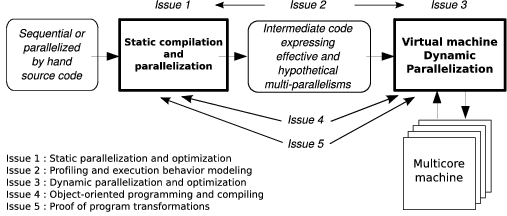
        <p>Upstream, all potential parallelism of the application has to be exhibited. Here static analysis and transformation approaches (issue 1) must be processed, resulting in a <i>multi-parallel</i> intermediate code advising the running virtual machine about all the parallelism that can be taken advantage of. However the compiler does not have much knowledge about the execution environment. It obviously knows the instruction set, it can be aware of the number of available cores, but it does not know the effective available resources at any time during the execution (memory, number of free cores, etc.).</p>
        <p>That is the reason why a “virtual machine” mechanism will have to adapt the application to the resources (issue 3). Moreover the compiler will be able to take advantage only of a part of the parallelism induced by the application. Indeed some program information (variables values, accessed memory adresses, etc.) being available only at runtime, another part of the available parallelism will have to be generated on-the-fly during the execution, here also, thanks to a dynamic mechanism.</p>
        <p>This on-the-fly parallelism extraction will be performed using speculative behavior models (issue 2), such models allowing to generate speculative parallel code (issue 3). Between our behavior modeling objectives, we can add the behavior monitoring, or profiling, of a program version. Indeed current and future architectures complexity avoids assuming an optimal behavior regarding a given program version. A monitoring process will allow to select on-the-fly the best parallelization.</p>
        <p>These different parallelizing steps are schematized on figure <a title="Research Directions" href="./uid5.html#uid10">1</a> .</p>
        <div align="center" style="margin-top:10px">
          <a name="uid10">
            <!--...-->
          </a>
          <table title="" class="objectContainer">
            <caption align="bottom"><strong>Figure
	1. </strong>Automatic parallelizing steps for multicore architectures</caption>
            <tr align="center">
              <td>
                <table>
                  <tr>
                    <td xmlns="" style="height:3px;" align="center">
                      <img xmlns="http://www.w3.org/1999/xhtml" style="height:142.26378pt" alt="IMG/figure_anglais.png" src="IMG/figure_anglais.png"/>
                    </td>
                  </tr>
                </table>
              </td>
            </tr>
          </table>
        </div>
        <p>Our project lies on the conception of a production chain for efficient execution of an application on a multicore architecture. Each link of this chain has to be formally verified in order to ensure correction as well as efficiency. More precisely, it has to be ensured that the compiler produces a correct intermediate code, and that the virtual machine actually performs the parallel execution semantically equivalent to the source code: every transformation applied to the application, either statically by the compiler or dynamically by the virtual machine, must preserve the initial semantics. They must be proved formally (issue 4).</p>
        <p>In the following, those different issues are detailed while forming our global and long term vision of what has to be done.</p>
      </div>
      <!--FIN du corps du module-->
      <br/>
      <div class="bottomNavigation">
        <div class="tail_aucentre">
          <a href="./uid3.html" accesskey="P"><img style="align:bottom; border:none" alt="previous" src="../static/img/icons/previous_motif.jpg"/> Previous | </a>
          <a href="./uid0.html" accesskey="U"><img style="align:bottom; border:none" alt="up" src="../static/img/icons/up_motif.jpg"/>  Home</a>
          <a href="./uid11.html" accesskey="N"> | Next <img style="align:bottom; border:none" alt="next" src="../static/img/icons/next_motif.jpg"/></a>
        </div>
        <br/>
      </div>
    </div>
  </body>
</html>