<?xml version="1.0" encoding="utf-8"?>
<!DOCTYPE html PUBLIC "-//W3C//DTD XHTML 1.1 plus MathML 2.0 plus SVG 1.1//EN" "http://www.w3.org/2002/04/xhtml-math-svg/xhtml-math-svg.dtd">
<html xmlns="http://www.w3.org/1999/xhtml">
  <head>
    <meta http-equiv="Content-Type" content="application/xhtml+xml; charset=utf-8"/>
    <title>Project-Team:GRAPHDECO</title>
    <link rel="stylesheet" href="../static/css/raweb.css" type="text/css"/>
    <meta name="description" content="New Results - Computer-Assisted Design with Heterogeneous Representations"/>
    <meta name="dc.title" content="New Results - Computer-Assisted Design with Heterogeneous Representations"/>
    <meta name="dc.creator" content="Adrien Bousseau"/>
    <meta name="dc.creator" content="Emmanuel Iarussi"/>
    <meta name="dc.creator" content="Adrien Bousseau"/>
    <meta name="dc.creator" content="Adrien Bousseau"/>
    <meta name="dc.creator" content="Emmanuel Iarussi"/>
    <meta name="dc.creator" content="Adrien Bousseau"/>
    <meta name="dc.creator" content="Adrien Bousseau"/>
    <meta name="dc.creator" content="Adrien Bousseau"/>
    <meta name="dc.creator" content="Adrien Bousseau"/>
    <meta name="dc.creator" content="Johanna Delanoy"/>
    <meta name="dc.creator" content="Adrien Bousseau"/>
    <meta name="dc.subject" content=""/>
    <meta name="dc.publisher" content="INRIA"/>
    <meta name="dc.date" content="(SCHEME=ISO8601) 2015-01"/>
    <meta name="dc.type" content="Report"/>
    <meta name="dc.language" content="(SCHEME=ISO639-1) en"/>
    <meta name="projet" content="GRAPHDECO"/>
    <!-- Piwik -->
    <script type="text/javascript" src="/rapportsactivite/piwik.js"></script>
    <noscript><p><img src="//piwik.inria.fr/piwik.php?idsite=49" style="border:0;" alt="" /></p></noscript>
    <!-- End Piwik Code -->
  </head>
  <body>
    <div class="tdmdiv">
      <div class="logo">
        <a href="http://www.inria.fr">
          <img style="align:bottom; border:none" src="../static/img/icons/logo_INRIA-coul.jpg" alt="Inria"/>
        </a>
      </div>
      <div class="TdmEntry">
        <div class="tdmentete">
          <a href="uid0.html">Project-Team Graphdeco</a>
        </div>
        <span>
          <a href="uid1.html">Members</a>
        </span>
      </div>
      <div class="TdmEntry">Overall Objectives<ul><li><a href="./uid3.html">General Presentation</a></li></ul></div>
      <div class="TdmEntry">Research Program<ul><li><a href="uid8.html&#10;&#9;&#9;  ">Introduction</a></li></ul></div>
      <div class="TdmEntry">Application Domains<ul><li><a href="uid18.html&#10;&#9;&#9;  ">Application Domains</a></li></ul></div>
      <div class="TdmEntry">
        <a href="./uid20.html">Highlights of the Year</a>
      </div>
      <div class="TdmEntry">New Software and Platforms<ul><li><a href="uid22.html&#10;&#9;&#9;  ">SWARPI</a></li><li><a href="uid25.html&#10;&#9;&#9;  ">SWARPI-Unity</a></li><li><a href="uid28.html&#10;&#9;&#9;  ">SWARPI2-IBR-COMMON</a></li><li><a href="uid31.html&#10;&#9;&#9;  ">CrossShade</a></li><li><a href="uid34.html&#10;&#9;&#9;  ">True2Form</a></li></ul></div>
      <div class="TdmEntry">New Results<ul><li class="tdmActPage"><a href="uid38.html&#10;&#9;&#9;  ">Computer-Assisted Design with Heterogeneous Representations</a></li><li><a href="uid51.html&#10;&#9;&#9;  ">Graphics with Uncertainty and Heterogeneous Content</a></li></ul></div>
      <div class="TdmEntry">Bilateral Contracts and Grants with Industry<ul><li><a href="uid70.html&#10;&#9;&#9;  ">Bilateral Grants with Industry</a></li></ul></div>
      <div class="TdmEntry">Partnerships and Cooperations<ul><li><a href="uid72.html&#10;&#9;&#9;  ">Regional Initiatives</a></li><li><a href="uid74.html&#10;&#9;&#9;  ">National Initiatives</a></li><li><a href="uid79.html&#10;&#9;&#9;  ">European Initiatives</a></li><li><a href="uid90.html&#10;&#9;&#9;  ">International Initiatives</a></li><li><a href="uid100.html&#10;&#9;&#9;  ">International Research Visitors</a></li></ul></div>
      <div class="TdmEntry">Dissemination<ul><li><a href="uid105.html&#10;&#9;&#9;  ">Promoting Scientific Activities</a></li><li><a href="uid115.html&#10;&#9;&#9;  ">Teaching - Supervision - Juries</a></li><li><a href="uid131.html&#10;&#9;&#9;  ">Popularization</a></li></ul></div>
      <div class="TdmEntry">
        <div>Bibliography</div>
      </div>
      <div class="TdmEntry">
        <ul>
          <li>
            <a id="tdmbibentyear" href="bibliography.html">Publications of the year</a>
          </li>
        </ul>
      </div>
    </div>
    <div id="main">
      <div class="mainentete">
        <div id="head_agauche">
          <small><a href="http://www.inria.fr">
	    
	    Inria
	  </a> | <a href="../index.html">
	    
	    Raweb 
	    2015</a> | <a href="http://www.inria.fr/en/teams/graphdeco">Presentation of the Project-Team GRAPHDECO</a> | <a href="https://team.inria.fr/graphdeco/">GRAPHDECO Web Site
	  </a></small>
        </div>
        <div id="head_adroite">
          <table class="qrcode">
            <tr>
              <td>
                <a href="graphdeco.xml">
                  <img style="align:bottom; border:none" alt="XML" src="../static/img/icons/xml_motif.png"/>
                </a>
              </td>
              <td>
                <a href="graphdeco.pdf">
                  <img style="align:bottom; border:none" alt="PDF" src="IMG/qrcode-graphdeco-pdf.png"/>
                </a>
              </td>
              <td>
                <a href="../graphdeco/graphdeco.epub">
                  <img style="align:bottom; border:none" alt="e-pub" src="IMG/qrcode-graphdeco-epub.png"/>
                </a>
              </td>
            </tr>
            <tr>
              <td/>
              <td>PDF
</td>
              <td>e-Pub
</td>
            </tr>
          </table>
        </div>
      </div>
      <!--FIN du corps du module-->
      <br/>
      <div class="bottomNavigation">
        <div class="tail_aucentre">
          <a href="./uid34.html" accesskey="P"><img style="align:bottom; border:none" alt="previous" src="../static/img/icons/previous_motif.jpg"/> Previous | </a>
          <a href="./uid0.html" accesskey="U"><img style="align:bottom; border:none" alt="up" src="../static/img/icons/up_motif.jpg"/>  Home</a>
          <a href="./uid51.html" accesskey="N"> | Next <img style="align:bottom; border:none" alt="next" src="../static/img/icons/next_motif.jpg"/></a>
        </div>
        <br/>
      </div>
      <div id="textepage">
        <!--DEBUT2 du corps du module-->
        <h2>Section: 
      New Results</h2>
        <h3 class="titre3">Computer-Assisted Design with Heterogeneous Representations</h3>
        <a name="uid39"/>
        <h4 class="titre4">BendFields: Regularized Curvature Fields from Rough Concept Sketches</h4>
        <p class="participants"><span class="part">Participants</span> :
	Adrien Bousseau, Emmanuel Iarussi.</p>
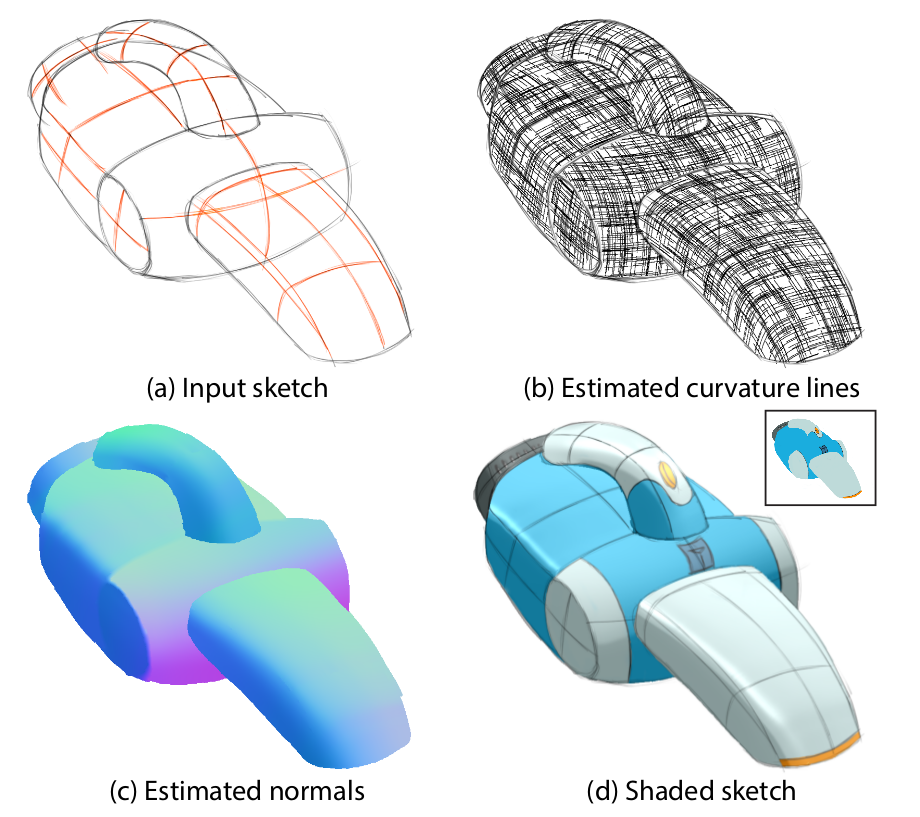
        <p>Designers frequently draw curvature lines to convey bending of smooth surfaces in concept sketches.
We present a method to extrapolate curvature lines in a rough concept sketch,
recovering the intended 3D curvature field and surface normal at each pixel of the sketch (Fig. <a title="Computer-Assisted Design with Heterogeneous Representations" href="./uid38.html#uid40">4</a> ).
This 3D information
allows us to enrich the sketch with 3D-looking shading and texturing.
We first introduce the concept of <i>regularized curvature lines</i> that model
the lines designers draw over curved surfaces, encompassing curvature lines and their extension
as geodesics over flat or umbilical regions.
We build on this concept to define the orthogonal cross field that assigns two regularized curvature lines
to each point of a 3D surface. Our algorithm first estimates the projection of this cross field
in the drawing, which is non-orthogonal due to foreshortening.
We formulate this estimation as a scattered interpolation of the strokes drawn in the sketch,
which makes our method robust to sketchy lines that are typical for design sketches.
Our interpolation relies on a novel smoothness energy that we derive from our
definition of regularized curvature lines.
Optimizing this energy subject to the stroke constraints produces a dense non-orthogonal 2D cross field,
which we then lift to 3D by imposing orthogonality.
Thus, one central concept of our approach is the generalization of existing cross field algorithms to the non-orthogonal case.
We demonstrate our algorithm on a variety of concept sketches with various levels of sketchiness.
We also compare our approach with existing work that takes clean vector drawings as input.</p>
        <p>This work is a collaboration with David Bommes from Titane project team at Inria Sophia-Antipolis, now at RWTH Aachen University.
It has been published at ACM Transactions on Graphics (TOG) <a href="./bibliography.html#graphdeco-2015-bid0">[7]</a> .</p>
        <div align="center" style="margin-top:10px">
          <a name="uid40">
            <!--...-->
          </a>
          <table title="" class="objectContainer">
            <caption align="bottom"><strong>Figure
	4. </strong>Our method <a href="./bibliography.html#graphdeco-2015-bid0">[7]</a>  takes as input a rough design sketch with annotated curvature lines (a). We propose a novel smoothness energy to propagate the curvature information to all pixels (b), which allows us to recover surface normals (c) and compute shading (d).</caption>
            <tr align="center">
              <td>
                <table>
                  <tr>
                    <td xmlns="" style="height:3px;" align="center">
                      <img xmlns="http://www.w3.org/1999/xhtml" style="width:256.2026pt" alt="IMG/bendfields.png" src="IMG/bendfields.png"/>
                    </td>
                  </tr>
                </table>
              </td>
            </tr>
          </table>
        </div>
        <a name="uid41"/>
        <h4 class="titre4">Line Drawing Interpretation in a Multi-View Context</h4>
        <p class="participants"><span class="part">Participant</span> :
	Adrien Bousseau.</p>
        <p>Many design tasks involve the creation of new objects in the context of an existing scene.
Existing work in computer vision only provides partial support for such tasks.
On the one hand, multi-view stereo algorithms allow the reconstruction of real-world scenes,
while on the other hand algorithms for line-drawing interpretation do not take
context into account.
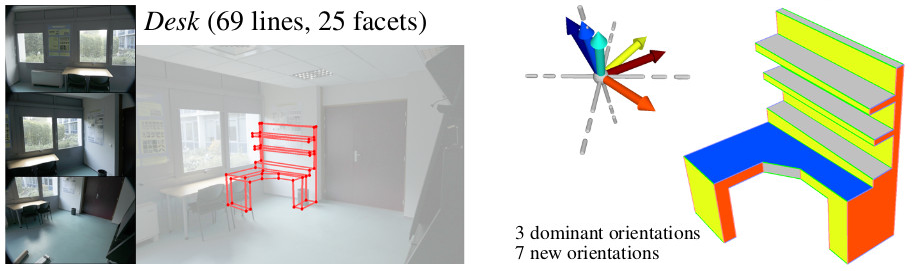
Our work combines the strength of these two domains to interpret line drawings of imaginary
objects drawn over photographs of an existing scene (Fig. <a title="Computer-Assisted Design with Heterogeneous Representations" href="./uid38.html#uid42">5</a> ).
The main challenge we face is to identify
the existing 3D structure that correlates with the line drawing while also allowing
the creation of new structure that is not present in the real world.
We propose a labeling algorithm to tackle this problem, where some of the
labels capture dominant orientations of the real scene while a free label
allows the discovery of new orientations in the imaginary scene.
We illustrate our algorithm by interpreting line drawings for
urban planing, home remodeling, furniture design and cultural heritage.</p>
        <p>This work is a collaboration with Jean-Dominique Favreau and Florent Lafarge from Titane project team, Inria Sophia-Antipolis.
It has been published at the Conference on Computer Vision and Pattern Recognition (CVPR) <a href="./bibliography.html#graphdeco-2015-bid8">[14]</a> .</p>
        <div align="center" style="margin-top:10px">
          <a name="uid42">
            <!--...-->
          </a>
          <table title="" class="objectContainer">
            <caption align="bottom"><strong>Figure
	5. </strong>Our method <a href="./bibliography.html#graphdeco-2015-bid8">[14]</a> 
takes as input several photographs of a scene, along with a line drawing of a new object (left).
We exploit the dominant orientations of the existing scene to reconstruct the line drawing in 3D (right).</caption>
            <tr align="center">
              <td>
                <table>
                  <tr>
                    <td xmlns="" style="height:3px;" align="center">
                      <img xmlns="http://www.w3.org/1999/xhtml" style="width:384.2974pt" alt="IMG/drawing_cvpr.png" src="IMG/drawing_cvpr.png"/>
                    </td>
                  </tr>
                </table>
              </td>
            </tr>
          </table>
        </div>
        <a name="uid43"/>
        <h4 class="titre4">WrapIt: Computer-Assisted Crafting of Wire Wrapped Jewelry</h4>
        <p class="participants"><span class="part">Participants</span> :
	Adrien Bousseau, Emmanuel Iarussi.</p>
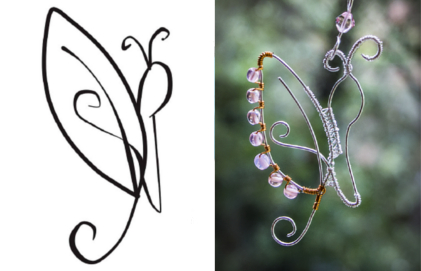
        <p>Wire wrapping is a traditional form of handmade jewelry that involves bending metal wire to create intricate shapes. The technique appeals to novices and casual crafters because of its low cost, accessibility and unique aesthetic. We present a computational design tool that addresses the two main challenges of creating 2D wire-wrapped jewelry: decomposing an input drawing into a set of wires, and bending the wires to give them shape (Fig. <a title="Computer-Assisted Design with Heterogeneous Representations" href="./uid38.html#uid44">6</a> ). Our main contribution is an automatic wire decomposition algorithm that segments a drawing into a small number of wires based on aesthetic and fabrication principles. We formulate the task as a constrained graph labeling problem and present a stochastic optimization approach that produces good results for a variety of inputs.
Given a decomposition, our system generates a 3D-printed custom support structure, or <i>jig</i>, that helps users bend the wire into the appropriate shape. We validated our wire decomposition algorithm against existing wire-wrapped designs, and used our end-to-end system to create new jewelry from clipart drawings. We also evaluated our approach with novice users, who were able to create various pieces of jewelry in less than half an hour.</p>
        <p>This work is a collaboration with Wilmot Li from Adobe, San Francisco. The project was initiated by a 3-months visit of Emmanuel Iarussi at Adobe.
It has been published at ACM Transactions on Graphics (Proc. SIGGRAPH Asia) <a href="./bibliography.html#graphdeco-2015-bid2">[8]</a> .</p>
        <div align="center" style="margin-top:10px">
          <a name="uid44">
            <!--...-->
          </a>
          <table title="" class="objectContainer">
            <caption align="bottom"><strong>Figure
	6. </strong>Our system <a href="./bibliography.html#graphdeco-2015-bid2">[8]</a>  helps novices convert a line drawing (left) into a real piece of jewelry (right).</caption>
            <tr align="center">
              <td>
                <table>
                  <tr>
                    <td xmlns="" style="height:3px;" align="center">
                      <img xmlns="http://www.w3.org/1999/xhtml" style="width:213.5pt" alt="IMG/wrapit.jpg" src="IMG/wrapit.jpg"/>
                    </td>
                  </tr>
                </table>
              </td>
            </tr>
          </table>
        </div>
        <a name="uid45"/>
        <h4 class="titre4">How Novices Sketch and Prototype Hand-Fabricated Objects</h4>
        <p class="participants"><span class="part">Participant</span> :
	Adrien Bousseau.</p>
        <p>We are interested in how to create digital tools to support informal sketching and prototyping of objects by <i>novices</i>.
Achieving this goal first requires a deeper understanding of how novices currently generate, explore, and communicate design ideas
with traditional tools, i.e., sketches on paper and hands-on prototyping materials.
We describe a study framed around two all-day design charrettes where participants perform
a complete design process including ideation sketching, concept development and presentation,
fabrication planning documentation and collaborative fabrication of hand-crafted prototypes.
This structure allows us to control key aspects of the design process
while collecting rich data about creative tasks, including sketches on paper, physical models, and
videos of collaboration discussions. We observed that while participants had
no formal training in design, they made use of advanced visualization techniques to
convey 3D concepts. Participants also extensively used physical materials (paper, foam,
cardboard) both to support concept exploration and to communicate their ideas
to collaborators. We deduce from these observations recommendations for the
conception of design tools adapted to the needs and skills of novices.</p>
        <p>This work is a collaboration with Wendy McKay, Theophanis Tsandilas and Lora Oehlberg from
the InSitu project team - Inria Saclay, in the context of the ANR DRAO project. It is conditionally accepted to ACM CHI 2016.</p>
        <a name="uid46"/>
        <h4 class="titre4">Vectorizing Rough Line Drawings</h4>
        <p class="participants"><span class="part">Participant</span> :
	Adrien Bousseau.</p>
        <p>Our goal in this project is to convert rough, freehand bitmap sketches to clean
vector drawings, keeping three main objectives in mind: (i) the vectorial curves should approximate well the input drawing,
(ii) the drawing should be composed of a small number of curves with few control points to preserve the compactness and editability of vector graphics,
and (iii) the algorithm should support user guidance to disambiguate the multiple interpretations inherent to artistic inputs.
Unfortunately, existing vectorization algorithms only partly satisfy these
requirements. In particular, while most methods employ curve fitting to satisfy the
first objective of data fidelity, this fitting is performed locally and is often sub-optimal
with respect to our second objective of <i>low complexity</i>.
To achieve our objectives, we propose to cast line drawing vectorization as a
global optimization that balances data fidelity with model complexity. We express
data fidelity as the goodness of fit of Bézier curve segments, and we express model
complexity as the number and degree of curve segments that compose the output drawing.
Our algorithm produces clean, compact and editable vector drawings from bitmap sketches.</p>
        <p>This ongoing work is a collaboration with Jean-Dominique Favreau and Florent Lafarge from Titane project team, Inria Sophia-Antipolis.</p>
        <a name="uid47"/>
        <h4 class="titre4">Exploring Design Spaces with Sketch-Based Rendering</h4>
        <p class="participants"><span class="part">Participant</span> :
	Adrien Bousseau.</p>
        <p>Designers often start product design by drawing many quick and imperfect sketches. These sketches typically capture shape variations of a concept from different viewpoints. We introduce <i>sketch-based rendering</i> as a way to help designers explore the design space induced by such sketches. Our interactive tool allows designers to interpolate between the sketches, providing a continuous, 3D-like visualization of the concept and its variations without requiring explicit 3D information.</p>
        <p>We propose an iterative algorithm to match and warp between sketches using little user interaction. We designed this algorithm to address the specific challenges inherent to concept sketches, in particular the fact that they are dominated by contours rather than color or texture, and that these contours should not distort during interpolation. We also describe how to approximate the relative camera positions of different sketches from the magnitude of their 2D motion fields. This approach allows plausible 3D-like camera movements despite the presence of sketch distortions and variations that prevent standard camera calibration. Our tool, thus, fills a gap in the initial stage of the product design pipeline by allowing designers and their patrons to make better informed choices before proceeding to more expensive 3D modeling and prototyping.</p>
        <p>This ongoing work is a collaboration with Ishan Darolia and Vinay Namboodiri from IIT Kampur and Rahul Arora and Karan Singh from University of Toronto.</p>
        <a name="uid48"/>
        <h4 class="titre4">Sketch-Based Inverse Procedural Modeling</h4>
        <p class="participants"><span class="part">Participant</span> :
	Adrien Bousseau.</p>
        <p>Designing and modeling 3D objects is a crucial skill in
various areas of entertainment, science, and engineering.
However, this task is notoriously hard and unintuitive, especially for novices.
Prior work has addressed the modeling problem from many
different directions.
Sketch-based modeling exploits human
intuition and experience in drawing objects. Nevertheless, the
quality of the final 3D model depends on the sketching skills of the
user, the amount of details added to the drawing, and ability to
resolve inherent ambiguities of the sketching process. Another
popular direction is procedural modeling, which has been successfully used to create
detailed and complex cities, realistic
and growing vegetation, and other man-made objects.
But procedural modeling is difficult to control and
thus hard to use as an exploratory design tool making it accessible
only to experts.
Our goal in this project is to leverage both the
intuitiveness, freedom and flexibility of sketching and the
precision, exactness, and detail amplification of procedural
modeling.
Users of our system begin to sketch a 3D model using a mouse or
a digital pen on a tablet. After only a few strokes,
our algorithm finds a compact 3D procedural representation that matches the sketch
while augmented it with geometric details.</p>
        <p>This ongoing work is a collaboration with Gen Nishida, Bedrich Benes, Ignacio Garcia Dorado and Daniel Aliaga from Purdue University.</p>
        <a name="uid49"/>
        <h4 class="titre4">A data-based approach to retrieve the viewpoint of a design sketch</h4>
        <p class="participants"><span class="part">Participants</span> :
	Johanna Delanoy, Adrien Bousseau.</p>
        <p>Designing objects requires frequent transitions from a 2D representation, the sketch, to a 3D one. Because 3D modeling is time consuming, it is made only during late phases of the design process. Our long term goal is to allow designers to automatically generate 3D models from their sketches. In this work, we address the preliminary step of recovering the viewpoint under which the object is drawn. We adopt a data-driven approach where we build correspondences between the sketch and 3D objects of the same class from a database. In particular, we relate the curvature lines and contours of the 3D objects to similar lines commonly drawn by designers using histograms of orientation. The 3D objects from the database are then used to vote for the viewpoints and the more probable ones are chosen. Our results on design sketches suggest that using both contours and curvature lines give higher precision than using either one. In particular, curvature information improves viewpoint retrieval when details of the objects are different from the sketch.</p>
        <p>The work has been published in the journal Revue Française d'Informatique Graphique and presented at the 28th Journées de l'Association Française d'Informatique Graphique <a href="./bibliography.html#graphdeco-2015-bid6">[5]</a> .</p>
        <div align="center" style="margin-top:10px">
          <a name="uid50">
            <!--...-->
          </a>
          <table title="" class="objectContainer">
            <caption align="bottom"><strong>Figure
	7. </strong>Our method <a href="./bibliography.html#graphdeco-2015-bid6">[5]</a>  allows to retrieve the viewpoint of a design sketch, using a collection of 3D objects.</caption>
            <tr align="center">
              <td>
                <table>
                  <tr>
                    <td xmlns="" style="height:3px;" align="center">
                      <img xmlns="http://www.w3.org/1999/xhtml" style="width:320.25pt" alt="IMG/teaserJohanna.jpg" src="IMG/teaserJohanna.jpg"/>
                    </td>
                  </tr>
                </table>
              </td>
            </tr>
          </table>
        </div>
      </div>
      <!--FIN du corps du module-->
      <br/>
      <div class="bottomNavigation">
        <div class="tail_aucentre">
          <a href="./uid34.html" accesskey="P"><img style="align:bottom; border:none" alt="previous" src="../static/img/icons/previous_motif.jpg"/> Previous | </a>
          <a href="./uid0.html" accesskey="U"><img style="align:bottom; border:none" alt="up" src="../static/img/icons/up_motif.jpg"/>  Home</a>
          <a href="./uid51.html" accesskey="N"> | Next <img style="align:bottom; border:none" alt="next" src="../static/img/icons/next_motif.jpg"/></a>
        </div>
        <br/>
      </div>
    </div>
  </body>
</html>