<?xml version="1.0" encoding="utf-8"?>
<!DOCTYPE html PUBLIC "-//W3C//DTD XHTML 1.1 plus MathML 2.0 plus SVG 1.1//EN" "http://www.w3.org/2002/04/xhtml-math-svg/xhtml-math-svg.dtd">
<html xmlns="http://www.w3.org/1999/xhtml">
  <head>
    <meta http-equiv="Content-Type" content="application/xhtml+xml; charset=utf-8"/>
    <title>Team:Monc</title>
    <link rel="stylesheet" href="../static/css/raweb.css" type="text/css"/>
    <meta name="description" content="Overall Objectives - General strategy"/>
    <meta name="dc.title" content="Overall Objectives - General strategy"/>
    <meta name="dc.subject" content=""/>
    <meta name="dc.publisher" content="INRIA"/>
    <meta name="dc.date" content="(SCHEME=ISO8601) 2015-01"/>
    <meta name="dc.type" content="Report"/>
    <meta name="dc.language" content="(SCHEME=ISO639-1) en"/>
    <meta name="projet" content="Monc"/>
    <!-- Piwik -->
    <script type="text/javascript" src="/rapportsactivite/piwik.js"></script>
    <noscript><p><img src="//piwik.inria.fr/piwik.php?idsite=49" style="border:0;" alt="" /></p></noscript>
    <!-- End Piwik Code -->
  </head>
  <body>
    <div class="tdmdiv">
      <div class="logo">
        <a href="http://www.inria.fr">
          <img style="align:bottom; border:none" src="../static/img/icons/logo_INRIA-coul.jpg" alt="Inria"/>
        </a>
      </div>
      <div class="TdmEntry">
        <div class="tdmentete">
          <a href="uid0.html">Team Monc</a>
        </div>
        <span>
          <a href="uid1.html">Members</a>
        </span>
      </div>
      <div class="TdmEntry">Overall Objectives<ul><li><a href="./uid3.html">Objectives</a></li><li class="tdmActPage"><a href="./uid7.html">General strategy</a></li></ul></div>
      <div class="TdmEntry">Research Program<ul><li><a href="uid17.html&#10;&#9;&#9;  ">Introduction</a></li><li><a href="uid21.html&#10;&#9;&#9;  ">Axis 1: Tumor modeling for patient-specific simulations</a></li><li><a href="uid25.html&#10;&#9;&#9;  ">Axis 2: Bio-physical modeling for personalized therapies</a></li><li><a href="uid32.html&#10;&#9;&#9;  ">Axis 3: Quantitative cancer modeling for biological and preclinical studies</a></li></ul></div>
      <div class="TdmEntry">Application Domains<ul><li><a href="uid38.html&#10;&#9;&#9;  ">Introduction</a></li><li><a href="uid44.html&#10;&#9;&#9;  ">Axis 1: Tumor modeling for patient-specific simulations</a></li><li><a href="uid47.html&#10;&#9;&#9;  ">Axis 2: Bio-physical modeling for personalized therapies</a></li><li><a href="uid49.html&#10;&#9;&#9;  ">Axis 3: Quantitative cancer modeling for biological and preclinical studies</a></li></ul></div>
      <div class="TdmEntry">
        <a href="./uid53.html">Highlights of the Year</a>
      </div>
      <div class="TdmEntry">New Software and Platforms<ul><li><a href="uid55.html&#10;&#9;&#9;  ">CADMOS</a></li><li><a href="uid59.html&#10;&#9;&#9;  ">Carcinom (Computer-Assisted Research about Cancer growth and INsights on Oncological Mechanisms)</a></li><li><a href="uid63.html&#10;&#9;&#9;  ">ELMO (Numerical Simulation of cell electroporation )</a></li><li><a href="uid70.html&#10;&#9;&#9;  ">Meta-poumon</a></li><li><a href="uid75.html&#10;&#9;&#9;  ">Nenuphar</a></li><li><a href="uid79.html&#10;&#9;&#9;  ">SESAR (Monitor of the effect of RT on Retroperitoneal Sarcoma)</a></li><li><a href="uid82.html&#10;&#9;&#9;  ">SegmentIt</a></li></ul></div>
      <div class="TdmEntry">New Results<ul><li><a href="uid87.html&#10;&#9;&#9;  ">Axis 1: Tumor modeling for patient-specific simulations</a></li><li><a href="uid91.html&#10;&#9;&#9;  ">Axis 2: Bio-physical modeling for personalized therapies</a></li><li><a href="uid94.html&#10;&#9;&#9;  ">Axis 3: Quantitative cancer modeling for biological and preclinical studies</a></li><li><a href="uid99.html&#10;&#9;&#9;  ">Other new results</a></li></ul></div>
      <div class="TdmEntry">Partnerships and Cooperations<ul><li><a href="uid101.html&#10;&#9;&#9;  ">Regional Initiatives</a></li><li><a href="uid107.html&#10;&#9;&#9;  ">National Initiatives</a></li><li><a href="uid141.html&#10;&#9;&#9;  ">International Initiatives</a></li><li><a href="uid154.html&#10;&#9;&#9;  ">International Research Visitors</a></li></ul></div>
      <div class="TdmEntry">Dissemination<ul><li><a href="uid159.html&#10;&#9;&#9;  ">Promoting Scientific Activities</a></li><li><a href="uid179.html&#10;&#9;&#9;  ">Teaching - Supervision - Juries</a></li><li><a href="uid212.html&#10;&#9;&#9;  ">Popularization</a></li></ul></div>
      <div class="TdmEntry">
        <div>Bibliography</div>
      </div>
      <div class="TdmEntry">
        <ul>
          <li>
            <a id="tdmbibentyear" href="bibliography.html">Publications of the year</a>
          </li>
        </ul>
      </div>
    </div>
    <div id="main">
      <div class="mainentete">
        <div id="head_agauche">
          <small><a href="http://www.inria.fr">
	    
	    Inria
	  </a> | <a href="../index.html">
	    
	    Raweb 
	    2015</a> | <a href="http://www.inria.fr/en/teams/monc">Presentation of the Team Monc</a> | <a href="https://team.inria.fr/monc/">Monc Web Site
	  </a></small>
        </div>
        <div id="head_adroite">
          <table class="qrcode">
            <tr>
              <td>
                <a href="monc.xml">
                  <img style="align:bottom; border:none" alt="XML" src="../static/img/icons/xml_motif.png"/>
                </a>
              </td>
              <td>
                <a href="monc.pdf">
                  <img style="align:bottom; border:none" alt="PDF" src="IMG/qrcode-monc-pdf.png"/>
                </a>
              </td>
              <td>
                <a href="../monc/monc.epub">
                  <img style="align:bottom; border:none" alt="e-pub" src="IMG/qrcode-monc-epub.png"/>
                </a>
              </td>
            </tr>
            <tr>
              <td/>
              <td>PDF
</td>
              <td>e-Pub
</td>
            </tr>
          </table>
        </div>
      </div>
      <!--FIN du corps du module-->
      <br/>
      <div class="bottomNavigation">
        <div class="tail_aucentre">
          <a href="./uid3.html" accesskey="P"><img style="align:bottom; border:none" alt="previous" src="../static/img/icons/previous_motif.jpg"/> Previous | </a>
          <a href="./uid0.html" accesskey="U"><img style="align:bottom; border:none" alt="up" src="../static/img/icons/up_motif.jpg"/>  Home</a>
          <a href="./uid17.html" accesskey="N"> | Next <img style="align:bottom; border:none" alt="next" src="../static/img/icons/next_motif.jpg"/></a>
        </div>
        <br/>
      </div>
      <div id="textepage">
        <!--DEBUT2 du corps du module-->
        <h2>Section: 
      Overall Objectives</h2>
        <h3 class="titre3">General strategy</h3>
        <div align="center" style="margin-top:10px">
          <a name="uid8">
            <!--...-->
          </a>
          <table title="" class="objectContainer">
            <caption align="bottom"><strong>Figure
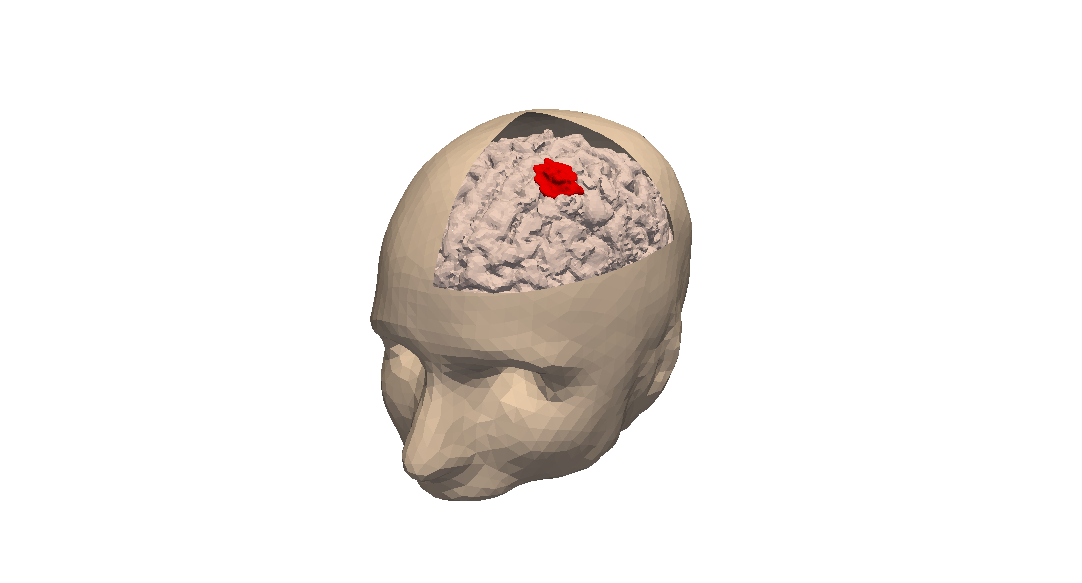
	1. </strong>3D numerical simulation of a meningioma tumor. The tumor is shown in red.</caption>
            <tr align="center">
              <td>
                <table>
                  <tr>
                    <td xmlns="" style="height:3px;" align="center">
                      <img xmlns="http://www.w3.org/1999/xhtml" style="width:427.0pt" alt="IMG/ImageMeningiome2.png" src="IMG/ImageMeningiome2.png"/>
                    </td>
                  </tr>
                </table>
              </td>
            </tr>
          </table>
        </div>
        <div align="center" style="margin-top:10px">
          <a name="uid9">
            <!--...-->
          </a>
          <table title="" class="objectContainer">
            <caption align="bottom"><strong>Figure
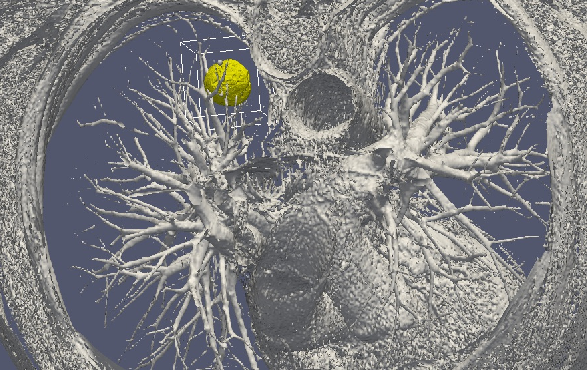
	2. </strong>3D numerical simulation of a lung tumor. The tumor is shown in yellow.</caption>
            <tr align="center">
              <td>
                <table>
                  <tr>
                    <td xmlns="" style="height:3px;" align="center">
                      <img xmlns="http://www.w3.org/1999/xhtml" style="width:427.0pt" alt="IMG/poumon2.png" src="IMG/poumon2.png"/>
                    </td>
                  </tr>
                </table>
              </td>
            </tr>
          </table>
        </div>
        <p>The general strategy consists of the interactions of several stages:</p>
        <ul>
          <li>
            <p class="notaparagraph"><a name="uid10"> </a><i>Stage 1:</i> Derivation of mechanistic models based on the biological knowledge and the available observations. The construction of such models relies on the up-to-date biological knowledge at the cellular level including description of the cell-cycle, interaction with the microenvironement (angiogenesis, interaction with the stroma). Such models also include a “macroscopic" description of specific molecular pathways that are known to have a critical role in carcinogenesis or that are targeted by new drugs. We emphasize that for this purpose, tight interactions with biologists are crucial. Lots of works devoted to the modeling at the cellular level are available in the literature. However, in order to be able to use
these models in a clinical context, we also need to describe the tumor at the tissue level. The <i>in vitro</i> mechanical characterization of tumor tissues has been widely studied. However, no description that could be patient specific or even tumor specific is available. It is therefore necessary to build adapted phenomenological models, according to the biological and clinical reality.</p>
          </li>
          <li>
            <p class="notaparagraph"><a name="uid11"> </a><i>Stage 2:</i> Data collection. In the clinical context, data may come from medical imaging (MRI, CT-Scan, PET scan) at different time points. It is also a crucial point: we need longitudinal data in time in order to be able to understand the time course of the disease. The data can also be obtained from the analysis of blood samples or biopsies. It is critical to have tight collaborations with clinicians for the selection of the specific cases to focus on, the understanding of the key points and of the key data, the classification of the grades of the tumors, the understanding of the treatment, ...In the preclinical context, data can be macroscopic measurements of the tumor volume for subcutaneous cases, green fluorescence protein (GFP) quantifications for total number of living cells, non-invasive bioluminescence signals or even imaging obtained with devices adapted to small animals.</p>
          </li>
          <li>
            <p class="notaparagraph"><a name="uid12"> </a><i>Stage 3:</i> Adaptation of the model to the data. The model has to be adapted to the data: it is useless to have a model taking many biological features of the disease into account if it cannot be reliably parameterized with the data. For example, very detailed description of the angiogenesis process given in the literature cannot be used, even if one has data arising from perfusion MRIs. A pragmatic approach has to be developed for this purpose. On the other hand, one has to try to model any element that can be useful to exploit the image. Parameterizing must be performed carefully in order to achieve an optimal trade-off between the accuracy of the model, its complexity, identifiability and predictive power. Parameter estimation is a critical issue in mathematical biology, which we cannot avoid: if there are too many parameters, it will be impossible to estimate them but if the model is too simple, it will be too far from reality.</p>
          </li>
          <li>
            <p class="notaparagraph"><a name="uid13"> </a><i>Stage 4:</i> Data assimilation. Due to the complexity of the data – for example multimodal, longitudinal medical imaging – the data assimilation is a major challenge. Such a process is a combination of methods for solving inverse problems and statistical methods including machine learning strategies. Presently, most of the inverse problems – developed in the team – are solved using a gradient method coupled with some Monte-Carlo type algorithm. More efficient methods could be used as for example the sequential methods, <i>i.e.</i> the Kalman type filters or the so-called Luenberger filter (nudging). Using the sequential methods can also simplify the Stage 3 because they can be used even with complex models. Of course, the strategy used by the team depends on the quantity and the quality of data. It is not the same if we have an homogeneous population of cases or if it is a very specific isolated case.</p>
          </li>
          <li>
            <p class="notaparagraph"><a name="uid14"> </a><i>Stage 4':</i> Data assimilation of gene expression. "Omics" data become more and more important in oncology and we aim at developing our models using the available information. For example, in our previous work on GIST, we have taken into account the cases with mutation on Ckit. However, it is still not clear how to use in general gene expression data in our macroscopic models, and particularly how to connect the genotype to the phenotype and the macroscopic growth. We expect to use statistical learning techniques on populations of patients in order to move towards this direction, but we emphasize that this task is very prospective and is a scientific challenge in itself.</p>
          </li>
          <li>
            <p class="notaparagraph"><a name="uid15"> </a><i>Stage 5:</i> Simulation. Once the models have been parametrized, the simulation part can be done. We also need to include a quantification of uncertainties and to produce 3D simulations that can be confronted to reality.</p>
          </li>
        </ul>
      </div>
      <!--FIN du corps du module-->
      <br/>
      <div class="bottomNavigation">
        <div class="tail_aucentre">
          <a href="./uid3.html" accesskey="P"><img style="align:bottom; border:none" alt="previous" src="../static/img/icons/previous_motif.jpg"/> Previous | </a>
          <a href="./uid0.html" accesskey="U"><img style="align:bottom; border:none" alt="up" src="../static/img/icons/up_motif.jpg"/>  Home</a>
          <a href="./uid17.html" accesskey="N"> | Next <img style="align:bottom; border:none" alt="next" src="../static/img/icons/next_motif.jpg"/></a>
        </div>
        <br/>
      </div>
    </div>
  </body>
</html>