<?xml version="1.0" encoding="utf-8"?>
<!DOCTYPE html PUBLIC "-//W3C//DTD XHTML 1.1 plus MathML 2.0 plus SVG 1.1//EN" "http://www.w3.org/2002/04/xhtml-math-svg/xhtml-math-svg.dtd">
<html xmlns="http://www.w3.org/1999/xhtml">
  <head>
    <meta http-equiv="Content-Type" content="application/xhtml+xml; charset=utf-8"/>
    <title>Project-Team:PARIETAL</title>
    <link rel="stylesheet" href="../static/css/raweb.css" type="text/css"/>
    <meta name="description" content="Research Program - Inverse problems in Neuroimaging"/>
    <meta name="dc.title" content="Research Program - Inverse problems in Neuroimaging"/>
    <meta name="dc.subject" content=""/>
    <meta name="dc.publisher" content="INRIA"/>
    <meta name="dc.date" content="(SCHEME=ISO8601) 2015-01"/>
    <meta name="dc.type" content="Report"/>
    <meta name="dc.language" content="(SCHEME=ISO639-1) en"/>
    <meta name="projet" content="PARIETAL"/>
    <!-- Piwik -->
    <script type="text/javascript" src="/rapportsactivite/piwik.js"></script>
    <noscript><p><img src="//piwik.inria.fr/piwik.php?idsite=49" style="border:0;" alt="" /></p></noscript>
    <!-- End Piwik Code -->
  </head>
  <body>
    <div class="tdmdiv">
      <div class="logo">
        <a href="http://www.inria.fr">
          <img style="align:bottom; border:none" src="../static/img/icons/logo_INRIA-coul.jpg" alt="Inria"/>
        </a>
      </div>
      <div class="TdmEntry">
        <div class="tdmentete">
          <a href="uid0.html">Project-Team Parietal</a>
        </div>
        <span>
          <a href="uid1.html">Members</a>
        </span>
      </div>
      <div class="TdmEntry">
        <a href="./uid3.html">Overall Objectives</a>
      </div>
      <div class="TdmEntry">Research Program<ul><li class="tdmActPage"><a href="uid5.html&#10;&#9;&#9;  ">Inverse problems in Neuroimaging</a></li><li><a href="uid19.html&#10;&#9;&#9;  ">Multivariate decompositions</a></li><li><a href="uid22.html&#10;&#9;&#9;  ">Covariance estimation</a></li></ul></div>
      <div class="TdmEntry">Application Domains<ul><li><a href="uid28.html&#10;&#9;&#9;  ">Human neuroimaging data and their use</a></li><li><a href="uid33.html&#10;&#9;&#9;  ">High-field MRI</a></li><li><a href="uid34.html&#10;&#9;&#9;  ">
Technical challenges for the analysis of neuroimaging data</a></li></ul></div>
      <div class="TdmEntry">
        <a href="./uid36.html">Highlights of the Year</a>
      </div>
      <div class="TdmEntry">New Software and Platforms<ul><li><a href="uid38.html&#10;&#9;&#9;  ">Scikit-learn</a></li><li><a href="uid43.html&#10;&#9;&#9;  ">Nilearn</a></li><li><a href="uid47.html&#10;&#9;&#9;  ">Mayavi</a></li><li><a href="uid50.html&#10;&#9;&#9;  ">PyHRF</a></li></ul></div>
      <div class="TdmEntry">New Results<ul><li><a href="uid56.html&#10;&#9;&#9;  ">Semi-Supervised Factored Logistic Regression for High-Dimensional Neuroimaging Data</a></li><li><a href="uid58.html&#10;&#9;&#9;  ">NeuroVault.org: a web-based repository for collecting and sharing unthresholded statistical maps of the human brain</a></li><li><a href="uid59.html&#10;&#9;&#9;  ">FAASTA: A fast solver for total-variation regularization of ill-conditioned problems with application to brain imaging </a></li><li><a href="uid60.html&#10;&#9;&#9;  "> Bootstrapped Permutation Test for Multiresponse Inference on Brain Behavior Associations.</a></li><li><a href="uid61.html&#10;&#9;&#9;  "> Total Variation meets Sparsity: statistical learning with segmenting penalties</a></li><li><a href="uid62.html&#10;&#9;&#9;  "> Improving sparse recovery on structured images with bagged clustering </a></li><li><a href="uid63.html&#10;&#9;&#9;  "> Integrating Multimodal Priors in Predictive Models for the Functional Characterization of Alzheimer's Disease</a></li><li><a href="uid64.html&#10;&#9;&#9;  ">Inverse problems with time-frequency dictionaries and Gaussian non-white noise</a></li><li><a href="uid65.html&#10;&#9;&#9;  ">Variable density sampling based on physically plausible gradient waveform. Application to 3D MRI angiography</a></li><li><a href="uid66.html&#10;&#9;&#9;  "> A projection method on measures sets.</a></li></ul></div>
      <div class="TdmEntry">Bilateral Contracts and Grants with Industry<ul><li><a href="uid68.html&#10;&#9;&#9;  ">The LearnClues Labcomm</a></li><li><a href="uid71.html&#10;&#9;&#9;  ">The Wendelin FUI project</a></li></ul></div>
      <div class="TdmEntry">Partnerships and Cooperations<ul><li><a href="uid80.html&#10;&#9;&#9;  ">Regional Initiatives</a></li><li><a href="uid84.html&#10;&#9;&#9;  ">National Initiatives</a></li><li><a href="uid97.html&#10;&#9;&#9;  ">European Initiatives</a></li><li><a href="uid107.html&#10;&#9;&#9;  ">International Initiatives</a></li><li><a href="uid116.html&#10;&#9;&#9;  ">International Research Visitors</a></li></ul></div>
      <div class="TdmEntry">Dissemination<ul><li><a href="uid123.html&#10;&#9;&#9;  ">Promoting Scientific Activities</a></li><li><a href="uid189.html&#10;&#9;&#9;  ">Teaching - Supervision - Juries</a></li><li><a href="uid215.html&#10;&#9;&#9;  ">Popularization</a></li></ul></div>
      <div class="TdmEntry">
        <div>Bibliography</div>
      </div>
      <div class="TdmEntry">
        <ul>
          <li>
            <a id="tdmbibentmajor" href="bibliography.html">Major publications</a>
          </li>
          <li>
            <a id="tdmbibentyear" href="bibliography.html#year">Publications of the year</a>
          </li>
          <li>
            <a id="tdmbibentfoot" href="bibliography.html#References">References in notes</a>
          </li>
        </ul>
      </div>
    </div>
    <div id="main">
      <div class="mainentete">
        <div id="head_agauche">
          <small><a href="http://www.inria.fr">
	    
	    Inria
	  </a> | <a href="../index.html">
	    
	    Raweb 
	    2015</a> | <a href="http://www.inria.fr/en/teams/parietal">Presentation of the Project-Team PARIETAL</a> | <a href="http://team.inria.fr/parietal/">PARIETAL Web Site
	  </a></small>
        </div>
        <div id="head_adroite">
          <table class="qrcode">
            <tr>
              <td>
                <a href="parietal.xml">
                  <img style="align:bottom; border:none" alt="XML" src="../static/img/icons/xml_motif.png"/>
                </a>
              </td>
              <td>
                <a href="parietal.pdf">
                  <img style="align:bottom; border:none" alt="PDF" src="IMG/qrcode-parietal-pdf.png"/>
                </a>
              </td>
              <td>
                <a href="../parietal/parietal.epub">
                  <img style="align:bottom; border:none" alt="e-pub" src="IMG/qrcode-parietal-epub.png"/>
                </a>
              </td>
            </tr>
            <tr>
              <td/>
              <td>PDF
</td>
              <td>e-Pub
</td>
            </tr>
          </table>
        </div>
      </div>
      <!--FIN du corps du module-->
      <br/>
      <div class="bottomNavigation">
        <div class="tail_aucentre">
          <a href="./uid3.html" accesskey="P"><img style="align:bottom; border:none" alt="previous" src="../static/img/icons/previous_motif.jpg"/> Previous | </a>
          <a href="./uid0.html" accesskey="U"><img style="align:bottom; border:none" alt="up" src="../static/img/icons/up_motif.jpg"/>  Home</a>
          <a href="./uid19.html" accesskey="N"> | Next <img style="align:bottom; border:none" alt="next" src="../static/img/icons/next_motif.jpg"/></a>
        </div>
        <br/>
      </div>
      <div id="textepage">
        <!--DEBUT2 du corps du module-->
        <h2>Section: 
      Research Program</h2>
        <h3 class="titre3">Inverse problems in Neuroimaging</h3>
        <p>Many problems in neuroimaging can be framed as forward and inverse
problems. For instance, the neuroimaging <i>inverse problem</i>
consists in predicting individual information (behavior, phenotype)
from neuroimaging data, while the <i>forward problem</i> consists in
fitting neuroimaging data with high-dimensional (e.g. genetic)
variables. Solving these problems entails the definition of two
terms: a loss that quantifies the goodness of fit of the solution
(does the model explain the data reasonably well ?), and a
regularization schemes that represents a prior on the expected
solution of the problem. In particular some priors enforce some
properties of the solutions, such as sparsity, smoothness or being
piece-wise constant.</p>
        <p class="notaparagraph">Let us detail the model used in the inverse problem: Let <span class="math"><math xmlns="http://www.w3.org/1998/Math/MathML"><mi>𝐗</mi></math></span>
be a neuroimaging dataset as an <span class="math"><math xmlns="http://www.w3.org/1998/Math/MathML"><mrow><mo>(</mo><msub><mi>n</mi><mrow><mi>s</mi><mi>u</mi><mi>b</mi><mi>j</mi></mrow></msub><mo>,</mo><msub><mi>n</mi><mrow><mi>v</mi><mi>o</mi><mi>x</mi><mi>e</mi><mi>l</mi><mi>s</mi></mrow></msub><mo>)</mo></mrow></math></span> matrix, where
<span class="math"><math xmlns="http://www.w3.org/1998/Math/MathML"><msub><mi>n</mi><mrow><mi>s</mi><mi>u</mi><mi>b</mi><mi>j</mi></mrow></msub></math></span> and <span class="math"><math xmlns="http://www.w3.org/1998/Math/MathML"><msub><mi>n</mi><mrow><mi>v</mi><mi>o</mi><mi>x</mi><mi>e</mi><mi>l</mi><mi>s</mi></mrow></msub></math></span> are the number of subjects under study,
and the image size respectively, <span class="math"><math xmlns="http://www.w3.org/1998/Math/MathML"><mi>𝐘</mi></math></span> an array of values that
represent characteristics of interest in the observed population,
written as <span class="math"><math xmlns="http://www.w3.org/1998/Math/MathML"><mrow><mo>(</mo><msub><mi>n</mi><mrow><mi>s</mi><mi>u</mi><mi>b</mi><mi>j</mi></mrow></msub><mo>,</mo><msub><mi>n</mi><mi>f</mi></msub><mo>)</mo></mrow></math></span> matrix, where <span class="math"><math xmlns="http://www.w3.org/1998/Math/MathML"><msub><mi>n</mi><mi>f</mi></msub></math></span> is the number of
characteristics that are tested, and <span class="math"><math xmlns="http://www.w3.org/1998/Math/MathML"><mi>β</mi></math></span> an array of shape
<span class="math"><math xmlns="http://www.w3.org/1998/Math/MathML"><mrow><mo>(</mo><msub><mi>n</mi><mrow><mi>v</mi><mi>o</mi><mi>x</mi><mi>e</mi><mi>l</mi><mi>s</mi></mrow></msub><mo>,</mo><msub><mi>n</mi><mi>f</mi></msub><mo>)</mo></mrow></math></span> that represents a set of pattern-specific maps. In
the first place, we may consider the columns <span class="math"><math xmlns="http://www.w3.org/1998/Math/MathML"><mrow><msub><mi>𝐘</mi><mn>1</mn></msub><mo>,</mo><mo>.</mo><mo>.</mo><mo>,</mo><msub><mi>𝐘</mi><msub><mi>n</mi><mi>f</mi></msub></msub></mrow></math></span> of <span class="math"><math xmlns="http://www.w3.org/1998/Math/MathML"><mi>Y</mi></math></span> independently, yielding <span class="math"><math xmlns="http://www.w3.org/1998/Math/MathML"><msub><mi>n</mi><mi>f</mi></msub></math></span> problems to be
solved in parallel:</p>
        <div align="center" class="mathdisplay">
          <math xmlns="http://www.w3.org/1998/Math/MathML">
            <mrow>
              <msub>
                <mi>𝐘</mi>
                <mi>i</mi>
              </msub>
              <mo>=</mo>
              <mi>𝐗</mi>
              <msub>
                <mi>β</mi>
                <mi>i</mi>
              </msub>
              <mo>+</mo>
              <msub>
                <mi>ϵ</mi>
                <mi>i</mi>
              </msub>
              <mo>,</mo>
              <mo>∀</mo>
              <mi>i</mi>
              <mo>∈</mo>
              <mrow>
                <mo>{</mo>
                <mn>1</mn>
                <mo>,</mo>
                <mo>.</mo>
                <mo>.</mo>
                <mo>,</mo>
                <msub>
                  <mi>n</mi>
                  <mi>f</mi>
                </msub>
                <mo>}</mo>
              </mrow>
              <mo>,</mo>
            </mrow>
          </math>
        </div>
        <p class="notaparagraph">where the vector contains <span class="math"><math xmlns="http://www.w3.org/1998/Math/MathML"><msub><mi>β</mi><mi>i</mi></msub></math></span> is the <span class="math"><math xmlns="http://www.w3.org/1998/Math/MathML"><msup><mi>i</mi><mrow><mi>t</mi><mi>h</mi></mrow></msup></math></span> row of
<span class="math"><math xmlns="http://www.w3.org/1998/Math/MathML"><mi>β</mi></math></span>. As the problem is clearly ill-posed, it is
naturally handled in a regularized regression framework:</p>
        <div align="center" class="mathdisplay">
          <a name="uid6"/>
          <table width="100%">
            <tr valign="middle">
              <td align="center">
                <math xmlns="http://www.w3.org/1998/Math/MathML">
                  <mrow>
                    <msub>
                      <mover accent="true">
                        <mi>β</mi>
                        <mo>^</mo>
                      </mover>
                      <mi>i</mi>
                    </msub>
                    <mo>=</mo>
                    <msub>
                      <mtext>argmin</mtext>
                      <msub>
                        <mi>β</mi>
                        <mi>i</mi>
                      </msub>
                    </msub>
                    <msup>
                      <mrow>
                        <mo>∥</mo>
                        <msub>
                          <mi>𝐘</mi>
                          <mi>i</mi>
                        </msub>
                        <mo>-</mo>
                        <mi>𝐗</mi>
                        <msub>
                          <mi>β</mi>
                          <mi>i</mi>
                        </msub>
                        <mo>∥</mo>
                      </mrow>
                      <mn>2</mn>
                    </msup>
                    <mo>+</mo>
                    <mi>Ψ</mi>
                    <mrow>
                      <mo>(</mo>
                      <msub>
                        <mi>β</mi>
                        <mi>i</mi>
                      </msub>
                      <mo>)</mo>
                    </mrow>
                    <mo>,</mo>
                  </mrow>
                </math>
              </td>
              <td class="eqno" width="10" align="right">(1)</td>
            </tr>
          </table>
        </div>
        <p class="notaparagraph">where <span class="math"><math xmlns="http://www.w3.org/1998/Math/MathML"><mi>Ψ</mi></math></span> is an adequate penalization used to regularize the
solution:</p>
        <div align="center" class="mathdisplay">
          <a name="uid7"/>
          <table width="100%">
            <tr valign="middle">
              <td align="center">
                <math xmlns="http://www.w3.org/1998/Math/MathML">
                  <mrow>
                    <mi>Ψ</mi>
                    <mrow>
                      <mo>(</mo>
                      <mi>β</mi>
                      <mo>;</mo>
                      <msub>
                        <mi>λ</mi>
                        <mn>1</mn>
                      </msub>
                      <mo>,</mo>
                      <msub>
                        <mi>λ</mi>
                        <mn>2</mn>
                      </msub>
                      <mo>,</mo>
                      <msub>
                        <mi>η</mi>
                        <mn>1</mn>
                      </msub>
                      <mo>,</mo>
                      <msub>
                        <mi>η</mi>
                        <mn>2</mn>
                      </msub>
                      <mo>)</mo>
                    </mrow>
                    <mo>=</mo>
                    <msub>
                      <mi>λ</mi>
                      <mn>1</mn>
                    </msub>
                    <msub>
                      <mrow>
                        <mo>∥</mo>
                        <mi>β</mi>
                        <mo>∥</mo>
                      </mrow>
                      <mn>1</mn>
                    </msub>
                    <mo>+</mo>
                    <msub>
                      <mi>λ</mi>
                      <mn>2</mn>
                    </msub>
                    <msub>
                      <mrow>
                        <mo>∥</mo>
                        <mi>β</mi>
                        <mo>∥</mo>
                      </mrow>
                      <mn>2</mn>
                    </msub>
                    <mo>+</mo>
                    <msub>
                      <mi>η</mi>
                      <mn>1</mn>
                    </msub>
                    <msub>
                      <mrow>
                        <mo>∥</mo>
                        <mi>∇</mi>
                        <mi>β</mi>
                        <mo>∥</mo>
                      </mrow>
                      <mn>1</mn>
                    </msub>
                    <mo>+</mo>
                    <msub>
                      <mi>η</mi>
                      <mn>2</mn>
                    </msub>
                    <msub>
                      <mrow>
                        <mo>∥</mo>
                        <mi>∇</mi>
                        <mi>β</mi>
                        <mo>∥</mo>
                      </mrow>
                      <mn>2</mn>
                    </msub>
                  </mrow>
                </math>
              </td>
              <td class="eqno" width="10" align="right">(2)</td>
            </tr>
          </table>
        </div>
        <p class="notaparagraph">with <span class="math"><math xmlns="http://www.w3.org/1998/Math/MathML"><mrow><msub><mi>λ</mi><mn>1</mn></msub><mo>,</mo><mspace width="0.166667em"/><msub><mi>λ</mi><mn>2</mn></msub><mo>,</mo><mspace width="0.166667em"/><msub><mi>η</mi><mn>1</mn></msub><mo>,</mo><mspace width="0.166667em"/><msub><mi>η</mi><mn>2</mn></msub><mo>≥</mo><mn>0</mn></mrow></math></span> (this
formulation particularly highlights the fact that convex regularizers
are norms or quasi-norms). In general, only one or two of these
constraints is considered (hence is enforced with a non-zero
coefficient):</p>
        <ul>
          <li>
            <p class="notaparagraph"><a name="uid8"> </a>When <span class="math"><math xmlns="http://www.w3.org/1998/Math/MathML"><mrow><msub><mi>λ</mi><mn>1</mn></msub><mo>&gt;</mo><mn>0</mn></mrow></math></span> only (LASSO), and to some extent, when <span class="math"><math xmlns="http://www.w3.org/1998/Math/MathML"><mrow><msub><mi>λ</mi><mn>1</mn></msub><mo>,</mo><msub><mi>λ</mi><mn>2</mn></msub><mo>&gt;</mo><mn>0</mn></mrow></math></span> only (elastic net), the optimal solution <span class="math"><math xmlns="http://www.w3.org/1998/Math/MathML"><mi>β</mi></math></span> is
(possibly very) sparse, but may not exhibit a proper image structure;
it does not fit well with the intuitive concept of a brain map.</p>
          </li>
          <li>
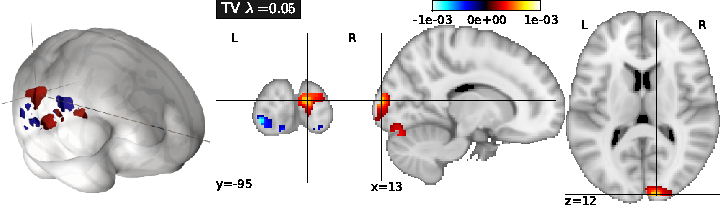
            <p class="notaparagraph"><a name="uid9"> </a>Total Variation regularization (see Fig. <a title="Inverse problems in Neuroimaging" href="./uid5.html#uid11">1</a> ) is obtained for
(<span class="math"><math xmlns="http://www.w3.org/1998/Math/MathML"><mrow><msub><mi>η</mi><mn>1</mn></msub><mo>&gt;</mo><mn>0</mn></mrow></math></span> only), and typically yields a piece-wise constant
solution. It can be associated with Lasso to enforce both sparsity and
sparse variations.</p>
          </li>
          <li>
            <p class="notaparagraph"><a name="uid10"> </a>Smooth lasso is obtained with (<span class="math"><math xmlns="http://www.w3.org/1998/Math/MathML"><mrow><msub><mi>η</mi><mn>2</mn></msub><mo>&gt;</mo><mn>0</mn></mrow></math></span> and <span class="math"><math xmlns="http://www.w3.org/1998/Math/MathML"><mrow><msub><mi>λ</mi><mn>1</mn></msub><mo>&gt;</mo><mn>0</mn></mrow></math></span>
only), and yields smooth, compactly supported spatial basis
functions.</p>
          </li>
        </ul>
        <div align="center" style="margin-top:10px">
          <a name="uid11">
            <!--...-->
          </a>
          <table title="" class="objectContainer">
            <caption align="bottom"><strong>Figure
	1. </strong>Example of the regularization of a brain map with total
variation in an inverse problem. The problem here consists in
predicting the spatial scale of an object presented as a stimulus,
given functional neuroimaging data acquired during the observation
of an image. Learning and test are performed across
individuals. Unlike other approaches, Total Variation regularization
yields a sparse and well-localized solution that enjoys particularly high
accuracy.</caption>
            <tr align="center">
              <td>
                <table>
                  <tr>
                    <td xmlns="" style="height:3px;" align="center">
                      <img xmlns="http://www.w3.org/1999/xhtml" style="width:405.6487pt" alt="IMG/inter_sizes_alpha1.png" src="IMG/inter_sizes_alpha1.png"/>
                    </td>
                  </tr>
                </table>
              </td>
            </tr>
          </table>
        </div>
        <p>The performance of the predictive model can simply be evaluated as the
amount of variance in <span class="math"><math xmlns="http://www.w3.org/1998/Math/MathML"><msub><mi>𝐘</mi><mi>i</mi></msub></math></span> fitted by the model, for each <span class="math"><math xmlns="http://www.w3.org/1998/Math/MathML"><mrow><mi>i</mi><mo>∈</mo><mo>{</mo><mn>1</mn><mo>,</mo><mo>.</mo><mo>.</mo><mo>,</mo><msub><mi>n</mi><mi>f</mi></msub><mo>}</mo></mrow></math></span>. This can be computed through cross-validation, by
<i>learning</i> <span class="math"><math xmlns="http://www.w3.org/1998/Math/MathML"><msub><mover accent="true"><mi>β</mi><mo>^</mo></mover><mi>i</mi></msub></math></span> on some part of the dataset, and then
estimating <span class="math"><math xmlns="http://www.w3.org/1998/Math/MathML"><mrow><mo>(</mo><msub><mi>Y</mi><mi>i</mi></msub><mo>-</mo><mi>X</mi><msub><mover accent="true"><mi>β</mi><mo>^</mo></mover><mi>i</mi></msub><mo>)</mo></mrow></math></span> using the remainder of the dataset.</p>
        <p>This framework is easily extended by considering</p>
        <ul>
          <li>
            <p class="notaparagraph"><a name="uid12"> </a><i>Grouped penalization</i>, where the penalization explicitly
includes a prior clustering of the features, i.e. voxel-related
signals, into given groups. This is particularly important to include
external anatomical priors on the relevant solution.</p>
          </li>
          <li>
            <p class="notaparagraph"><a name="uid13"> </a><i>Combined penalizations</i>, i.e. a mixture of simple and
group-wise penalizations, that allow some variability to fit the
data in different populations of subjects, while keeping some common
constraints.</p>
          </li>
          <li>
            <p class="notaparagraph"><a name="uid14"> </a><i>Logistic regression</i>, where a logistic non-linearity is
applied to the linear model so that it yields a probability of
classification in a binary classification problem.</p>
          </li>
          <li>
            <p class="notaparagraph"><a name="uid15"> </a><i>Robustness to between-subject variability</i> is an important
question, as it makes little sense that a learned model depends
dramatically on the particular observations used for learning. This is
an important issue, as this kind of robustness is somewhat opposite to
sparsity requirements.</p>
          </li>
          <li>
            <p class="notaparagraph"><a name="uid16"> </a><i>Multi-task learning</i>: if several target variables
are thought to be related, it might be useful to constrain the
estimated parameter vector <span class="math"><math xmlns="http://www.w3.org/1998/Math/MathML"><mi>β</mi></math></span> to have a shared support across all
these variables.</p>
            <p class="notaparagraph"><a name="uid16"> </a>For instance, when one of the variables <span class="math"><math xmlns="http://www.w3.org/1998/Math/MathML"><msub><mi>𝐘</mi><mi>i</mi></msub></math></span> is not well fitted by
the model, the estimation of other variables <span class="math"><math xmlns="http://www.w3.org/1998/Math/MathML"><mrow><msub><mi>𝐘</mi><mi>j</mi></msub><mo>,</mo><mi>j</mi><mo>≠</mo><mi>i</mi></mrow></math></span> may
provide constraints on the support of <span class="math"><math xmlns="http://www.w3.org/1998/Math/MathML"><msub><mi>β</mi><mi>i</mi></msub></math></span> and thus, improve the
prediction of <span class="math"><math xmlns="http://www.w3.org/1998/Math/MathML"><msub><mi>𝐘</mi><mi>i</mi></msub></math></span>. Yet this does not impose constraints on the
non-zero parameters of the parameters <span class="math"><math xmlns="http://www.w3.org/1998/Math/MathML"><msub><mi>β</mi><mi>i</mi></msub></math></span>.</p>
            <div align="center" class="mathdisplay">
              <a name="uid17"/>
              <table width="100%">
                <tr valign="middle">
                  <td align="center">
                    <math xmlns="http://www.w3.org/1998/Math/MathML">
                      <mrow>
                        <mi>𝐘</mi>
                        <mo>=</mo>
                        <mi>𝐗</mi>
                        <mi>β</mi>
                        <mo>+</mo>
                        <mi>ϵ</mi>
                        <mo>,</mo>
                      </mrow>
                    </math>
                  </td>
                  <td class="eqno" width="10" align="right">(3)</td>
                </tr>
              </table>
            </div>
            <p class="notaparagraph"><a name="uid16"> </a>then</p>
            <div align="center" class="mathdisplay">
              <a name="uid18"/>
              <table width="100%">
                <tr valign="middle">
                  <td align="center">
                    <math xmlns="http://www.w3.org/1998/Math/MathML">
                      <mrow>
                        <mover accent="true">
                          <mi>β</mi>
                          <mo>^</mo>
                        </mover>
                        <mo>=</mo>
                        <msub>
                          <mtext>argmin</mtext>
                          <mrow>
                            <mi>β</mi>
                            <mo>=</mo>
                            <mrow>
                              <mo>(</mo>
                              <msub>
                                <mi>β</mi>
                                <mi>i</mi>
                              </msub>
                              <mo>)</mo>
                            </mrow>
                            <mo>,</mo>
                            <mi>i</mi>
                            <mo>=</mo>
                            <mn>1</mn>
                            <mo>.</mo>
                            <mo>.</mo>
                            <msub>
                              <mi>n</mi>
                              <mi>f</mi>
                            </msub>
                          </mrow>
                        </msub>
                        <munderover>
                          <mo>∑</mo>
                          <mrow>
                            <mi>i</mi>
                            <mo>=</mo>
                            <mn>1</mn>
                          </mrow>
                          <msub>
                            <mi>n</mi>
                            <mi>f</mi>
                          </msub>
                        </munderover>
                        <msup>
                          <mrow>
                            <mo>∥</mo>
                            <msub>
                              <mi>𝐘</mi>
                              <mi>𝐢</mi>
                            </msub>
                            <mo>-</mo>
                            <mi>𝐗</mi>
                            <msub>
                              <mi>β</mi>
                              <mi>𝐢</mi>
                            </msub>
                            <mo>∥</mo>
                          </mrow>
                          <mn>2</mn>
                        </msup>
                        <mo>+</mo>
                        <mi>λ</mi>
                        <munderover>
                          <mo>∑</mo>
                          <mrow>
                            <mi>j</mi>
                            <mo>=</mo>
                            <mn>1</mn>
                          </mrow>
                          <msub>
                            <mi>n</mi>
                            <mrow>
                              <mi>v</mi>
                              <mi>o</mi>
                              <mi>x</mi>
                              <mi>e</mi>
                              <mi>l</mi>
                              <mi>s</mi>
                            </mrow>
                          </msub>
                        </munderover>
                        <msqrt>
                          <mrow>
                            <msubsup>
                              <mo>∑</mo>
                              <mrow>
                                <mi>i</mi>
                                <mo>=</mo>
                                <mn>1</mn>
                              </mrow>
                              <msub>
                                <mi>n</mi>
                                <mi>f</mi>
                              </msub>
                            </msubsup>
                            <msubsup>
                              <mi>β</mi>
                              <mrow>
                                <mi>𝐢</mi>
                                <mo>,</mo>
                                <mi>𝐣</mi>
                              </mrow>
                              <mn mathvariant="bold">2</mn>
                            </msubsup>
                          </mrow>
                        </msqrt>
                      </mrow>
                    </math>
                  </td>
                  <td class="eqno" width="10" align="right">(4)</td>
                </tr>
              </table>
            </div>
          </li>
        </ul>
      </div>
      <!--FIN du corps du module-->
      <br/>
      <div class="bottomNavigation">
        <div class="tail_aucentre">
          <a href="./uid3.html" accesskey="P"><img style="align:bottom; border:none" alt="previous" src="../static/img/icons/previous_motif.jpg"/> Previous | </a>
          <a href="./uid0.html" accesskey="U"><img style="align:bottom; border:none" alt="up" src="../static/img/icons/up_motif.jpg"/>  Home</a>
          <a href="./uid19.html" accesskey="N"> | Next <img style="align:bottom; border:none" alt="next" src="../static/img/icons/next_motif.jpg"/></a>
        </div>
        <br/>
      </div>
    </div>
  </body>
</html>