<?xml version="1.0" encoding="utf-8"?>
<!DOCTYPE html PUBLIC "-//W3C//DTD XHTML 1.1 plus MathML 2.0 plus SVG 1.1//EN" "http://www.w3.org/2002/04/xhtml-math-svg/xhtml-math-svg.dtd">
<html xmlns="http://www.w3.org/1999/xhtml">
  <head>
    <meta http-equiv="Content-Type" content="application/xhtml+xml; charset=utf-8"/>
    <title>Project-Team:DRACULA</title>
    <link rel="stylesheet" href="../static/css/raweb.css" type="text/css"/>
    <meta name="description" content="Overall Objectives - Presentation"/>
    <meta name="dc.title" content="Overall Objectives - Presentation"/>
    <meta name="dc.subject" content=""/>
    <meta name="dc.publisher" content="INRIA"/>
    <meta name="dc.date" content="(SCHEME=ISO8601) 2016-01"/>
    <meta name="dc.type" content="Report"/>
    <meta name="dc.language" content="(SCHEME=ISO639-1) en"/>
    <meta name="projet" content="DRACULA"/>
    <script type="text/javascript" src="https://raweb.inria.fr/rapportsactivite/RA2016/static/MathJax/MathJax.js?config=TeX-MML-AM_CHTML">
      <!--MathJax-->
    </script>
  </head>
  <body>
    <div class="tdmdiv">
      <div class="logo">
        <a href="http://www.inria.fr">
          <img style="align:bottom; border:none" src="../static/img/icons/logo_INRIA-coul.jpg" alt="Inria"/>
        </a>
      </div>
      <div class="TdmEntry">
        <div class="tdmentete">
          <a href="uid0.html">Project-Team Dracula</a>
        </div>
        <span>
          <a href="uid1.html">Members</a>
        </span>
      </div>
      <div class="TdmEntry">Overall Objectives<ul><li class="tdmActPage"><a href="./uid3.html">Presentation</a></li><li><a href="./uid6.html">Keywords</a></li><li><a href="./uid7.html">Objectives</a></li></ul></div>
      <div class="TdmEntry">Research Program<ul><li><a href="uid16.html&#10;&#9;&#9;  ">Cell dynamics</a></li><li><a href="uid17.html&#10;&#9;&#9;  ">From particle dynamics to continuum mechanics</a></li><li><a href="uid18.html&#10;&#9;&#9;  ">PDE models</a></li><li><a href="uid19.html&#10;&#9;&#9;  ">Delay differential Equations</a></li></ul></div>
      <div class="TdmEntry">Application Domains<ul><li><a href="uid21.html&#10;&#9;&#9;  ">Normal hematopoiesis</a></li><li><a href="uid32.html&#10;&#9;&#9;  ">Pathological hematopoiesis</a></li></ul></div>
      <div class="TdmEntry">New Software and Platforms<ul><li><a href="uid36.html&#10;&#9;&#9;  ">CelDyn</a></li></ul></div>
      <div class="TdmEntry">New Results<ul><li><a href="uid40.html&#10;&#9;&#9;  ">Mathematical modeling of memory CD8 T cell ontogeny and quantitative predictions</a></li><li><a href="uid41.html&#10;&#9;&#9;  ">Multiscale model of the CD8 T cell immune response</a></li><li><a href="uid42.html&#10;&#9;&#9;  ">Moving the Boundaries of Granulopoiesis Modelling</a></li><li><a href="uid43.html&#10;&#9;&#9;  ">Bone marrow infiltration by multiple myeloma causes anemia by reversible disruption of erythropoiesis</a></li><li><a href="uid44.html&#10;&#9;&#9;  ">Mathematical modelling of hematopoiesis dynamics with growth factor-dependent coefficients</a></li><li><a href="uid45.html&#10;&#9;&#9;  ">Mathematical modelling of Chronic Myleoid Leukemia (CML)</a></li><li><a href="uid46.html&#10;&#9;&#9;  ">Hybrid Modelling in Biology</a></li><li><a href="uid47.html&#10;&#9;&#9;  ">Design and study of a new model describing the effect of radiotherapy on healthy cells</a></li><li><a href="uid48.html&#10;&#9;&#9;  ">Contribution to the interaction between Alzheimer’s disease and prion with the analysis of a mathematical model arising from in vitro experiments</a></li><li><a href="uid49.html&#10;&#9;&#9;  ">Methods of Blood Flow Modelling</a></li><li><a href="uid50.html&#10;&#9;&#9;  ">Anomalous diffusion as an age-structured renewal process</a></li><li><a href="uid51.html&#10;&#9;&#9;  ">Doubly nonlocal reaction-diffusion equations and the emergence of species</a></li><li><a href="uid52.html&#10;&#9;&#9;  ">Existence of very weak global solutions to cross diffusion models</a></li></ul></div>
      <div class="TdmEntry">Bilateral Contracts and Grants with Industry<ul><li><a href="uid54.html&#10;&#9;&#9;  ">Bilateral Contracts with Industry</a></li><li><a href="uid55.html&#10;&#9;&#9;  ">Bilateral Grants with Industry</a></li><li><a href="uid56.html&#10;&#9;&#9;  ">Bilateral Grants with Industry</a></li></ul></div>
      <div class="TdmEntry">Partnerships and Cooperations<ul><li><a href="uid58.html&#10;&#9;&#9;  ">Regional Initiatives</a></li><li><a href="uid59.html&#10;&#9;&#9;  ">National Initiatives</a></li><li><a href="uid69.html&#10;&#9;&#9;  ">International Initiatives</a></li><li><a href="uid79.html&#10;&#9;&#9;  ">International Research Visitors</a></li></ul></div>
      <div class="TdmEntry">Dissemination<ul><li><a href="uid83.html&#10;&#9;&#9;  ">Promoting Scientific Activities</a></li><li><a href="uid113.html&#10;&#9;&#9;  ">Teaching - Supervision - Juries</a></li><li><a href="uid150.html&#10;&#9;&#9;  ">Popularization</a></li></ul></div>
      <div class="TdmEntry">
        <div>Bibliography</div>
      </div>
      <div class="TdmEntry">
        <ul>
          <li>
            <a id="tdmbibentyear" href="bibliography.html">Publications of the year</a>
          </li>
          <li>
            <a id="tdmbibentfoot" href="bibliography.html#References">References in notes</a>
          </li>
        </ul>
      </div>
    </div>
    <div id="main">
      <div class="mainentete">
        <div id="head_agauche">
          <small><a href="http://www.inria.fr">
	    
	    Inria
	  </a> | <a href="../index.html">
	    
	    Raweb 
	    2016</a> | <a href="http://www.inria.fr/en/teams/dracula">Presentation of the Project-Team DRACULA</a> | <a href="http://dracula.univ-lyon1.fr/">DRACULA Web Site
	  </a></small>
        </div>
        <div id="head_adroite">
          <table class="qrcode">
            <tr>
              <td>
                <a href="dracula.xml">
                  <img style="align:bottom; border:none" alt="XML" src="../static/img/icons/xml_motif.png"/>
                </a>
              </td>
              <td>
                <a href="dracula.pdf">
                  <img style="align:bottom; border:none" alt="PDF" src="IMG/qrcode-dracula-pdf.png"/>
                </a>
              </td>
              <td>
                <a href="../dracula/dracula.epub">
                  <img style="align:bottom; border:none" alt="e-pub" src="IMG/qrcode-dracula-epub.png"/>
                </a>
              </td>
            </tr>
            <tr>
              <td/>
              <td>PDF
</td>
              <td>e-Pub
</td>
            </tr>
          </table>
        </div>
      </div>
      <!--FIN du corps du module-->
      <br/>
      <div class="bottomNavigation">
        <div class="tail_aucentre">
          <a href="./uid1.html" accesskey="P"><img style="align:bottom; border:none" alt="previous" src="../static/img/icons/previous_motif.jpg"/> Previous | </a>
          <a href="./uid0.html" accesskey="U"><img style="align:bottom; border:none" alt="up" src="../static/img/icons/up_motif.jpg"/>  Home</a>
          <a href="./uid6.html" accesskey="N"> | Next <img style="align:bottom; border:none" alt="next" src="../static/img/icons/next_motif.jpg"/></a>
        </div>
        <br/>
      </div>
      <div id="textepage">
        <!--DEBUT2 du corps du module-->
        <h2>Section: 
      Overall Objectives</h2>
        <h3 class="titre3">Presentation</h3>
        <p>Dracula is a joint research team between Inria, University of Lyon
1 (UCBL) and CNRS (ICJ, UMR 5208 and CGMC UMR 5534). It was
created in January 2011.</p>
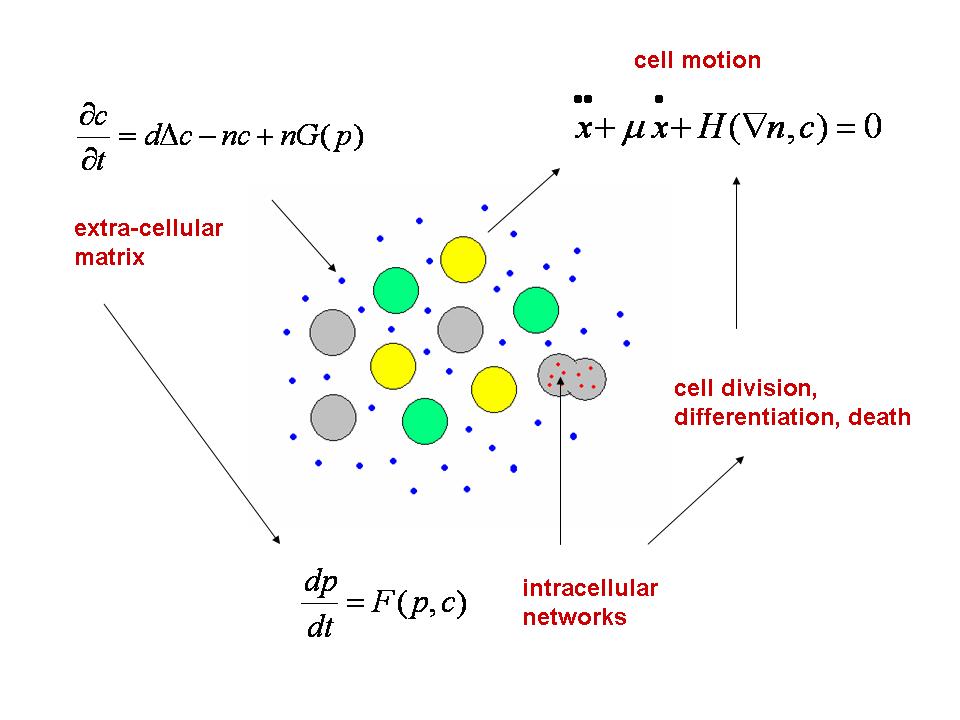
        <p>The Dracula project is devoted to multi-scale modeling in biology with applications to normal and pathological hematopoiesis (blood cell production). Multi-scale modeling implies simultaneous modeling of intra-cellular networks (molecular level), of cell behavior (cellular level), of the dynamics of cell populations (organ or tissue) with the control by other organs (organism) (see Figure <a title="Presentation" href="./uid3.html#uid4">1</a>). Such modeling represents one of the major challenges in modern science due to its importance and because of the complexity of biological phenomena and of the presence of very different scales.</p>
        <div align="center" style="margin-top:10px">
          <a name="uid4">
            <!--...-->
          </a>
          <table title="" class="objectContainer">
            <caption align="bottom"><strong>Figure
	1. </strong>Schema of multi-scale models of cell dynamics: DPD-PDE-ODE models.</caption>
            <tr align="center">
              <td>
                <table>
                  <tr>
                    <td style="height:3px;" align="center">
                      <img style="width:341.43306pt" alt="IMG/CellDynamics.jpg" src="IMG/CellDynamics.jpg"/>
                    </td>
                  </tr>
                </table>
              </td>
            </tr>
          </table>
        </div>
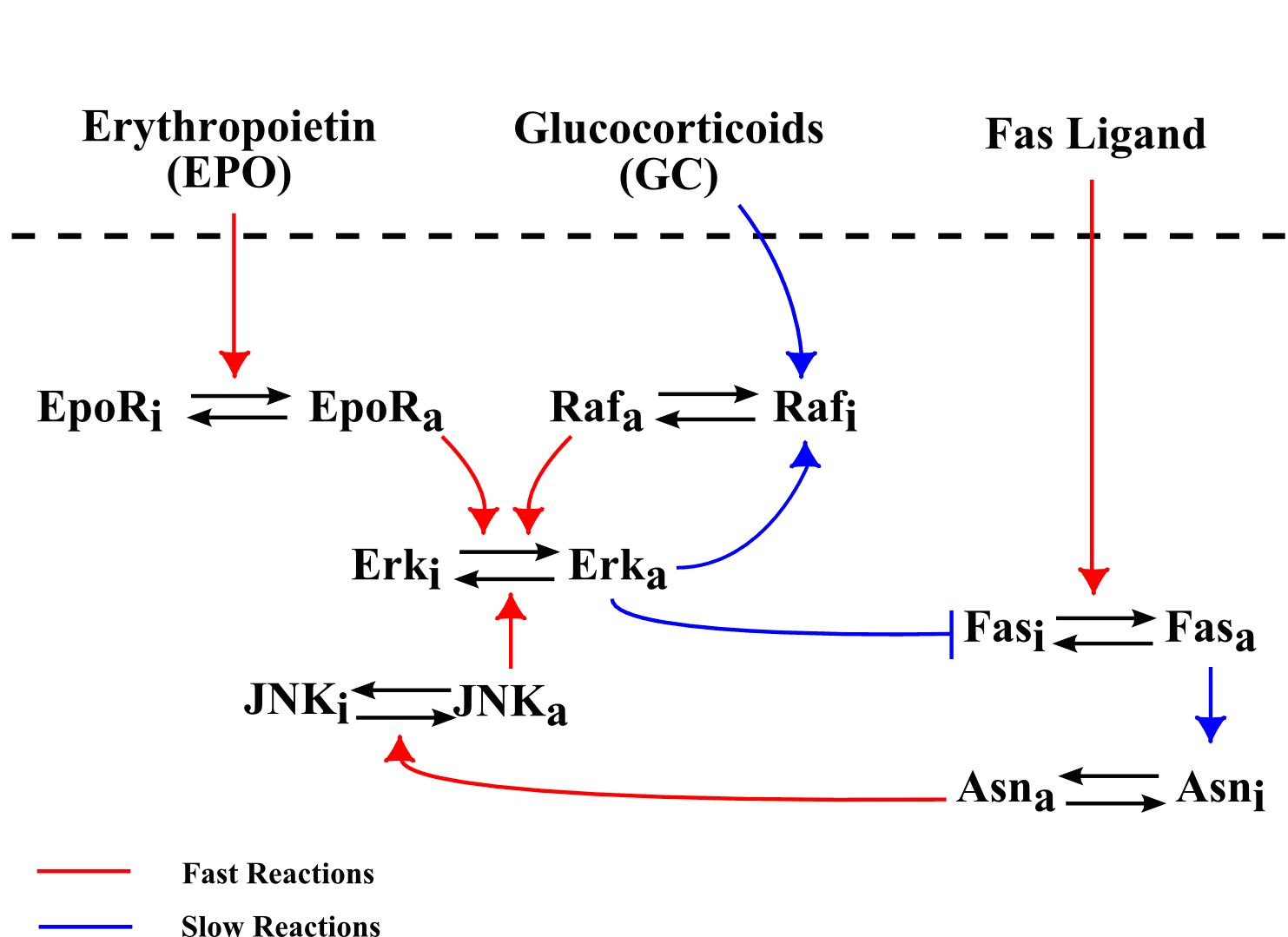
        <p>Hematopoiesis is a complex process that begins with primitive hematopoietic stem cells and results in formation of mature cells: red blood cells, white cells and platelets. Blood cells are produced in the bone marrow, from where mature cells are released into the blood stream. Hematopoiesis is based on a balance between cell proliferation (including self-renewal), differentiation and apoptosis (programmed cell death). The choice between these three possibilities is determined by intra-cellular regulatory networks and by numerous control mechanisms in the bone marrow (see Figure <a title="Presentation" href="./uid3.html#uid5">2</a>) or carried out by other organs. Intra-cellular regulatory networks are complex biochemical reactions involving proteins, enzymes and signalling molecules. Thus, hematopoiesis is a complex process which has a vital importance for the organism. Its malfunctioning can result in numerous blood diseases including leukemia.</p>
        <div align="center" style="margin-top:10px">
          <a name="uid5">
            <!--...-->
          </a>
          <table title="" class="objectContainer">
            <caption align="bottom"><strong>Figure
	2. </strong>A schematic description of the intra-cellular molecular events that are relevant for decision making in an erythroid progenitor. The non active form of the protein is labeled i, the active form a. Blue lines indicate transcriptional regulation, red lines indicate biochemical regulation.</caption>
            <tr align="center">
              <td>
                <table>
                  <tr>
                    <td style="height:3px;" align="center">
                      <img style="width:284.52756pt" alt="IMG/Intracellular.jpg" src="IMG/Intracellular.jpg"/>
                    </td>
                  </tr>
                </table>
              </td>
            </tr>
          </table>
        </div>
        <p>Multi-scale modeling in hematopoiesis holds a great potential. A variety of techniques exists to deal with this problem. However, the complexity of the system poses new difficulties and leads to the development of new tools. The expected results of this study are numerous. On one hand, it will shed new light on the different physiological mechanisms that converge toward the continuous regeneration of blood cells, for example: the behavior of hematopoietic stem cells under stress conditions, the understanding of deregulation of erythropoiesis (the process of red blood cell production) under drag treatments (this can lead to lack of red blood cells (anemia), or a surplus of red blood cells), the understanding of immune response process under the control of T-cell activation and memory cell generation, in order to adapt infection prevention strategies.</p>
        <p>On the other hand, the modeling methods developed here for hematopoiesis are relevant to study other complex biological systems. We pay a special attention on developing methods that are not restricted to hematopoiesis. In parallel with hematopoiesis modeling, most of members of Dracula keep on working on modeling of other biological phenomena, for example: tumor cells, prion disease, adaptive dynamics, atherosclerosis, and so on. Approaches developed in the present project are very likely relevant in these fields too.</p>
        <p>An important part of our researches is in close collaboration with biologists and physicians in order to stay in close contact with the biological and medical goals. The presence, within the project, of a biologist (Olivier Gandrillon) that has acquired over the years the know-how required for interacting with mathematicians is probably one of the main asset of the project. He participates actively in many tasks of our program, especially involving description of biological process, and he is "consultant" for other biological aspects, in the other parts of the project.</p>
      </div>
      <!--FIN du corps du module-->
      <br/>
      <div class="bottomNavigation">
        <div class="tail_aucentre">
          <a href="./uid1.html" accesskey="P"><img style="align:bottom; border:none" alt="previous" src="../static/img/icons/previous_motif.jpg"/> Previous | </a>
          <a href="./uid0.html" accesskey="U"><img style="align:bottom; border:none" alt="up" src="../static/img/icons/up_motif.jpg"/>  Home</a>
          <a href="./uid6.html" accesskey="N"> | Next <img style="align:bottom; border:none" alt="next" src="../static/img/icons/next_motif.jpg"/></a>
        </div>
        <br/>
      </div>
    </div>
  </body>
</html>