<?xml version="1.0" encoding="utf-8"?>
<!DOCTYPE html PUBLIC "-//W3C//DTD XHTML 1.1 plus MathML 2.0 plus SVG 1.1//EN" "http://www.w3.org/2002/04/xhtml-math-svg/xhtml-math-svg.dtd">
<html xmlns="http://www.w3.org/1999/xhtml">
  <head>
    <meta http-equiv="Content-Type" content="application/xhtml+xml; charset=utf-8"/>
    <title>Project-Team:HEPHAISTOS</title>
    <link rel="stylesheet" href="../static/css/raweb.css" type="text/css"/>
    <meta name="description" content="New Results - Assistance"/>
    <meta name="dc.title" content="New Results - Assistance"/>
    <meta name="dc.creator" content="Mohamed Hedi Amri"/>
    <meta name="dc.creator" content="Alain Coulbois"/>
    <meta name="dc.creator" content="Artem Melnyk"/>
    <meta name="dc.creator" content="Aurélien Massein"/>
    <meta name="dc.creator" content="Yves Papegay"/>
    <meta name="dc.creator" content="Odile Pourtallier"/>
    <meta name="dc.creator" content="Alain Coulbois"/>
    <meta name="dc.creator" content="Artem Melnyk"/>
    <meta name="dc.creator" content="Jean-Pierre Merlet"/>
    <meta name="dc.subject" content=""/>
    <meta name="dc.publisher" content="INRIA"/>
    <meta name="dc.date" content="(SCHEME=ISO8601) 2016-01"/>
    <meta name="dc.type" content="Report"/>
    <meta name="dc.language" content="(SCHEME=ISO639-1) en"/>
    <meta name="projet" content="HEPHAISTOS"/>
    <script type="text/javascript" src="https://raweb.inria.fr/rapportsactivite/RA2016/static/MathJax/MathJax.js?config=TeX-MML-AM_CHTML">
      <!--MathJax-->
    </script>
  </head>
  <body>
    <div class="tdmdiv">
      <div class="logo">
        <a href="http://www.inria.fr">
          <img style="align:bottom; border:none" src="../static/img/icons/logo_INRIA-coul.jpg" alt="Inria"/>
        </a>
      </div>
      <div class="TdmEntry">
        <div class="tdmentete">
          <a href="uid0.html">Project-Team Hephaistos</a>
        </div>
        <span>
          <a href="uid1.html">Members</a>
        </span>
      </div>
      <div class="TdmEntry">
        <a href="./uid3.html">Overall Objectives</a>
      </div>
      <div class="TdmEntry">Research Program<ul><li><a href="uid20.html&#10;&#9;&#9;  ">Interval analysis</a></li><li><a href="uid30.html&#10;&#9;&#9;  ">Robotics</a></li></ul></div>
      <div class="TdmEntry">Application Domains<ul><li><a href="uid34.html&#10;&#9;&#9;  ">Domain 1</a></li></ul></div>
      <div class="TdmEntry">
        <a href="./uid36.html">Highlights of the Year</a>
      </div>
      <div class="TdmEntry">New Software and Platforms<ul><li><a href="uid46.html&#10;&#9;&#9;  ">ALIAS</a></li><li><a href="uid50.html&#10;&#9;&#9;  ">Platforms</a></li></ul></div>
      <div class="TdmEntry">New Results<ul><li><a href="uid55.html&#10;&#9;&#9;  ">Robotics </a></li><li class="tdmActPage"><a href="uid59.html&#10;&#9;&#9;  ">Assistance</a></li><li><a href="uid76.html&#10;&#9;&#9;  ">Miscellaneous results</a></li></ul></div>
      <div class="TdmEntry">Bilateral Contracts and Grants with Industry<ul><li><a href="uid80.html&#10;&#9;&#9;  ">Airbus</a></li></ul></div>
      <div class="TdmEntry">Partnerships and Cooperations<ul><li><a href="uid87.html&#10;&#9;&#9;  ">Regional Initiatives</a></li><li><a href="uid90.html&#10;&#9;&#9;  ">National Initiatives</a></li><li><a href="uid93.html&#10;&#9;&#9;  ">European Initiatives</a></li><li><a href="uid104.html&#10;&#9;&#9;  ">International Initiatives</a></li><li><a href="uid114.html&#10;&#9;&#9;  ">International Research Visitors</a></li></ul></div>
      <div class="TdmEntry">Dissemination<ul><li><a href="uid117.html&#10;&#9;&#9;  ">Promoting Scientific Activities</a></li><li><a href="uid141.html&#10;&#9;&#9;  ">Teaching - Supervision - Juries</a></li><li><a href="uid151.html&#10;&#9;&#9;  ">Popularization</a></li></ul></div>
      <div class="TdmEntry">
        <div>Bibliography</div>
      </div>
      <div class="TdmEntry">
        <ul>
          <li>
            <a id="tdmbibentmajor" href="bibliography.html">Major publications</a>
          </li>
          <li>
            <a id="tdmbibentyear" href="bibliography.html#year">Publications of the year</a>
          </li>
        </ul>
      </div>
    </div>
    <div id="main">
      <div class="mainentete">
        <div id="head_agauche">
          <small><a href="http://www.inria.fr">
	    
	    Inria
	  </a> | <a href="../index.html">
	    
	    Raweb 
	    2016</a> | <a href="http://www.inria.fr/en/teams/hephaistos">Presentation of the Project-Team HEPHAISTOS</a> | <a href="https://team.inria.fr/hephaistos/">HEPHAISTOS Web Site
	  </a></small>
        </div>
        <div id="head_adroite">
          <table class="qrcode">
            <tr>
              <td>
                <a href="hephaistos.xml">
                  <img style="align:bottom; border:none" alt="XML" src="../static/img/icons/xml_motif.png"/>
                </a>
              </td>
              <td>
                <a href="hephaistos.pdf">
                  <img style="align:bottom; border:none" alt="PDF" src="IMG/qrcode-hephaistos-pdf.png"/>
                </a>
              </td>
              <td>
                <a href="../hephaistos/hephaistos.epub">
                  <img style="align:bottom; border:none" alt="e-pub" src="IMG/qrcode-hephaistos-epub.png"/>
                </a>
              </td>
            </tr>
            <tr>
              <td/>
              <td>PDF
</td>
              <td>e-Pub
</td>
            </tr>
          </table>
        </div>
      </div>
      <!--FIN du corps du module-->
      <br/>
      <div class="bottomNavigation">
        <div class="tail_aucentre">
          <a href="./uid55.html" accesskey="P"><img style="align:bottom; border:none" alt="previous" src="../static/img/icons/previous_motif.jpg"/> Previous | </a>
          <a href="./uid0.html" accesskey="U"><img style="align:bottom; border:none" alt="up" src="../static/img/icons/up_motif.jpg"/>  Home</a>
          <a href="./uid76.html" accesskey="N"> | Next <img style="align:bottom; border:none" alt="next" src="../static/img/icons/next_motif.jpg"/></a>
        </div>
        <br/>
      </div>
      <div id="textepage">
        <!--DEBUT2 du corps du module-->
        <h2>Section: 
      New Results</h2>
        <h3 class="titre3">Assistance</h3>
        <a name="uid60"/>
        <h4 class="titre4">Smart Environment for Human Behaviour
Recognition </h4>
        <p class="participants"><span class="part">Participants</span> :
	Mohamed Hedi Amri, Alain Coulbois, Artem Melnyk, Aurélien Massein, Yves Papegay, Odile Pourtallier [correspondante] .</p>
        <p>The general aim of this research activity focuses on long term indoor
monitoring of frail persons.
In particular we are interested in early detection of daily routine
and activity modifications.
These modifications may indicate health condition alteration of the
person and may require
further medical or family care.
Note that our work does not aim at detecting brutal
modifications such as faintness or fall.</p>
        <p>In our research we envisage both individual and collective housing
such as rehabilitation center or retirement home.</p>
        <p>Our work relies on the following leading ideas :</p>
        <ul>
          <li>
            <p class="notaparagraph"><a name="uid61"> </a>We do not base our monitoring system on wearable devices since
it appears that they may not be well accepted and worn regularly,</p>
          </li>
          <li>
            <p class="notaparagraph"><a name="uid62"> </a>Privacy advocates adequacy between the monitoring level needed
by a person and the detail level of the data collected. We therefore
strive to
design a system fitted to the need of monitoring of the person.</p>
          </li>
          <li>
            <p class="notaparagraph"><a name="uid63"> </a>In addition to privacy concern, intrusive feature of video led
us not to use it.</p>
          </li>
        </ul>
        <p>This year we have concentrated our effort on the first step of this
research that consists in being able to locate the
person in his/her indoor environment.</p>
        <p>A natural way of being able to adapt the accuracy of localization (and
consequently accuracy of monitoring), is to use a partition of
the monitoring area in a finite number of elementary zones ; the
number of zones together with their geometry being closely related
with the pursued level of monitoring. In practice these zones will be
materialized by sensors barriers that detect the passage of
a person from one zone to the other. Henceforth each zone are polygonal.</p>
        <p>Several directions have been followed this year.</p>
        <ul>
          <li>
            <p class="notaparagraph"><a name="uid64"> </a>monitoring system design,</p>
          </li>
          <li>
            <p class="notaparagraph"><a name="uid65"> </a>material development,</p>
          </li>
          <li>
            <p class="notaparagraph"><a name="uid66"> </a>data gathering and analysis,</p>
          </li>
          <li>
            <p class="notaparagraph"><a name="uid67"> </a>experimentation.</p>
          </li>
        </ul>
        <a name="uid68"/>
        <h5 class="titre5">Monitoring system design</h5>
        <p>We aim at designing the partition of the monitoring space. Given the
geometry of the monitoring area, the admissible position of the
sensors barriers and a set of points of interest, the objective is to
determine the positions of a minimal number of barriers such
that each zone therefore defined includes at most one point of
interest. The crossing of a given secession of barriers therefore
allows to determine the trajectory of a person from one point of
interest to another. An algorithm for solving this problem has been
developed.</p>
        <a name="uid69"/>
        <h5 class="titre5">Material development</h5>
        <p>We initially used commercialized Infra Red barriers to detect the
crossing time from one zone to an other. Nevertheless although the
collected data is sufficient for the monitoring of a single person it
prove not to be sufficient in a environment where there may be
several persons, which is typically the case when considering
retirement home for example.</p>
        <p>Hence we have developed a multi-sensor barrier, a box containing two
infra red distance sensors and two motion sensors
(passive infrared type). It has been designed and created by 3D fast
prototyping printer. The box is light, cheap and discreet.
In addition to
detecting the crossing time, it also gives the direction of crossing
together with information about the speed and the size of the
crossing person or object. This last information is helpful to
differentiate for example a person using a wheelchair, a valid person
(e.g medical staff), or an elderly.</p>
        <p>We use phidget interface kits connected to a fit-pc for data
acquisition and recording.</p>
        <a name="uid70"/>
        <h5 class="titre5">Data gathering and analysis</h5>
        <p>The aim of this data processing is to transform the raw data provided
by the sensor barriers in a higher level data composed by the time and
direction of
crossing and rough estimation of the speed and size of the object or
person crossing the barrier.
This information can be deduced using only the data given by the
distance sensors after processing. Nevertheless in real situations the
barrier may be
hidden by an object (food or cleaning trolley for example), and the
redundant information from PIR sensors of an other closed barrier may
be useful to recover the missing information.</p>
        <p>The data are intended to be collected on large period of time
(typically months). Inline filtering and averaging techniques were
used to transform large and noisy raw data to get reasonable dataset
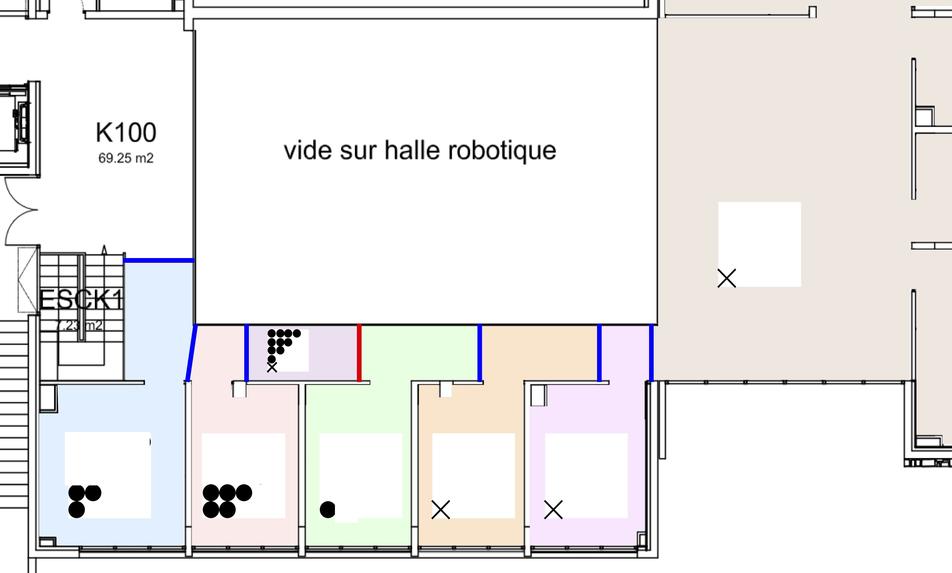
size. Figure <a title="Assistance" href="./uid59.html#uid71">3</a> shows in blue or red the general direction of the
measurement of the stations (that create detection zones) and in each
zone the current estimation of the number of people in each zone (a
cross indicates 0, a black circle represents one person). For example
the lower left zone has between 1 and 2 people.</p>
        <div align="center" style="margin-top:10px">
          <a name="uid71">
            <!--...-->
          </a>
          <table title="" class="objectContainer">
            <caption align="bottom"><strong>Figure
	3. </strong>Occupancy of zone in a complex environment as measured by
several stations</caption>
            <tr align="center">
              <td>
                <table>
                  <tr>
                    <td style="height:3px;" align="center">
                      <img style="width:227.62204pt" alt="IMG/comptage.jpg" src="IMG/comptage.jpg"/>
                    </td>
                  </tr>
                </table>
              </td>
            </tr>
          </table>
        </div>
        <a name="uid72"/>
        <h5 class="titre5">Experimentation</h5>
        <p>A monitoring system has been installed in the first floor of EHPAD
Valrose in Nice. The area of monitoring was restricted to the hallway
that leads to the individual rooms of six residents. Residents are
proposed several activities (social or cultural activities, physical
activities, meals) and have to use the hallway when participating to
those activities. In addition to residents medical and service staff
also use this hallway. The aim of this experiment is
to determine an activity measure for each resident and to study its
evolution with time. In that case the sensor placement is designed in
such way that individual information may be obtained (e.g. by having
stations on both side of the door of the individual room).</p>
        <p>The installed system is composed of 10 multi sensor barriers installed
on the wall of the hallway and 7 additional PIR sensors installed on
the ceiling of the hallway. The data are
transmitted by phidget interface kits and are processed by a fit-PC
that store the daily data sets. A similar setup will be installed at
the very beginning of 2017 in the Institut Claude Pompidou to monitor
the activity in the corridors and in the waiting room. Here the
medical community is more interested in statistical analysis than in
individual analysis.</p>
        <a name="uid73"/>
        <h4 class="titre4">Sensors placement</h4>
        <p>Both economic motivations due to demographic evolution and willingness
of people to live independently at home when aging, facing physical
impairment or recovering from injuries has raised the need for
activity monitoring at home, in rehabilitation center or in retirement
home.
Monitoring systems provide informations that can range from a broad
measure of the daily activity to a precise analysis of the ability of
a person performing a task (cooking, dressing, ...) and its evolution.</p>
        <p>The broad range of needs and contexts, together with the large variety
of available sensors implies the necessity to carefully think the
design of the monitoring system.
An appropriate system should be inexpensive and forgettable for the
monitored person, should respect privacy but collect necessary data,
and should easily adapt to stick to new needs.
We aim to provide an assisting tool for designing appropriate
monitoring systems.</p>
        <p>As a second year of a PhD work, metrics have been defined to evaluate
quality of sensors solutions and placement to infer people behaviors
inside a smart environments. Based on these metrics, a methodology for
optimal design of smart environments has been developed.</p>
        <a name="uid74"/>
        <h4 class="titre4">Rehabilitation </h4>
        <p class="participants"><span class="part">Participants</span> :
	Alain Coulbois, Artem Melnyk, Jean-Pierre Merlet [correspondant] .</p>
        <p>We have developed the specific walking aid <tt>ANG-med</tt>  to be used
to monitor rehabilitation exercises beside performing analysis of
walking pattern as any walker of the <tt>ANG</tt>  family. The main
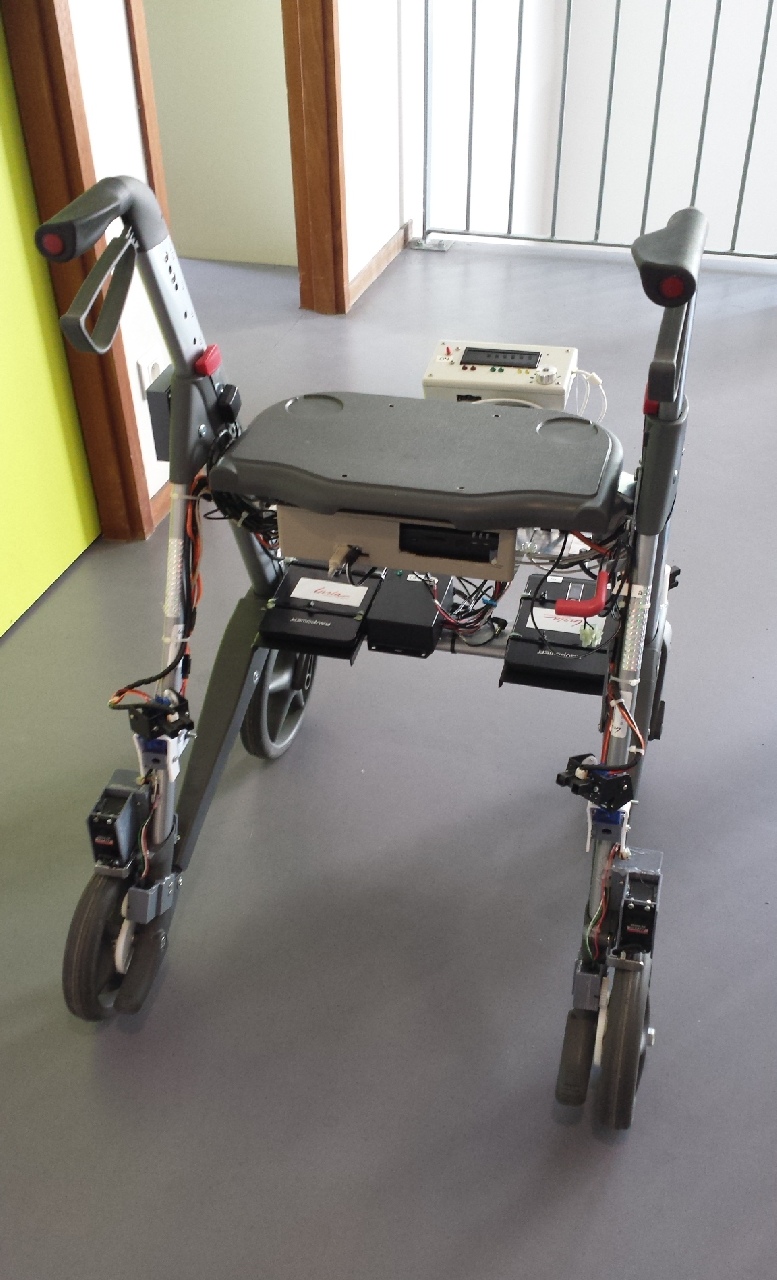
addition for this walker are two rear looking distance sensors and two
of such sensor mounted on a pan-tilt head (figure <a title="Assistance" href="./uid59.html#uid75">4</a>). These
sensors have been placed under the guidance of the medical community
in order to
monitor and assess rehabilitation exercise such as leg
flexion/extension/abduction and plantar flexion.</p>
        <div align="center" style="margin-top:10px">
          <a name="uid75">
            <!--...-->
          </a>
          <table title="" class="objectContainer">
            <caption align="bottom"><strong>Figure
	4. </strong>Rear view of the <tt>ANG-med</tt>  walker with the 4 distance
sensors that are used to monitor and assess rehabilitation exercises</caption>
            <tr align="center">
              <td>
                <table>
                  <tr>
                    <td style="height:3px;" align="center">
                      <img style="width:113.81102pt" alt="IMG/ANG_MED_rear.jpg" src="IMG/ANG_MED_rear.jpg"/>
                    </td>
                  </tr>
                </table>
              </td>
            </tr>
          </table>
        </div>
        <p>The walker is since on year in test in the MATIA fundation in
Spain. The software that is used to for this walker has been
developed with the European RAPP project (see section <a title="European Initiatives" href="./uid93.html#uid95">9.3.1.1</a>) so
that new exercise may
easily be programmed and downloaded through a message passing
system <a href="./bibliography.html#hephaistos-2016-bid12">[9]</a>.
</p>
      </div>
      <!--FIN du corps du module-->
      <br/>
      <div class="bottomNavigation">
        <div class="tail_aucentre">
          <a href="./uid55.html" accesskey="P"><img style="align:bottom; border:none" alt="previous" src="../static/img/icons/previous_motif.jpg"/> Previous | </a>
          <a href="./uid0.html" accesskey="U"><img style="align:bottom; border:none" alt="up" src="../static/img/icons/up_motif.jpg"/>  Home</a>
          <a href="./uid76.html" accesskey="N"> | Next <img style="align:bottom; border:none" alt="next" src="../static/img/icons/next_motif.jpg"/></a>
        </div>
        <br/>
      </div>
    </div>
  </body>
</html>