<?xml version="1.0" encoding="utf-8"?>
<!DOCTYPE html PUBLIC "-//W3C//DTD XHTML 1.1 plus MathML 2.0 plus SVG 1.1//EN" "http://www.w3.org/2002/04/xhtml-math-svg/xhtml-math-svg.dtd">
<html xmlns="http://www.w3.org/1999/xhtml">
  <head>
    <meta http-equiv="Content-Type" content="application/xhtml+xml; charset=utf-8"/>
    <title>Team:LEMON</title>
    <link rel="stylesheet" href="../static/css/raweb.css" type="text/css"/>
    <meta name="description" content="Overall Objectives - Context"/>
    <meta name="dc.title" content="Overall Objectives - Context"/>
    <meta name="dc.subject" content=""/>
    <meta name="dc.publisher" content="INRIA"/>
    <meta name="dc.date" content="(SCHEME=ISO8601) 2016-01"/>
    <meta name="dc.type" content="Report"/>
    <meta name="dc.language" content="(SCHEME=ISO639-1) en"/>
    <meta name="projet" content="LEMON"/>
    <script type="text/javascript" src="https://raweb.inria.fr/rapportsactivite/RA2016/static/MathJax/MathJax.js?config=TeX-MML-AM_CHTML">
      <!--MathJax-->
    </script>
  </head>
  <body>
    <div class="tdmdiv">
      <div class="logo">
        <a href="http://www.inria.fr">
          <img style="align:bottom; border:none" src="../static/img/icons/logo_INRIA-coul.jpg" alt="Inria"/>
        </a>
      </div>
      <div class="TdmEntry">
        <div class="tdmentete">
          <a href="uid0.html">Team Lemon</a>
        </div>
        <span>
          <a href="uid1.html">Members</a>
        </span>
      </div>
      <div class="TdmEntry">Overall Objectives<ul><li class="tdmActPage"><a href="./uid3.html">Context</a></li></ul></div>
      <div class="TdmEntry">Research Program<ul><li><a href="uid8.html&#10;&#9;&#9;  ">State of the Art</a></li><li><a href="uid12.html&#10;&#9;&#9;  ">Scientific Objectives</a></li></ul></div>
      <div class="TdmEntry">Application Domains<ul><li><a href="uid20.html&#10;&#9;&#9;  ">Coastal Oceanography</a></li><li><a href="uid21.html&#10;&#9;&#9;  ">Urban Floods</a></li><li><a href="uid22.html&#10;&#9;&#9;  ">River Hydraulics</a></li></ul></div>
      <div class="TdmEntry">
        <a href="./uid24.html">Highlights of the Year</a>
      </div>
      <div class="TdmEntry">New Software and Platforms<ul><li><a href="uid27.html&#10;&#9;&#9;  ">TsunamiLab</a></li><li><a href="uid32.html&#10;&#9;&#9;  ">SW2D</a></li><li><a href="uid40.html&#10;&#9;&#9;  ">WindPoS</a></li></ul></div>
      <div class="TdmEntry">New Results<ul><li><a href="uid45.html&#10;&#9;&#9;  ">Ocean modeling</a></li><li><a href="uid49.html&#10;&#9;&#9;  ">Renewable energies</a></li><li><a href="uid51.html&#10;&#9;&#9;  ">Multiscale modeling for environmental issues</a></li><li><a href="uid56.html&#10;&#9;&#9;  ">Other results</a></li></ul></div>
      <div class="TdmEntry">Bilateral Contracts and Grants with Industry<ul><li><a href="uid60.html&#10;&#9;&#9;  ">Bilateral Contracts with Industry</a></li><li><a href="uid63.html&#10;&#9;&#9;  ">Bilateral Grants with Industry</a></li></ul></div>
      <div class="TdmEntry">Partnerships and Cooperations<ul><li><a href="uid65.html&#10;&#9;&#9;  ">Regional Initiatives</a></li><li><a href="uid68.html&#10;&#9;&#9;  ">National Initiatives</a></li><li><a href="uid74.html&#10;&#9;&#9;  ">European Initiatives</a></li><li><a href="uid76.html&#10;&#9;&#9;  ">International Initiatives</a></li><li><a href="uid85.html&#10;&#9;&#9;  ">International Research Visitors</a></li></ul></div>
      <div class="TdmEntry">Dissemination<ul><li><a href="uid88.html&#10;&#9;&#9;  ">Promoting Scientific Activities</a></li><li><a href="uid102.html&#10;&#9;&#9;  ">Teaching - Supervision - Juries</a></li><li><a href="uid140.html&#10;&#9;&#9;  ">Popularization</a></li></ul></div>
      <div class="TdmEntry">
        <div>Bibliography</div>
      </div>
      <div class="TdmEntry">
        <ul>
          <li>
            <a id="tdmbibentyear" href="bibliography.html">Publications of the year</a>
          </li>
          <li>
            <a id="tdmbibentfoot" href="bibliography.html#References">References in notes</a>
          </li>
        </ul>
      </div>
    </div>
    <div id="main">
      <div class="mainentete">
        <div id="head_agauche">
          <small><a href="http://www.inria.fr">
	    
	    Inria
	  </a> | <a href="../index.html">
	    
	    Raweb 
	    2016</a> | <a href="http://www.inria.fr/en/teams/lemon">Presentation of the Team LEMON</a> | <a href="http://team.inria.fr/lemon/en">LEMON Web Site
	  </a></small>
        </div>
        <div id="head_adroite">
          <table class="qrcode">
            <tr>
              <td>
                <a href="lemon.xml">
                  <img style="align:bottom; border:none" alt="XML" src="../static/img/icons/xml_motif.png"/>
                </a>
              </td>
              <td>
                <a href="lemon.pdf">
                  <img style="align:bottom; border:none" alt="PDF" src="IMG/qrcode-lemon-pdf.png"/>
                </a>
              </td>
              <td>
                <a href="../lemon/lemon.epub">
                  <img style="align:bottom; border:none" alt="e-pub" src="IMG/qrcode-lemon-epub.png"/>
                </a>
              </td>
            </tr>
            <tr>
              <td/>
              <td>PDF
</td>
              <td>e-Pub
</td>
            </tr>
          </table>
        </div>
      </div>
      <!--FIN du corps du module-->
      <br/>
      <div class="bottomNavigation">
        <div class="tail_aucentre">
          <a href="./uid1.html" accesskey="P"><img style="align:bottom; border:none" alt="previous" src="../static/img/icons/previous_motif.jpg"/> Previous | </a>
          <a href="./uid0.html" accesskey="U"><img style="align:bottom; border:none" alt="up" src="../static/img/icons/up_motif.jpg"/>  Home</a>
          <a href="./uid8.html" accesskey="N"> | Next <img style="align:bottom; border:none" alt="next" src="../static/img/icons/next_motif.jpg"/></a>
        </div>
        <br/>
      </div>
      <div id="textepage">
        <!--DEBUT2 du corps du module-->
        <h2>Section: 
      Overall Objectives</h2>
        <h3 class="titre3">Context</h3>
        <p>Coastal zones are the theatre for numerous interfaces. The main elements
that come to mind are the sea/earth interface, saline/brackish/fresh
water interfaces and sediment/biological world interfaces. These elements
cause most of the phenomena met within coastal zones to be in fragile
equilibrium or more often, in constant evolution. This is due to the
evolving external pressures, such as anthropic activity or physical
forces (tectonic features, tide, precipitations, storms, sea level rise, sediment transport,
etc.). In order to illustrate the considerable importance of such
a research project, let us underline the following figures:</p>
        <ul>
          <li>
            <p class="notaparagraph"><a name="uid4"> </a><b>60 % of the world population lives in a 100km wide coastal strip</b> (80% within 30km in Brittany),</p>
          </li>
          <li>
            <p class="notaparagraph"><a name="uid5"> </a><b>current sea level rise</b> has occurred at a mean rate of 1.8 mm per year for the past century, and more recently at rates
estimated near <span class="math"><math xmlns="http://www.w3.org/1998/Math/MathML"><mrow><mn>2</mn><mo>.</mo><mn>8</mn><mo>±</mo><mn>0</mn><mo>.</mo><mn>4</mn></mrow></math></span> to <span class="math"><math xmlns="http://www.w3.org/1998/Math/MathML"><mrow><mn>3</mn><mo>.</mo><mn>1</mn><mo>±</mo><mn>0</mn><mo>.</mo><mn>7</mn></mrow></math></span> mm per year (1993-2003). It is likely to rise in the future: IPCC recently anticipated a 1.5m
sea level rise within the next century,</p>
          </li>
        </ul>
        <p>It results that <b>coastal management</b> requires the
development of theoretical and applied models to facilitate the <b>decision
process</b>. For example, a city that wants to develop a harbour needs
to anticipate the time-evolution of urban floods. The construction of
defense barriers to protect buildings and houses from natural hazards
relies on the knowledge of potential submersion events, in a period
where the impact of global climatic and anthropic changes on the coastal
zone is expected to generate increased coastal risks (IPCC 2007 and 2013).
One also needs to analyze <i>"what if"</i> scenarios
for proposed changes in land use or land cover in coastal regions
(such as French Mont Saint-Michel).</p>
        <p class="notaparagraph">As a matter of fact, the software
packages available for engineering applications are usually not satisfactory. More specifically, some modeling hypotheses (such as the hydrostatic approximation) should be weakened, and more appropriate numerical schemes should be implemented.
What is proposed with LEMON is to <b>increase the quality of
coastal engineering numerical tools</b>, thanks to better designed mathematical
and numerical models.</p>
        <div align="center" style="margin-top:10px">
          <a name="uid6">
            <!--...-->
          </a>
          <table title="" class="objectContainer">
            <caption align="bottom"><strong>Figure
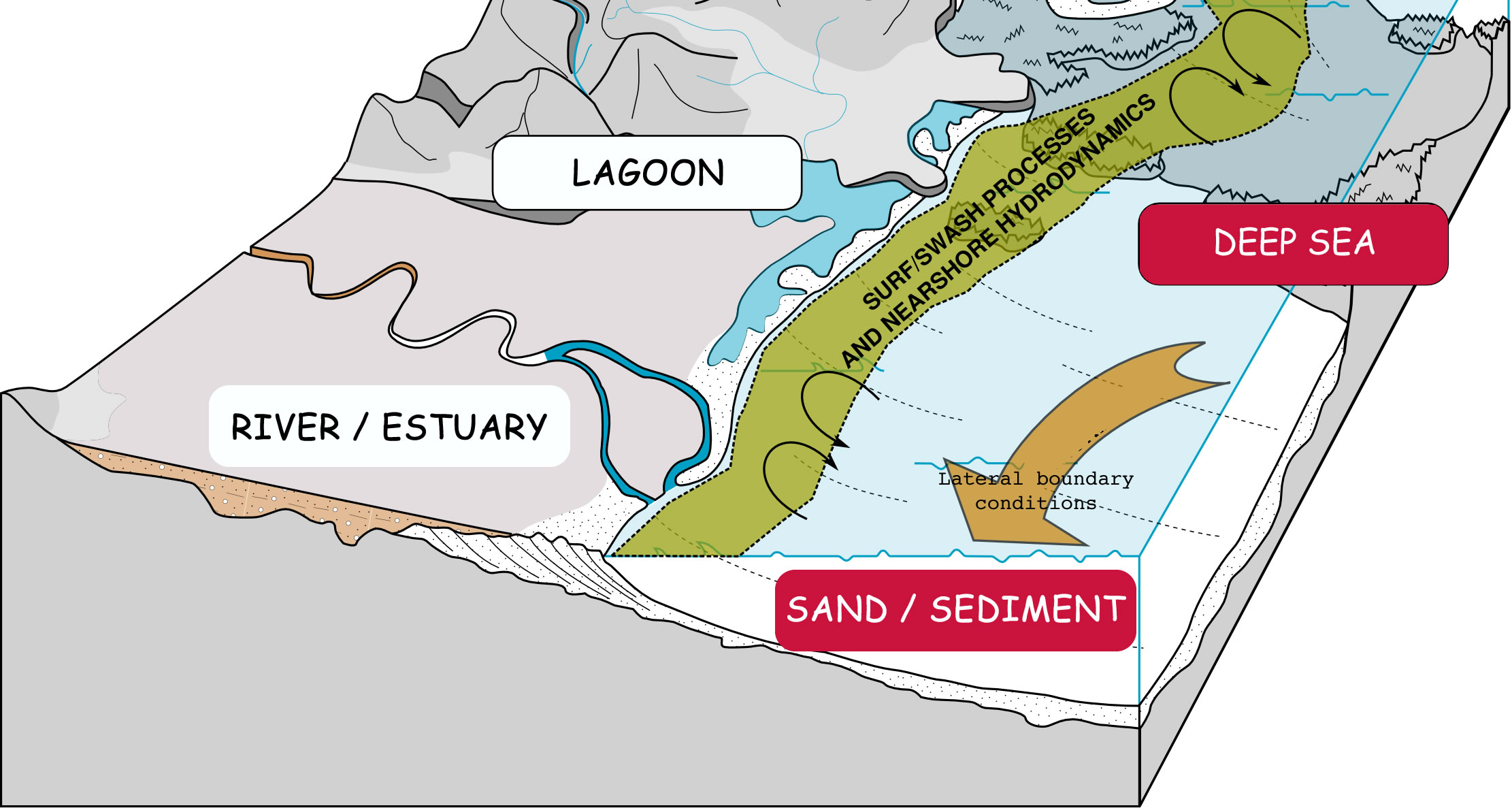
	1. </strong>Examples of interacting nearshore processes. Courtesy F. Bouchette.</caption>
            <tr align="center">
              <td>
                <table>
                  <tr>
                    <td style="height:3px;" align="center">
                      <img style="width:227.62204pt" alt="IMG/Littoral.png" src="IMG/Littoral.png"/>
                    </td>
                  </tr>
                </table>
              </td>
            </tr>
          </table>
        </div>
        <p>The mathematical modeling of the phenomena occurring within
coastal zones and their interactions is currently a major scientific
issue. If we want to model coastal zones, we have to consider the
fact that they cover a very wide
range of situations and that they are the result of several complex
interacting phenomena (see Figure <a title="Context" href="./uid3.html#uid6">1</a>). More specifically,
many time scales and space scales are involved and many physical and
biological phenomena are in action. Moreover, within each zone, specific
interactions between
those phenomena make it an almost unique situation. Hence, we are
far from having a database aggregating every possible situation. Modeling complex phenomena
with the objective of building and improving management/decision tools
requires the interaction of several models, each of them being dedicated
to the simulation of a specific process. Such
(mathematical and numerical) models usually exist but scarcely
interact: therefore there is a need to understand how these bricks
can be modified (forcing terms, boundary conditions) in order to be assembled. It will require a
dialog with specialists of the application domain (geophysics, mechanical
engineering, biology, hydrology, etc.) to help to develop new mathematical and
numerical models for coastal engineering.</p>
        <p class="notaparagraph">Developing more accurate and/or less CPU demanding models and coupling them together, LEMON will have a strong impact in the
applications targeted and in coastal management.</p>
      </div>
      <!--FIN du corps du module-->
      <br/>
      <div class="bottomNavigation">
        <div class="tail_aucentre">
          <a href="./uid1.html" accesskey="P"><img style="align:bottom; border:none" alt="previous" src="../static/img/icons/previous_motif.jpg"/> Previous | </a>
          <a href="./uid0.html" accesskey="U"><img style="align:bottom; border:none" alt="up" src="../static/img/icons/up_motif.jpg"/>  Home</a>
          <a href="./uid8.html" accesskey="N"> | Next <img style="align:bottom; border:none" alt="next" src="../static/img/icons/next_motif.jpg"/></a>
        </div>
        <br/>
      </div>
    </div>
  </body>
</html>