<?xml version="1.0" encoding="utf-8"?>
<!DOCTYPE html PUBLIC "-//W3C//DTD XHTML 1.1 plus MathML 2.0 plus SVG 1.1//EN" "http://www.w3.org/2002/04/xhtml-math-svg/xhtml-math-svg.dtd">
<html xmlns="http://www.w3.org/1999/xhtml">
  <head>
    <meta http-equiv="Content-Type" content="application/xhtml+xml; charset=utf-8"/>
    <title>Team:TONUS</title>
    <link rel="stylesheet" href="../static/css/raweb.css" type="text/css"/>
    <meta name="description" content="Research Program - Reduced kinetic models for plasmas"/>
    <meta name="dc.title" content="Research Program - Reduced kinetic models for plasmas"/>
    <meta name="dc.subject" content=""/>
    <meta name="dc.publisher" content="INRIA"/>
    <meta name="dc.date" content="(SCHEME=ISO8601) 2016-01"/>
    <meta name="dc.type" content="Report"/>
    <meta name="dc.language" content="(SCHEME=ISO639-1) en"/>
    <meta name="projet" content="TONUS"/>
    <script type="text/javascript" src="https://raweb.inria.fr/rapportsactivite/RA2016/static/MathJax/MathJax.js?config=TeX-MML-AM_CHTML">
      <!--MathJax-->
    </script>
  </head>
  <body>
    <div class="tdmdiv">
      <div class="logo">
        <a href="http://www.inria.fr">
          <img style="align:bottom; border:none" src="../static/img/icons/logo_INRIA-coul.jpg" alt="Inria"/>
        </a>
      </div>
      <div class="TdmEntry">
        <div class="tdmentete">
          <a href="uid0.html">Team Tonus</a>
        </div>
        <span>
          <a href="uid1.html">Members</a>
        </span>
      </div>
      <div class="TdmEntry">
        <a href="./uid3.html">Overall Objectives</a>
      </div>
      <div class="TdmEntry">Research Program<ul><li><a href="uid7.html&#10;&#9;&#9;  ">Kinetic models for plasmas</a></li><li class="tdmActPage"><a href="uid11.html&#10;&#9;&#9;  ">Reduced kinetic models for plasmas</a></li><li><a href="uid17.html&#10;&#9;&#9;  ">Electromagnetic solvers</a></li></ul></div>
      <div class="TdmEntry">Application Domains<ul><li><a href="uid21.html&#10;&#9;&#9;  ">Controlled fusion and ITER</a></li><li><a href="uid22.html&#10;&#9;&#9;  ">Other applications</a></li></ul></div>
      <div class="TdmEntry">New Software and Platforms<ul><li><a href="uid26.html&#10;&#9;&#9;  ">SCHNAPS - KIRSCH</a></li><li><a href="uid30.html&#10;&#9;&#9;  ">Selalib</a></li><li><a href="uid34.html&#10;&#9;&#9;  ">Django</a></li></ul></div>
      <div class="TdmEntry">New Results<ul><li><a href="uid43.html&#10;&#9;&#9;  ">Time scheme for finite elements code for fluids models</a></li><li><a href="uid44.html&#10;&#9;&#9;  ">Preconditioning for elliptic solvers</a></li><li><a href="uid45.html&#10;&#9;&#9;  ">Implicit Lattice Boltzmann scheme for fluid models</a></li><li><a href="uid50.html&#10;&#9;&#9;  ">Hybrid computing</a></li><li><a href="uid51.html&#10;&#9;&#9;  ">DG scheme for Drift-Kinetic equation</a></li><li><a href="uid52.html&#10;&#9;&#9;  ">Quasi-neutrality equation in a polar mesh</a></li><li><a href="uid53.html&#10;&#9;&#9;  ">PICSL: Particle in Cell and Semi-Lagrangian schemes for
two species plasma simulations</a></li><li><a href="uid54.html&#10;&#9;&#9;  ">TARGET: TArgeting Realistic GEometry
in Tokamak code gysela</a></li><li><a href="uid55.html&#10;&#9;&#9;  ">Field aligned interpolation for gyrokinetics</a></li><li><a href="uid56.html&#10;&#9;&#9;  ">High order implicit time splitting schemes for the BGK model</a></li><li><a href="uid57.html&#10;&#9;&#9;  ">Particle-In-Cell simulations for Vlasov-Poisson equations</a></li><li><a href="uid58.html&#10;&#9;&#9;  ">Kinetic modeling and simulation of edge tokamak plasmas and plasma-wall interactions</a></li></ul></div>
      <div class="TdmEntry">Bilateral Contracts and Grants with Industry<ul><li><a href="uid60.html&#10;&#9;&#9;  ">Bilateral Contracts with Industry</a></li></ul></div>
      <div class="TdmEntry">Partnerships and Cooperations<ul><li><a href="uid62.html&#10;&#9;&#9;  ">Regional Initiatives</a></li><li><a href="uid63.html&#10;&#9;&#9;  ">National Initiatives</a></li><li><a href="uid70.html&#10;&#9;&#9;  ">European Initiatives</a></li><li><a href="uid75.html&#10;&#9;&#9;  ">International Initiatives</a></li></ul></div>
      <div class="TdmEntry">Dissemination<ul><li><a href="uid83.html&#10;&#9;&#9;  ">Promoting Scientific Activities</a></li><li><a href="uid134.html&#10;&#9;&#9;  ">Teaching - Supervision - Juries</a></li></ul></div>
      <div class="TdmEntry">
        <div>Bibliography</div>
      </div>
      <div class="TdmEntry">
        <ul>
          <li>
            <a id="tdmbibentyear" href="bibliography.html">Publications of the year</a>
          </li>
          <li>
            <a id="tdmbibentfoot" href="bibliography.html#References">References in notes</a>
          </li>
        </ul>
      </div>
    </div>
    <div id="main">
      <div class="mainentete">
        <div id="head_agauche">
          <small><a href="http://www.inria.fr">
	    
	    Inria
	  </a> | <a href="../index.html">
	    
	    Raweb 
	    2016</a> | <a href="http://www.inria.fr/en/teams/tonus">Presentation of the Team TONUS</a> | <a href="http://www-irma.u-strasbg.fr/~helluy/Tonus">TONUS Web Site
	  </a></small>
        </div>
        <div id="head_adroite">
          <table class="qrcode">
            <tr>
              <td>
                <a href="tonus.xml">
                  <img style="align:bottom; border:none" alt="XML" src="../static/img/icons/xml_motif.png"/>
                </a>
              </td>
              <td>
                <a href="tonus.pdf">
                  <img style="align:bottom; border:none" alt="PDF" src="IMG/qrcode-tonus-pdf.png"/>
                </a>
              </td>
              <td>
                <a href="../tonus/tonus.epub">
                  <img style="align:bottom; border:none" alt="e-pub" src="IMG/qrcode-tonus-epub.png"/>
                </a>
              </td>
            </tr>
            <tr>
              <td/>
              <td>PDF
</td>
              <td>e-Pub
</td>
            </tr>
          </table>
        </div>
      </div>
      <!--FIN du corps du module-->
      <br/>
      <div class="bottomNavigation">
        <div class="tail_aucentre">
          <a href="./uid7.html" accesskey="P"><img style="align:bottom; border:none" alt="previous" src="../static/img/icons/previous_motif.jpg"/> Previous | </a>
          <a href="./uid0.html" accesskey="U"><img style="align:bottom; border:none" alt="up" src="../static/img/icons/up_motif.jpg"/>  Home</a>
          <a href="./uid17.html" accesskey="N"> | Next <img style="align:bottom; border:none" alt="next" src="../static/img/icons/next_motif.jpg"/></a>
        </div>
        <br/>
      </div>
      <div id="textepage">
        <!--DEBUT2 du corps du module-->
        <h2>Section: 
      Research Program</h2>
        <h3 class="titre3">Reduced kinetic models for plasmas</h3>
        <p>As already said, kinetic plasmas computer simulations are very intensive,
because of the gyrokinetic turbulence. In some situations, it is possible
to make assumptions on the shape of the distribution function that
simplify the model. We obtain in this way a family of fluid or reduced
models.</p>
        <p>Assuming that the distribution function has a Maxwellian shape, for
instance, we obtain the MagnetoHydroDynamic (MHD) model. It is physically
valid only in some parts of the tokamak (at the edges for instance).
The fluid model is generally obtained from the hypothesis that the
collisions between particles are strong. Fine collision models are mainly investigated by other partners of the IPL (Inria Project Lab) FRATRES. In our approach we do
not assume that the collisions are strong, but rather try to adapt
the representation of the distribution function according to its shape,
keeping the kinetic effects. The reduction is not necessarily a consequence
of collisional effects. Indeed, even without collisions, the plasma
may still relax to an equilibrium state over sufficiently long time
scales (Landau damping effect). Recently, a team at the Plasma Physics
Institut (IPP) in Garching has carried out a statistical analysis
of the 5D distribution functions obtained from gyrokinetic tokamak
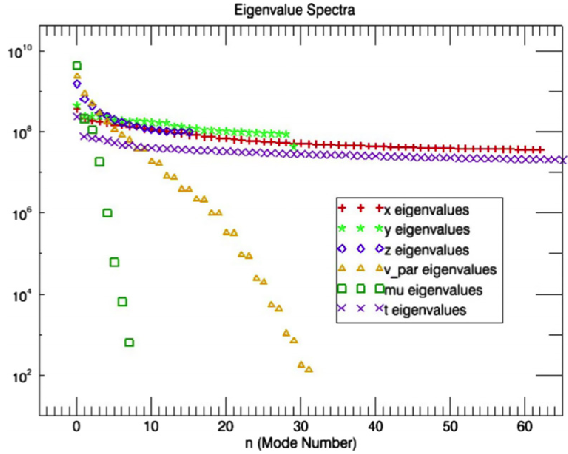
simulations <a href="./bibliography.html#tonus-2016-bid5">[22]</a>. They discovered that the fluctuations are
much higher in the space directions than in the velocity directions
(see Figure <a title="Reduced kinetic models for plasmas" href="./uid11.html#uid12">1</a>).</p>
        <div align="center" style="margin-top:10px">
          <a name="uid12">
            <!--...-->
          </a>
          <table title="" class="objectContainer">
            <caption align="bottom"><strong>Figure
	1. </strong>Space and velocity fluctuations spectra (from <a href="./bibliography.html#tonus-2016-bid5">[22]</a>)</caption>
            <tr align="center">
              <td>
                <table>
                  <tr>
                    <td style="height:3px;" align="center">
                      <img style="width:227.62204pt" alt="IMG/photoeigenv.png" src="IMG/photoeigenv.png"/>
                    </td>
                  </tr>
                </table>
              </td>
            </tr>
          </table>
        </div>
        <p>This indicates that the approximation of the distribution function
could require fewer data while still achieving a good representation,
even in the collisionless regime.</p>
        <p>Our approach is different from the fluid approximation. In what follows
we call this the “reduced model” approach. A reduced model is
a model where the explicit dependency on the velocity variable is
removed. In a more mathematical way, we consider that in some regions
of the plasma, it is possible to exhibit a (preferably small) set
of parameters <span class="math"><math xmlns="http://www.w3.org/1998/Math/MathML"><mi>α</mi></math></span> that allows us to describe the main properties
of the plasma with a generalized “Maxwellian” <span class="math"><math xmlns="http://www.w3.org/1998/Math/MathML"><mi>M</mi></math></span>. Then</p>
        <div align="center" class="mathdisplay">
          <math xmlns="http://www.w3.org/1998/Math/MathML">
            <mrow>
              <mi>f</mi>
              <mo>(</mo>
              <mi>x</mi>
              <mo>,</mo>
              <mi>v</mi>
              <mo>,</mo>
              <mi>t</mi>
              <mo>)</mo>
              <mo>=</mo>
              <mi>M</mi>
              <mo>(</mo>
              <mi>α</mi>
              <mo>(</mo>
              <mi>x</mi>
              <mo>,</mo>
              <mi>t</mi>
              <mo>)</mo>
              <mo>,</mo>
              <mi>v</mi>
              <mo>)</mo>
              <mo>.</mo>
            </mrow>
          </math>
        </div>
        <p class="notaparagraph">In this case it is sufficient to solve for <span class="math"><math xmlns="http://www.w3.org/1998/Math/MathML"><mrow><mi>α</mi><mo>(</mo><mi>x</mi><mo>,</mo><mi>t</mi><mo>)</mo></mrow></math></span>. Generally,
the vector <span class="math"><math xmlns="http://www.w3.org/1998/Math/MathML"><mi>α</mi></math></span> is solution of a first order hyperbolic system.</p>
        <p>Several approaches are possible: waterbag approximations, velocity space transforms,
<i>etc.</i></p>
        <a name="uid13"/>
        <h4 class="titre4">Velocity space transformations</h4>
        <p>An experiment made in the 60's <a href="./bibliography.html#tonus-2016-bid6">[25]</a> exhibits in a spectacular
way the reversible nature of the Vlasov equations. When two perturbations
are applied to a plasma at different times, at first the plasma seems
to damp and reach an equilibrium. But the information of the perturbations
is still here and “hidden” in the high frequency microscopic oscillations
of the distribution function. At a later time a resonance occurs and
the plasma produces an echo. The time at which the echo occurs can
be computed (see Villani (Landau damping. CEMRACS 2010 lectures.
<a href="http://smai.emath.fr/cemracs/cemracs10/PROJ/Villani-lectures.pdf">http://smai.emath.fr/cemracs/cemracs10/PROJ/Villani-lectures.pdf</a>), page 74).
The fine mathematical study of this phenomenon allowed C. Villani and C. Mouhot
to prove their famous result on the rigorous nonlinear Landau damping
<a href="./bibliography.html#tonus-2016-bid7">[26]</a>.</p>
        <p>More practically, this experiment and its theoretical framework show
that it is interesting to represent the distribution function by an
expansion on an orthonormal basis of oscillating functions in the
velocity variables. This representation allows a better control of
the energy transfer between the low frequencies and the high frequencies
in the velocity direction, and thus provides more relevant numerical
methods. This kind of approach is studied for instance by Eliasson
in <a href="./bibliography.html#tonus-2016-bid8">[19]</a> with the Fourier expansion.</p>
        <p>In long time scales, filamentation phenomena result in high frequency
oscillations in velocity space that numerical schemes cannot resolve.
For stability purposes, most numerical schemes contain dissipation
mechanisms that may affect the precision of the finest oscillations
that can be resolved.</p>
        <a name="uid15"/>
        <h4 class="titre4">Adaptive modeling</h4>
        <p>Another trend in scientific computing is to optimize the computation
time through adaptive modeling. This approach consists in applying
the more efficient model locally, in the computational domain, according
to an error indicator. In tokamak simulations, this kind of approach
could be very efficient, if we are able to choose locally the best
intermediate kinetic-fluid model as the computation runs. This field
of research is very promising. It requires developing a clever hierarchy
of models, rigorous error indicators, versatile software architecture,
and algorithms adapted to new multicore computers.</p>
        <a name="uid16"/>
        <h4 class="titre4">Numerical schemes</h4>
        <p>As previously indicated, an efficient method for solving the reduced
models is the Discontinuous Galerkin (DG) approach. It is possible
to make it of arbitrary order. It requires limiters when it is applied
to nonlinear PDEs occurring for instance in fluid mechanics. But the
reduced models that we intent to write are essentially linear. The
nonlinearity is concentrated in a few coupling source terms.</p>
        <p>In addition, this method, when written in a special set of variables,
called the entropy variables, has nice properties concerning the entropy
dissipation of the model. It opens the door to constructing numerical
schemes with good conservation properties and no entropy dissipation,
as already used for other systems of PDEs <a href="./bibliography.html#tonus-2016-bid9">[28]</a>, <a href="./bibliography.html#tonus-2016-bid10">[16]</a>, <a href="./bibliography.html#tonus-2016-bid11">[24]</a>, <a href="./bibliography.html#tonus-2016-bid12">[23]</a>.</p>
      </div>
      <!--FIN du corps du module-->
      <br/>
      <div class="bottomNavigation">
        <div class="tail_aucentre">
          <a href="./uid7.html" accesskey="P"><img style="align:bottom; border:none" alt="previous" src="../static/img/icons/previous_motif.jpg"/> Previous | </a>
          <a href="./uid0.html" accesskey="U"><img style="align:bottom; border:none" alt="up" src="../static/img/icons/up_motif.jpg"/>  Home</a>
          <a href="./uid17.html" accesskey="N"> | Next <img style="align:bottom; border:none" alt="next" src="../static/img/icons/next_motif.jpg"/></a>
        </div>
        <br/>
      </div>
    </div>
  </body>
</html>