<?xml version="1.0" encoding="utf-8"?>
<!DOCTYPE html PUBLIC "-//W3C//DTD XHTML 1.1 plus MathML 2.0 plus SVG 1.1//EN" "http://www.w3.org/2002/04/xhtml-math-svg/xhtml-math-svg.dtd">
<html xmlns="http://www.w3.org/1999/xhtml">
  <head>
    <meta http-equiv="Content-Type" content="application/xhtml+xml; charset=utf-8"/>
    <title>Project-Team:VISAGES</title>
    <link rel="stylesheet" href="../static/css/raweb.css" type="text/css"/>
    <meta name="description" content="Research Program - Research Program"/>
    <meta name="dc.title" content="Research Program - Research Program"/>
    <meta name="dc.subject" content=""/>
    <meta name="dc.publisher" content="INRIA"/>
    <meta name="dc.date" content="(SCHEME=ISO8601) 2016-01"/>
    <meta name="dc.type" content="Report"/>
    <meta name="dc.language" content="(SCHEME=ISO639-1) en"/>
    <meta name="projet" content="VISAGES"/>
    <script type="text/javascript" src="https://raweb.inria.fr/rapportsactivite/RA2016/static/MathJax/MathJax.js?config=TeX-MML-AM_CHTML">
      <!--MathJax-->
    </script>
  </head>
  <body>
    <div class="tdmdiv">
      <div class="logo">
        <a href="http://www.inria.fr">
          <img style="align:bottom; border:none" src="../static/img/icons/logo_INRIA-coul.jpg" alt="Inria"/>
        </a>
      </div>
      <div class="TdmEntry">
        <div class="tdmentete">
          <a href="uid0.html">Project-Team Visages</a>
        </div>
        <span>
          <a href="uid1.html">Members</a>
        </span>
      </div>
      <div class="TdmEntry">Overall Objectives<ul><li><a href="./uid3.html">Overall objectives</a></li></ul></div>
      <div class="TdmEntry">Research Program<ul><li class="tdmActPage"><a href="uid5.html&#10;&#9;&#9;  ">Research Program</a></li></ul></div>
      <div class="TdmEntry">Application Domains<ul><li><a href="uid21.html&#10;&#9;&#9;  ">Neuroimaging</a></li><li><a href="uid22.html&#10;&#9;&#9;  ">Multiple sclerosis</a></li><li><a href="uid23.html&#10;&#9;&#9;  ">Modeling of anatomical and anatomo-functional
neurological patterns</a></li></ul></div>
      <div class="TdmEntry">
        <a href="./uid25.html">Highlights of the Year</a>
      </div>
      <div class="TdmEntry">New Software and Platforms<ul><li><a href="uid29.html&#10;&#9;&#9;  ">Anima</a></li><li><a href="uid34.html&#10;&#9;&#9;  ">MedInria</a></li><li><a href="uid42.html&#10;&#9;&#9;  ">Shanoir</a></li><li><a href="uid49.html&#10;&#9;&#9;  ">QtShanoir</a></li><li><a href="uid58.html&#10;&#9;&#9;  ">ShanoirUploader</a></li><li><a href="uid64.html&#10;&#9;&#9;  ">iShanoir</a></li><li><a href="uid69.html&#10;&#9;&#9;  ">autoMRI</a></li><li><a href="uid75.html&#10;&#9;&#9;  ">Integration of EEG and fMRI</a></li><li><a href="uid83.html&#10;&#9;&#9;  ">Platforms</a></li></ul></div>
      <div class="TdmEntry">New Results<ul><li><a href="uid87.html&#10;&#9;&#9;  ">Image Computing: Detection, Segmentation,
Registration and Analysis</a></li><li><a href="uid93.html&#10;&#9;&#9;  ">Image processing on Diffusion Weighted Magnetic
Resonance Imaging</a></li><li><a href="uid95.html&#10;&#9;&#9;  ">EEG and MR Imaging</a></li><li><a href="uid100.html&#10;&#9;&#9;  ">Applications in Neuroradiology and Neurological
Disorders</a></li><li><a href="uid104.html&#10;&#9;&#9;  ">Management of Information in Neuroimaging</a></li></ul></div>
      <div class="TdmEntry">Bilateral Contracts and Grants with Industry<ul><li><a href="uid106.html&#10;&#9;&#9;  ">Bilateral Contracts with Industry</a></li><li><a href="uid108.html&#10;&#9;&#9;  ">Bilateral Grants with Industry</a></li></ul></div>
      <div class="TdmEntry">Partnerships and Cooperations<ul><li><a href="uid111.html&#10;&#9;&#9;  ">Regional Initiatives</a></li><li><a href="uid117.html&#10;&#9;&#9;  ">National Initiatives</a></li><li><a href="uid126.html&#10;&#9;&#9;  ">European Initiatives</a></li><li><a href="uid155.html&#10;&#9;&#9;  ">International Initiatives</a></li><li><a href="uid171.html&#10;&#9;&#9;  ">International Research Visitors</a></li></ul></div>
      <div class="TdmEntry">Dissemination<ul><li><a href="uid181.html&#10;&#9;&#9;  ">Promoting Scientific Activities</a></li><li><a href="uid226.html&#10;&#9;&#9;  ">Teaching - Supervision - Juries</a></li><li><a href="uid252.html&#10;&#9;&#9;  ">Popularization</a></li></ul></div>
      <div class="TdmEntry">
        <div>Bibliography</div>
      </div>
      <div class="TdmEntry">
        <ul>
          <li>
            <a id="tdmbibentyear" href="bibliography.html">Publications of the year</a>
          </li>
        </ul>
      </div>
    </div>
    <div id="main">
      <div class="mainentete">
        <div id="head_agauche">
          <small><a href="http://www.inria.fr">
	    
	    Inria
	  </a> | <a href="../index.html">
	    
	    Raweb 
	    2016</a> | <a href="http://www.inria.fr/en/teams/visages">Presentation of the Project-Team VISAGES</a> | <a href="http://www.irisa.fr/visages/index">VISAGES Web Site
	  </a></small>
        </div>
        <div id="head_adroite">
          <table class="qrcode">
            <tr>
              <td>
                <a href="visages.xml">
                  <img style="align:bottom; border:none" alt="XML" src="../static/img/icons/xml_motif.png"/>
                </a>
              </td>
              <td>
                <a href="visages.pdf">
                  <img style="align:bottom; border:none" alt="PDF" src="IMG/qrcode-visages-pdf.png"/>
                </a>
              </td>
              <td>
                <a href="../visages/visages.epub">
                  <img style="align:bottom; border:none" alt="e-pub" src="IMG/qrcode-visages-epub.png"/>
                </a>
              </td>
            </tr>
            <tr>
              <td/>
              <td>PDF
</td>
              <td>e-Pub
</td>
            </tr>
          </table>
        </div>
      </div>
      <!--FIN du corps du module-->
      <br/>
      <div class="bottomNavigation">
        <div class="tail_aucentre">
          <a href="./uid3.html" accesskey="P"><img style="align:bottom; border:none" alt="previous" src="../static/img/icons/previous_motif.jpg"/> Previous | </a>
          <a href="./uid0.html" accesskey="U"><img style="align:bottom; border:none" alt="up" src="../static/img/icons/up_motif.jpg"/>  Home</a>
          <a href="./uid21.html" accesskey="N"> | Next <img style="align:bottom; border:none" alt="next" src="../static/img/icons/next_motif.jpg"/></a>
        </div>
        <br/>
      </div>
      <div id="textepage">
        <!--DEBUT2 du corps du module-->
        <h2>Section: 
      Research Program</h2>
        <h3 class="titre3">Research Program</h3>
        <p>The scientific foundations of our team concern the development of new
processing algorithms in the field of medical image computing : image fusion
(registration and visualization), image segmentation and analysis, management
of image related information. Since this is a very large domain, which can
endorse numerous types of application; for seek of efficiency, the purpose of
our methodological work primarily focuses on clinical aspects and for the most
part on head and neck related diseases. In addition, we emphasize our research
efforts on the neuroimaging domain. Concerning the scientific foundations, we
have pushed our research efforts:</p>
        <ul>
          <li>
            <p class="notaparagraph"><a name="uid6"> </a>In the field of image fusion and image registration (rigid and
deformable transformations) with a special emphasis on new challenging
registration issues, especially when statistical approaches based on joint
histogram cannot be used or when the registration stage has to cope with loss
or appearance of material (like in surgery or in tumor imaging for instance).</p>
          </li>
          <li>
            <p class="notaparagraph"><a name="uid7"> </a>In the field of image analysis and statistical modeling with a new
focus on image feature and group analysis problems. A special attention was
also to develop advanced frameworks for the construction of atlases and for
automatic and supervised labeling of brain structures.</p>
          </li>
          <li>
            <p class="notaparagraph"><a name="uid8"> </a>In the field of image segmentation and structure recognition, with a
special emphasis on the difficult problems of <i>i</i>) image restoration for
new imaging sequences (new Magnetic Resonance Imaging protocols, 3D
ultrasound sequences...), and <i>ii</i>) structure segmentation and labelling
based on shape, multimodal and statistical information.</p>
          </li>
          <li>
            <p class="notaparagraph"><a name="uid9"> </a>Following the Neurobase national project where we had a leading role,
we wanted to enhance the development of distributed and heterogeneous medical
image processing systems.</p>
          </li>
        </ul>
        <div align="center" style="margin-top:10px">
          <a name="uid10">
            <!--...-->
          </a>
          <table title="" class="objectContainer">
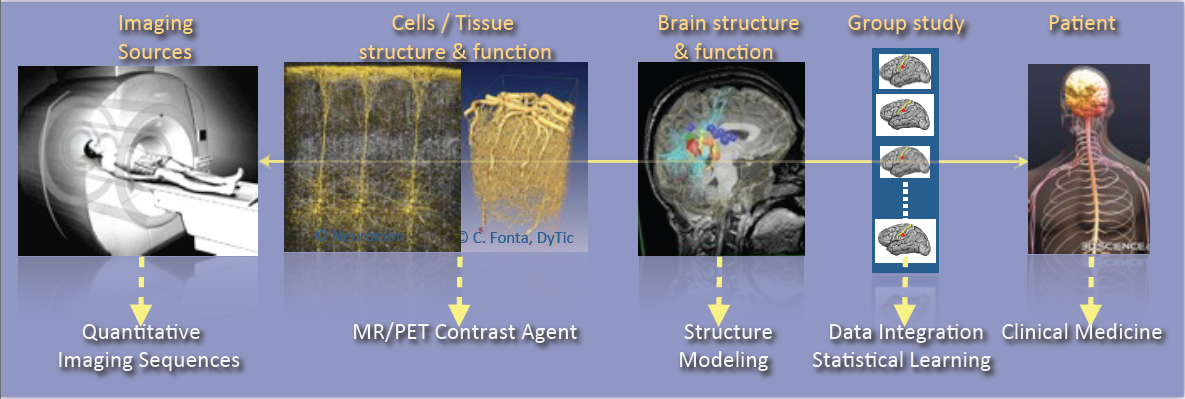
            <caption align="bottom"><strong>Figure
	1. </strong>The major overall scientific foundation of the team concerns the
integration of data from the Imaging source to the patient at different
scales: from the cellular or molecular level describing the structure and
function, to the functional and structural level of brain structures and
regions, to the population level for the modelling of group patterns and
the learning of group or individual imaging markers.</caption>
            <tr align="center">
              <td>
                <table>
                  <tr>
                    <td style="height:3px;" align="center">
                      <img style="width:427.0pt" alt="IMG/OverallObjectives.png" src="IMG/OverallObjectives.png"/>
                    </td>
                  </tr>
                </table>
              </td>
            </tr>
          </table>
        </div>
        <p>As shown in Fig. <a title="Research Program" href="./uid5.html#uid10">1</a>, research activities of the
<span class="smallcap">VisAGeS </span> U746 team are tightly coupling observations and models through
integration of clinical and multi-scale data, phenotypes (cellular, molecular
or structural patterns). We work on personalized models of central nervous
system organs and pathologies, and intend to confront these models to clinical
investigation studies for quantitative diagnosis, prevention of diseases,
therapy planning and validation. These approaches are developed in a
translational framework where the data integration process to build the models
inherits from specific clinical studies, and where the models are assessed on
prospective clinical trials for diagnosis and therapy planning. All of this
research activity is conducted in tight links with the
<a href="http://www.neurinfo.org">Neurinfo</a> imaging platform environments and the
engineering staff of the platform. In this context, some of our major
challenges in this domain concern:</p>
        <ul>
          <li>
            <p class="notaparagraph"><a name="uid11"> </a>The elaboration of new descriptors to study the brain structure and
function (e.g. variation of brain perfusion with and without contrast agent,
evolution in shape and size of an anatomical structure in relation with
normal, pathological or functional patterns, computation of asymmetries from
shapes and volumes).</p>
          </li>
          <li>
            <p class="notaparagraph"><a name="uid12"> </a>The integration of additional spatio-temporal imaging sequences
covering a larger range of observation, from the molecular level to the organ
through the cell (Arterial Spin Labeling, diffusion MRI, MR relaxometry, MR
cell labeling imaging, PET molecular imaging, …). This includes the
elaboration of new image descriptors coming from spatio-temporal quantitative
or contrast-enhanced MRI.</p>
          </li>
          <li>
            <p class="notaparagraph"><a name="uid13"> </a>The creation of computational models through data fusion of molecular,
cellular, structural and functional image descriptors from group studies of
normal and/or pathological subjects.</p>
          </li>
          <li>
            <p class="notaparagraph"><a name="uid14"> </a>The evaluation of these models on acute pathologies especially for the
study of degenerative, psychiatric or developmental brain diseases (e.g.
Multiple Sclerosis, Epilepsy, Parkinson, Dementia, Strokes, Depression,
Schizophrenia, …) in a translational framework.</p>
          </li>
        </ul>
        <p>In terms of methodological developments, we are particularly working on
statistical methods for multidimensional image analysis, and feature selection
and discovery, which includes:</p>
        <ul>
          <li>
            <p class="notaparagraph"><a name="uid15"> </a>The development of specific shape and appearance models, construction
of atlases better adapted to a patient or a group of patients in order to
better characterize the pathology;</p>
          </li>
          <li>
            <p class="notaparagraph"><a name="uid16"> </a>The development of advanced segmentation and modeling methods dealing
with longitudinal and multidimensional data (vector or tensor fields),
especially with the integration of new prior models to control the
integration of multiscale data and aggregation of models;</p>
          </li>
          <li>
            <p class="notaparagraph"><a name="uid17"> </a>The development of new models and probabilistic methods to create water
diffusion maps from MRI;</p>
          </li>
          <li>
            <p class="notaparagraph"><a name="uid18"> </a>The integration of machine learning procedures for classification and
labeling of multidimensional features (from scalar to tensor fields and/or
geometric features): pattern and rule inference and knowledge extraction are
key techniques to help in the elaboration of knowledge in the complex domains
we address;</p>
          </li>
          <li>
            <p class="notaparagraph"><a name="uid19"> </a>The development of new dimensionality reduction techniques for problems
with massive data, which includes dictionary learning for sparse model
discovery. Efficient techniques have still to be developed to properly
extract from a raw mass of images derived data that are easier to analyze.</p>
          </li>
        </ul>
      </div>
      <!--FIN du corps du module-->
      <br/>
      <div class="bottomNavigation">
        <div class="tail_aucentre">
          <a href="./uid3.html" accesskey="P"><img style="align:bottom; border:none" alt="previous" src="../static/img/icons/previous_motif.jpg"/> Previous | </a>
          <a href="./uid0.html" accesskey="U"><img style="align:bottom; border:none" alt="up" src="../static/img/icons/up_motif.jpg"/>  Home</a>
          <a href="./uid21.html" accesskey="N"> | Next <img style="align:bottom; border:none" alt="next" src="../static/img/icons/next_motif.jpg"/></a>
        </div>
        <br/>
      </div>
    </div>
  </body>
</html>