<?xml version="1.0" encoding="utf-8"?>
<!DOCTYPE html PUBLIC "-//W3C//DTD XHTML 1.1 plus MathML 2.0 plus SVG 1.1//EN" "http://www.w3.org/2002/04/xhtml-math-svg/xhtml-math-svg.dtd">
<html xmlns="http://www.w3.org/1999/xhtml">
  <head>
    <meta http-equiv="Content-Type" content="application/xhtml+xml; charset=utf-8"/>
    <title>Project-Team:GRAPHDECO</title>
    <link rel="stylesheet" href="../static/css/raweb.css" type="text/css"/>
    <meta name="description" content="Overall Objectives - General Presentation"/>
    <meta name="dc.title" content="Overall Objectives - General Presentation"/>
    <meta name="dc.subject" content=""/>
    <meta name="dc.publisher" content="INRIA"/>
    <meta name="dc.date" content="(SCHEME=ISO8601) 2017-01"/>
    <meta name="dc.type" content="Report"/>
    <meta name="dc.language" content="(SCHEME=ISO639-1) en"/>
    <meta name="projet" content="GRAPHDECO"/>
    <script type="text/javascript" src="https://cdn.mathjax.org/mathjax/latest/MathJax.js?config=TeX-MML-AM_CHTML">
      <!--MathJax-->
    </script>
  </head>
  <body>
    <div class="tdmdiv">
      <div class="logo">
        <a href="http://www.inria.fr">
          <img style="align:bottom; border:none" src="../static/img/icons/logo_INRIA-coul.jpg" alt="Inria"/>
        </a>
      </div>
      <div class="TdmEntry">
        <div class="tdmentete">
          <a href="uid0.html">Project-Team Graphdeco</a>
        </div>
        <span>
          <a href="uid1.html">Personnel</a>
        </span>
      </div>
      <div class="TdmEntry">Overall Objectives<ul><li class="tdmActPage"><a href="./uid3.html">General Presentation</a></li></ul></div>
      <div class="TdmEntry">Research Program<ul><li><a href="uid8.html&#10;&#9;&#9;  ">Introduction</a></li></ul></div>
      <div class="TdmEntry">
        <a href="./uid18.html">Highlights of the Year</a>
      </div>
      <div class="TdmEntry">New Software and Platforms<ul><li><a href="uid20.html&#10;&#9;&#9;  ">SGTDGP</a></li><li><a href="uid25.html&#10;&#9;&#9;  ">Unity IBR</a></li><li><a href="uid27.html&#10;&#9;&#9;  ">SIBR</a></li></ul></div>
      <div class="TdmEntry">New Results<ul><li><a href="uid30.html&#10;&#9;&#9;  ">Computer-Assisted Design with Heterogeneous Representations</a></li><li><a href="uid34.html&#10;&#9;&#9;  ">Graphics with Uncertainty and Heterogeneous Content</a></li></ul></div>
      <div class="TdmEntry">Bilateral Contracts and Grants with Industry<ul><li><a href="uid39.html&#10;&#9;&#9;  ">Bilateral Contracts with Industry</a></li></ul></div>
      <div class="TdmEntry">Partnerships and Cooperations<ul><li><a href="uid44.html&#10;&#9;&#9;  ">Regional Initiatives</a></li><li><a href="uid45.html&#10;&#9;&#9;  ">National Initiatives</a></li><li><a href="uid50.html&#10;&#9;&#9;  ">European Initiatives</a></li><li><a href="uid73.html&#10;&#9;&#9;  ">International Initiatives</a></li><li><a href="uid76.html&#10;&#9;&#9;  ">International Research Visitors</a></li></ul></div>
      <div class="TdmEntry">Dissemination<ul><li><a href="uid82.html&#10;&#9;&#9;  ">Promoting Scientific Activities</a></li><li><a href="uid92.html&#10;&#9;&#9;  ">Teaching - Supervision - Juries</a></li><li><a href="uid109.html&#10;&#9;&#9;  ">Popularization</a></li></ul></div>
      <div class="TdmEntry">
        <div>Bibliography</div>
      </div>
      <div class="TdmEntry">
        <ul>
          <li>
            <a id="tdmbibentmajor" href="bibliography.html">Major publications</a>
          </li>
          <li>
            <a id="tdmbibentyear" href="bibliography.html#year">Publications of the year</a>
          </li>
        </ul>
      </div>
    </div>
    <div id="main">
      <div class="mainentete">
        <div id="head_agauche">
          <small><a href="http://www.inria.fr">
	    
	    Inria
	  </a> | <a href="../index.html">
	    
	    Raweb 
	    2017</a> | <a href="http://www.inria.fr/en/teams/graphdeco">Presentation of the Project-Team GRAPHDECO</a> | <a href="https://team.inria.fr/graphdeco/">GRAPHDECO Web Site
	  </a></small>
        </div>
        <div id="head_adroite">
          <table class="qrcode">
            <tr>
              <td>
                <a href="graphdeco.xml">
                  <img style="align:bottom; border:none" alt="XML" src="../static/img/icons/xml_motif.png"/>
                </a>
              </td>
              <td>
                <a href="graphdeco.pdf">
                  <img style="align:bottom; border:none" alt="PDF" src="IMG/qrcode-graphdeco-pdf.png"/>
                </a>
              </td>
              <td>
                <a href="../graphdeco/graphdeco.epub">
                  <img style="align:bottom; border:none" alt="e-pub" src="IMG/qrcode-graphdeco-epub.png"/>
                </a>
              </td>
            </tr>
            <tr>
              <td/>
              <td>PDF
</td>
              <td>e-Pub
</td>
            </tr>
          </table>
        </div>
      </div>
      <!--FIN du corps du module-->
      <br/>
      <div class="bottomNavigation">
        <div class="tail_aucentre">
          <a href="./uid1.html" accesskey="P"><img style="align:bottom; border:none" alt="previous" src="../static/img/icons/previous_motif.jpg"/> Previous | </a>
          <a href="./uid0.html" accesskey="U"><img style="align:bottom; border:none" alt="up" src="../static/img/icons/up_motif.jpg"/>  Home</a>
          <a href="./uid8.html" accesskey="N"> | Next <img style="align:bottom; border:none" alt="next" src="../static/img/icons/next_motif.jpg"/></a>
        </div>
        <br/>
      </div>
      <div id="textepage">
        <!--DEBUT2 du corps du module-->
        <h2>Section: 
      Overall Objectives</h2>
        <h3 class="titre3">General Presentation</h3>
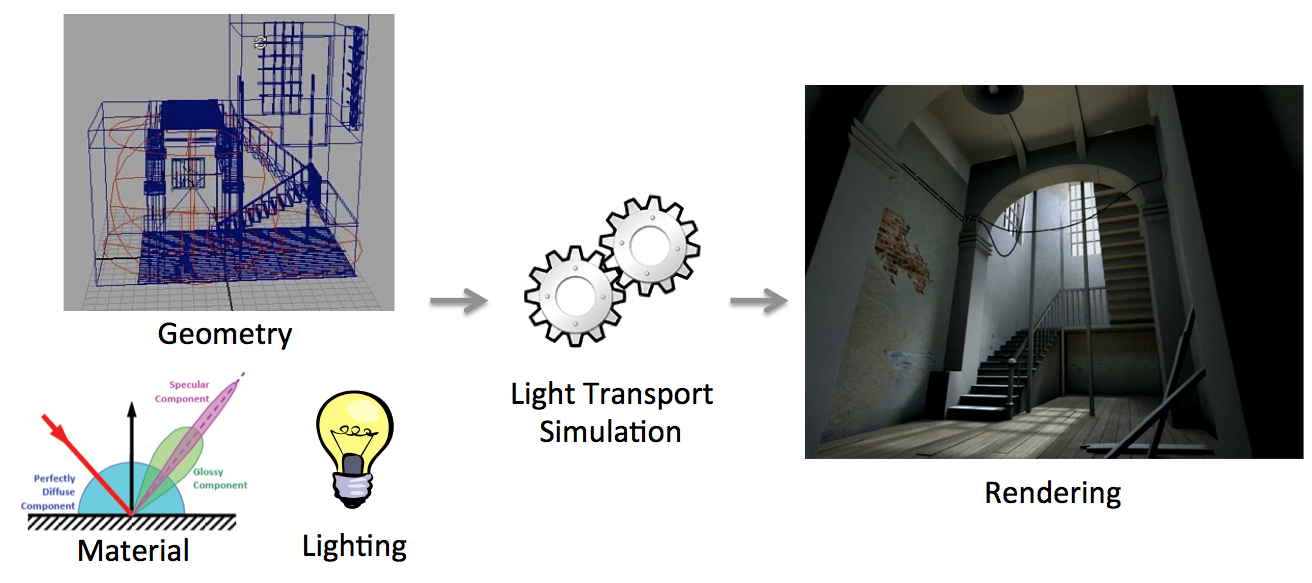
        <p>In traditional Computer Graphics (CG)
input is <i>accurately modeled</i> by hand by artists.
The artists first create the 3D geometry – i.e., the polygons
and surfaces used to represent the 3D scene.
They then need to assign colors, textures and more generally material properties
to each piece of geometry in the scene.
Finally they also define the position, type and intensity of the lights.
This modeling process is illustrated schematically in Fig. <a title="General Presentation" href="./uid3.html#uid4">1</a>(left)).
Creating all this 3D content involves a high level of training and skills, and is reserved
to a small minority of expert modelers. This tedious process is a significant
distraction for creative exploration, during which artists and designers are primarily interested
in obtaining compelling imagery and prototypes rather than in
accurately specifying all the ingredients listed above.
Designers also often want to explore many variations of a concept, which requires them
to repeat the above steps multiple times.</p>
        <p>Once the 3D elements are in place, a <i>rendering</i> algorithm is employed to
generate a shaded, realistic image (Fig. <a title="General Presentation" href="./uid3.html#uid4">1</a>(right)).
Costly rendering algorithms are then required to simulate light transport (or
<i>global illumination</i>)
from the light sources to the camera, accounting for the complex interactions between light and
materials and the visibility between objects.
Such rendering algorithms only provide meaningful results if
the input has been <i>accurately</i> modeled and is <i>complete</i>,
which is prohibitive as discussed above.</p>
        <div align="center" style="margin-top:10px">
          <a name="uid4">
            <!--...-->
          </a>
          <table title="" class="objectContainer">
            <caption align="bottom"><strong>Figure
	1. </strong>Traditional computer graphics pipeline. Rendering from www.thegnomonworkshop.com</caption>
            <tr align="center">
              <td>
                <table>
                  <tr>
                    <td style="height:3px;" align="center">
                      <img style="width:341.6013pt" alt="IMG/cg_simulation.png" src="IMG/cg_simulation.png"/>
                    </td>
                  </tr>
                </table>
              </td>
            </tr>
          </table>
        </div>
        <p>A major recent development is that many alternative sources of 3D content
are becoming available. Cheap depth sensors allow anyone to capture real
objects but the resulting 3D models are often <i>uncertain</i>,
since the reconstruction can be inaccurate and is most often incomplete.
There have also been significant advances in casual content creation, e.g.,
sketch-based modeling tools. The resulting models are often approximate since people
rarely draw accurate perspective and proportions. These models also often lack details,
which can be seen as a form of uncertainty since a variety of refined models could
correspond to the rough one.
Finally, in recent years we have witnessed the emergence of new usage of 3D content
for rapid prototyping, which aims at accelerating the transition from rough ideas to
physical artifacts.</p>
        <p>The inability to handle <i>uncertainty</i> in the data is a major shortcoming of CG today
as it prevents the direct use of cheap and casual sources of 3D content for the
design and rendering of high-quality images.
The abundance and ease of access to <i>inaccurate</i>, <i>incomplete</i> and <i>heterogeneous</i> 3D content
imposes the need to <i>rethink the foundations of 3D computer graphics</i>
to allow <i>uncertainty</i> to be treated in inherent manner in Computer Graphics, from design all the way to rendering
and prototyping.</p>
        <p>The technological shifts we mention above, together with developments in computer vision, user-friendly sketch-based modeling,
online tutorials, but also image, video and 3D model repositories and 3D printing
represent a great opportunity for new imaging methods.
There are several significant challenges to overcome before such visual content can become widely accessible.</p>
        <p>In GraphDeco, we have identified two major scientific challenges of our field which we will address:</p>
        <ul>
          <li>
            <p class="notaparagraph"><a name="uid5"> </a>First, the design pipeline needs to be revisited to <b>explicitly account for
the variability and uncertainty of a concept and its representations</b>, from early sketches to 3D models
and prototypes. Professional practice also needs to be adapted and facilitated to be accessible to all.</p>
          </li>
          <li>
            <p class="notaparagraph"><a name="uid6"> </a>Second, a new approach is required to
<b>develop computer graphics models and algorithms capable of handling uncertain
and heterogeneous data</b> as well as traditional synthetic content.</p>
          </li>
        </ul>
        <p class="notaparagraph">We next describe the context of our proposed research for these two challenges.
Both directions address hetereogeneous and uncertain input and (in some
cases) output, and build on a set of common methodological tools.</p>
      </div>
      <!--FIN du corps du module-->
      <br/>
      <div class="bottomNavigation">
        <div class="tail_aucentre">
          <a href="./uid1.html" accesskey="P"><img style="align:bottom; border:none" alt="previous" src="../static/img/icons/previous_motif.jpg"/> Previous | </a>
          <a href="./uid0.html" accesskey="U"><img style="align:bottom; border:none" alt="up" src="../static/img/icons/up_motif.jpg"/>  Home</a>
          <a href="./uid8.html" accesskey="N"> | Next <img style="align:bottom; border:none" alt="next" src="../static/img/icons/next_motif.jpg"/></a>
        </div>
        <br/>
      </div>
    </div>
  </body>
</html>