<?xml version="1.0" encoding="utf-8"?>
<!DOCTYPE html PUBLIC "-//W3C//DTD XHTML 1.1 plus MathML 2.0 plus SVG 1.1//EN" "http://www.w3.org/2002/04/xhtml-math-svg/xhtml-math-svg.dtd">
<html xmlns="http://www.w3.org/1999/xhtml">
  <head>
    <meta http-equiv="Content-Type" content="application/xhtml+xml; charset=utf-8"/>
    <title>Project-Team:MONC</title>
    <link rel="stylesheet" href="../static/css/raweb.css" type="text/css"/>
    <meta name="description" content="Overall Objectives - General strategy"/>
    <meta name="dc.title" content="Overall Objectives - General strategy"/>
    <meta name="dc.subject" content=""/>
    <meta name="dc.publisher" content="INRIA"/>
    <meta name="dc.date" content="(SCHEME=ISO8601) 2017-01"/>
    <meta name="dc.type" content="Report"/>
    <meta name="dc.language" content="(SCHEME=ISO639-1) en"/>
    <meta name="projet" content="MONC"/>
    <script type="text/javascript" src="https://cdn.mathjax.org/mathjax/latest/MathJax.js?config=TeX-MML-AM_CHTML">
      <!--MathJax-->
    </script>
  </head>
  <body>
    <div class="tdmdiv">
      <div class="logo">
        <a href="http://www.inria.fr">
          <img style="align:bottom; border:none" src="../static/img/icons/logo_INRIA-coul.jpg" alt="Inria"/>
        </a>
      </div>
      <div class="TdmEntry">
        <div class="tdmentete">
          <a href="uid0.html">Project-Team Monc</a>
        </div>
        <span>
          <a href="uid1.html">Personnel</a>
        </span>
      </div>
      <div class="TdmEntry">Overall Objectives<ul><li><a href="./uid3.html">Objectives</a></li><li class="tdmActPage"><a href="./uid7.html">General strategy</a></li></ul></div>
      <div class="TdmEntry">Research Program<ul><li><a href="uid21.html&#10;&#9;&#9;  ">Introduction</a></li><li><a href="uid25.html&#10;&#9;&#9;  ">Axis 1: Tumor modeling for patient-specific simulations</a></li><li><a href="uid30.html&#10;&#9;&#9;  ">Axis 2: Bio-physical modeling for personalized therapies</a></li><li><a href="uid39.html&#10;&#9;&#9;  ">Axis 3: Quantitative cancer modeling for biological and preclinical studies</a></li></ul></div>
      <div class="TdmEntry">Application Domains<ul><li><a href="uid45.html&#10;&#9;&#9;  ">Tumor growth monitoring and therapeutic evaluation</a></li><li><a href="uid53.html&#10;&#9;&#9;  ">Biophysical therapies</a></li><li><a href="uid56.html&#10;&#9;&#9;  ">In-vitro and animals experimentations in oncology</a></li></ul></div>
      <div class="TdmEntry">
        <a href="./uid60.html">Highlights of the Year</a>
      </div>
      <div class="TdmEntry">New Results<ul><li><a href="uid62.html&#10;&#9;&#9;  ">Mathematical modeling of tumor-tumor distant interactions supports a systemic control of tumor growth </a></li><li><a href="uid63.html&#10;&#9;&#9;  ">Precision of manual two-dimensional segmentations of lung and liver metastases and its impact on tumour response assessment using RECIST 1.1 </a></li><li><a href="uid64.html&#10;&#9;&#9;  ">Dose- and time-dependence of the host-mediated response to paclitaxel therapy: a mathematical modeling approach</a></li><li><a href="uid65.html&#10;&#9;&#9;  ">Tumor growth model of ductal carcinoma: from in situ phase to stroma invasion </a></li><li><a href="uid66.html&#10;&#9;&#9;  ">Superconvergent second order Cartesian method for solving free boundary problem for invadopodia formation</a></li><li><a href="uid67.html&#10;&#9;&#9;  ">A Voronoi Interface approach to cell aggregate electropermeabilization</a></li><li><a href="uid68.html&#10;&#9;&#9;  ">Revisiting bevacizumab + cytotoxics scheduling using mathematical modeling: proof of concept study in experimental non-small cell lung carcinoma</a></li></ul></div>
      <div class="TdmEntry">Bilateral Contracts and Grants with Industry<ul><li><a href="uid70.html&#10;&#9;&#9;  ">Bilateral Contracts with Industry</a></li></ul></div>
      <div class="TdmEntry">Partnerships and Cooperations<ul><li><a href="uid73.html&#10;&#9;&#9;  ">National Initiatives</a></li><li><a href="uid102.html&#10;&#9;&#9;  ">European Initiatives</a></li><li><a href="uid103.html&#10;&#9;&#9;  ">International Initiatives</a></li></ul></div>
      <div class="TdmEntry">Dissemination<ul><li><a href="uid120.html&#10;&#9;&#9;  ">Promoting Scientific Activities</a></li><li><a href="uid152.html&#10;&#9;&#9;  ">Teaching - Supervision - Juries</a></li><li><a href="uid178.html&#10;&#9;&#9;  ">Popularization</a></li></ul></div>
      <div class="TdmEntry">
        <div>Bibliography</div>
      </div>
      <div class="TdmEntry">
        <ul>
          <li>
            <a id="tdmbibentmajor" href="bibliography.html">Major publications</a>
          </li>
          <li>
            <a id="tdmbibentyear" href="bibliography.html#year">Publications of the year</a>
          </li>
        </ul>
      </div>
    </div>
    <div id="main">
      <div class="mainentete">
        <div id="head_agauche">
          <small><a href="http://www.inria.fr">
	    
	    Inria
	  </a> | <a href="../index.html">
	    
	    Raweb 
	    2017</a> | <a href="http://www.inria.fr/en/teams/monc">Presentation of the Project-Team MONC</a> | <a href="https://team.inria.fr/monc/">MONC Web Site
	  </a></small>
        </div>
        <div id="head_adroite">
          <table class="qrcode">
            <tr>
              <td>
                <a href="monc.xml">
                  <img style="align:bottom; border:none" alt="XML" src="../static/img/icons/xml_motif.png"/>
                </a>
              </td>
              <td>
                <a href="monc.pdf">
                  <img style="align:bottom; border:none" alt="PDF" src="IMG/qrcode-monc-pdf.png"/>
                </a>
              </td>
              <td>
                <a href="../monc/monc.epub">
                  <img style="align:bottom; border:none" alt="e-pub" src="IMG/qrcode-monc-epub.png"/>
                </a>
              </td>
            </tr>
            <tr>
              <td/>
              <td>PDF
</td>
              <td>e-Pub
</td>
            </tr>
          </table>
        </div>
      </div>
      <!--FIN du corps du module-->
      <br/>
      <div class="bottomNavigation">
        <div class="tail_aucentre">
          <a href="./uid3.html" accesskey="P"><img style="align:bottom; border:none" alt="previous" src="../static/img/icons/previous_motif.jpg"/> Previous | </a>
          <a href="./uid0.html" accesskey="U"><img style="align:bottom; border:none" alt="up" src="../static/img/icons/up_motif.jpg"/>  Home</a>
          <a href="./uid21.html" accesskey="N"> | Next <img style="align:bottom; border:none" alt="next" src="../static/img/icons/next_motif.jpg"/></a>
        </div>
        <br/>
      </div>
      <div id="textepage">
        <!--DEBUT2 du corps du module-->
        <h2>Section: 
      Overall Objectives</h2>
        <h3 class="titre3">General strategy</h3>
        <div align="center" style="margin-top:10px">
          <a name="uid8">
            <!--...-->
          </a>
          <table title="" class="objectContainer">
            <caption align="bottom"><strong>Figure
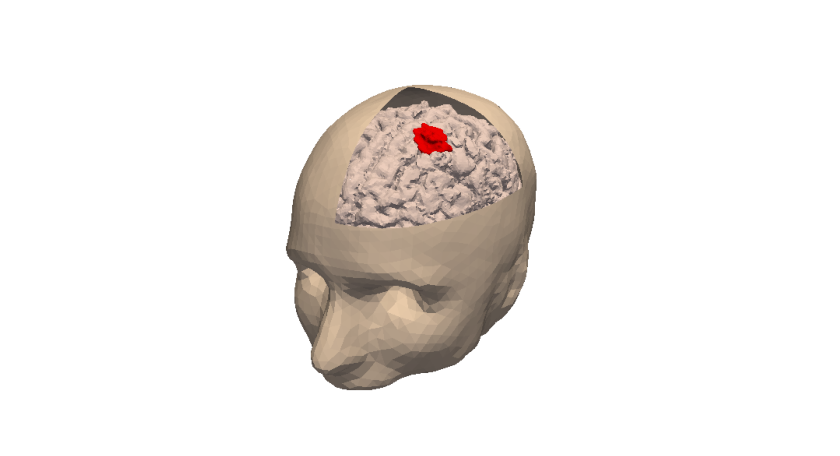
	1. </strong>3D numerical simulation of a meningioma. The tumor is shown in red.</caption>
            <tr align="center">
              <td>
                <table>
                  <tr>
                    <td style="height:3px;" align="center">
                      <img style="width:298.8987pt" alt="IMG/ImageMeningiome2.png" src="IMG/ImageMeningiome2.png"/>
                    </td>
                  </tr>
                </table>
              </td>
            </tr>
          </table>
        </div>
        <div align="center" style="margin-top:10px">
          <a name="uid9">
            <!--...-->
          </a>
          <table title="" class="objectContainer">
            <caption align="bottom"><strong>Figure
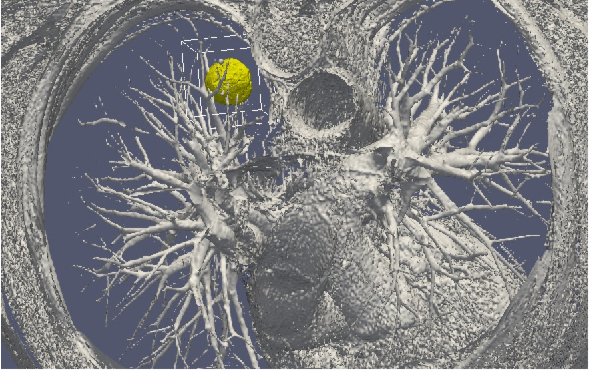
	2. </strong>3D numerical simulation of a lung tumor. The tumor is shown in yellow.</caption>
            <tr align="center">
              <td>
                <table>
                  <tr>
                    <td style="height:3px;" align="center">
                      <img style="width:298.8987pt" alt="IMG/poumon2.png" src="IMG/poumon2.png"/>
                    </td>
                  </tr>
                </table>
              </td>
            </tr>
          </table>
        </div>
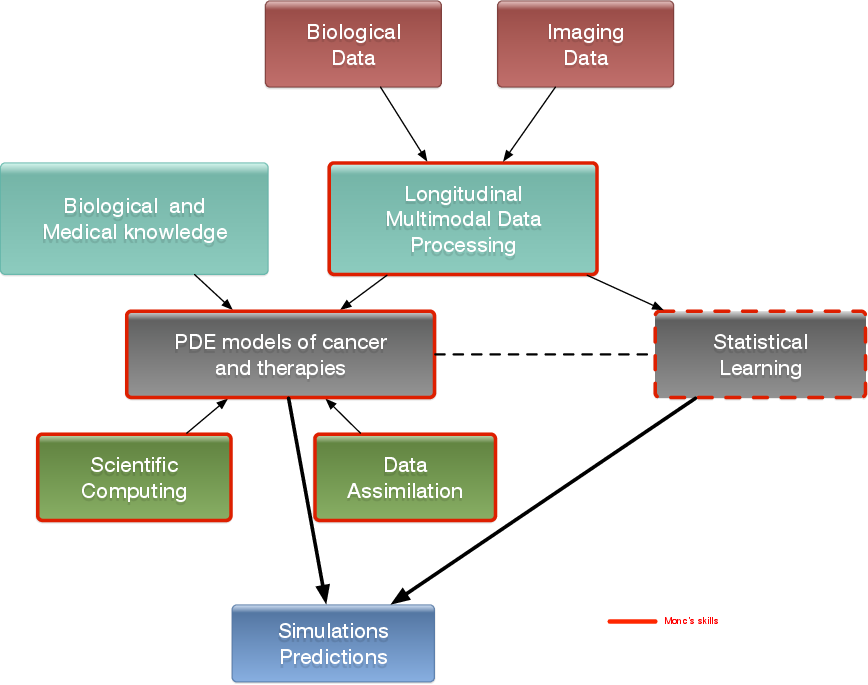
        <p>The general strategy consists of the interactions of several stages:</p>
        <ul>
          <li>
            <p class="notaparagraph"><a name="uid10"> </a><i>Stage 1:</i>  <i>Derivation of mechanistic models based on the biological knowledge and the available observations.</i> The construction of such models relies on the up-to-date biological knowledge at the cellular level including description of the cell-cycle, interaction with the microenvironement (angiogenesis, interaction with the stroma). Such models also include a "macroscopic" description of specific molecular pathways that are known to have a critical role in carcinogenesis or that are targeted by new drugs. We emphasize that for this purpose, close interactions with biologists are crucial. Lots of works devoted to modeling at the cellular level are available in the literature. However, in order to be able to use
these models in a clinical context, the tumor is also to be described at the tissue level. The <i>in vitro</i> mechanical characterization of tumor tissues has been widely studied. Yet no description that could be patient specific or even tumor specific is available. It is therefore necessary to build adapted phenomenological models, according to the biological and clinical reality.</p>
          </li>
          <li>
            <p class="notaparagraph"><a name="uid11"> </a><i>Stage 2:</i>  <i>Data collection.</i> In the clinical context, data may come from medical imaging (MRI, CT-Scan, PET scan) at different time points. It is also a crucial point: we need longitudinal data in time in order to be able to understand the evolution of the disease. Data may also be obtained from analyses of blood samples or biopsies. A close collaboration with clinicians is required for selecting the specific cases to focus on, the understanding of the key points and data, the classification of the grades of the tumors, the understanding of the treatment,...In the preclinical context, data may for instance be macroscopic measurements of the tumor volume for subcutaneous cases, green fluorescence protein (GFP) quantifications for total number of living cells, non-invasive bioluminescence signals or even imaging obtained with devices adapted to small animals.</p>
            <ul>
              <li>
                <p class="notaparagraph"><a name="uid12"> </a><i>Data processing:</i> Besides selection of representative cases by our collaborators, most of the time, data has to be processed before being used in our models. We develop novel methods for semi-automatic segmentations (they are implemented in SegmentIt), non-rigid registration and extraction of image texture information.</p>
              </li>
            </ul>
          </li>
          <li>
            <p class="notaparagraph"><a name="uid13"> </a><i>Stage 3:</i>  <i>Adaptation of the model to data.</i> The model has to be adapted to data: it is useless to have a model taking many biological features of the disease into account if it cannot be reliably parameterized with available data. For example, very detailed descriptions of the angiogenesis process found in the literature cannot be used, as they have too much parameters to determine for the information available. A pragmatic approach has to be developed for this purpose. On the other hand, one has to try to model any element that can be useful to exploit the image. Parameterizing must be performed carefully in order to achieve an optimal trade-off between the accuracy of the model, its complexity, identifiability and predictive power. Parameter estimation is a critical issue in mathematical biology: if there are too many parameters, it will be impossible to estimate them but if the model is too simple, it will be too far from reality.</p>
          </li>
          <li>
            <p class="notaparagraph"><a name="uid14"> </a><i>Stage 4:</i>  <i>Data assimilation.</i> Because of data complexity - for example multimodal, longitudinal medical imaging - data assimilation is a major challenge. Such a process is a combination of methods for solving inverse problems and statistical methods including machine learning strategies.</p>
            <ul>
              <li>
                <p class="notaparagraph"><a name="uid15"> </a><i>Personalized models:</i> Currently, most of the inverse problems developed in the team are solved using a gradient method coupled with some MCMC type algorithm. We are now trying to use more efficient methods as Kalman type filters or so-called Luenberger filter (nudging). Using sequential methods could also simplify Stage 3 because they can be used even with complex models. Of course, the strategy used by the team depends on the quantity and the quality of data. It is not the same if we have an homogeneous population of cases or if it is a very specific isolated case.</p>
              </li>
              <li>
                <p class="notaparagraph"><a name="uid16"> </a><i>Statistical learning:</i> In some clinical cases, there is no longitudinal data available to build a mathematical model describing the evolution of the disease. In these cases (<i>e.g.</i> in our collaboration with Humanitas Research Hospital), we use machine learning techniques to correlate clinical and imaging features with clinical outcome of patients (radiomics). When longitudinal data and a sufficient number of patients are available, we combine this approach and mathematical modeling by adding the personalized model parameters for each patient as features in the statistical algorithm. Our goal is then to have a better description of the evolution of the disease over time (as compared to only taking temporal variations of features into account). We also plan to use statistical algorithms to build reduced-order models, more efficient to run or calibrate than the original models.</p>
              </li>
              <li>
                <p class="notaparagraph"><a name="uid17"> </a><i>Data assimilation of gene expression.</i> "Omics" data become more and more important in oncology and we aim at developing our models using this information as well. For example, in our work on GIST, we have taken the effect of a Ckit mutation on resistance to treatment into account. However, it is still not clear how to use in general gene expression data in our macroscopic models, and particularly how to connect the genotype to the phenotype and the macroscopic growth. We expect to use statistical learning techniques on populations of patients in order to move towards this direction, but we emphasize that this task is very prospective and is a scientific challenge in itself.</p>
              </li>
            </ul>
          </li>
          <li>
            <p class="notaparagraph"><a name="uid18"> </a><i>Stage 5:</i>  <i>Simulation and prediction</i>. Once the models have been parametrized, the simulation part can be done. We also need to include a quantification of uncertainties and to produce 3D simulations that can be confronted to reality.</p>
          </li>
        </ul>
        <div align="center" style="margin-top:10px">
          <a name="uid19">
            <!--...-->
          </a>
          <table title="" class="objectContainer">
            <caption align="bottom"><strong>Figure
	3. </strong>General strategy of the team to build meaningful models in oncology.</caption>
            <tr align="center">
              <td>
                <table>
                  <tr>
                    <td style="height:3px;" align="center">
                      <img style="width:427.0pt" alt="IMG/strategy.png" src="IMG/strategy.png"/>
                    </td>
                  </tr>
                </table>
              </td>
            </tr>
          </table>
        </div>
      </div>
      <!--FIN du corps du module-->
      <br/>
      <div class="bottomNavigation">
        <div class="tail_aucentre">
          <a href="./uid3.html" accesskey="P"><img style="align:bottom; border:none" alt="previous" src="../static/img/icons/previous_motif.jpg"/> Previous | </a>
          <a href="./uid0.html" accesskey="U"><img style="align:bottom; border:none" alt="up" src="../static/img/icons/up_motif.jpg"/>  Home</a>
          <a href="./uid21.html" accesskey="N"> | Next <img style="align:bottom; border:none" alt="next" src="../static/img/icons/next_motif.jpg"/></a>
        </div>
        <br/>
      </div>
    </div>
  </body>
</html>