<?xml version="1.0" encoding="utf-8"?>
<!DOCTYPE html PUBLIC "-//W3C//DTD XHTML 1.1 plus MathML 2.0 plus SVG 1.1//EN" "http://www.w3.org/2002/04/xhtml-math-svg/xhtml-math-svg.dtd">
<html xmlns="http://www.w3.org/1999/xhtml">
  <head>
    <meta http-equiv="Content-Type" content="application/xhtml+xml; charset=utf-8"/>
    <title>Project-Team:WILLOW</title>
    <link rel="stylesheet" href="../static/css/raweb.css" type="text/css"/>
    <meta name="description" content="New Results - 3D object and scene modeling, analysis, and retrieval"/>
    <meta name="dc.title" content="New Results - 3D object and scene modeling, analysis, and retrieval"/>
    <meta name="dc.creator" content="Hajime Taira"/>
    <meta name="dc.creator" content="Masatoshi Okutomi"/>
    <meta name="dc.creator" content="Torsten Sattler"/>
    <meta name="dc.creator" content="Mircea Cimpoi"/>
    <meta name="dc.creator" content="Marc Pollefeys"/>
    <meta name="dc.creator" content="Josef Sivic"/>
    <meta name="dc.creator" content="Tomas Pajdla"/>
    <meta name="dc.creator" content="Akihiko Torii"/>
    <meta name="dc.creator" content="Torsten Sattler"/>
    <meta name="dc.creator" content="Will Maddern"/>
    <meta name="dc.creator" content="Carl Toft"/>
    <meta name="dc.creator" content="Akihiko Torii"/>
    <meta name="dc.creator" content="Lars Hammarstrand"/>
    <meta name="dc.creator" content="Erik Stenborg"/>
    <meta name="dc.creator" content="Daniel Safari"/>
    <meta name="dc.creator" content="Masatoshi Okutomi"/>
    <meta name="dc.creator" content="Marc Pollefeys"/>
    <meta name="dc.creator" content="Josef Sivic"/>
    <meta name="dc.creator" content="Frederik Kahl"/>
    <meta name="dc.creator" content="Tomas Pajdla"/>
    <meta name="dc.creator" content="Kathlen Kohn"/>
    <meta name="dc.creator" content="Bernd Sturmfels"/>
    <meta name="dc.creator" content="Matthew Trager"/>
    <meta name="dc.creator" content="Boris Bukh"/>
    <meta name="dc.creator" content="Xavier Goaoc"/>
    <meta name="dc.creator" content="Alfredo Hubard"/>
    <meta name="dc.creator" content="Matthew Trager"/>
    <meta name="dc.creator" content="Matthew Trager"/>
    <meta name="dc.creator" content="Brian Osserman"/>
    <meta name="dc.creator" content="Jean Ponce"/>
    <meta name="dc.creator" content="Matthew Trager"/>
    <meta name="dc.creator" content="Jean Ponce"/>
    <meta name="dc.creator" content="Brian Osserman"/>
    <meta name="dc.creator" content="Matthew Trager"/>
    <meta name="dc.subject" content=""/>
    <meta name="dc.publisher" content="INRIA"/>
    <meta name="dc.date" content="(SCHEME=ISO8601) 2018-01"/>
    <meta name="dc.type" content="Report"/>
    <meta name="dc.language" content="(SCHEME=ISO639-1) en"/>
    <meta name="projet" content="WILLOW"/>
    <script type="text/javascript" src="https://cdn.mathjax.org/mathjax/latest/MathJax.js?config=TeX-MML-AM_CHTML">
      <!--MathJax-->
    </script>
  </head>
  <body>
    <div class="tdmdiv">
      <div class="logo">
        <a href="http://www.inria.fr">
          <img style="align:bottom; border:none" src="../static/img/icons/logo_INRIA-coul.jpg" alt="Inria"/>
        </a>
      </div>
      <div class="TdmEntry">
        <div class="tdmentete">
          <a href="uid0.html">Project-Team Willow</a>
        </div>
        <span>
          <a href="uid1.html">Team, Visitors, External Collaborators</a>
        </span>
      </div>
      <div class="TdmEntry">Overall Objectives<ul><li><a href="./uid3.html">Statement</a></li></ul></div>
      <div class="TdmEntry">Research Program<ul><li><a href="uid5.html&#10;&#9;&#9;  ">3D object and scene modeling, analysis,
and retrieval</a></li><li><a href="uid7.html&#10;&#9;&#9;  ">Category-level object and scene recognition</a></li><li><a href="uid8.html&#10;&#9;&#9;  ">Image restoration, manipulation and enhancement</a></li><li><a href="uid9.html&#10;&#9;&#9;  ">Human activity capture and classification</a></li></ul></div>
      <div class="TdmEntry">Application Domains<ul><li><a href="uid13.html&#10;&#9;&#9;  ">Introduction</a></li><li><a href="uid14.html&#10;&#9;&#9;  ">Quantitative image analysis in science and humanities</a></li><li><a href="uid15.html&#10;&#9;&#9;  ">Video Annotation, Interpretation, and Retrieval</a></li></ul></div>
      <div class="TdmEntry">
        <a href="./uid17.html">Highlights of the Year</a>
      </div>
      <div class="TdmEntry">New Software and Platforms<ul><li><a href="uid22.html&#10;&#9;&#9;  ">NCNet</a></li><li><a href="uid27.html&#10;&#9;&#9;  ">Mixture-of-Embedding-Experts</a></li><li><a href="uid32.html&#10;&#9;&#9;  ">BodyNet</a></li><li><a href="uid37.html&#10;&#9;&#9;  ">FlexWLoc</a></li><li><a href="uid42.html&#10;&#9;&#9;  ">Pinocchio</a></li><li><a href="uid46.html&#10;&#9;&#9;  ">weakalign</a></li><li><a href="uid51.html&#10;&#9;&#9;  ">InLoc</a></li></ul></div>
      <div class="TdmEntry">New Results<ul><li class="tdmActPage"><a href="uid57.html&#10;&#9;&#9;  ">3D object and scene modeling, analysis, and retrieval</a></li><li><a href="uid70.html&#10;&#9;&#9;  ">Category-level object and scene recognition</a></li><li><a href="uid80.html&#10;&#9;&#9;  ">Image restoration, manipulation and enhancement</a></li><li><a href="uid84.html&#10;&#9;&#9;  ">Human activity capture and classification</a></li></ul></div>
      <div class="TdmEntry">Bilateral Contracts and Grants with Industry<ul><li><a href="uid96.html&#10;&#9;&#9;  ">Bilateral Contracts with Industry</a></li><li><a href="uid99.html&#10;&#9;&#9;  ">Bilateral Grants with Industry</a></li></ul></div>
      <div class="TdmEntry">Partnerships and Cooperations<ul><li><a href="uid104.html&#10;&#9;&#9;  ">National Initiatives</a></li><li><a href="uid106.html&#10;&#9;&#9;  ">European Initiatives</a></li><li><a href="uid109.html&#10;&#9;&#9;  ">International Initiatives</a></li><li><a href="uid112.html&#10;&#9;&#9;  ">International Research Visitors</a></li></ul></div>
      <div class="TdmEntry">Dissemination<ul><li><a href="uid115.html&#10;&#9;&#9;  ">Promoting Scientific Activities</a></li><li><a href="uid186.html&#10;&#9;&#9;  ">Teaching - Supervision - Juries</a></li><li><a href="uid218.html&#10;&#9;&#9;  ">Popularization</a></li></ul></div>
      <div class="TdmEntry">
        <div>Bibliography</div>
      </div>
      <div class="TdmEntry">
        <ul>
          <li>
            <a id="tdmbibentyear" href="bibliography.html">Publications of the year</a>
          </li>
        </ul>
      </div>
    </div>
    <div id="main">
      <div class="mainentete">
        <div id="head_agauche">
          <small><a href="http://www.inria.fr">
	    
	    Inria
	  </a> | <a href="../index.html">
	    
	    Raweb 
	    2018</a> | <a href="http://www.inria.fr/en/teams/willow">Presentation of the Project-Team WILLOW</a> | <a href="http://www.di.ens.fr/willow">WILLOW Web Site
	  </a></small>
        </div>
        <div id="head_adroite">
          <table class="qrcode">
            <tr>
              <td>
                <a href="willow.xml">
                  <img style="align:bottom; border:none" alt="XML" src="../static/img/icons/xml_motif.png"/>
                </a>
              </td>
              <td>
                <a href="willow.pdf">
                  <img style="align:bottom; border:none" alt="PDF" src="IMG/qrcode-willow-pdf.png"/>
                </a>
              </td>
              <td>
                <a href="../willow/willow.epub">
                  <img style="align:bottom; border:none" alt="e-pub" src="IMG/qrcode-willow-epub.png"/>
                </a>
              </td>
            </tr>
            <tr>
              <td/>
              <td>PDF
</td>
              <td>e-Pub
</td>
            </tr>
          </table>
        </div>
      </div>
      <!--FIN du corps du module-->
      <br/>
      <div class="bottomNavigation">
        <div class="tail_aucentre">
          <a href="./uid51.html" accesskey="P"><img style="align:bottom; border:none" alt="previous" src="../static/img/icons/previous_motif.jpg"/> Previous | </a>
          <a href="./uid0.html" accesskey="U"><img style="align:bottom; border:none" alt="up" src="../static/img/icons/up_motif.jpg"/>  Home</a>
          <a href="./uid70.html" accesskey="N"> | Next <img style="align:bottom; border:none" alt="next" src="../static/img/icons/next_motif.jpg"/></a>
        </div>
        <br/>
      </div>
      <div id="textepage">
        <!--DEBUT2 du corps du module-->
        <h2>Section: 
      New Results</h2>
        <h3 class="titre3">3D object and scene modeling, analysis, and retrieval</h3>
        <a name="uid58"/>
        <h4 class="titre4">Indoor Visual Localization with Dense Matching and View Synthesis</h4>
        <p class="participants"><span class="part">Participants</span> :
	Hajime Taira, Masatoshi Okutomi, Torsten Sattler, Mircea Cimpoi, Marc Pollefeys, Josef Sivic, Tomas Pajdla, Akihiko Torii.</p>
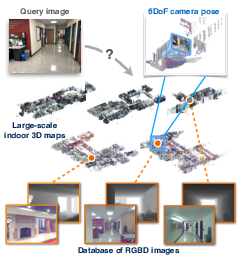
        <p>In <a href="./bibliography.html#willow-2018-bid0">[20]</a>, we seek to predict the 6 degree-of-freedom (6DoF) pose of a query photograph with respect to a large indoor 3D map. The contributions of this work are three-fold. First, we develop a new large-scale visual localization method targeted for indoor environments. The method proceeds along three steps: (i) efficient retrieval of candidate poses that ensures scalability to large-scale environments, (ii) pose estimation using dense matching rather than local features to deal with textureless indoor scenes, and (iii) pose verification by virtual view synthesis to cope with significant changes in viewpoint, scene layout, and occluders. Second, we collect a new dataset with reference 6DoF poses for large-scale indoor localization. Query photographs are captured by mobile phones at a different time than the reference 3D map, thus presenting a realistic indoor localization scenario. Third, we demonstrate that our method significantly outperforms current state-of-the-art indoor localization approaches on this new challenging data.
Figure <a title="3D object and scene modeling, analysis, and retrieval" href="./uid57.html#uid59">1</a> presents some example results.</p>
        <div align="center" style="margin-top:10px">
          <a name="uid59">
            <!--...-->
          </a>
          <table title="" class="objectContainer">
            <caption align="bottom"><strong>Figure
	1. </strong>Large-scale indoor visual localization. Given a database of geometrically-registered RGBD images, we predict
the 6DoF camera pose of a query RGB image by retrieving candidate images, estimating candicate camera poses, and selecting
the best matching camera pose. To address inherent difficulties in
indoor visual localization, we introduce the ?InLoc? approach that
performs a sequence of progressively stricter verification steps.</caption>
            <tr align="center">
              <td>
                <table>
                  <tr>
                    <td style="height:3px;" align="center">
                      <img style="width:256.2026pt" alt="IMG/taira.png" src="IMG/taira.png"/>
                    </td>
                  </tr>
                </table>
              </td>
            </tr>
          </table>
        </div>
        <a name="uid60"/>
        <h4 class="titre4">Benchmarking 6DOF Outdoor Visual Localization in Changing Conditions</h4>
        <p class="participants"><span class="part">Participants</span> :
	Torsten Sattler, Will Maddern, Carl Toft, Akihiko Torii, Lars Hammarstrand, Erik Stenborg, Daniel Safari, Masatoshi Okutomi, Marc Pollefeys, Josef Sivic, Frederik Kahl, Tomas Pajdla.</p>
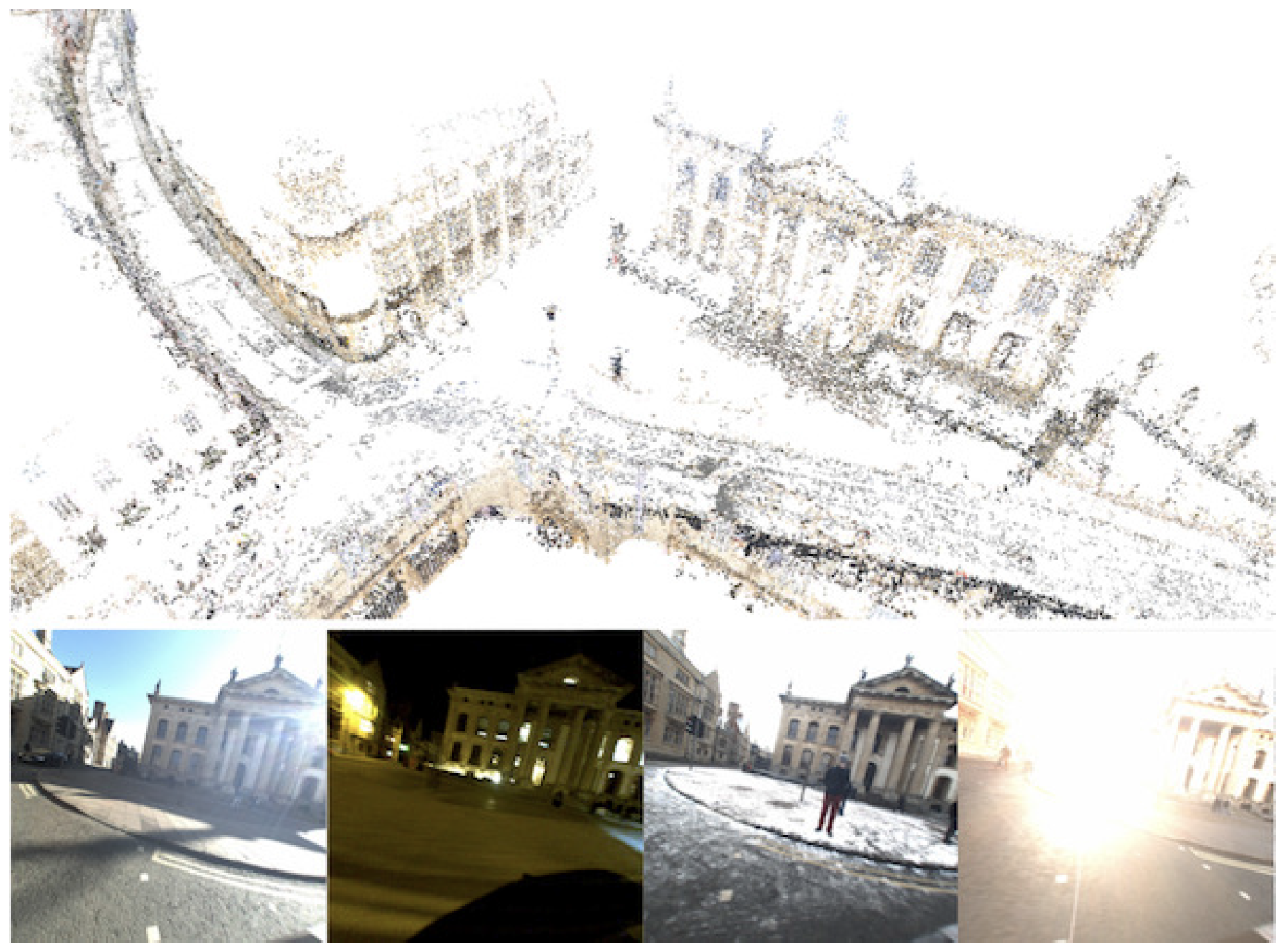
        <p>Visual localization enables autonomous vehicles to navigate in their surroundings and augmented reality applications to link virtual to real worlds. Practical visual localization approaches need to be robust to a wide variety of viewing condition, including day-night changes, as well as weather and seasonal variations, while providing highly accurate 6 degree-of-freedom (6DOF) camera pose estimates. In <a href="./bibliography.html#willow-2018-bid1">[19]</a>, we introduce the first benchmark datasets specifically designed for analyzing the impact of such factors on visual localization. Using carefully created ground truth poses for query images taken under a wide variety of conditions, we evaluate the impact of various factors on 6DOF camera pose estimation accuracy through extensive experiments with state-of-the-art localization approaches. Based on our results, we draw conclusions about the difficulty of different conditions, showing that long-term localization is far from solved, and propose promising avenues for future work, including sequence-based localization approaches and the need for better local features. Our benchmark is available at visuallocalization.net.
Figure <a title="3D object and scene modeling, analysis, and retrieval" href="./uid57.html#uid61">2</a> presents some example results.</p>
        <div align="center" style="margin-top:10px">
          <a name="uid61">
            <!--...-->
          </a>
          <table title="" class="objectContainer">
            <caption align="bottom"><strong>Figure
	2. </strong>Visual localization in changing urban conditions. We
present three new datasets, Aachen Day-Night, RobotCar Seasons
(shown) and CMU Seasons for evaluating 6DOF localization
against a prior 3D map (top) using registered query images taken
from a wide variety of conditions (bottom), including day-night
variation, weather, and seasonal changes over long periods of time.</caption>
            <tr align="center">
              <td>
                <table>
                  <tr>
                    <td style="height:3px;" align="center">
                      <img style="width:256.2026pt" alt="IMG/sattler.png" src="IMG/sattler.png"/>
                    </td>
                  </tr>
                </table>
              </td>
            </tr>
          </table>
        </div>
        <a name="uid62"/>
        <h4 class="titre4">Changing Views on Curves and Surfaces</h4>
        <p class="participants"><span class="part">Participants</span> :
	Kathlen Kohn, Bernd Sturmfels, Matthew Trager.</p>
        <p class="participants"><span class="part">Participants</span> :
	Boris Bukh, Xavier Goaoc, Alfredo Hubard, Matthew Trager.</p>
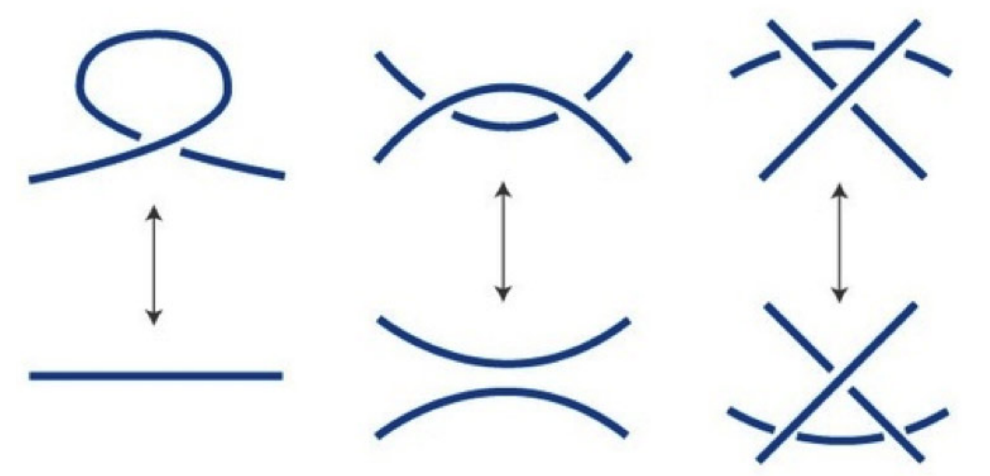
        <p>Visual events in computer vision are studied from the perspective of algebraic geometry. Given a sufficiently general curve or surface in 3-space, we consider the image or contour curve that arises by projecting from a viewpoint. Qualitative changes in that curve occur when the viewpoint crosses the visual event surface as illustrated in <a title="3D object and scene modeling, analysis, and retrieval" href="./uid57.html#uid63">3</a>. We examine the components of this ruled surface, and observe that these coincide with the iterated singular loci of the coisotropic hypersurfaces associated with the original curve or surface. We derive formulas, due to Salmon and Petitjean, for the degrees of these surfaces, and show how to compute exact representations for all visual event surfaces using algebraic methods. This work has been published in <a href="./bibliography.html#willow-2018-bid2">[8]</a>.</p>
        <div align="center" style="margin-top:10px">
          <a name="uid63">
            <!--...-->
          </a>
          <table title="" class="objectContainer">
            <caption align="bottom"><strong>Figure
	3. </strong>Changing views of a curve correspond to Reidemeister moves. The viewpoint <span class="math"><math xmlns="http://www.w3.org/1998/Math/MathML"><mi>z</mi></math></span>
crosses the tangential surface (left), edge surface (middle), or trisecant surface (right).</caption>
            <tr align="center">
              <td>
                <table>
                  <tr>
                    <td style="height:3px;" align="center">
                      <img style="width:298.8987pt" alt="IMG/changing_views.png" src="IMG/changing_views.png"/>
                    </td>
                  </tr>
                </table>
              </td>
            </tr>
          </table>
        </div>
        <p>subsectionConsistent Sets of Lines with no Colorful Incidence</p>
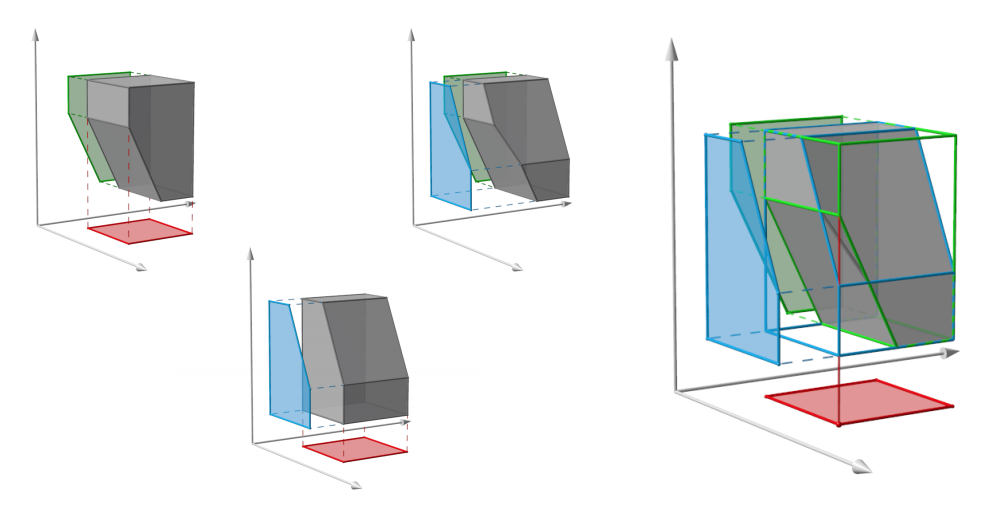
        <p>We consider incidences among colored sets of lines in <span class="math"><math xmlns="http://www.w3.org/1998/Math/MathML"><msup><mi>ℝ</mi><mi>d</mi></msup></math></span> and examine whether the existence of certain concurrences between lines of <span class="math"><math xmlns="http://www.w3.org/1998/Math/MathML"><mi>k</mi></math></span> colors force the existence of at least one concurrence between lines of <span class="math"><math xmlns="http://www.w3.org/1998/Math/MathML"><mrow><mi>k</mi><mo>+</mo><mn>1</mn></mrow></math></span> colors. This question is relevant for problems in 3D reconstruction in computer vision such as the one illustrated in Figure <a title="3D object and scene modeling, analysis, and retrieval" href="./uid57.html#uid64">4</a>. This work has been published in <a href="./bibliography.html#willow-2018-bid3">[12]</a>.</p>
        <div align="center" style="margin-top:10px">
          <a name="uid64">
            <!--...-->
          </a>
          <table title="" class="objectContainer">
            <caption align="bottom"><strong>Figure
	4. </strong>Three silhouettes that are 2-consistent but not globally consistent for three orthogonal
projections. Each of the first three figures shows a three-dimensional set that projects onto two
of the three silhouettes. The fourth figure illustrates that no set can project simultaneously onto
all three silhouettes: the highlighted red image point cannot be lifted in 3D, since no point that
projects onto it belongs to the pre-images of both the blue and green silhouettes.</caption>
            <tr align="center">
              <td>
                <table>
                  <tr>
                    <td style="height:3px;" align="center">
                      <img style="width:298.8987pt" alt="IMG/consistent_set.png" src="IMG/consistent_set.png"/>
                    </td>
                  </tr>
                </table>
              </td>
            </tr>
          </table>
        </div>
        <a name="uid65"/>
        <h4 class="titre4">On the Solvability of Viewing Graphs</h4>
        <p class="participants"><span class="part">Participants</span> :
	Matthew Trager, Brian Osserman, Jean Ponce.</p>
        <p>A set of fundamental matrices relating pairs of cameras in some configuration can be represented as edges of a ” viewing graph ". Whether or not these fundamental matrices are generically sufficient to recover the global camera configuration depends on the structure of this graph. We study characterizations of ” solvable " viewing graphs, and present several new results that can be applied to determine which pairs of views may be used to recover all camera parameters. We also discuss strategies for verifying the solvability of a graph computationally. This work has been published in <a href="./bibliography.html#willow-2018-bid4">[21]</a>.</p>
        <a name="uid66"/>
        <h4 class="titre4">In Defense of Relative Multi-View Geometry</h4>
        <p class="participants"><span class="part">Participants</span> :
	Matthew Trager, Jean Ponce.</p>
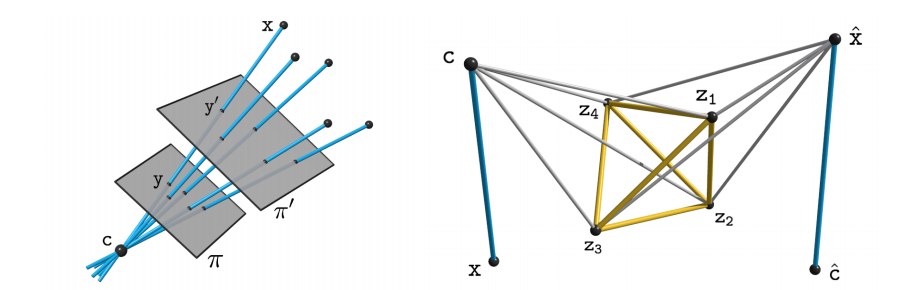
        <p>The idea of studying multi-view geometry and structure-from-motion problems <i>relative</i> to the scene and camera configurations, without appeal to external coordinate systems, dates back to the early days of modern geometric computer vision. Yet, it has a bad rap, the scene reconstructions obtained often being deemed as inaccurate despite careful implementations. The aim of this article is to correct this perception with a series of new results. In particular, we show that using a small subset of scene and image points to parameterize their relative configurations offers a natural coordinate-free formulation of Carlsson-Weinshall duality for arbitrary numbers of images. An example is shown in Figure <a title="3D object and scene modeling, analysis, and retrieval" href="./uid57.html#uid67">5</a>. For three views, this approach also yields novel purely- and quasi-linear formulations of structure from motion using <i>reduced trilinearities</i>, without the complex polynomial constraints associated with trifocal tensors, revealing in passing the strong link between “3D” (<span class="math"><math xmlns="http://www.w3.org/1998/Math/MathML"><mrow><msup><mi>ℙ</mi><mn>3</mn></msup><mo>→</mo><msup><mi>ℙ</mi><mn>2</mn></msup></mrow></math></span>) and “2D” (<span class="math"><math xmlns="http://www.w3.org/1998/Math/MathML"><mrow><msup><mi>ℙ</mi><mn>2</mn></msup><mo>→</mo><msup><mi>ℙ</mi><mn>1</mn></msup></mrow></math></span>) models of trinocular vision. Finally, we demonstrate through preliminary experiments that the proposed relative reconstruction methods gives good results on real data. This works is available as a preprint <a href="./bibliography.html#willow-2018-bid5">[32]</a>.</p>
        <div align="center" style="margin-top:10px">
          <a name="uid67">
            <!--...-->
          </a>
          <table title="" class="objectContainer">
            <caption align="bottom"><strong>Figure
	5. </strong>Configurations. <b>Left</b>: Image point and viewing ray configurations are isomorphic
and independent of the retinal plane. <b>Right</b>: Geometric Carlsson-Weinshall duality
between scene point and pinhole configurations.</caption>
            <tr align="center">
              <td>
                <table>
                  <tr>
                    <td style="height:3px;" align="center">
                      <img style="width:384.2974pt" alt="IMG/in_defense.png" src="IMG/in_defense.png"/>
                    </td>
                  </tr>
                </table>
              </td>
            </tr>
          </table>
        </div>
        <a name="uid68"/>
        <h4 class="titre4">Multigraded Cayley-Chow Forms</h4>
        <p class="participants"><span class="part">Participants</span> :
	Brian Osserman, Matthew Trager.</p>
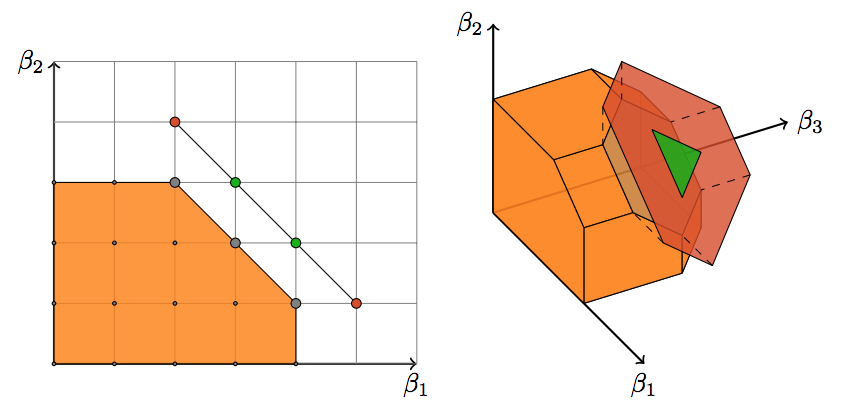
        <p>We introduce a theory of multigraded Cayley-Chow forms associated to subvarieties of products of projective spaces. Figure <a title="3D object and scene modeling, analysis, and retrieval" href="./uid57.html#uid69">6</a> illustrares some examples of projective speces. Two new phenomena arise: first, the construction turns out to require certain inequalities on the dimensions of projections; and second, in positive characteristic the multigraded Cayley-Chow forms can have higher multiplicities. The theory also provides a natural framework for understanding multifocal tensors in computer vision. This works is available as a preprint <a href="./bibliography.html#willow-2018-bid6">[30]</a>.</p>
        <div align="center" style="margin-top:10px">
          <a name="uid69">
            <!--...-->
          </a>
          <table title="" class="objectContainer">
            <caption align="bottom"><strong>Figure
	6. </strong>Two polymatroids. The sets of bases (corresponding
to our multidegree supports) are in gray; while the sets of circuits
and of non-circuit 1-deficient vectors
are in green and red, respectively.</caption>
            <tr align="center">
              <td>
                <table>
                  <tr>
                    <td style="height:3px;" align="center">
                      <img style="width:384.2974pt" alt="IMG/multigraded.png" src="IMG/multigraded.png"/>
                    </td>
                  </tr>
                </table>
              </td>
            </tr>
          </table>
        </div>
      </div>
      <!--FIN du corps du module-->
      <br/>
      <div class="bottomNavigation">
        <div class="tail_aucentre">
          <a href="./uid51.html" accesskey="P"><img style="align:bottom; border:none" alt="previous" src="../static/img/icons/previous_motif.jpg"/> Previous | </a>
          <a href="./uid0.html" accesskey="U"><img style="align:bottom; border:none" alt="up" src="../static/img/icons/up_motif.jpg"/>  Home</a>
          <a href="./uid70.html" accesskey="N"> | Next <img style="align:bottom; border:none" alt="next" src="../static/img/icons/next_motif.jpg"/></a>
        </div>
        <br/>
      </div>
    </div>
  </body>
</html>