<?xml version="1.0" encoding="utf-8"?>
<!DOCTYPE html PUBLIC "-//W3C//DTD XHTML 1.1 plus MathML 2.0 plus SVG 1.1//EN" "http://www.w3.org/2002/04/xhtml-math-svg/xhtml-math-svg.dtd">
<html xmlns="http://www.w3.org/1999/xhtml">
  <head>
    <meta http-equiv="Content-Type" content="application/xhtml+xml; charset=utf-8"/>
    <title>Project-Team:APICS</title>
    <link rel="stylesheet" href="../static/css/raweb.css" type="text/css"/>
    <meta name="description" content="New Results - Matching problems and their applications"/>
    <meta name="dc.title" content="New Results - Matching problems and their applications"/>
    <meta name="dc.creator" content="Laurent Baratchart"/>
    <meta name="dc.creator" content="Martine Olivi"/>
    <meta name="dc.creator" content="Gibin Bose"/>
    <meta name="dc.creator" content="David Martinez Martinez"/>
    <meta name="dc.creator" content="Fabien Seyfert"/>
    <meta name="dc.subject" content=""/>
    <meta name="dc.publisher" content="INRIA"/>
    <meta name="dc.date" content="(SCHEME=ISO8601) 2017-01"/>
    <meta name="dc.type" content="Report"/>
    <meta name="dc.language" content="(SCHEME=ISO639-1) en"/>
    <meta name="projet" content="APICS"/>
    <script type="text/javascript" src="https://cdn.mathjax.org/mathjax/latest/MathJax.js?config=TeX-MML-AM_CHTML">
      <!--MathJax-->
    </script>
  </head>
  <body>
    <div class="tdmdiv">
      <div class="logo">
        <a href="http://www.inria.fr">
          <img style="align:bottom; border:none" src="../static/img/icons/logo_INRIA-coul.jpg" alt="Inria"/>
        </a>
      </div>
      <div class="TdmEntry">
        <div class="tdmentete">
          <a href="uid0.html">Project-Team Apics</a>
        </div>
        <span>
          <a href="uid1.html">Personnel</a>
        </span>
      </div>
      <div class="TdmEntry">Overall Objectives<ul><li><a href="./uid3.html">Research Themes</a></li></ul></div>
      <div class="TdmEntry">Research Program<ul><li><a href="uid7.html&#10;&#9;&#9;  ">Introduction</a></li><li><a href="uid11.html&#10;&#9;&#9;  ">Range of inverse problems</a></li><li><a href="uid17.html&#10;&#9;&#9;  ">Approximation</a></li><li><a href="uid23.html&#10;&#9;&#9;  ">Software tools of the team</a></li></ul></div>
      <div class="TdmEntry">Application Domains<ul><li><a href="uid46.html&#10;&#9;&#9;  ">Introduction</a></li><li><a href="uid47.html&#10;&#9;&#9;  ">Inverse magnetization problems</a></li><li><a href="uid49.html&#10;&#9;&#9;  ">Inverse source problems in EEG</a></li><li><a href="uid50.html&#10;&#9;&#9;  ">Identification and design of microwave devices</a></li></ul></div>
      <div class="TdmEntry">New Results<ul><li><a href="uid59.html&#10;&#9;&#9;  ">Inverse problems for Poisson-Laplace equations</a></li><li class="tdmActPage"><a href="uid62.html&#10;&#9;&#9;  ">Matching problems and their applications</a></li><li><a href="uid66.html&#10;&#9;&#9;  ">Stability assessment of microwave amplifiers and design of oscillators</a></li><li><a href="uid67.html&#10;&#9;&#9;  ">The Hardy-Hodge decomposition</a></li></ul></div>
      <div class="TdmEntry">Bilateral Contracts and Grants with Industry<ul><li><a href="uid69.html&#10;&#9;&#9;  ">Bilateral Contracts with Industry</a></li></ul></div>
      <div class="TdmEntry">Partnerships and Cooperations<ul><li><a href="uid75.html&#10;&#9;&#9;  ">Regional Initiatives</a></li><li><a href="uid81.html&#10;&#9;&#9;  ">National Initiatives</a></li><li><a href="uid84.html&#10;&#9;&#9;  ">European Initiatives</a></li><li><a href="uid88.html&#10;&#9;&#9;  ">International Initiatives</a></li><li><a href="uid99.html&#10;&#9;&#9;  ">International Research Visitors</a></li><li><a href="uid114.html&#10;&#9;&#9;  ">List of international and industrial partners</a></li></ul></div>
      <div class="TdmEntry">Dissemination<ul><li><a href="uid119.html&#10;&#9;&#9;  ">Promoting Scientific Activities</a></li><li><a href="uid151.html&#10;&#9;&#9;  ">Teaching - Supervision - Juries</a></li><li><a href="uid166.html&#10;&#9;&#9;  ">Popularization</a></li></ul></div>
      <div class="TdmEntry">
        <div>Bibliography</div>
      </div>
      <div class="TdmEntry">
        <ul>
          <li>
            <a id="tdmbibentmajor" href="bibliography.html">Major publications</a>
          </li>
          <li>
            <a id="tdmbibentyear" href="bibliography.html#year">Publications of the year</a>
          </li>
          <li>
            <a id="tdmbibentfoot" href="bibliography.html#References">References in notes</a>
          </li>
        </ul>
      </div>
    </div>
    <div id="main">
      <div class="mainentete">
        <div id="head_agauche">
          <small><a href="http://www.inria.fr">
	    
	    Inria
	  </a> | <a href="../index.html">
	    
	    Raweb 
	    2017</a> | <a href="http://www.inria.fr/en/teams/apics">Presentation of the Project-Team APICS</a> | <a href="http://team.inria.fr/apics/">APICS Web Site
	  </a></small>
        </div>
        <div id="head_adroite">
          <table class="qrcode">
            <tr>
              <td>
                <a href="apics.xml">
                  <img style="align:bottom; border:none" alt="XML" src="../static/img/icons/xml_motif.png"/>
                </a>
              </td>
              <td>
                <a href="apics.pdf">
                  <img style="align:bottom; border:none" alt="PDF" src="IMG/qrcode-apics-pdf.png"/>
                </a>
              </td>
              <td>
                <a href="../apics/apics.epub">
                  <img style="align:bottom; border:none" alt="e-pub" src="IMG/qrcode-apics-epub.png"/>
                </a>
              </td>
            </tr>
            <tr>
              <td/>
              <td>PDF
</td>
              <td>e-Pub
</td>
            </tr>
          </table>
        </div>
      </div>
      <!--FIN du corps du module-->
      <br/>
      <div class="bottomNavigation">
        <div class="tail_aucentre">
          <a href="./uid59.html" accesskey="P"><img style="align:bottom; border:none" alt="previous" src="../static/img/icons/previous_motif.jpg"/> Previous | </a>
          <a href="./uid0.html" accesskey="U"><img style="align:bottom; border:none" alt="up" src="../static/img/icons/up_motif.jpg"/>  Home</a>
          <a href="./uid66.html" accesskey="N"> | Next <img style="align:bottom; border:none" alt="next" src="../static/img/icons/next_motif.jpg"/></a>
        </div>
        <br/>
      </div>
      <div id="textepage">
        <!--DEBUT2 du corps du module-->
        <h2>Section: 
      New Results</h2>
        <h3 class="titre3">Matching problems and their applications</h3>
        <p class="participants"><span class="part">Participants</span> :
	Laurent Baratchart, Martine Olivi, Gibin Bose, David Martinez Martinez, Fabien Seyfert.</p>
        <p>This is collaborative work with
Stéphane Bila (XLIM, Limoges, France),
Yohann Sence (XLIM, Limoges, France),
Thierry Monediere (XLIM, Limoges, France),
Francois Torrès (XLIM, Limoges, France) in the context of the ANR Cocoram (see Section <a title="National Initiatives" href="./uid81.html#uid82">7.2.1</a>) as well as
with,
Fabien Ferrero (LEAT, Sophia-Antipolis, France)
Leonardo Lizzi (LEAT, Sophia-Antipolis, France).</p>
        <p>Filter synthesis is usually performed under the hypothesis that both ports
of the filter are loaded on a constant resistive load (usually 50 Ohm). In complex systems, filters
are however cascaded with other devices, and end up
being loaded, at least at one port, on a non purely resistive frequency varying load. This
is for example the case when synthesizing a multiplexer: each filter is here
loaded at one of its ports on a common junction. Thus,
the load varies with frequency by construction,
and is not purely resistive either.
Likewise, in an emitter-receiver, the antenna is followed by a
filter.
Whereas the antenna can usually be regarded as a resistive load at
some frequencies, this is far from being true on the
whole pass-band.
A mismatch between the antenna and the filter,
however, causes irremediable power losses, both in emission and transmission.
Our goal is therefore to develop a method for filter synthesis that allows
us to match varying loads on specific frequency bands, while enforcing some rejection properties away from the pass-band.</p>
        <div align="center" style="margin-top:10px">
          <a name="uid63">
            <!--...-->
          </a>
          <table title="" class="objectContainer">
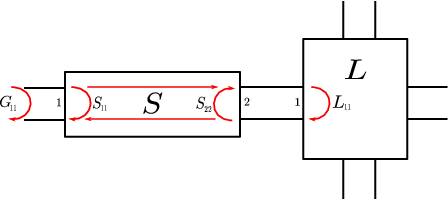
            <caption align="bottom"><strong>Figure
	5. </strong>Filter plugged on a system with reflection coefficient <span class="math"><math xmlns="http://www.w3.org/1998/Math/MathML"><msub><mi>L</mi><mn>11</mn></msub></math></span></caption>
            <tr align="center">
              <td>
                <table>
                  <tr>
                    <td style="height:3px;" align="center">
                      <img style="width:384.2974pt" alt="IMG/Figure5.png" src="IMG/Figure5.png"/>
                    </td>
                  </tr>
                </table>
              </td>
            </tr>
          </table>
        </div>
        <p>Figure <a title="Matching problems and their applications" href="./uid62.html#uid63">5</a> shows a filter with scattering matrix <span class="math"><math xmlns="http://www.w3.org/1998/Math/MathML"><mi>S</mi></math></span>, plugged at its right port on a frequency varying load with reflection parameter <span class="math"><math xmlns="http://www.w3.org/1998/Math/MathML"><msub><mi>L</mi><mrow><mn>1</mn><mo>,</mo><mn>1</mn></mrow></msub></math></span>. If the filter is lossless, simple algebraic manipulations show that on the frequency axis the reflex-ion parameter satisfies:</p>
        <div align="center" class="mathdisplay">
          <math xmlns="http://www.w3.org/1998/Math/MathML">
            <mrow>
              <mfenced separators="" open="|" close="|">
                <msub>
                  <mi>G</mi>
                  <mrow>
                    <mn>1</mn>
                    <mo>,</mo>
                    <mn>1</mn>
                  </mrow>
                </msub>
              </mfenced>
              <mo>=</mo>
              <mfenced separators="" open="|" close="|">
                <mfrac>
                  <mrow>
                    <msub>
                      <mi>S</mi>
                      <mrow>
                        <mn>2</mn>
                        <mo>,</mo>
                        <mn>2</mn>
                      </mrow>
                    </msub>
                    <mo>-</mo>
                    <mover>
                      <msub>
                        <mi>L</mi>
                        <mrow>
                          <mn>1</mn>
                          <mo>,</mo>
                          <mn>1</mn>
                        </mrow>
                      </msub>
                      <mo>¯</mo>
                    </mover>
                  </mrow>
                  <mrow>
                    <mn>1</mn>
                    <mo>-</mo>
                    <msub>
                      <mi>S</mi>
                      <mrow>
                        <mn>2</mn>
                        <mo>,</mo>
                        <mn>2</mn>
                      </mrow>
                    </msub>
                    <msub>
                      <mi>L</mi>
                      <mrow>
                        <mn>1</mn>
                        <mo>,</mo>
                        <mn>1</mn>
                      </mrow>
                    </msub>
                  </mrow>
                </mfrac>
              </mfenced>
              <mo>=</mo>
              <mi>δ</mi>
              <mrow>
                <mo>(</mo>
                <msub>
                  <mi>G</mi>
                  <mrow>
                    <mn>1</mn>
                    <mo>,</mo>
                    <mn>1</mn>
                  </mrow>
                </msub>
                <mo>,</mo>
                <msub>
                  <mi>S</mi>
                  <mrow>
                    <mn>2</mn>
                    <mo>,</mo>
                    <mn>2</mn>
                  </mrow>
                </msub>
                <mo>)</mo>
              </mrow>
              <mo>.</mo>
            </mrow>
          </math>
        </div>
        <p class="notaparagraph">The matching problem of minimizing <span class="math"><math xmlns="http://www.w3.org/1998/Math/MathML"><mrow><mrow><mo>|</mo></mrow><msub><mi>G</mi><mrow><mn>1</mn><mo>,</mo><mn>1</mn></mrow></msub><mrow><mo>|</mo></mrow></mrow></math></span>
amounts therefore to minimize the pseudo-hyperbolic distance <span class="math"><math xmlns="http://www.w3.org/1998/Math/MathML"><mi>δ</mi></math></span> between
the filter's reflex-ion parameter <span class="math"><math xmlns="http://www.w3.org/1998/Math/MathML"><msub><mi>S</mi><mrow><mn>2</mn><mo>,</mo><mn>2</mn></mrow></msub></math></span> and the load's reflex-ion <span class="math"><math xmlns="http://www.w3.org/1998/Math/MathML"><msub><mi>L</mi><mrow><mn>1</mn><mo>,</mo><mn>1</mn></mrow></msub></math></span>,
on a given frequency band. On the contrary enforcing a rejection level on a stop band, amounts to maintaining the value of <span class="math"><math xmlns="http://www.w3.org/1998/Math/MathML"><mrow><mi>δ</mi><mo>(</mo><msub><mi>L</mi><mrow><mn>1</mn><mo>,</mo><mn>1</mn></mrow></msub><mo>,</mo><msub><mi>S</mi><mrow><mn>2</mn><mo>,</mo><mn>2</mn></mrow></msub><mo>)</mo></mrow></math></span> above a certain threshold on this frequency band. For a broad class of filters, namely those that can be modeled by a circuit of <span class="math"><math xmlns="http://www.w3.org/1998/Math/MathML"><mi>n</mi></math></span> coupled resonators, the scattering matrix <span class="math"><math xmlns="http://www.w3.org/1998/Math/MathML"><mi>S</mi></math></span> is a rational function of McMillan degree <span class="math"><math xmlns="http://www.w3.org/1998/Math/MathML"><mi>n</mi></math></span> in the frequency
variable.
The matching problem thus appears to be a rational approximation problem in the
hyperbolic metric.</p>
        <a name="uid64"/>
        <h4 class="titre4">Approach based on interpolation</h4>
        <p>When the degree <span class="math"><math xmlns="http://www.w3.org/1998/Math/MathML"><mi>n</mi></math></span> of the rational function <span class="math"><math xmlns="http://www.w3.org/1998/Math/MathML"><msub><mi>S</mi><mrow><mn>2</mn><mo>,</mo><mn>2</mn></mrow></msub></math></span> is fixed, the hyperbolic minimization problem is non-convex which leads us to
seek methods to derive good initial guesses for classical descent algorithms.
To this effect, if <span class="math"><math xmlns="http://www.w3.org/1998/Math/MathML"><mrow><msub><mi>S</mi><mrow><mn>2</mn><mo>,</mo><mn>2</mn></mrow></msub><mo>=</mo><mi>p</mi><mo>/</mo><mi>q</mi></mrow></math></span> where <span class="math"><math xmlns="http://www.w3.org/1998/Math/MathML"><mi>p</mi></math></span>, <span class="math"><math xmlns="http://www.w3.org/1998/Math/MathML"><mi>q</mi></math></span> are polynomials,
we considered the following
interpolation problem <span class="math"><math xmlns="http://www.w3.org/1998/Math/MathML"><mi>𝒫</mi></math></span>: given <span class="math"><math xmlns="http://www.w3.org/1998/Math/MathML"><mi>n</mi></math></span> frequency points <span class="math"><math xmlns="http://www.w3.org/1998/Math/MathML"><mrow><msub><mi>w</mi><mn>1</mn></msub><mo>⋯</mo><msub><mi>w</mi><mi>n</mi></msub></mrow></math></span> and a
transmission polynomial <span class="math"><math xmlns="http://www.w3.org/1998/Math/MathML"><mi>r</mi></math></span>, to find a monic polynomial <span class="math"><math xmlns="http://www.w3.org/1998/Math/MathML"><mi>p</mi></math></span>
of degree <span class="math"><math xmlns="http://www.w3.org/1998/Math/MathML"><mi>n</mi></math></span> such that:</p>
        <div align="center" class="mathdisplay">
          <math xmlns="http://www.w3.org/1998/Math/MathML">
            <mtable displaystyle="true">
              <mtr>
                <mtd columnalign="right">
                  <mrow>
                    <mi>j</mi>
                    <mo>=</mo>
                    <mn>1</mn>
                    <mo>.</mo>
                    <mo>.</mo>
                    <mi>n</mi>
                    <mo>,</mo>
                    <mspace width="0.166667em"/>
                    <mspace width="0.166667em"/>
                    <mspace width="0.166667em"/>
                    <mspace width="1.em"/>
                    <mfrac>
                      <mi>p</mi>
                      <mi>q</mi>
                    </mfrac>
                    <mrow>
                      <mo>(</mo>
                      <msub>
                        <mi>w</mi>
                        <mi>j</mi>
                      </msub>
                      <mo>)</mo>
                    </mrow>
                    <mo>=</mo>
                    <mover>
                      <mrow>
                        <msub>
                          <mi>L</mi>
                          <mrow>
                            <mn>1</mn>
                            <mo>,</mo>
                            <mn>1</mn>
                          </mrow>
                        </msub>
                        <mrow>
                          <mo>(</mo>
                          <msub>
                            <mi>w</mi>
                            <mi>j</mi>
                          </msub>
                          <mo>)</mo>
                        </mrow>
                      </mrow>
                      <mo>¯</mo>
                    </mover>
                    <mspace width="0.166667em"/>
                    <mspace width="0.166667em"/>
                    <mspace width="0.166667em"/>
                  </mrow>
                </mtd>
              </mtr>
            </mtable>
          </math>
        </div>
        <p class="notaparagraph">where <span class="math"><math xmlns="http://www.w3.org/1998/Math/MathML"><mi>q</mi></math></span> is the unique monic Hurwitz polynomial of degree <span class="math"><math xmlns="http://www.w3.org/1998/Math/MathML"><mi>n</mi></math></span>
satisfying the Feldtkeller equation</p>
        <div align="center" class="mathdisplay">
          <math xmlns="http://www.w3.org/1998/Math/MathML">
            <mrow>
              <mi>q</mi>
              <msup>
                <mi>q</mi>
                <mo>*</mo>
              </msup>
              <mo>=</mo>
              <mi>p</mi>
              <msup>
                <mi>p</mi>
                <mo>*</mo>
              </msup>
              <mo>+</mo>
              <mi>r</mi>
              <msup>
                <mi>r</mi>
                <mo>*</mo>
              </msup>
              <mo>,</mo>
            </mrow>
          </math>
        </div>
        <p class="notaparagraph">which accounts for the losslessness of the filter. The frequencies <span class="math"><math xmlns="http://www.w3.org/1998/Math/MathML"><mrow><mo>(</mo><msub><mi>w</mi><mi>k</mi></msub><mo>)</mo></mrow></math></span> are perfect matching points where <span class="math"><math xmlns="http://www.w3.org/1998/Math/MathML"><mrow><mi>δ</mi><mo>(</mo><msub><mi>S</mi><mrow><mn>2</mn><mo>,</mo><mn>2</mn></mrow></msub><mrow><mo>(</mo><msub><mi>w</mi><mi>k</mi></msub><mo>)</mo></mrow><mo>,</mo><msub><mi>L</mi><mrow><mn>1</mn><mo>,</mo><mn>1</mn></mrow></msub><mrow><mo>(</mo><msub><mi>w</mi><mi>k</mi></msub><mo>)</mo></mrow><mo>)</mo><mo>=</mo><mn>0</mn></mrow></math></span> holds, while the real zeros <span class="math"><math xmlns="http://www.w3.org/1998/Math/MathML"><mrow><mo>(</mo><msub><mi>x</mi><mi>k</mi></msub><mo>)</mo></mrow></math></span> of <span class="math"><math xmlns="http://www.w3.org/1998/Math/MathML"><mi>r</mi></math></span> are perfect rejection points (i.e. <span class="math"><math xmlns="http://www.w3.org/1998/Math/MathML"><mrow><mi>δ</mi><mo>(</mo><msub><mi>S</mi><mrow><mn>2</mn><mo>,</mo><mn>2</mn></mrow></msub><mrow><mo>(</mo><msub><mi>x</mi><mi>k</mi></msub><mo>)</mo></mrow><mo>,</mo><msub><mi>L</mi><mrow><mn>1</mn><mo>,</mo><mn>1</mn></mrow></msub><mrow><mo>(</mo><msub><mi>x</mi><mi>k</mi></msub><mo>)</mo></mrow><mo>)</mo><mo>=</mo><mn>1</mn></mrow></math></span>). The interpolation problem is therefore a point-wise version of our original matching-rejection problem. The monic restriction on <span class="math"><math xmlns="http://www.w3.org/1998/Math/MathML"><mi>p</mi></math></span> and <span class="math"><math xmlns="http://www.w3.org/1998/Math/MathML"><mi>q</mi></math></span> ensures the realizability of the filter in terms of coupled resonating circuits. If a perfect phase shifter is added in front of the filter, realized for example with a transmission line on a narrow frequency band, these monic restrictions can be dropped and an extra interpolation point <span class="math"><math xmlns="http://www.w3.org/1998/Math/MathML"><msub><mi>w</mi><mrow><mi>n</mi><mo>+</mo><mn>1</mn></mrow></msub></math></span> is added, thereby yielding another interpolation problem <span class="math"><math xmlns="http://www.w3.org/1998/Math/MathML"><mover accent="true"><mi>𝒫</mi><mo>^</mo></mover></math></span>. Our main result, states that <span class="math"><math xmlns="http://www.w3.org/1998/Math/MathML"><mi>𝒫</mi></math></span> as well as <span class="math"><math xmlns="http://www.w3.org/1998/Math/MathML"><mover accent="true"><mi>𝒫</mi><mo>^</mo></mover></math></span> admit a unique solution. Moreover the evaluation map defined by <span class="math"><math xmlns="http://www.w3.org/1998/Math/MathML"><mrow><mi>ψ</mi><mrow><mo>(</mo><mi>p</mi><mo>)</mo></mrow><mo>=</mo><mfenced separators="" open="(" close=")"><mi>p</mi><mo>/</mo><mi>q</mi><mrow><mo>(</mo><msub><mi>x</mi><mn>1</mn></msub><mo>)</mo></mrow><mo>,</mo><mo>⋯</mo><mo>,</mo><mi>p</mi><mo>/</mo><mi>q</mi><mrow><mo>(</mo><msub><mi>x</mi><mi>n</mi></msub><mo>)</mo></mrow></mfenced></mrow></math></span> is a
homeomorphism from monic polynomials of degree <span class="math"><math xmlns="http://www.w3.org/1998/Math/MathML"><mi>n</mi></math></span> onto <span class="math"><math xmlns="http://www.w3.org/1998/Math/MathML"><msup><mi>𝔻</mi><mi>n</mi></msup></math></span> (<span class="math"><math xmlns="http://www.w3.org/1998/Math/MathML"><mi>𝔻</mi></math></span> the complex open disk), and <span class="math"><math xmlns="http://www.w3.org/1998/Math/MathML"><msup><mi>ψ</mi><mrow><mo>-</mo><mn>1</mn></mrow></msup></math></span> is a diffeomorphism on an open, connected, dense set of <span class="math"><math xmlns="http://www.w3.org/1998/Math/MathML"><msup><mi>𝔻</mi><mi>n</mi></msup></math></span>. This last property has shown to be
crucial for the design of an effective computational procedure based on continuation techniques. Current implementations of the latter tackle instances of <span class="math"><math xmlns="http://www.w3.org/1998/Math/MathML"><mi>𝒫</mi></math></span> or <span class="math"><math xmlns="http://www.w3.org/1998/Math/MathML"><mover accent="true"><mi>𝒫</mi><mo>^</mo></mover></math></span> for <span class="math"><math xmlns="http://www.w3.org/1998/Math/MathML"><mrow><mi>n</mi><mo>=</mo><mn>10</mn></mrow></math></span> in less than <span class="math"><math xmlns="http://www.w3.org/1998/Math/MathML"><mrow><mn>0</mn><mo>.</mo><mn>1</mn><mspace width="0.166667em"/><mspace width="0.166667em"/><mi>s</mi><mi>e</mi><mi>c</mi></mrow></math></span>, and allow for a recursive use of this interpolation framework in multiplexer synthesis problems.
The detailed mathematical proofs can be found in
<a href="./bibliography.html#apics-2017-bid70">[11]</a>.</p>
        <a name="uid65"/>
        <h4 class="titre4">Uniform matching and global optimality considerations</h4>
        <p>The previous interpolation procedure provides us with a matching/rejecting filtering characteristics at a discrete set of frequencies. It can serve as a
starting point for heavier optimization procedures, where the matching and rejection specifications are expressed uniformly over the bandwidth. Although the practical results thus obtained are quite convincing, we have no proof of their global optimality. This has led us to seek alternative
approaches allowing us to assess, at least in simple cases, global optimality of the obtained response. By optimality of a response we mean, as in classical filtering,
a best match of the response in the uniform norm on a given pass-band,
while meeting given rejection constraints on a stop-band. Following the approach of Fano and Youla, we considered the problem of designing a <span class="math"><math xmlns="http://www.w3.org/1998/Math/MathML"><mrow><mn>2</mn><mo>×</mo><mn>2</mn></mrow></math></span> loss-less frequency response, under the condition that a specified load can be “unchained” from one of its port. This classically amounts to set interpolation conditions on the response at the transmission zeros of the Darlington extension of the load. When the load admits a rational representation of degree 1, and if the transmission zeros of the overall system are fixed, we were able to show that the uniform matching problem over an interval, together with rejection constraints at other frequency locations, reduces to a convex minimization problem with convex constraints over the set of non-negative polynomials of given degree. In this case, which is already of some practical interest for antenna matching (antennas usually exhibit a single resonance in their matching band which is decently approximated in degree 1), it is therefore possible to perform filter synthesis with a guarantee on the global optimality of the obtained characteristics. The constructive aspects of this approach,
relying on convex duality and linear programming, were presented in <a href="./bibliography.html#apics-2017-bid71">[16]</a>, together with an implementation using a SIW (substrate integrated filter).
For antennas with a transmission coefficient of higher degree, like dual band antennas, we developed a convex relaxation of the matching problem
which yields a set lower bounds on the matching error,
for every considered degree of the overall system (matching system + load). This substantially improves
Helton's approach, that furnishes a single global theoretical lower bound
independent of the degree, obtained via an infinite degree <span class="math"><math xmlns="http://www.w3.org/1998/Math/MathML"><msup><mi>H</mi><mi>∞</mi></msup></math></span> relaxation of the problem.A preliminary version of this approach was presented in
<a href="./bibliography.html#apics-2017-bid72">[15]</a>, while a more detailed paper is under way.
We consider this to be an important breakthrough concerning
this classical problem in electronics.
The implementation of the method involves solving a convex optimization problem on the cone of positive polynomials under some non-linear, yet convex, matrix inequality constraints. Solving the latter combining logarithmic barrier functions and Lagrangian relaxation techniques provided us, for example, with an
excellent initial design for a matching network dedicated to an
array of dual-band antennas with circular polarization, studied in the context of the ANR Cocoram. Design of matching networks for complex antennas is
also considered in collaboration with LEAT, within the context of
Gibin's Bose PhD.
</p>
      </div>
      <!--FIN du corps du module-->
      <br/>
      <div class="bottomNavigation">
        <div class="tail_aucentre">
          <a href="./uid59.html" accesskey="P"><img style="align:bottom; border:none" alt="previous" src="../static/img/icons/previous_motif.jpg"/> Previous | </a>
          <a href="./uid0.html" accesskey="U"><img style="align:bottom; border:none" alt="up" src="../static/img/icons/up_motif.jpg"/>  Home</a>
          <a href="./uid66.html" accesskey="N"> | Next <img style="align:bottom; border:none" alt="next" src="../static/img/icons/next_motif.jpg"/></a>
        </div>
        <br/>
      </div>
    </div>
  </body>
</html>