<?xml version="1.0" encoding="utf-8"?>
<!DOCTYPE html PUBLIC "-//W3C//DTD XHTML 1.1 plus MathML 2.0 plus SVG 1.1//EN" "http://www.w3.org/2002/04/xhtml-math-svg/xhtml-math-svg.dtd">
<html xmlns="http://www.w3.org/1999/xhtml">
  <head>
    <meta http-equiv="Content-Type" content="application/xhtml+xml; charset=utf-8"/>
    <title>Project-Team:SOCRATE</title>
    <link rel="stylesheet" href="../static/css/raweb.css" type="text/css"/>
    <meta name="description" content="Overall Objectives - Introduction"/>
    <meta name="dc.title" content="Overall Objectives - Introduction"/>
    <meta name="dc.subject" content=""/>
    <meta name="dc.publisher" content="INRIA"/>
    <meta name="dc.date" content="(SCHEME=ISO8601) 2017-01"/>
    <meta name="dc.type" content="Report"/>
    <meta name="dc.language" content="(SCHEME=ISO639-1) en"/>
    <meta name="projet" content="SOCRATE"/>
    <script type="text/javascript" src="https://cdn.mathjax.org/mathjax/latest/MathJax.js?config=TeX-MML-AM_CHTML">
      <!--MathJax-->
    </script>
  </head>
  <body>
    <div class="tdmdiv">
      <div class="logo">
        <a href="http://www.inria.fr">
          <img style="align:bottom; border:none" src="../static/img/icons/logo_INRIA-coul.jpg" alt="Inria"/>
        </a>
      </div>
      <div class="TdmEntry">
        <div class="tdmentete">
          <a href="uid0.html">Project-Team Socrate</a>
        </div>
        <span>
          <a href="uid1.html">Personnel</a>
        </span>
      </div>
      <div class="TdmEntry">Overall Objectives<ul><li class="tdmActPage"><a href="./uid3.html">Introduction</a></li><li><a href="./uid5.html">Technological State of the Art</a></li><li><a href="./uid17.html">Scientific Challenges</a></li></ul></div>
      <div class="TdmEntry">Research Program<ul><li><a href="uid24.html&#10;&#9;&#9;  ">Research Axes</a></li><li><a href="uid26.html&#10;&#9;&#9;  ">Flexible Radio Front-End</a></li><li><a href="uid27.html&#10;&#9;&#9;  ">Multi-User Communications</a></li><li><a href="uid28.html&#10;&#9;&#9;  ">Software Radio Programming Model</a></li><li><a href="uid33.html&#10;&#9;&#9;  ">Inter-Axes Collaboration</a></li></ul></div>
      <div class="TdmEntry">
        <a href="./uid44.html">Highlights of the Year</a>
      </div>
      <div class="TdmEntry">New Software and Platforms<ul><li><a href="uid50.html&#10;&#9;&#9;  ">fftweb</a></li><li><a href="uid52.html&#10;&#9;&#9;  ">FloPoCo</a></li><li><a href="uid57.html&#10;&#9;&#9;  ">minus</a></li><li><a href="uid59.html&#10;&#9;&#9;  ">WiPlan</a></li><li><a href="uid61.html&#10;&#9;&#9;  ">Sytare</a></li><li><a href="uid66.html&#10;&#9;&#9;  ">Platform - FIT/CortexLab</a></li></ul></div>
      <div class="TdmEntry">New Results<ul><li><a href="uid70.html&#10;&#9;&#9;  ">Flexible Radio Front-End</a></li><li><a href="uid73.html&#10;&#9;&#9;  ">Multi-User Communications</a></li><li><a href="uid90.html&#10;&#9;&#9;  ">Software Radio Programming Model</a></li></ul></div>
      <div class="TdmEntry">Bilateral Contracts and Grants with Industry<ul><li><a href="uid96.html&#10;&#9;&#9;  ">Bilateral Grants with Industry</a></li></ul></div>
      <div class="TdmEntry">Partnerships and Cooperations<ul><li><a href="uid102.html&#10;&#9;&#9;  ">National Initiatives</a></li><li><a href="uid115.html&#10;&#9;&#9;  ">European Initiatives</a></li><li><a href="uid132.html&#10;&#9;&#9;  ">International Initiatives</a></li><li><a href="uid154.html&#10;&#9;&#9;  ">International Research Visitors</a></li></ul></div>
      <div class="TdmEntry">Dissemination<ul><li><a href="uid169.html&#10;&#9;&#9;  ">Promoting Scientific Activities</a></li><li><a href="uid203.html&#10;&#9;&#9;  ">Teaching - Supervision - Juries</a></li></ul></div>
      <div class="TdmEntry">
        <div>Bibliography</div>
      </div>
      <div class="TdmEntry">
        <ul>
          <li>
            <a id="tdmbibentyear" href="bibliography.html">Publications of the year</a>
          </li>
          <li>
            <a id="tdmbibentfoot" href="bibliography.html#References">References in notes</a>
          </li>
        </ul>
      </div>
    </div>
    <div id="main">
      <div class="mainentete">
        <div id="head_agauche">
          <small><a href="http://www.inria.fr">
	    
	    Inria
	  </a> | <a href="../index.html">
	    
	    Raweb 
	    2017</a> | <a href="http://www.inria.fr/en/teams/socrate">Presentation of the Project-Team SOCRATE</a> | <a href="https://team.inria.fr/socrate/">SOCRATE Web Site
	  </a></small>
        </div>
        <div id="head_adroite">
          <table class="qrcode">
            <tr>
              <td>
                <a href="socrate.xml">
                  <img style="align:bottom; border:none" alt="XML" src="../static/img/icons/xml_motif.png"/>
                </a>
              </td>
              <td>
                <a href="socrate.pdf">
                  <img style="align:bottom; border:none" alt="PDF" src="IMG/qrcode-socrate-pdf.png"/>
                </a>
              </td>
              <td>
                <a href="../socrate/socrate.epub">
                  <img style="align:bottom; border:none" alt="e-pub" src="IMG/qrcode-socrate-epub.png"/>
                </a>
              </td>
            </tr>
            <tr>
              <td/>
              <td>PDF
</td>
              <td>e-Pub
</td>
            </tr>
          </table>
        </div>
      </div>
      <!--FIN du corps du module-->
      <br/>
      <div class="bottomNavigation">
        <div class="tail_aucentre">
          <a href="./uid1.html" accesskey="P"><img style="align:bottom; border:none" alt="previous" src="../static/img/icons/previous_motif.jpg"/> Previous | </a>
          <a href="./uid0.html" accesskey="U"><img style="align:bottom; border:none" alt="up" src="../static/img/icons/up_motif.jpg"/>  Home</a>
          <a href="./uid5.html" accesskey="N"> | Next <img style="align:bottom; border:none" alt="next" src="../static/img/icons/next_motif.jpg"/></a>
        </div>
        <br/>
      </div>
      <div id="textepage">
        <!--DEBUT2 du corps du module-->
        <h2>Section: 
      Overall Objectives</h2>
        <h3 class="titre3">Introduction</h3>
        <p>The success of radio networking relies
on a small set of rules: <i>i)</i>
protocols are completely defined beforehand, <i>ii)</i> resource
allocation policies are mainly designed in a static manner and
<i>iii)</i> access network architectures are planned and
controlled. Such a model obviously lacks adaptability and also suffers
from a suboptimal behavior and performance.</p>
        <p>Because of the growing demand for radio resources, several
heterogeneous standards and technologies have been introduced by the
standard organizations or industry by different workgroups within the
IEEE (802 family), ETSI (GSM), 3GPP (3G, 4G) or the Internet Society
(IETF standards) leading to the almost saturated usage of several
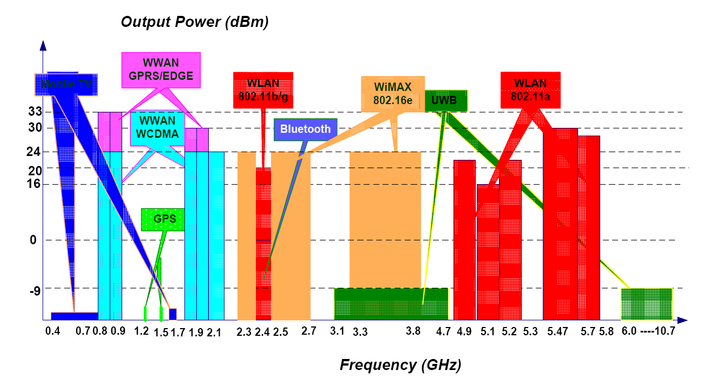
frequency bands (see Fig. <a title="Introduction" href="./uid3.html#uid4">1</a>).</p>
        <div align="center" style="margin-top:10px">
          <a name="uid4">
            <!--...-->
          </a>
          <table title="" class="objectContainer">
            <caption align="bottom"><strong>Figure
	1. </strong>The most recent standards for wireless communications are developed in the UHF and VHF bands. These bands are mostly saturated  <i>(source: WPAN/WLAN/WWAN Multi-Radio Coexistence, IEEE 802 Plenary, Atlanta, USA, Nov.2007)</i></caption>
            <tr align="center">
              <td>
                <table>
                  <tr>
                    <td style="height:3px;" align="center">
                      <img style="width:369.88582pt" alt="IMG/UHFbandsharing.png" src="IMG/UHFbandsharing.png"/>
                    </td>
                  </tr>
                </table>
              </td>
            </tr>
          </table>
        </div>
        <p>These two facts, obsolescence of current radio networking rules on one hand, and
saturation of the radio frequency band on the other hand, are the main
premises for the advent
of a new era of radio networking that will be characterized by
self-adaptive mechanisms. These mechanisms will rely on software radio
œtechnologies,
distributed algorithms, end-to-end dynamic routing protocols and
therefore require a cross-layer vision of “cognitive wireless
networking”: <i>Getting to the meet of Cognition and
Cooperation, beyond the inherent communication aspects: cognition is
more than cognitive radio and cooperation is not just
relaying. Cognition and cooperation have truly the potential to
break new ground for mobile communication systems and to offer new
business models.</i> <a href="./bibliography.html#socrate-2017-bid0">[63]</a></p>
        <p>From a social perspective, pervasive communications and ambient
networking are becoming part of more and more facets of our daily
life. Probably the most popular usage is mobile Internet access, which is
made possible by numerous access technologies, e.g. cellular mobile
networks, WiFi, Bluetooth, etc. The access technology itself is becoming <i>transparent for the end user</i>, who does not care about how to access
the network but is only interested in the services available and in
the quality of this service.</p>
        <p>Beyond simple Internet access, many other applications and services
are built on the basis of pervasive connectivity, for which the
communication is just a mean, and not a finality. Thus, the wireless
link is expected to even be <i>invisible to the end user</i> and
constitutes the first element of the Future Internet of Things
<a href="./bibliography.html#socrate-2017-bid1">[62]</a>, to develop a complete twin virtual world fully
connected to the real one.</p>
        <p>The way radio technologies have been developed until now is far from
offering a real wireless convergence <a href="./bibliography.html#socrate-2017-bid2">[54]</a>. The current
development of the wireless industry is surely slowed down by the lack
of radio resources and the lack of systems flexibility.</p>
        <p>One can get rid of this technological bottleneck by solving three
complementary problems: <i>terminal flexibility, agile
radio resource management</i> and <i>autonomous networking</i>. These
three objectives are subsumed by the concept of <i>Software Radio</i>,
a term coined by J. Mitola in his seminal work during the early 90's
<a href="./bibliography.html#socrate-2017-bid3">[59]</a>, <a href="./bibliography.html#socrate-2017-bid4">[60]</a>. While implementing everything in software
nodes is still an utopia, many architectures now hitting the market
include some degree of programmability; this is called
Software-Defined Radio. The word “defined” has been added to
distinguish from the ideal software radio. A software <i>defined</i>
radio is a software radio which is defined for a given frequency
range and a maximal bandwidth.</p>
        <p>In parallel, the development of new standards is threatened by the
radio spectrum scarcity. As illustrated in Fig. <a title="Introduction" href="./uid3.html#uid4">1</a>, the
increasing number of standards already causes partial saturation of
the UHF band, and will probably lead to its full saturation in the
long run. However, this saturation is only “virtual” because all equipments
are fortunately not emitting all the time <a href="./bibliography.html#socrate-2017-bid2">[54]</a>. A good
illustration is the so-called “white spaces”, i.e. frequency bands that
are liberated by analog television disappearing and can be re-used
for other purposes, different rules are set up in different countries.
In this example, a solution for increasing the real capacity of the
band originates from <i>self-adaptive behavior</i>. In this case,
flexible terminals will have to implement agile algorithms to share
the radio spectrum and to avoid interference. In this context,
cooperative approaches are even more promising than simple resource
sharing algorithms.</p>
        <p>With Software-Defined Radio technology, terminal flexibility is at
hand, many questions arise that are related to the software layer of a
software radio machine: how will this kind of platform be programmed?
How can we write programs that are portable from one terminal to
another? Autonomous networking will only be reached after a deep
understanding of network information theory. Thus, given that there will be
many ways for transmitting data from one point to another, what is
the most efficient way in terms of throughput? power consumption?
etc. Last but not least, agile Radio Resource sharing is addressed
by studying <span class="smallcap">mimo </span> and multi-standard radio front-end. This new technology is offering a wide range of research problems. These
three topics: software programming of a software radio machine,
distributed algorithms for radio resource management and
multi-standard radio front-end constitute the research directions of
Socrate.</p>
      </div>
      <!--FIN du corps du module-->
      <br/>
      <div class="bottomNavigation">
        <div class="tail_aucentre">
          <a href="./uid1.html" accesskey="P"><img style="align:bottom; border:none" alt="previous" src="../static/img/icons/previous_motif.jpg"/> Previous | </a>
          <a href="./uid0.html" accesskey="U"><img style="align:bottom; border:none" alt="up" src="../static/img/icons/up_motif.jpg"/>  Home</a>
          <a href="./uid5.html" accesskey="N"> | Next <img style="align:bottom; border:none" alt="next" src="../static/img/icons/next_motif.jpg"/></a>
        </div>
        <br/>
      </div>
    </div>
  </body>
</html>