<?xml version="1.0" encoding="utf-8"?>
<!DOCTYPE html PUBLIC "-//W3C//DTD XHTML 1.1 plus MathML 2.0 plus SVG 1.1//EN" "http://www.w3.org/2002/04/xhtml-math-svg/xhtml-math-svg.dtd">
<html xmlns="http://www.w3.org/1999/xhtml">
  <head>
    <meta http-equiv="Content-Type" content="application/xhtml+xml; charset=utf-8"/>
    <title>Project-Team:SOCRATE</title>
    <link rel="stylesheet" href="../static/css/raweb.css" type="text/css"/>
    <meta name="description" content="Overall Objectives - Technological State of the Art"/>
    <meta name="dc.title" content="Overall Objectives - Technological State of the Art"/>
    <meta name="dc.subject" content=""/>
    <meta name="dc.publisher" content="INRIA"/>
    <meta name="dc.date" content="(SCHEME=ISO8601) 2017-01"/>
    <meta name="dc.type" content="Report"/>
    <meta name="dc.language" content="(SCHEME=ISO639-1) en"/>
    <meta name="projet" content="SOCRATE"/>
    <script type="text/javascript" src="https://cdn.mathjax.org/mathjax/latest/MathJax.js?config=TeX-MML-AM_CHTML">
      <!--MathJax-->
    </script>
  </head>
  <body>
    <div class="tdmdiv">
      <div class="logo">
        <a href="http://www.inria.fr">
          <img style="align:bottom; border:none" src="../static/img/icons/logo_INRIA-coul.jpg" alt="Inria"/>
        </a>
      </div>
      <div class="TdmEntry">
        <div class="tdmentete">
          <a href="uid0.html">Project-Team Socrate</a>
        </div>
        <span>
          <a href="uid1.html">Personnel</a>
        </span>
      </div>
      <div class="TdmEntry">Overall Objectives<ul><li><a href="./uid3.html">Introduction</a></li><li class="tdmActPage"><a href="./uid5.html">Technological State of the Art</a></li><li><a href="./uid17.html">Scientific Challenges</a></li></ul></div>
      <div class="TdmEntry">Research Program<ul><li><a href="uid24.html&#10;&#9;&#9;  ">Research Axes</a></li><li><a href="uid26.html&#10;&#9;&#9;  ">Flexible Radio Front-End</a></li><li><a href="uid27.html&#10;&#9;&#9;  ">Multi-User Communications</a></li><li><a href="uid28.html&#10;&#9;&#9;  ">Software Radio Programming Model</a></li><li><a href="uid33.html&#10;&#9;&#9;  ">Inter-Axes Collaboration</a></li></ul></div>
      <div class="TdmEntry">
        <a href="./uid44.html">Highlights of the Year</a>
      </div>
      <div class="TdmEntry">New Software and Platforms<ul><li><a href="uid50.html&#10;&#9;&#9;  ">fftweb</a></li><li><a href="uid52.html&#10;&#9;&#9;  ">FloPoCo</a></li><li><a href="uid57.html&#10;&#9;&#9;  ">minus</a></li><li><a href="uid59.html&#10;&#9;&#9;  ">WiPlan</a></li><li><a href="uid61.html&#10;&#9;&#9;  ">Sytare</a></li><li><a href="uid66.html&#10;&#9;&#9;  ">Platform - FIT/CortexLab</a></li></ul></div>
      <div class="TdmEntry">New Results<ul><li><a href="uid70.html&#10;&#9;&#9;  ">Flexible Radio Front-End</a></li><li><a href="uid73.html&#10;&#9;&#9;  ">Multi-User Communications</a></li><li><a href="uid90.html&#10;&#9;&#9;  ">Software Radio Programming Model</a></li></ul></div>
      <div class="TdmEntry">Bilateral Contracts and Grants with Industry<ul><li><a href="uid96.html&#10;&#9;&#9;  ">Bilateral Grants with Industry</a></li></ul></div>
      <div class="TdmEntry">Partnerships and Cooperations<ul><li><a href="uid102.html&#10;&#9;&#9;  ">National Initiatives</a></li><li><a href="uid115.html&#10;&#9;&#9;  ">European Initiatives</a></li><li><a href="uid132.html&#10;&#9;&#9;  ">International Initiatives</a></li><li><a href="uid154.html&#10;&#9;&#9;  ">International Research Visitors</a></li></ul></div>
      <div class="TdmEntry">Dissemination<ul><li><a href="uid169.html&#10;&#9;&#9;  ">Promoting Scientific Activities</a></li><li><a href="uid203.html&#10;&#9;&#9;  ">Teaching - Supervision - Juries</a></li></ul></div>
      <div class="TdmEntry">
        <div>Bibliography</div>
      </div>
      <div class="TdmEntry">
        <ul>
          <li>
            <a id="tdmbibentyear" href="bibliography.html">Publications of the year</a>
          </li>
          <li>
            <a id="tdmbibentfoot" href="bibliography.html#References">References in notes</a>
          </li>
        </ul>
      </div>
    </div>
    <div id="main">
      <div class="mainentete">
        <div id="head_agauche">
          <small><a href="http://www.inria.fr">
	    
	    Inria
	  </a> | <a href="../index.html">
	    
	    Raweb 
	    2017</a> | <a href="http://www.inria.fr/en/teams/socrate">Presentation of the Project-Team SOCRATE</a> | <a href="https://team.inria.fr/socrate/">SOCRATE Web Site
	  </a></small>
        </div>
        <div id="head_adroite">
          <table class="qrcode">
            <tr>
              <td>
                <a href="socrate.xml">
                  <img style="align:bottom; border:none" alt="XML" src="../static/img/icons/xml_motif.png"/>
                </a>
              </td>
              <td>
                <a href="socrate.pdf">
                  <img style="align:bottom; border:none" alt="PDF" src="IMG/qrcode-socrate-pdf.png"/>
                </a>
              </td>
              <td>
                <a href="../socrate/socrate.epub">
                  <img style="align:bottom; border:none" alt="e-pub" src="IMG/qrcode-socrate-epub.png"/>
                </a>
              </td>
            </tr>
            <tr>
              <td/>
              <td>PDF
</td>
              <td>e-Pub
</td>
            </tr>
          </table>
        </div>
      </div>
      <!--FIN du corps du module-->
      <br/>
      <div class="bottomNavigation">
        <div class="tail_aucentre">
          <a href="./uid3.html" accesskey="P"><img style="align:bottom; border:none" alt="previous" src="../static/img/icons/previous_motif.jpg"/> Previous | </a>
          <a href="./uid0.html" accesskey="U"><img style="align:bottom; border:none" alt="up" src="../static/img/icons/up_motif.jpg"/>  Home</a>
          <a href="./uid17.html" accesskey="N"> | Next <img style="align:bottom; border:none" alt="next" src="../static/img/icons/next_motif.jpg"/></a>
        </div>
        <br/>
      </div>
      <div id="textepage">
        <!--DEBUT2 du corps du module-->
        <h2>Section: 
      Overall Objectives</h2>
        <h3 class="titre3">Technological State of the Art</h3>
        <p>A Software-Defined Radio (<span class="smallcap">sdr </span>) system is a radio communication system
in which computations that in the past were typically implemented in hardware
(e.g. mixers, filters, amplifiers, modulators/demodulators, detectors,
etc.) are instead implemented as software programs  <a href="./bibliography.html#socrate-2017-bid3">[59]</a>, <a href="./bibliography.html#socrate-2017-bid5">[55]</a>.</p>
        <a name="uid6"/>
        <h4 class="titre4">SDR Technology</h4>
        <div align="center" style="margin-top:10px">
          <a name="uid7">
            <!--...-->
          </a>
          <table title="" class="objectContainer">
            <caption align="bottom"><strong>Figure
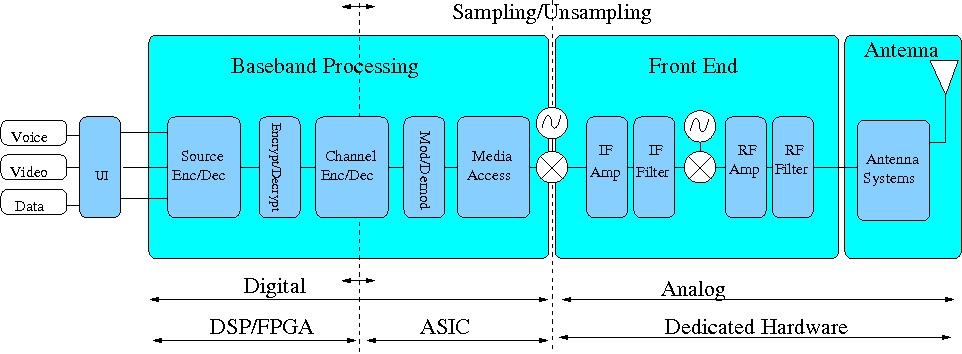
	2. </strong>Radio Block Diagram, highlighting separation between digital and analog parts, as well as programmable, configurable and fixed hardware parts.</caption>
            <tr align="center">
              <td>
                <table>
                  <tr>
                    <td style="height:3px;" align="center">
                      <img style="width:369.88582pt" alt="IMG/radioBlock.jpg" src="IMG/radioBlock.jpg"/>
                    </td>
                  </tr>
                </table>
              </td>
            </tr>
          </table>
        </div>
        <p>The different components of a radio system are illustrated in
Fig. <a title="Technological State of the Art" href="./uid5.html#uid7">2</a>. Of course, all of the digital components may not
be programmable, but the bigger the programmable part (<span class="smallcap">dsp </span>/<span class="smallcap">fpga </span>
part on Fig. <a title="Technological State of the Art" href="./uid5.html#uid7">2</a>), the more <i>software</i> the radio.
Dedicated <span class="smallcap">ip </span>s. In this context, <span class="smallcap">ip </span> stand for <i>Intellectual Properties, this term is widely used to designated dedicated
special-purpose circuit blocks implemented in various technologies: Asic,
</i><span class="smallcap">fpga </span><i>, </i><span class="smallcap">dsp </span><i>, etc.</i> are needed, for these <span class="smallcap">ip </span> it is more suitable
to use the term <i>configurable</i> than programmable. In a typical
<span class="smallcap">sdr </span>, the analog part is limited to a frequency translation
down to an intermediate band which is sampled and all the signal
processing is done digitally.</p>
        <a name="uid8"/>
        <h4 class="titre4">SDR Forum Classification</h4>
        <p>To encourage a common meaning for the term “<span class="smallcap">sdr </span>” the <span class="smallcap">sdr </span> Forum
(recently renamed <i>Wireless Innovation
Forum</i> (<a href="http://www.wirelessinnovation.org">http://www.wirelessinnovation.org</a>) proposes to distinguish five tiers:</p>
        <ul>
          <li>
            <p class="notaparagraph"><a name="uid9"> </a><i>Tier 0 – Hardware Radio:</i> The radio parameters cannot be
changed, radio is implemented only with hardware components.</p>
          </li>
          <li>
            <p class="notaparagraph"><a name="uid10"> </a><i>Tier 1 – Software Controlled Radio:</i> A radio where only
the control functions are implemented in software, baseband
processing is still performed in hardware, the radio is able to
switch between different hardware.</p>
          </li>
          <li>
            <p class="notaparagraph"><a name="uid11"> </a><i>Tier 2 – Software-Defined Radio:</i> The most popularly
understood definition of <span class="smallcap">sdr </span>: the radio includes software control
of modulation, bandwidth, frequency range and frequency bands.
Conversion to digital domain still occurs after frequency
conversion. It is currently implemented using a wide range of
technologies: Asics, <span class="smallcap">fpga </span>s, <span class="smallcap">dsp </span>s, etc.</p>
          </li>
          <li>
            <p class="notaparagraph"><a name="uid12"> </a><i>Tier 3 – Ideal Software Radio:</i> Digital conversion occurs directly at the antenna, programmability extends to the whole system.</p>
          </li>
          <li>
            <p class="notaparagraph"><a name="uid13"> </a><i>Tier 4 – Ultimate Software Radio:</i> Same reconfigurability capabilities as in Tier 3, but with a switching between two configurations in less than one millisecond.</p>
          </li>
        </ul>
        <p>The main restriction to build an ideal software radio is sampling
rate: sampling at a high rate is not an easy task. Following
the Shannon-Nyquist theorem, sampling the <span class="smallcap">rf </span> signal at a rate greater
than twice the frequency of the signal is sufficient to reconstruct
the signal. Sampling can be done at lower rate (decimation), but
errors can be introduced (aliasing) that can be corrected by filtering
(dirty radio concept). Building an <span class="smallcap">sdr </span> terminal implies a trade-of
between sampling frequency and terminal complexity. For instance,
sampling at 4.9 GHz would require a 12-bit resolution <span class="smallcap">adc </span> with
at least 10GHz sample rate which is today not available with
reasonable power consumption (several hundreds Watt).</p>
        <a name="uid14"/>
        <h4 class="titre4">Cognitive Radio</h4>
        <p><span class="smallcap">sdr </span> technology enables <i>over the air programming</i> (Otap) which
consists in describing methods for distributing new software updates
through the radio interface. However, as <span class="smallcap">sdr </span> architectures are heterogeneous, a standard distribution method has not emerged yet.</p>
        <p><i>Cognitive Radio</i> is a wireless communication system that can
sense the air, and decide to configure itself in a given mode,
following a local or distributed decision algorithm. Although Tier 3
<span class="smallcap">sdr </span> would be an ideal platform for cognitive radio implementation,
cognitive radios do not have to be <span class="smallcap">sdr </span>.</p>
        <p>Cognitive Radio is currently a very hot research topic as show the
dozens of sessions in research conferences dedicated to it. In 2009, the American National Science Foundation (<span class="smallcap">nsf </span>) held a workshop on “Future Directions in Cognitive Radio Network Research”  <a href="./bibliography.html#socrate-2017-bid6">[61]</a>. The purpose of the workshop was to explore how the transition from cognitive radios to cognitive radio <i>networks</i> can be made. The resulting report indicated the following: </p>
        <p class="notaparagraph"><ul><li><p class="notaparagraph"><a name="uid15"> </a>Emerging cognitive radio technology has been identified as a
high impact disruptive technology innovation, that could provide
solutions to the <i>radio traffic jam</i> problem and provide a path to
scaling wireless systems for the next 25 years.</p></li><li><p class="notaparagraph"><a name="uid16"> </a>Significant new
research is required to address the many technical challenges of
cognitive radio networking. These include dynamic spectrum
allocation methods, spectrum sensing, cooperative communications,
incentive mechanisms, cognitive network architecture and protocol
design, cognitive network security, cognitive system adaptation
algorithms and emergent system behavior.</p></li></ul>

 </p>
        <p class="notaparagraph">The report also mentioned the lack of cognitive radio testbeds and urged <i>“The development of a set of cognitive networking test-beds that can be
used to evaluate cognitive networks at various stages of their development”</i>, which, in some sense strengthens the creation of the Socrate team and its implication in the FIT project  <a href="./bibliography.html#socrate-2017-bid7">[56]</a>.</p>
      </div>
      <!--FIN du corps du module-->
      <br/>
      <div class="bottomNavigation">
        <div class="tail_aucentre">
          <a href="./uid3.html" accesskey="P"><img style="align:bottom; border:none" alt="previous" src="../static/img/icons/previous_motif.jpg"/> Previous | </a>
          <a href="./uid0.html" accesskey="U"><img style="align:bottom; border:none" alt="up" src="../static/img/icons/up_motif.jpg"/>  Home</a>
          <a href="./uid17.html" accesskey="N"> | Next <img style="align:bottom; border:none" alt="next" src="../static/img/icons/next_motif.jpg"/></a>
        </div>
        <br/>
      </div>
    </div>
  </body>
</html>