
2025Activity reportProject-TeamHEPHAISTOS
RNSR: 201421207V- Research center Inria Centre at Université Côte d'Azur
- Team name: HExapode, PHysiology, AssISTance and RobOtics
Creation of the Project-Team: 2015 July 01
Each year, Inria research teams publish an Activity Report presenting their work and results over the reporting period. These reports follow a common structure, with some optional sections depending on the specific team. They typically begin by outlining the overall objectives and research programme, including the main research themes, goals, and methodological approaches. They also describe the application domains targeted by the team, highlighting the scientific or societal contexts in which their work is situated.
The reports then present the highlights of the year, covering major scientific achievements, software developments, or teaching contributions. When relevant, they include sections on software, platforms, and open data, detailing the tools developed and how they are shared. A substantial part is dedicated to new results, where scientific contributions are described in detail, often with subsections specifying participants and associated keywords.
Finally, the Activity Report addresses funding, contracts, partnerships, and collaborations at various levels, from industrial agreements to international cooperations. It also covers dissemination and teaching activities, such as participation in scientific events, outreach, and supervision. The document concludes with a presentation of scientific production, including major publications and those produced during the year.
Keywords
Computer Science and Digital Science
- A5.1. Human-Computer Interaction
- A5.10. Robotics
- A5.11. Smart spaces
- A6. Modeling, simulation and control
- A6.1. Methods in mathematical modeling
- A6.2. Scientific computing, Numerical Analysis & Optimization
- A6.3. Computation-data interaction
- A6.4. Automatic control
- A6.5. Mathematical modeling for physical sciences
- A8.4. Computer Algebra
- A8.11. Game Theory
- A9.2. Machine learning
- A9.5. Robotics and AI
- A9.6. Decision support
- A9.7. AI algorithmics
- A9.9. Distributed AI, Multi-agent
- A9.10. Hybrid approaches for AI
Other Research Topics and Application Domains
- B1.1. Biology
- B2.1. Well being
- B2.5. Handicap and personal assistances
- B2.7. Medical devices
- B2.8. Sports, performance, motor skills
- B3.1. Sustainable development
- B3.5. Agronomy
- B4.5. Energy consumption
- B5.2. Design and manufacturing
- B5.6. Robotic systems
- B5.7. 3D printing
- B8.1. Smart building/home
- B8.4. Security and personal assistance
- B9.1. Education
- B9.2. Art
- B9.4. Sports
- B9.6.10. Digital humanities
- B9.9. Ethics
- B9.10. Privacy
1 Team members, visitors, external collaborators
Research Scientists
- Yves Papegay [Team leader, INRIA, Researcher, HDR]
- Jean-Pierre Merlet [INRIA, Emeritus, HDR]
- Odile Pourtallier [INRIA, Researcher]
- Eric Wajnberg [INRAE - convention with INRIA, Senior Researcher, HDR]
PhD Student
- Clara Thomas [INRIA]
Administrative Assistant
- Jane Desplanques [INRIA]
2 Overall objectives
HEPHAISTOS has been created as a team on January 1st, 2014 and as a project team in July 2015.
The goal of the project is to set up a generic methodology for the design and evaluation of an adaptable and interactive assistive ecosystem for the elderly and the vulnerable persons that provides furthermore assistance to the helpers, on-demand medical data and may manage emergency situations. More precisely our goals are to develop devices with the following properties:
- they can be adapted to the end-user and to its everyday environment;
- they should be affordable and minimally intrusive;
- they may be controlled through a large variety of simple interfaces;
- they may eventually be used to monitor the health status of the end-user in order to detect emerging pathology.
Assistance will be provided through a network of communicating devices that may be either specifically designed for this task or be just adaptation/instrumentation of daily life objects.
The targeted population is limited to frail people 1 and the assistive devices will have to support the individual autonomy (at home and outdoor) by providing complementary resources in relation with the existing capacities of the person. Personalization and adaptability are key factor of success and acceptance. Our long term goal will be to provide robotized devices for assistance, including smart objects, that may help disabled, elderly and handicapped people in their personal life.
Assistance is a very large field and a single project-team cannot address all the related issues. Hence HEPHAISTOS will focus on the following main societal challenges:
- mobility: previous interviews and observations in the HEPHAISTOS team have shown that this was a major concern for all the players in the ecosystem. Mobility is a key factor to improve personal autonomy and reinforce privacy, perceived autonomy and self-esteem.
- managing emergency situations: emergency situations (e.g. fall) may have dramatic consequences for elderly. Assistive devices should ideally be able to prevent such situation and at least should detect them with the purposes of sending an alarm and to minimize the effects on the health of the elderly.
- medical monitoring: elderly may have a fast changing trajectory of life and the medical community is lacking timely synthetic information on this evolution, while available technologies enable to get raw information in a non intrusive and low cost manner. We intend to provide synthetic health indicators, that take measurement uncertainties into account, obtained through a network of assistive devices. However respect of the privacy of life, protection of the elderly and ethical considerations 10 impose to ensure the confidentiality of the data and a strict control of such a service by the medical community.
- rehabilitation and biomechanics: our goals in rehabilitation are 1) to provide more objective and robust indicators, that take measurement uncertainties into account to assess the progress of a rehabilitation process and 2) to provide processes and devices (including the use of virtual reality) that facilitate a rehabilitation process and are more flexible and easier to use both for users and doctors. Biomechanics is an essential tool to evaluate the pertinence of these indicators, to gain access to physiological parameters that are difficult to measure directly and to prepare efficiently real-life experiments.
Addressing these societal focuses induces the following scientific objectives:
-
design and control of a network of connected assistive
devices: existing
assistance devices suffer from a lack of essential functions
(communication, monitoring, localization,...) and their acceptance and
efficiency may largely be improved. Furthermore essential functions
(such as fall detection, knowledge sharing, learning, adaptation to
the user and helpers) are missing. We intend to develop new
devices, either by adapting existing systems or developing brand-new
ones to cover these gaps. Their performances, robustness and
adaptability will be obtained through an original design
process, called appropriate design, that takes uncertainties
into account to determine almost all the nominal values of the
design parameters that guarantee to obtain the required
performances.
The development of these devices covers our robotics works
(therefore including robot analysis, kinematics, control, ...)
but is not limited to them. These devices will be present in the three
elements of the ecosystem (user, technological helps and
environment) and will be integrated in a common network.
The study of this robotic network and of its element is
therefore a major focus point of the HEPHAISTOS
project. In this field our
objectives are:
- to develop methods for the analysis of existing robots, taking into account uncertainties in their modeling that are inherent to such mechatronic devices;
- to propose innovative robotic systems.
- evaluation, modeling and programming of assistive ecosystem: design of such an ecosystem is an iterative process which relies on different types of evaluation. A large difference with other robotized environments is that effectiveness is not only based on technological performances but also on subjectively perceived dimensions such as acceptance or improvement of self-esteem. We will develop methodologies that cover both evaluation dimensions. Technological performances are still important and modeling (especially with symbolic computation) of the ecosystem will play a major role for the design process, the safety and the efficiency, which will be improved by a programming/communication framework that encompass all the assistance devices. Evaluation will be realized with the help of clinical partners in real-life or by using our experimental platforms.
- uncertainty management: uncertainties are especially present in all of our activities (sensor, control, physiological parameters, user behavior, ...). We intend to systematically take them into account especially using interval analysis, statistics, game theory or a mix of these tools.
- economy of assistance: interviews by the HEPHAISTOS team and market analysis have shown that cost is a major issue for the elderly and their family. At the opposite of other industrial sectors manufacturing costs play a very minor role when fixing the price of assistance devices: indeed prices result more from the relations between the players and from regulations. We intend to model these relations in order to analyze the influence of regulations on the final cost.
The societal challenges and the scientific objectives will be supported by experimentation and simulation using our development platforms or external resources.
In terms of methodologies, the project will focus on the use and mathematical developments of symbolic tools (for modeling, design, interval analysis), on interval analysis (for design, uncertainties management, evaluation), on game theory (for control, localization, economy of assistance) and on control theory. Implementation of the algorithms will be performed within the framework of general purpose software such as Scilab, Maple, Mathematica and the interval analysis part will be based on the existing library ALIAS, that is still being developed mostly for internal use.
Experimental work and the development of our own prototypes are strategic for the project as they allow us to validate our theoretical work and to discover new problems that will feed in the long term the theoretical analysis developed by the team members.
Dissemination is also an essential goal of our activity due to its background both on the assistance side and on the theoretical activities : our approaches are not sufficiently known in the medical, engineering and academic communities.
In summary, HEPHAISTOS has as major research axes assistance robotics, modeling, game theory, interval analysis, robotics and AI (see section 7.2). The coherence of these axes is that interval analysis is a major tool to manage the uncertainties that are inherent to a robotized device, while assistance robotics provides realistic problems which allow us to develop, test and improve our algorithms. Our overall objectives are presented in this document and in a specific page on assistance.
3 Research program
As seen in the overall objectives, managing uncertainties is a key point of our research. In the health domain, uncertainties are managed with statistics (which explains partly the presence of Eric Wajnberg in our team) but statistics just give trends while in some cases we will be more interested in the worst case scenario. Interval analysis is an approach that can be used in that case and we constantly improve the foundations of this method.
3.1 Interval analysis
We are interested in real-valued system solving (, ), in optimization problems, and in the proof of the existence of properties (for example, it exists such that or it exists two values , such that and ). There are few restrictions on the function as we are able to manage explicit functions using classical mathematical operators (e.g. ) as well as implicit functions (e.g. determining if there are parameter values of a parametrized matrix such that the determinant of the matrix is negative, without calculating the analytical form of the determinant).
Solutions are searched within a finite domain (called a box) which may be either continuous or mixed (i.e. for which some variables must belong to a continuous range while other variables may only have values within a discrete set). An important point is that we aim at finding all the solutions within the domain whenever the computer arithmetic will allow it: in other words we are looking for certified solutions. For example, for 0-dimensional system solving, we will provide a box that contains one, and only one, solution together with a numerical approximation of this solution. This solution may further be refined at will using multi-precision.
The core of our methods is the use of interval analysis that allows one to manipulate mathematical expressions whose unknowns have interval values. A basic component of interval analysis is the interval evaluation of an expression. Given an analytical expression in the unknowns and ranges for these unknowns, we are able to compute a range , called the interval evaluation, such that
In other words the interval evaluation provides a lower bound of the minimum of and an upper bound of its maximum over the box.
For example if and , then , meaning that for any in [0.5,1.6] we guarantee that .
The interval evaluation of an expression has interesting properties:
- it can be implemented in such a way that the results are guaranteed with respect to round-off errors i.e. property 1 is still valid in spite of numerical errors induced by the use of floating point numbers;
- if or , then no values of the unknowns in their respective ranges can cancel ;
- if (), then is positive (negative) for any value of the unknowns in their respective ranges.
A major drawback of the interval evaluation is that may be overestimated, i.e. values of such that may not exist. This overestimation occurs because in our calculation each occurrence of a variable is considered as an independent variable. Hence if a variable has multiple occurrences, then an overestimation may occur. Such phenomena can be observed in the previous example, where while the real maximum of is approximately 0.9144. The value of is obtained because we are using in our calculation the formula with having the same interval value as .
Fortunately there are methods that allow one to reduce the overestimation and the overestimation amount decreases with the width of the ranges. The latter remark leads to the use of a branch-and-bound strategy in which for a given box a variable range will be bisected, thereby creating two new boxes that are stored in a list and processed later on. The algorithm is complete if all boxes in the list have been processed, or if during the process a box generates an answer to the problem at hand (e.g. if we want to prove that , then the algorithm stops as soon as for a certain box ).
A generic interval analysis algorithm involves the following steps on the current box 13, 4:
- exclusion operators: these operators determine that there is no solution to the problem within a given box. An important issue here is the extensive and smart use of the monotonicity of the functions.
- filters: these operators may reduce the size of the box, i.e. decrease the width of the allowed ranges for the variables.
- existence operators: they allow one to determine the existence of a unique solution within a given box and are usually associated with a numerical scheme that allows for the computation of this solution in a safe way.
- bisection: choose one of the variable and bisect its range for creating two new boxes.
- storage: store the new boxes in the list.
The scope of the HEPHAISTOS project is to address all these steps in order to find the most efficient procedures. Our efforts focus on mathematical developments (adapting classical theorems to interval analysis, proving interval analysis theorems), the use of symbolic computation and formal proofs (a symbolic pre-processing allows one to automatically adapt the solver to the structure of the problem), software implementation and experimental tests (for validation purposes).
Important note: We have insisted on interval analysis because this is a major component or our robotics activity. Our theoretical work in robotics is an analysis of the robotic environment in order to exhibit proofs on the behavior of the system that may be qualitative (e.g. the proof that a cable-driven parallel robot with more than 6 non-deformable cables will have at most 6 cables under tension simultaneously) or quantitative. In the quantitative case as we are dealing with realistic and not toy examples (including our own prototypes that are developed whenever no equivalent hardware is available or to verify our assumptions), we have to manage problems that are so complex that analytical solutions are probably out of reach (e.g. the direct kinematics of parallel robots), and we have to resort to algorithms and numerical analysis. We are aware of different approaches in numerical analysis (e.g. some team members were previously involved in teams devoted to computational geometry and algebraic geometry) but interval analysis provides us another approach with high flexibility, the possibility of managing non algebraic problems (e.g. the kinematics of cable-driven parallel robots with sagging cables, that involves inverse hyperbolic functions) and to address various types of issues (system solving, optimization, proof of existence ...). However, whenever needed, we will rely as well on statistics, continuation, algebraic geometry, and since a couple of years on AI.
3.2 Robotics
HEPHAISTOS, as a follow-up of COPRIN, has a long-standing tradition of robotics studies, especially for closed-loop robots 7, especially cable-driven parallel robots. We address theoretical issues with the purpose of obtaining analytical and theoretical solutions, but in many cases only numerical solutions can be obtained due to the complexity of the problem. This approach has motivated the use of interval analysis for two reasons:
- the versatility of interval analysis allows us to address issues (e.g. singularity analysis) that cannot be tackled by any other method due to the size of the problem;
- uncertainties (which are inherent to a robotic device) have to be taken into account so that the real robot is guaranteed to have the same properties as the theoretical one, even in the worst case. This is a crucial issue for many applications in robotics (e.g. medical or assistance robot).
Our field of study in robotics focuses on kinematic issues such as workspace and singularity analysis, positioning accuracy, trajectory planning, reliability, calibration, modularity management and, prominently, appropriate design, i.e. determining the dimensioning of a robot mechanical architecture that guarantees that the real robot satisfies a given set of requirements. The methods that we develop can be used for other robotic problems, see for example the management of uncertainties in aircraft design 11.
Our theoretical work must be validated through experiments that are essential for the sake of credibility and, a contrario, experiments will feed our theoretical work. Hence HEPHAISTOS works with partners on the development of real robots but also develops its own prototypes. In the last years, we have developed a large number of prototypes and we have extended our development to devices that are not strictly robots but are part of an overall environment for assistance. We benefit here from the development of new miniature, low energy computers with an interface for analog and logical sensors such as the Arduino or the Phidgets. The web page presents all of our prototypes and experimental work. Note that this familiarity with hardware is also used from time to time to develop devices for others INRIA projects and, during the Covid crisis, our building was instrumented for accurately monitoring CO and CO2 level well before it became the norm.
4 Application domains
While the methods developed in the project can be used for a very broad set of application domains (for example we have an activity in CO2 emission allowances and biology), it is clear that the size of the project does not allow us to address all of them. Hence we have decided to focus our applicative activities on mechanism theory, where we focus on modeling, optimal design and analysis of mechanisms. Along the same line, our focus is robotics and especially service robotics which includes rescue robotics, rehabilitation and assistive robots for elderly and handicapped people. Although these topics were new for us when initiating the project, we have spent two years determining priorities and guidelines by conducting about 200 interviews with field experts (end-users, doctors, family and caregivers, institutes), establishing strong collaboration with them (e.g. with the CHU of Nice) and putting together an appropriate experimental setup for testing our solutions.
It must be reminded that we are able to manage a large variety of problems in totally different domains only because interval analysis, game theory and symbolic tools provides us with the methodological tools that allow us to address completely a given problem from the formulation and analysis up to the very final step of providing numerical solutions. Hence although we mainly focus on medical and assistance robotics we address also a large number of applications: agriculture, biology, arts, system design to name a few.
5 Social and environmental responsibility
5.1 Footprint of research activities
Clearly our activities have a negative impact on the environment (travels, hardware orders, ...). Although Sophia-Antipolis is not the best place regarding national travels, we have decreased our national and international travel activities while having reduced our global impact at work in different manners (lighting, work mobility, ...). Still we must emphasize that all aspects of our impact have to be taken into account before coercive measures are taken. For example, when we travel to a retirement house to install assistive devices, the footprint impact has to be balanced with our social impact and finding the right compromise is not an easy task and the choice is not the responsibility of the team alone. Furthermore human relationships are essential for initiating new research areas and for the time being virtual collaborations and conferences are not very effective for that purpose.
5.2 Impact of research results
Our works on assistance clearly may have a social impact and we are deeply aware of our ethical responsibilities as illustrated by the activity of the team in ethical committees, our collaboration with the academic law community and our large dissemination effort toward the general audience.
Regarding environmental responsibility, energy has been since the very beginning of our project an important topic in our research. Indeed our assistance/health monitoring devices require additional energy source and elderly people may have some difficulties to deal with battery charging. Consequently, since the beginning of the project, we have focused on low consumption electronic components and most our devices use mechanical energy converter or solar panel to produce most of the energy they need. However the intended benefits of these devices on health, self-esteem and dignity (all issues that are difficult to measure/compare in pure financial terms or with respect to environmental impacts in all their dimensions) have to be taken into account.
6 Highlights of the year
6.1 Scientific highlights
In 2025, most of the research activities started earlier have been developed in:
- green robotics;
- hybrid solver of parametric non linear square system of equations mixing neural networks and numerical iterative schemes;
- use of artificial intelligence for kinematics modeling of soft robots;
- use of networks of conversational agents for planification and control of robots tasks.
However, the relatively short remaining lifetime of the project – expected to end by late 2026 – together with a shift in focus by one of its members, prevented us from establishing the necessary collaborations, including those initiated with the Nice University Hospital (CHU de Nice), and led us to suspend our activities related to human activity analysis and recognition.
But, based on the work of our PhD student, the development of a new assistive mobility robot with a multi-room workspace has been started. The room has been designed and build, while installation of robotics components is on the way.
And, the long-standing collaboration with the artist Anne-Valérie Gasc resumed this year with the initiation of her new research-creation project, which aims to rethink architectural design through the emergence of neighborhood and proximity-based behaviors.
7 New results
7.1 Hybrid AI methods
7.1.1 Parametric equations solver with AI
Participants: Jean-Pierre Merlet.
These last 3 years we have worked on a generic solver for finding the real root(s) of parametric non linear square system of equations i.e. systems which have as many unknowns as equations but with equation coefficients that are functions of a parameters set whose elements are assumed to be bounded. Such a system has usually several solutions and their number depends on the parameters values and cannot be determined in advance. Our aim is to obtain a solver that provides exact solutions (i.e. as close as needed). We also aim at getting all solutions for any : we cannot guarantee this point for our solver but it has a self-learning capacity that allows to reduce the number of missed solutions.
Beside the equations there is a single entry point for building our solver: we assume that we have been able to determine an initial solution set i.e. the solutions (not necessarily all of them) for a small set of of specific systems (typically this set has 8 samples of ). Using continuation and singularity checking, we can split the initial solution set into different components. For each of these components, we may create arbitrary large learning sets, i.e. set of samples () where is a solution of the system for . We then use these learning sets to create Multi-Layer Perceptrons (MLP) but we use a specific training strategy based on the concept of success rate: the success rate is the percentage of samples whose solutions are obtained by using the prediction of the MLP as a guess for a deterministic method (typically the Newton method). The training strategy mixes the decrease of a loss function but the trained MLP will be the one that has the lowest loss but also the largest success rate. If this success rate is 100, then the MLP hybridized with the Newton method will find the solution for all sample of the learning set. If the success rate is not 100, we use the missed solutions to create a specific learning set for a new MLP. The training stops when all solutions of all learning sets are found when submitted to the created MLPs. Hence the solving process consists in submitting an input to all the hybridized MLPs (but the Newton method is run only if the MLP predictions has some sense). This solver may be improved by creating verification sets,where the are different solutions of the system for . They are derived from the initial solution set in such a way that the are different from the one in the learning sets. If solution(s) are missed by the solver they are used to create new hybridized MLPs that are added to the solver.
Although creating the solver may require several hours, the computation time for getting the solutions for a given is very low, typically a few ms (furthermore parallel computing allows for a drastic decrease for both training the solver and for getting the solutions). Hence the solver should be used when it is expected to solve the system for a large number of .
This solver has initially been developed for solving the direct kinematics of cable-driven parallel robot with sagging cables. Alternative solving methods, such as interval analysis or continuation, require several hours so that with a training time of about 60 hours the proposed solver is more efficient as soon as more than 20 occurrences of the problem are considered. The solver has also been tested on difficult problems from the ALIAS benchmark such as the Brent reactor problem with similar success.
We have succeeded in extending the principle of the proposed solver to deal with ODE (that appear, for example, in the kinematics of robot with flexible limbs, see section 7.2.1). We have also shown that the solver may be used for non-square system with equations and unknowns leading to an infinite number of solutions as soon as optimizing some criterion should lead to a unique solution. Indeed we may develop a gradient-descent method that consider all combinations of unknowns and set a fixed values for them. In that case, the solver is able to provide all possible values for the remaining unknowns so that the optimizer is able to determine the best descent direction. We have tested this approach on the inverse kinematics of cable-driven parallel robot with more than sagging cables. In that case, we have equations for unknowns so that the system is under-constrained as soon as . The proposed approach leads to a criteria value which differs by at most 2% from the optimum value with a computation time which is at least 10 times lower than any other optimizer. This year we have tested this approach on a calibration problem. The cables in a cable-driven parallel robot are submitted to wear that leads to a decrease of their Young modulus and it is interesting to get an estimation of the modulus first for preventive maintenance but also for improving the positioning accuracy of the platform.
Being given a platform pose and its corresponding cable lengths at rest, these decreases lead to a modification of the effective pose that is reached by the platform. We assume that the effective platform pose can be measured at least at some calibration poses where the platform is basically supported by 2 or 3 cables, called supportive cables, whose tensions is much higher than the one of the remaining cables (the measurement assumption is valid for our prototypes that are equipped with lidars on the platform). The calibration poses are chosen in such a way that all cables are supportive in at least one of these poses. We then define a cost function as with the purpose of finding the Young modulus of each cable that minimize the cost function. Using classical optimizers and taking into account that there may be uncertainties on the pose measurements and on the cable lengths, we have been able to get reasonable estimation as soon as the decrease for at least one of the was about 10-15% compared to the when the cable is new, but the process is computationally intensive (several hours). Including the direct kineematics neural network solver in the optimization process allows one to get an almost real-time estimation of the as soon as the decrease is about 20-30% so that the estimation may be used immediately to improve the positioning accuracy of the robot 18.
Our objective now is to develop a generic framework for obtaining a solver for arbitrary square system of equations with minimal manual intervention of the end-user.
7.2 Robotics
Participants: Jean-Pierre Merlet [correspondant], Yves Papegay, Clara Thomas.
7.2.1 Kinematics of soft robots and AI
Participants: Jean-Pierre Merlet.
There is a growing academic interest in soft robots for which the links are made of flexible material, many of which have a closed-loop structure (typically like parallel robots). A community (that includes the INRIA DEFROST project-team in Lille 20) is working on soft robots, having benefited from 3D printing to create numerous prototypes, and focuses on the complex modeling of such a system. From a kinematic viewpoint, the main topic is inverse kinematic solution (finding the actuators positions to have the end-effector of the robot in a given pose). Yet, complex issues computing the robot workspace, finding all solutions of the direct kinematics or solving design problem (e.g. determining the geometry(ies) of the robot so that all poses in a given workspace are reachable) are rarely addressed excepted for planar robots. Basically flexible beams are modeled through an ODE but, as an analytic form for its solution is usually not known, a discrete approximation is used for numerical treatment and consequently the solver proposed in section 7.1.1 may be used. An invitation from O. Petuya and M. Urizar Arana at Bilbao University has allowed us to get familiar with the problem of dealing with a flexible 6 degrees of freedom parallel robot with 6 flexible links with an extremity that is fixed on an actuated revolute joint. Each beam is decomposed into 10 elements and that lead to a relatively large system of equations. However, with about 300 hybridized MLPs, we have been able to find all solutions on verification sets with a total of 3000 direct kinematics solutions (for the specific robot we are considering, the direct kinematics may have from 5 to 14 solutions). Regarding the computation time, the sequential version of the solver requires about 30 seconds to provide the direct kinematics solutions. However, a distributed implementation on IA processors with multiple GPU will drastically reduce this time. Our collaborator of University of Bilbao have implemented a direct kinematics solver based on an optimization process but the neural network solver is about 10 times faster and in some cases provides direct kinnematics solutions that have not been found by the Bilbao solver.
Our objective now is to work on a generic framework with a distributed implementation that will be used both for the training of the MLP and for the solver.
7.2.2 Green robotics
Participants: Jean-Pierre Merlet, Yves Papegay, Clara Thomas [correspondant].
About 48% of the 4 000 000 existing robots are performing manutention operations and about half of them are performing repetitive pick-and-place operations, where an object has to be moved from A to B. This motion usually involves only 3 translational degrees of freedom and possibly a rotation around the vertical axis. The total energy consumption of the existing robots was evaluated to be 6 705 GWh in 2022, which is roughly 0.013% of the world energy consumption of industry. It may be conservatively estimated that pick-and-place robots involves about 1500 GWh. Although robotics is not a major player regarding energy consumption, it is still interesting to design robots which use less energy and resources.
Several types of mechanical architecture are used for pick-and-place operation: serial, cartesian and Scara types. These architectures are not energy efficient as they impose to actuate several heavy mechanical elements beside the load (e.g the serial type require energy just to stay in its pose). Furthermore, these robots are controlled with a rather powerful computer as they may be used for other purposes and these systems use a lot of mechanical and electronic resources while being not very flexible and difficult to maintain. All in all, this leads to a relatively large energy consumption and an extensive use of resources for such a simple task. Our objective is to propose a specific robot for pick-and-place operations with a much lower energy consumption, less resources, being simple to maintain and offering a larger flexibility than the currently used robots.
The first step of our proposal is to adopt a different mechanical architecture based on cable-driven parallel robots where the robot's end-effector is connected to the ground by cables whose lengths is controlled. They have multiple advantages:
- they involve only a very limited mobile mass as beside the load only the cables are moving
- they are highly flexible: just by moving the winches, it is possible to cover any kind of workspace even a very large one (the FAST telescope covers a circular area of 500 m of diameter)
- their lifting capacity may be very high (our Marionet-crane has a lifting capacity of 2.5 tons)
- they are easy to maintain either by just changing the cables or the winches that are fairly standard
- the energy efficiency or parallel robots is, in general, 25% higher than any other robot structure
Cable-driven parallel robots (CDPR) may be designed for various degrees of freedom but the simpler one, called the -1 CDPR, has cables attached at the same point on the platform. This CDPR offers either planar motion with the 2-1 ( motion) or spatial motion with the 3-1 and 4-1 (the difference being a larger workspace for the 4-1). The platform may include an independent rotation motion if necessary. Our approach excludes very fast pick-and-place operation that are usually performed with parallel robot of the Delta type: CDPR may also be fast but we are more interested in pick-and-place operation over a large workspace and possibly for heavy load (typically classical pick-and-place robots are designed for a load of 1 kg).

The image shows an indoor setup with two tripods positioned in front of a gray background. Each tripod holds a spool of red thread. The threads are tensioned and connected together to a black part to mimick a pick and place operation.
A 2-1 CDPR for a pick-and-place trajectory of 80 cm
To check the energy efficiency of a CDPR, we have considered a 2-1 CDPR (see Figure 1) and we have defined a classical pick-and-place trajectory (a vertical upward motion from to , an horizontal motion toward a position at the vertical from B and a vertical downward motion toward B). In parallel we have collected a database of energy consumption for pick-and-place robots and its partition between the robot and the control cabinet, the later one representing in general around 40% of the total energy consumption. Note that most of these robots have usually a relatively small workspace (the distance between and being less than one meter). Last year, we have exhibited a theoretical model of energy consumption for the 2-1, 3-1 and 4-1 CDPR. This model has been experimentally validated for the 2-1 CDPR, showing that the robot's energy consumption was about 500 times lower than classical robots for the same payload.
Regarding energy consumption, we have still used a computer to control our CDPR although a low power computer may be used (a Raspberry Pi is largely sufficient). Regarding electronic resources, we were using Phidgets boards (one for controlling the velocities of the two motors and one for getting the values of the motor's encoders). For grasping the object at the pick place, we have on the platform a battery and a radio receiver with a relay that switches on an on-board electric magnet: this relay is activated by the computer which has a radio emitter. Our objective this year was to get rid of the computer and of most of the electronic resources.
For that purpose we have calculated the cable velocities as function of time to execute the pick-and-place trajectory at a given speed between and . We have then designed and 3D-printed a cylindrical rotating drum, called the control drum (displayed in Figure 2), with two tracks (one for each motor) that are followed by resistive sliders.

The image shows a mechanical device on a table. Attached to a metallic frame is a red circular drum connected to two large gears connected by a belt to a motor. Several sensors acts on an engravure of the red drum.
The control drum with its two tracks and sliders
The sliders motions reflect exactly the function to get from to and then from to to perform a full cycle so that we get from the sliders two control tensions that are sent to a motor controller board. Being given the clearance of the sliders, the platform motion is approximate and the positioning accuracy degrades when multiple cycles are performed. Hence we must design a system to ensure that the motion to and is accurate. For that purpose, we use 4 switches on the robot drums that is moving when the cable lengths are changed. Two of them for cable are used to detect that the -th cable length corresponds to the one for having the platform close to and the other two, play the same role for and . Hence we have the following triplets (platform pose, switch activated on cable 1, switch activated on cable 2): , , , (). Starting from , we bypass the tensions provided by the sliders and send to the motor controller two constant tensions that allow to get an approximate vertical motion of the platform: 0 to motor as soon as switch is activated. When both switch are active (the platform is at ), we switch back to the slider tensions. As soon as is activated, we stop motor and when both are active (the platform is at ) we bypass the slider tensions and send a constant tension to each motors that are stopped whenever or are active so that the platform stops at . This process is reverted to move from to .
In term of energy consumption, the system uses only energy to move the load along the trajectory and to rotate continuously the control drum and needs only the motor controller board as electronic resource. It is still programmable: the trajectory speed may be adjusted by changing the rotation speed of the control drum and executing a new trajectory require only printing a new control drum (we have designed a software that takes as input the trajectory and generates printing data). The system is also easy to maintain and repair with only 3 motors, one electronic board and a few mechanical elements (the cables and the reduction gears for the motors). It can also accommodate large loads by changing the power of the two motors actuating the cable drums.
The system has been tested for two trajectories respectively with a length of 80 cm and 400 cm (the later being difficult to perform with classical robots) and a load of 1 kg: the energy consumption is 100 lower than the one of the best classical robot. The main issue of the 2-1 is oscillation of the load, which is however small at the pick and place pose. A simple way to reduce this oscillation is to have 2 cables on each motor drum that act as a parallelogram with a drastic reduction of the oscillation. For next year, we plan to test a 3-1 CDPR that has a spatial workspace allowing to avoid obstacles between and .
Note that we may also consider the case where the sliders of the control drum may directly actuate the winches. This system will use single motor and no electronic board while a simple computer is used to design the control drum: we will be back to a mechanically programmable robot !
7.2.3 Multi-room assistive mobility robot
Participants: Jean-Pierre Merlet, Yves Papegay, Clara Thomas [correspondant].
The project-team has a long experience on using cable-driven parallel robots (CDPR) for assisting mobility of frail people. We have already shown, both theoretically and experimentally, that this type of robot has several advantages for this purpose: modularity (adapting the robot geometry to manage both the end-user and its environment), large lifting capacity, low intrusivity and cost. Such a robot is in concurrence with other assistive robots, such as a Cartesian robot with rails on the ceiling (very intrusive and high cost) or mobile robots (very intrusive, low energy autonomy, limited mobility and not appropriate for moving the subject in small rooms like in toilets or bathrooms). But a common drawback of the CDPR or Cartesian robots is that they are limited to be used in a single room and it is not reasonable to have one such robot in every room (with the problem for the end-user to use these robots in sequence for example when the subject is in a harness).
Hence one of our objective for the coming years is to develop a 4-1 CDPR (which allows the end-user to move in any part of a rectangular room) whose geometry (i.e. the location of the pulling points of the cables) may be changed on the fly to realize a strategy allowing the end-user to move from one room to another one, the rooms being joined by a corridor.
Changing a CDPR geometry -
There are two options to change the geometry of a CDPR: moving the winches or using pulleys to redirect the cables toward their pulling points. For moving a winch, we may have it on a wheeled mobile platform (supported by 2 parallel rails) that has its own battery and will stop at specific places where electrical contacts allows one to supply power for the winch (see Figure 3). For changing the direction of the mobile platform (e.g. at a corner), we use swing bridges with a linear actuator to control the platform rotation.


The image shows a mechanical system as a whole and a close-up. It consist of a moving platform based on wheels on a double rail that is able to turn to ensure connection between two perpendicular linear segments.
The image shows a mechanical system as a whole and a close-up. It consist of a moving platform based on wheels on a double rail that is able to turn to ensure connection between two perpendicular linear segments.
A winch on its mobile platform and the rail system with a swing bridge
In the pulleys version, the 4 winches are fixed on the ground and the cable follows a circuit determined by the position of the pulleys which are either in a fixed position (e.g. to round a corner) or are mobile (for the pulley leading to the outpoint point of the cable). To avoid intrusivity, the cables follow the walls until they reach an output point. Note that for both versions, a cable output point may be moved only if the cable tension is very low.
Strategy for reconfiguring the CDPR -
As mentioned previously, we may move a cable output point only if the corresponding cable is not under tension. Let us consider the projection of the center of mass of the platform on the ground and the same projection for the output point . It may be shown that if lies inside a triangle , then the load can be equilibrated by tension in the cable , the remaining cable being slack. If lies on the segment between , then the load will be supported by cables . A consequence is that, for any end-user pose, we will have at least one cable that will be slack and thus its output point may be moved.
This will play a major role in our strategy. We assume that initially the end-user is in room 1 and has to go through a corridor to move in room 2. It may be asked to move to a specific place (but always moving toward room 2). As for the output points they are initially placed in such a way that the end-user may move freely in room 1 and, at the end of the reconfiguration, they will be in a position in such a way that the end-user may move freely in room 2. Also we do not allow backward motion for them so that the Manhattan distance to their is always decreasing. The strategy is then to combine end-user motion and changes in the output points so that the end-user is always supported by only two cables (in the final phase the end-user may be supported by three cables), thereby allowing to change simultaneously the position of two output points.
To plan the motion of the end-user, we have to take into account that the cables should not hit any corner of the rooms and corridor. We have developed an efficient algorithm that takes as input the current position of the the output points of all cables and determine the region(s) in which this constraint is satisfied while the CDPR is able to support the weight of the end-user.
We have then shown that, if we have rectangular rooms and corridor, there always exist strategies to move the end-user from one room to the other one. We are now working on finding optimal solutions that minimize the energy consumption and, possibly more important, the time required for the reconfiguration i.e the time before the end-user will be free to move in any place in room 2.
We have also modified our experimental flat to create two rooms and have installed a pulleys system that will allow to follow a reconfiguration strategy. A 4-1 CDPR support an instrumented platform that can freely rotate around its normal. This platform will be able to indicate in which direction the end-user is willing to move while the tilt of the platform will be used to control the CDPR velocity. We are currently developing the software for using this platform.
7.2.4 Networks of conversational agents and robots
Participants: Yves Papegay.
The use of Large Language Models (LLMs) in robotics is an emerging trend. These new natural language processing capabilities aim to improve the induction of high-level robot behavior. The proposed approach relies on conversational agents organized in graphs, a powerful, modular, and flexible method that leverages LLMs to interpret and contextualize commands while integrating classical components for motion planning, dynamic environment control, or object manipulation. The first challenge is to reliably transform descriptions of the environment, instructions, or constraints expressed in natural language into a functional decomposition of robotic tasks. This requires combining the contextualization provided by LLM embedding mechanisms with access to factual information about the environment, whether dynamic (from sensors) or static. A second challenge lies in the increasing complexity of agent organization, which grows with the complexity of the tasks to be managed. This organization must dynamically adapt to changes in the robots behavior or capabilities while ensuring the correct execution of tasks. With specialized agents possessing domain expertise, these technologies promise to enhance robots' ability to adapt to complex situations and provide robust solutions to the application problems encountered.
This new exploration work started last year in collaboration with David Daney (Auctus team, centre Inria de l'Université de Bordeaux). It was supposed to take place and to be supported by a robotics PEPR proposition that has been delayed for one year.
7.3 Biology activities
Participants: Eric Wajnberg.
Several activities conducted in the previous years and described in the previous activities reports have been published in journals this year (14, 15 and 16). A book on life history evolution traits, interactions, and applications has also been released this year 19.
7.3.1 Monte-Carlo simulation models
Work with a research team at INRAE - Sophia Antipolis -
A modeling framework was developed with Elodie Vercken (INRAE of Sophia Antipolis). The goal is to understand the ecological framework driving the process of species (both animal or vegetal) invading new habitats. Invasive species can be an unintentional process when a new species reaches a new habitat, or an intentional event when a new species is released, for example to control a pest damaging crops. There is an advanced theoretical framework that has been developed over the last century to understand species invasion processes, but most, if not all, of this theoretical framework was based on individuals movement (or their progeny) in 1D spaces. We thus decided to developed a model on 2D spaces with different levels of spatial heterogeneity (e.g., in the amount of resources available). For this, we used a Monte Carlo simulation framework, and the code was distributed on an international computer grid to save computation times. We obtained interesting and innovative results, and we are currently writing the manuscript that will be submitted to a high-level international journal in the field of ecology.
Work with a research team at the University of Rennes -
Plants are producing chemical compounds to defend themselves from herbivorous attacks. These compounds can be constitutive (they are always produced by the plants), or induced (they are produced when there is an attack by a herbivore). Producing such compounds entails costs (e.g., physiological, metabolic, etc.) for the plant, and there is thus a benefit-cost ratio issue to be solved. Indeed, producing too many compounds (or with a too high concentration) will efficiently protect the plant, but the cost to produce them would be too high, eventually leading the plant to die (or to drastically reduce the number of seeds produced). Reciprocally, producing not enough compounds (or at a too low concentration) might lead the plant to be killed by herbivores. With Prof. Jean-Sebastian Pierre (University of Rennes), we developed an optimality probabilistic model to identify both the number and concentration of both constitutive and induced chemical protection compounds. We used a linear programing framework, and the code has been developed in R. We obtained interesting results, and we are currently framing the manuscript.
Optimizing pollinator activity in avocado orchards: A collaborative work with Israel and Brazil -
A cooperative work was developed with Israeli colleagues from the University of Jerusalem, Israel (with Prof. Yael Mandelik) with the goal of optimizing the pollinating activity of bees (and thus fruit production) in avocado orchards. Currently, beehives are placed in the center of each orchard, hoping that the bees presence will improve fruit production. In this respect, an empirical approach proposes to plant wild flowers on the ground to retain the bees in the orchard, but these flowers are competing with avocado flowers, and there is a need to develop a theoretical framework to find the optimal practice maximizing fruit production. With colleagues from the University of São Carlos (state of São Paulo, Brazil), we thus developed a detailed Monte Carlo simulation, modeling the foraging behavior of bees in avocado orchards with different types of flowers on the ground. This work is actually based on the supervision of two PhD students, one in Israel, performing the empirical work in avocado orchards, and one in Brazil, developing the code and the simulation framework. Again, computation times are important, and the code has been distributed on an international computer grid. The first results are just arriving, and they look sufficiently interesting to be published. This publishing work will be developed in 2026.
7.4 Robotic Systems, Symbolic Modeling and Simulation for artistic creation
Participants: Yves Papegay.
Since 2018, Hephaistos has been involved in the artistic projects of Anne-Valérie Gasc, Larmes du Prince (website), Fabrique d'un Épuisement (website) and Machines Aveugles (website), through the design, development, and deployment of robotic systems. This year, we have joined her new research-creation project, whose central theme is to rethink architectural design from the emergence of neighborhood and proximity-based behaviors. This project brings together the experimental field of art and that of computation around the mathematical conceptualization and the computational translation of the notion of neighborhood, considered as a lever for questioning and testing an architecture without predefined structure. In other words, it explores an inductive rather than constructive approach to architecture, where inhabitable spatialities emerge locally from pre-existing proximity behaviors. This collaboration address both the modeling and analysis of neighborhood dynamics based on cellular automata, and the design, development, and implementation of robotic systems that will actively participate in the artistic productions. The theoretical and practical foundations of the project, situated at the intersection of artistic experimentation and mathematical abstraction have been established and published in 17.
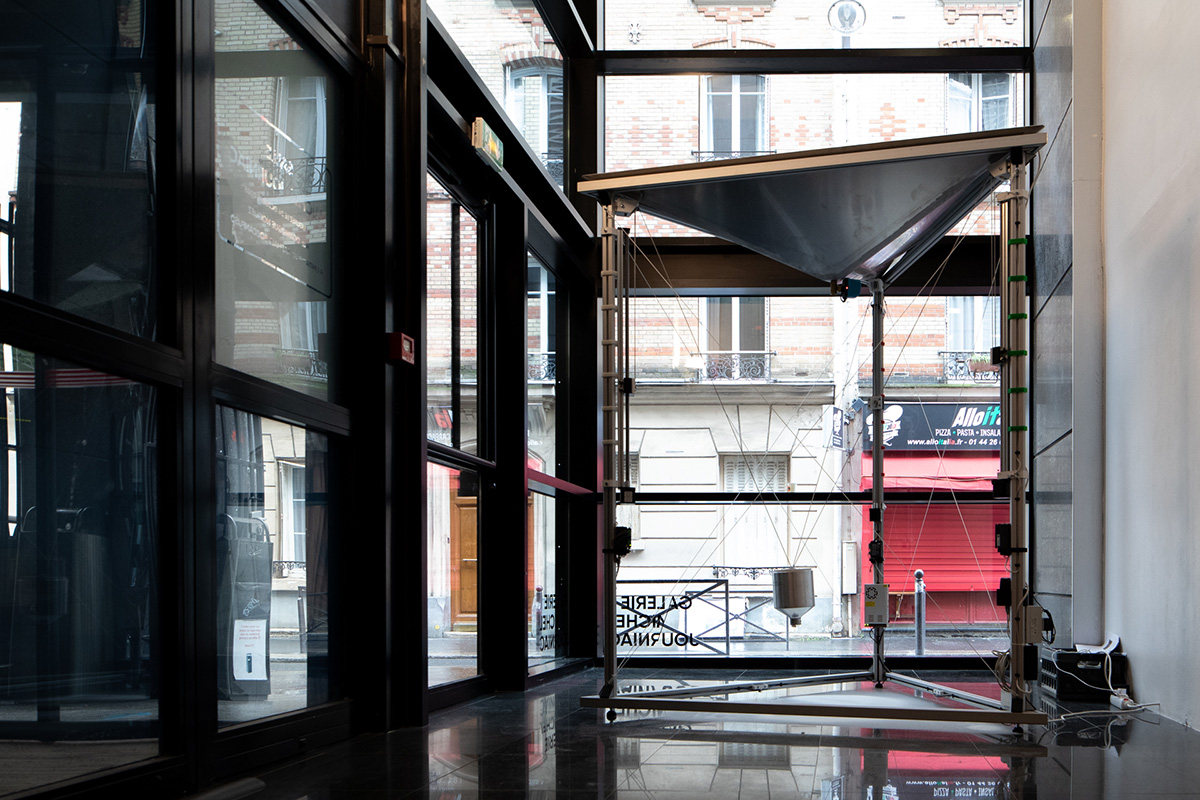
7.4.1 Apeiron: From Biofilm Eradication to the Emergence of Artificial Life
The artwork Apeiron was created in response to a private commission from the owner of the La Salle Blanche (LSB) factory in Apt, which designs and manufactures decontaminable furniture for clean rooms (laboratories and operating theaters). To protect the south-facing façade of the workshops from direct sunlight, the commission consists in installing a micro-perforated tarpaulin measuring 42 meters in length and 4.6 meters in height, printed each year with a different artistic proposal. In 2025, Apeiron inaugurates this ephemeral collection.

The image shows the facade of the fatory with the printed tarpaulin of the artwork.
While LSB’s furniture is designed to delay the appearance of biofilms and to facilitate their destruction on white surfaces, our artistic- scientific collaboration took an opposite approach, focusing on the spontaneous emergence of micro-cellular behaviors that model living systems through continuous cellular automata of the Lenia type.
At the intersection between destruction and the spontaneous creation of living cellular behaviors, the artwork consisted in designing a cellular automaton scaled to the dimensions of the printable surface and following the color codes of biofilm images obtained by fluorescence microscopy, notably by the Institut Pasteur: inert surfaces in gray, living cells in fluorescent green, and dead cells in red (see Figure 4).
8 Partnerships and cooperations
8.1 European initiatives
Participants: Jean-Pierre Merlet, Yves Papegay.
8.1.1 Other european programs/initiatives
- Hephaistos is part of the euROBIN, the Network of Excellence on AI and robotics that was launched in 2021.
8.2 National initiatives
- Hephaistos is part of the AMI EquipEx+ project TIRREX – Technological Infrastructure for Robotics Research of Excellence - dealing with XXL robots.
9 Dissemination
9.1 Promoting scientific activities
9.1.1 Scientific events: organization
Member of the organizing committees
- Jean-Pierre Merlet is a permanent member of the scientific committee of the CableCon conference.
9.1.2 Journal
Member of the editorial boards
- Eric Wajnberg is Editor-in-Chief of the international journal “BioControl” since September 2006, a member of the Editorial Board of the international journal “Entomologia Experimentalis et Applicata”, since 1996, a member of the Editorial Board of the international journal “Applied Entomology and Zoology”, since 2003 and a member of the Editorial Board of the international journal “Neotropical Entomology”, since 2009.
Reviewer - reviewing activities
- Eric Wajnberg is referee for about 60 international scientific journals. He is reviewing about 20 manuscripts per year.
9.1.3 Invited talks
- Jean-Pierre Merlet has been invited for one week at Bilbao University for presenting his work on neural networks and kinematics and to collaborate for its use for continuum robot (section 7.2.1).
- Jean-Pierre Merlet has been invited to the workshop Regards Croisés en SHS sur les Exosquelettes organized at Artois University, both to give a talk on robotics assistance device and to provide technical comments on the works of the human science community on the topic of exoskeletons.
- Jean-Pierre Merlet has been invited as a panelist during the conference CableCon in Hong-Kong and gave an invited talk during the workshop MOMI on Human Computer Interaction.
9.1.4 Leadership within the scientific community
- Jean-Pierre Merlet is a member of the IFToMM (International Federation for the Promotion of Mechanism and Machine Science) technical Committees on History and on Computational Kinematics. He is a member of the IFToMM Executive Council Publication Advisory Board and an IEEE Fellow.
- Jean-Pierre Merlet is a member of the advisory "Conseil des Sages" of GDR Robotique and participates to the GDR working group on “Frugality and sobriety”, whose purpose is to reduce the ecological impact of robotics.
9.1.5 Scientific expertise
- Jean-Pierre Merlet is a nominator for the Japan’s Prize and participated to the WAICF conference in Cannes where he has presented his work on neural networks (section 7.1.1).
- Yves Papegay is a member of the OpenMath Society, building an extensible standard for representing the semantics of mathematical objects.
- Eric Wajnberg is an appointed member of the Academic Committee of the Hebrew University of Jerusalem, an appointed member of the International Advisory Board of the “International Center for Excellence in Biological Control”.
9.1.6 Research administration
- Yves Papegay is the head of local CUMI (Committee of users of the numerical resources and tools).
- Odile Pourtallier is a member of local "Comité de Centre" and of the CUB (Committee of users of the offices)
- Within AGOS, the organization in charge of social welfare and employee benefits, Odile Pourtallier serves as the local secretary of the CGL, which is the Local Management Committee of AGOS. At the national level, she is a member of the executive board and is responsible for the AGOS Archives mission. This mission consists in defining the future of the AGOS archives since its creation, which are currently stored in Rocquencourt. Part of these archives will be used to document and write the history of AGOS from its origins. Odile Pourtallier is also responsible for the ‘AGOS Benefits’ working group. This group is in charge of redefining and harmonizing the subsidy and benefit policies implemented by all local CGLs, in order to ensure their consistency and their full compliance with URSSAF regulations.
9.2 Teaching - Supervision - Juries - Educational and pedagogical outreach
9.2.1 Supervision
- Jean-Pierre Merlet and Yves Papegay are supervising together the PhD of Clara Thomas , who just completed her second year by working on the use of the modularity of CDPR for green and mobility assistance robots.
9.2.2 Juries
- Jean-Pierre Merlet has been a member of a PhD defense jury at Paris Sorbonne University (Lê A., 2025/10/15)
- Yves Papegay has been a member of a PhD defense jury at Politech Angers (Remin, H., 2025/01/10)
9.2.3 Educational and pedagogical outreach
- Jean-Pierre Merlet has been one of the lecturer at the 5th Summer School on Singularities of Mechanisms and Robotic Manipulators.
9.3 Popularization
9.3.1 Productions (articles, videos, podcasts, serious games, ...)
- Jean-Pierre Merlet prepared an introductory tutorial to robotics using the ePoc mobile learning format, which is currently under test with end-users.
9.3.2 Participation in Live events
- In the scope of Inform@thiques.fr, Yves Papegay organized several School on Experimental Mathematics in July in Oxford, for high-school students, during high-school holidays.
- Yves Papegay animated two master classes (in French and in Romanian) for high school students, one in Spring in Pertuis (France) on Neural Networks, and one in Autumn on generative AI in Cluj-Napoca (Romania).
10 Scientific production
10.1 Major publications
- 1 articleInterval method for calibration of parallel robots: a vision-based experimentation.Mechanism and Machine Theory418August 2006, 929-944
- 2 articleChoosing measurement poses for robot calibration with the local convergence method and Tabu search.Int. J. of Robotics Research246June 2005, 501-518
- 3 inproceedingsEfficient kinematics of a 2-1 and 3-1 CDPR with non-elastic sagging cables.CableCon 2021 - 5th International Conference on Cable-Driven Parallel RobotsVirtual, FranceJuly 2021HALDOI
- 4 articleInterval Analysis and Reliability in Robotics.International Journal of Reliability and Safety32009, 104-130URL: http://hal.archives-ouvertes.fr/inria-00001152/en/back to text
- 5 inproceedingsMaximal cable tensions of a N-1 cable-driven parallel robot with elastic or ideal cables.CableCon 2021 - 5th International Conference on Cable-Driven Parallel RobotsVirtual, FranceJuly 2021HALDOI
- 6 inproceedingsMixing AI and deterministic methods for the design of a transfer system for frail people.Sophia IAsummitSophia-Antipolis, FranceNovember 2021HAL
- 7 bookParallel robots, 2nd Edition.Springer2005back to text
- 8 inproceedingsThe kinematics of cable-driven parallel robots with sagging cables: preliminary results.ICRA 2015 - IEEE International Conference on Robotics and AutomationSeattle, United States2015, 1593-1598HALDOI
- 9 inproceedingsUsing interval analysis in robotics problems.SCANTokyo, JapanSeptember 2018HAL
- 10 articleLes avancées en robotique d'assistance à la personne sous le prisme du droit et de l'éthique.Revue générale de droit médicaleDecember 2017HALback to text
- 11 phdthesisDe la modélisation littérale à la simulation certifiée.Université de Nice Sophia-AntipolisNice, FranceJune 2012, URL: http://tel.archives-ouvertes.fr/tel-00787230back to text
- 12 inproceedingsFrom Modeling to Simulation with Symbolic Computation: An Application to Design and Performance Analysis of Complex Optical Devices.Proceedings of the Second Workshop on Computer Algebra in Scientific ComputingMunichSpringer VerlagJune 1999
- 13 inproceedingsA Polynomial Time Local Propagation Algorithm for General Dataflow Constraint Problems.Proc. Constraint Programming CP'98, LNCS 1520 (Springer Verlag)1998, 432--446back to text
10.2 Publications of the year
International journals
National journals
International peer-reviewed conferences
Scientific books
10.3 Cited publications
- 20 articleModeling and control of a 5-DOF parallel continuum haptic device.IEEE Trans. on Robotics3952023back to text